


Poke your way past pungent piles of flowers stacked on the crowded Manhattan sidewalk, press the button and wait for the buzzer, climb the narrow staircase to the unmarked door on the third floor, and enter the headquarters of the news operation that helped bring down the attorney general of the United States. When Joshua Micah Marshall ’91’s Talking Points Memo blog won this year’s George Polk Award for legal reporting for his aggressive coverage of the firing of eight U.S. attorneys, readers could be excused for assuming that the stories that led to Alberto Gonzales’ resignation as the nation’s top law-enforcement official emanated from a sparkling, venture-capital-supported, startup newsroom, festooned with free snacks and state-of-the-art technology. Or perhaps those who regularly range around the hundreds of political blogs that clamor for attention during this election year imagined that Marshall’s TPM Media operated out of the proverbial pajama-clad blogger’s basement.
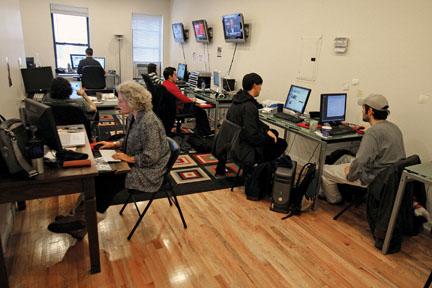
The truth smashes both stereotypes, revealing the romance and the harsh reality of the new media — and the precarious state of American journalism in this time of widespread cynicism about those who would dare to decide what constitutes the news. Marshall and 12 staffers and unpaid interns share a one-room walk-up on Sixth Avenue that is, to a visitor from a big metropolitan newspaper, shockingly small. Here, at the pinnacle of success in the political blogosphere, nine young writers and editors crowd around a single long glass table, their PCs and laptops jammed against each other as they monitor the cascade of information and images that accompany Americans through their workday. Three TVs on the wall above keep track of the cable news networks; every once in a while, when one of the channels covers a candidate’s speech live, the sound is unmuted and someone at the big table starts tapping out a brief commentary on the latest development.
Over the course of each long weekday during this historic presidential campaign, thousands of words flow out on the original Talking Points Memo (talkingpointsmemo.com) site — where Marshall blogs and his staff creates links to reporting by major newspapers and wire services, and by some of TPM’s own writers — as well as on four other home pages, featuring video clips (TPM TV, at tpmtv.talkingpointsmemo. com), original investigative work (TPM Muckraker, at tpmmuckraker.talkingpointsmemo.com), reader-generated commentary and discussions about politics, books, and ideas (TPM Café, at tpmcafe.talkingpointsmemo.com), and a compendium of political news and polling data (TPM Election Central, at tpmelectioncentral.talkingpointsmemo.com).
Marshall, who comes to work in jeans and flip-flops, presides over this stream of content from the back corner of the room, partially hidden from the fray by a bookcase, but always connected by the instant-messaging tool that links everyone in the room — and their managing editor, David Kurtz, who works out of his house in Missouri. (Kurtz was a reader who became a frequent voice on the site’s comment boards, which led to some blogging, which led to an executive post. Welcome to the blogosphere.) To those who grew up on movie images of loud and boisterous newsrooms, TPM seems more like a very strict library — for 20 or 30 minutes at a stretch throughout the day, not a single word is spoken. Robust conversation is constant, but almost entirely electronic. Every once in a while, the silence is pierced by a loud “Really?” or “I can’t believe that,” when a typed reply simply won’t suffice. An intern from American University, David Grossman, says he got a memo on his first day in the TPM office, saying, “Can you please keep the real chatter down so we can concentrate on messages?”
If the TPM newsroom sounds and looks different from its mainstream counterparts, what the 20-somethings here do all day bears some resemblance to what happens at The New York Times , your local newspaper, or your network affiliate. Reporters call sources, sift through documents, consult with experts, and seek to synthesize masses of information in an alluring and thoughtful manner. But this is a different animal, a new kind of journalism — one that turns to readers to do some of the work, has a clear political perspective, and reflects the personality of the site’s founder.
In an age of devastating cutbacks at newspapers and broadcast outlets that add up to a virtual dismantling of the nation’s traditional news-gathering capability, political blogs such as Marshall’s represent the hope that journalism will morph into something new — a faster, more interactive, more responsive iteration of the print and broadcast news businesses of the 20th century. Or will blogs succeed mainly in tearing down the existing news infrastructure, leaving us to wake up one day and realize that we have become a nation of commentators, with precious little original reporting on which to comment?
But wait: While three-quarters of all Americans use the Internet, only 70 percent of those employ it as a source of news. And only about four in 10 Web users read blogs, according to the Pew Internet American Life Project. Narrow even further: Not even a third of those blog readers check out political blogs — readers of the likes of TPM, Daily Kos, Huffington Post, Instapundit, and Just One Minute tend to be hyper-involved (and overwhelmingly white, male, well-educated, and well-off).
And so, despite rampant rhetoric among some readers about blogs stepping into the void left by our crumbling news infrastructure, Marshall makes no pretense of replacing the mass-market news media. “If newspapers start to close down, that’s horrific for journalism,” he says. “We can’t compete with The New York Times and The Washington Post . If they ceased to exist, it would be a catastrophe for us. They have 50 times more reporters; they’re sourced up. We narrate the arc of stories being reported by those and other news organizations, and we add original reporting on stories where we see a gap. Big, established organizations provide the surveillance to show us where to focus our resources. It’s not lost on me that most of what’s on the Web is not original reporting.”
But increasingly, young reporters gravitate to places like TPM because they’ve grown up reading and commenting on these sites. They believe blogs are journalism’s future. And even if blogs are no mass medium — about 150,000 people a day visit TPM, or 1.4 million unique users in a given month — political blogs collectively can boast that they increasingly generate the buzz that seems to be seeping out of the old-line media. The keys to that buzz are speed and video. On a lazy late-summer afternoon, news breaks about the indictment of Alaska Sen. Ted Stevens, who is accused of taking and hiding gifts from an oil firm in his home state. An hour before either the Times or the Post has a staff-written story on its Web page, TPM has aggregated news accounts and video clips, posted an analysis of how this news might alter Stevens’ re-election chances (on Election Central), and collected an archive of reporting from the Anchorage Daily News and TPM’s own reporters (on Muckraker).
“Nothing big should happen without us reflecting it within five minutes,” Marshall says. The idea is not to be a headline service, but to add perspective and point of view for an audience that expects instantaneous response. “We’re a hybrid of reporting, aggregating, commentary, and interactivity,” he explains. “The daily newspaper model, where every article is self-contained, creates a lot of discontinuity. We’re part of a more diverse news ecosystem. We’re not parasitic — we bring new social goods to the table.”
TPM’s size and resources limit just how much it can add to an unfolding story, but its audience is not necessarily looking for scoops. Rather, Marshall’s readers want a sense of community — they want the news, but they want it presented from a perspective they share. A Columbia Journalism Review profile of Marshall concluded, “Even if he and his colleagues decided to abandon original reporting entirely, TPM would probably still retain almost all of its audience.” But Marshall believes in reporting; it is not enough merely to opine, he says. The trick is figuring out just how to afford reporters in a form that is just emerging from the hobbyist’s basement.
Deputy publisher Andrew Golis — the only member of the TPM staff who works full-time on the business operation rather than producing content — steps over to Marshall’s desk with the crisis of the moment: With just a few weeks to go before the Republican Party’s convention, TPM has neither credentials nor a hotel room. The business has neither the money nor the desire to pay the premium rates hotels charge during a political convention. Marshall and Golis worry through the numbers, then talk about the myriad benefits of having a reporter sleep on somebody’s couch, nudging themselves toward an affordable solution.
“Can we turn the A/C back on now?” an intern pleads from the front of the TPM newsroom.
Josh Marshall is sweating profusely. He is also on camera. So he alternates between delivering a couple of sentences of his daily video commentary and toweling himself dry. It takes nearly 20 minutes for him to record his five-minute video, and throughout that time, so as to provide at least a modicum of production standards for viewers at home, the big, noisy air conditioner in the room’s front window must be turned off.
“Done,” Marshall finally announces, having blasted John McCain for flip-flopping on Afghanistan — and the mainstream press for failing to pick up on the story. “Go for it.” The machine groans back into action.
“This is an inherently unstructured kind of journalism,” says Marshall, who chose TPM’s headquarters because it’s near his apartment. “Structure” isn’t the first word that springs to mind when friends describe Marshall. They think of him as even more rumpled than your average iconoclastic reporter, short on charisma but boiling over with journalistic passion. Marshall admits he’s surprised to find himself in the rapid-fire world of instant journalism after he had set out on a more measured, academic path. He never intended to become the conductor of a round-the-clock symphony of information, egging on young writers to post five items each day, ideally peaking at midday to satisfy a nation of bored office workers looking for lunchtime diversion. A history major at Princeton, Marshall wrote his thesis on Virginia’s struggle over nullification — the ability of the states to reject federal law as unconstitutional — in the early 19th-century debate over states’ rights. Bitten with the history bug, he moved up the coast to Brown University, where he settled in to work on his doctorate. But academia turned out to be too slow, too confining. He stalled out on his dissertation — on relations between Indians and English settlers in 17th-century New England — though he came back to the topic years later and completed the work, earning his doctorate. One day his adviser, sensing Marshall’s struggle with the pace and scope of academic life, asked whether he was comfortable with a career in which he would write papers and books that might be read by 300 people.
“That just crystallized it for me,” Marshall recalls. “No, I needed more. I needed to be more in the world.”
Marshall “always pursued what he wanted with an unbelievable determination and fervor and was never held back by convention or expectations,” says his wife, Millet Israeli ’92, a lawyer who recently took a buyout at Dow Jones and now works part-time at TPM, taking care of legal matters and focusing on growing the business through advertising deals and partnerships. The two knew each other slightly at Princeton and reconnected more than a decade later, after Millet’s 10th reunion, when she “thought back on friends I had lost touch with and Josh’s name was the first to come to mind. I remembered him as incredibly unique, smart and intense.” Israeli says Marshall’s intensity and pace made it almost inevitable that he would reach for a broader playing field than academia.
Sure enough, while at Brown, Marshall began spending more and more time and energy on freelance magazine writing, focusing on the nascent debate over free speech on the Internet. That led to a job at The American Prospect , the liberal opinion magazine co-founded and co-edited by Princeton sociology professor Paul Starr. When the magazine moved from Cambridge to Washington, Marshall followed. There, in 2000, at the height of the chaos over the botched election count in Florida, he decided to try his hand at blogging, launching TPM a few months before he quit the Prospect .
While in graduate school, Marshall had started a business creating some of the first generation of Web sites for law firms, so he knew his way around code and Web design. That gave him a leg up on some other early bloggers, but it was Marshall’s embrace of “crowdsourcing” — the appeal to readers collectively to carry out reporting work that might take a single writer far longer to complete — that propelled him to the top ranks of liberal bloggers.
In 2002, when news broke about then-Sen. Trent Lott of Mississippi making pro-segregation remarks at a dinner honoring Strom Thurmond, Marshall asked his readers to flesh out the story. They dug up examples of other such comments Lott had made in the past, and Talking Points Memo had itself a dandy little scoop. Before long, Lott was history, and TPM was getting bookmarked on a lot of computers.
Traffic begat buzz, which begat advertising, which begat enough money that Marshall could stop hustling for freelance writing gigs. He wasn’t getting rich by any means, but in 2004, TPM became a business rather than a hobby. Marshall still didn’t have a sales staff — nor does he have one today, unless you count Golis, a 2006 graduate of Harvard who spends much of his time negotiating with Google, which feeds TPM many of its ads, and the so-called remnant bureaus, firms that sell ad space on a wide range of Web sites. And it wasn’t beneath the blogger to issue occasional appeals for donations, a practice he still doesn’t completely swear off. (Reader contributions have funded trips for reporters to cover presidential primaries, and even the hiring of reporters for Muckraker.)
“What we do to raise revenue is feeble,” Marshall says, but he takes a certain pride in TPM’s scruffy independence. He rebuffs all expressions of interest from outsiders looking to buy up successful blogs. “I like having complete control over what we do, and so far, the revenue is supporting us.” It helps that the interns are unpaid and most of the staffers — many of whom are just out of college — earn less than the national average household income of $48,000. “This is not a career place,” Marshall says. “It’s a place where you get experience.” Indeed, some TPM graduates are moving on to bigger and better-paying journalism jobs, at, for example, Pro Publica, the new, nonprofit investigative-journalism boutique that seeks to place its stories in major publications around the country; and at Huffington Post, the well-funded competing blog in a fancier part of Manhattan. “Hardly any of the people who leave here are going into the existing media structure,” Marshall says.
That could be in part because old mainstream news organizations aren’t hiring these days (though one TPM alumnus is now at ABC News), but it’s also because some TPM staffers come to the studio apartment on Sixth Avenue not only to be reporters, but to work toward a political goal — in this case, the center-liberal Democratic perspective that girds Marshall’s work. “Working here is a mix of activism and reporting,” says Golis. Marshall calls the TPM approach “our own version of objectivity.” Although the bloggers and most readers who comment on the site make no bones about their liberal persuasion, “our news blog should operate in a way that even a dyed-in-the-wool Republican could discern the facts separate from any point of view,” Marshall says.
He insists that Muckraker devotes at least as much of its bandwidth and reporting energies to wayward Democrats as to misbehaving Republicans. “We never try to hide our point of view,” he says, “but we have the grudging respect of the Republican campaigns.” Because TPM has no beat reporters, it has no ongoing relationship with the presidential campaigns. Still, the site’s writers generally get the cooperation they need (the only campaign that “never gave us the time of day was Rudy Giuliani’s,” Marshall says).
Like any writer, Marshall enjoys having an impact. And certainly his instinct to grab hold of the U.S. attorney firings story last year pushed TPM to a new level. Once again, Marshall turned to his readers as participants in the reporting process: When the Justice Department released 3,000 pages of documents that provided details of the Bush administration’s politicization of the selection of federal prosecutors, hundreds of TPM readers helped Marshall pore through the legal jargon and identify the most revealing passages. That collaboration, driven by Marshall’s own analysis and the sense of urgency he creates in his nearly 24/7 blogging, won him the Polk Award. (TPM “connected the dots and found a pattern of federal prosecutors being forced from office for failing to do the Bush administration’s bidding,” the award citation said.) It also got him back on the Justice Department e-mail list, from which TPM had been removed.
But Marshall remains wary of the price that journalism and society pay for mass media, which he says almost inevitably create a bland flow of information, bleached of point of view. To reach a mass audience, “you have to retreat from making judgments,” he says. Blogs may be boutique operations, but “the fluidity and instability of the new media are a civic plus,” he argues. “Things are less predictable for politicians, and that’s good. There are fewer choke points for information. The diversity of voices is a good compensation for the loss of a common narrative that everyone at the pub knows.”
But can blogs expand their journalistic impact without reaching for a much larger readership? Marshall is not indifferent to the fact that TPM’s audience “definitely skews affluent and educated,” Marshall says. Early on, it was “mortifyingly male,” though the gender mix has improved somewhat. The audience for political blogs, both left and right, had stagnated in the two years before the 2008 campaign sent readership numbers soaring. But with the end of the election cycle, that spike in traffic will disappear, and Marshall will be faced with this reality: Advertisers aren’t very interested in the hard-core users who live on the blogs; they want to reach a mass of people. To enlarge their audience, blogs must find ways to broaden their content, ideally without losing the intimacy and sophistication that won them a following in the first place.
Marshall is more interested in the journalism than in the business side of the operation, which is one reason his wife is diving into the work. Israeli believes the next phase in the evolution of blogs is for advertisers to shift large portions of their ad budgets to “nonmainstream digital media. Not only can they target the audiences they want to attract, but they can clearly get more bang for their buck — that is, more eyeballs on their ads for far less money than the newspapers and TV networks are charging. The younger audiences — the so-called Gen Y’ers — just don’t read newspapers, watch network television, or even go to the newspapers’ or networks’ Web sites at anything like the levels of people in their 30s and over.”
One way TPM is moving to reach a broader crowd is by adding a lot of video. And although the site’s focus remains firmly on politics, TPM also is attracting some of the country’s top literary voices to write essays on TPM Café. There’s no money in it for the likes of social critics Todd Gitlin and Richard Florida, fiction writers Mary Karr and Robert Stone, or political analysts such as Woodrow Wilson School Dean Anne-Marie Slaughter ’80, but they agree to mix it up with TPM readers because the level of debate is unusually high and the number of places where serious discussions of current books can occur seems to shrink by the month. (Writers also get to push their own books, a welcome advantage as newspapers close or slash their book-review sections.)
But although the all-consuming nature of round-the-clock blogging is a match for Marshall’s personality, he and Israeli have two children under the age of 2, and both parents crave some time at home. That has Marshall thinking about his blog, what it has become and where it might go.
“I’m intense,” he says. “I built this organization on intensity. But I don’t like the idea of a society built on intensity, where the only successful enterprises are those built on constant motion. I like what we do, but you also need the 10,000-word piece in The New Yorker and the beat reporter in The Washington Post .”
In 2005, Marshall started work on a book on Henry Hudson and other 16th- and 17th-century explorers of the Arctic. But TPM’s success and growth made it impossible to focus on a long project. Marshall hopes to go back to the book, even if he has to wait a decade or so to return to a slower, deeper kind of work. Pre-blog, as a freelancer for Washington Monthly , The Atlantic , and other magazines, Marshall relished the luxury of “being steeped in the reporting. Part of that I do miss. I’m no longer building the deep well of knowledge of new topics the way I did.”
Increasingly, the TPM brand stands on its own. This year, for the first time, some stories appear on the site without having been vetted by the founder. “It’s been at least my goal over the past couple of years to de-me-ify TPM,” Marshall says. He smiles self-consciously. “There are limits to that.”
Indeed, many readers still think clicking onto TPM is the electronic equivalent of a visit inside Marshall’s mind — and there is some truth to that image. Success on the Web is very much linked to personality, and Marshall’s achievement stems from his ability to package his political perspective and his faith in the power of reporting, mix in his passion, and produce a journalism that connects to its audience in new ways, yet remains, ultimately, intensely personal. TPM may have a national name, a burgeoning audience, and an energetic team of young journalists toiling away in their room above the flower shop, but it’s still Josh Marshall’s blog.
Marc Fisher ’80, a writer for The Washington Post , is the author of Something in the Air: Radio, Rock, and the Revolution that Shaped a Generation.