

“Some say the world will end in fire, some say in ice.”— Robert Frost.
It’s perhaps the scariest question one can contemplate. Will the universe die? Will all the planets, stars and galaxies in the cosmos, and all the myriad forms of life that they sustain, eventually cease to exist? Astronomers long have known that the earth is doomed; in about 5 billion years the sun will run out of hydrogen fuel and swell to gigantic size, vaporizing our planet. But will there always be new stars born from the ashes of their predecessors, and new planets for life to colonize?
Most cosmologists — the scientists who study the shape, structure, and history of the universe — are not very hopeful on this point. The universe has been expanding ever since the Big Bang started nearly 14 billion years ago. In the late 1990s researchers were shocked to discover that the cosmic expansion isn’t slowing down as they had expected. Instead, it’s speeding up. The implications are dire: If the universal acceleration continues, the multitude of galaxies that now pepper the night sky will recede from view. Our local group of galaxies — the Milky Way, Andromeda, and a few dozen lesser lights — will be surrounded by darkness, like a lone campfire in a vast black desert. In about 100 trillion years our aging galaxy no longer will have enough hydrogen to produce new stars, and the embers of our diminished universe will slowly cool and decay. After 10¹°° years — an unimaginably long but not infinite stretch of time — nothing will be left except an extremely diffuse scattering of particles. (Imagine one electron surrounded by billions of light-years of empty space.) This is the icy apocalypse that Robert Frost envisioned in his poem “Fire and Ice.” Or as T.S. Eliot put it in “The Hollow Men”: “This is the way the world ends, not with a bang but a whimper.”
In the past few years, though, some theorists have held out the promise of a fiery rebirth. Princeton University cosmologist Paul Steinhardt is one of the architects of the cyclic model, a hypothesis that challenges the conventional view of our universe’s beginning and makes very different predictions about its end. If the cyclic model is correct, the universe would stop expanding about a trillion years from now, then slowly contract for another 10 billion years. The contraction would be so gradual that the future inhabitants of our galaxy wouldn’t notice anything amiss except for a shift in the values of certain physical constants. “They would see that something strange was happening with the laws of physics,” Steinhardt says. “And then the universe would be blitzed with huge amounts of energy.” The result would be another Big Bang, injecting new matter and radiation into the cosmos and triggering a new round of expansion. All traces of civilization would be annihilated, but perhaps life could arise again in the next cosmic cycle.
Neither the fiery nor icy future seems particularly pleasant, but it would be nice to know which one we’re facing. Luckily, the clues to our ultimate fate may be all around us, hidden in plain sight. At the start of the Big Bang the universe was a hot, seething soup of protons, electrons, and photons (particles of light), but after 380,000 years the soup cooled enough to allow protons and electrons to form hydrogen atoms. The universe suddenly became transparent, and the primordial photons have been streaming across the cosmos ever since, appearing in present-day telescopes as a sea of radiation called the cosmic microwave background (CMB). Cosmologists now are using ever more precise instruments to examine this radiation because it offers a snapshot of the universe in its infancy, with intricate fluctuations that may reveal exactly how it was born and how it might die.
Princeton has a special connection to the CMB. In 1964, a group of researchers in the University’s physics department — including Robert Dicke ’39, Jim Peebles, David Wilkinson, and Peter Roll — was preparing to build an instrument that could detect the primordial radiation. They were gathered for a lunchtime meeting when Dicke got a phone call from Arno Penzias, a Bell Labs scientist who was trying to find the source of some odd static he’d picked up with his laboratory’s radio antenna in nearby Holmdel, N.J. Dicke quickly realized that Penzias had discovered the CMB. After he hung up the phone, he turned to his colleagues and said, “Well, boys, we’ve been scooped.” (Penzias and his Bell Labs co-worker Robert Wilson later received the Nobel Prize.)
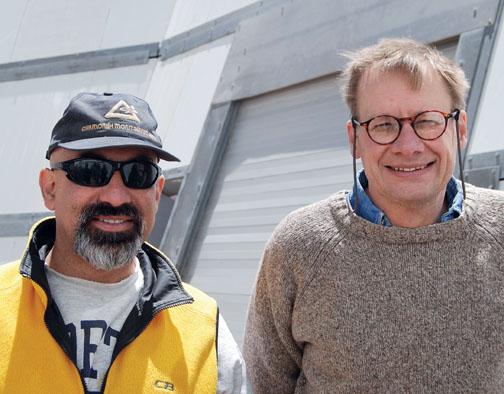
In the following decades, however, Princeton researchers made up for the scoop by participating in several studies that investigated the properties of the CMB. The first measurements of the radiation indicated that it was isotropic — that is, all the photons shared a temperature of 2.7 kelvins (2.7 degrees Celsius above absolute zero), no matter which direction they were coming from. This finding suggested that the primordial soup of the infant universe was almost perfectly smooth. But in the early 1990s a NASA satellite called the Cosmic Background Explorer found slight variations in the CMB’s temperature: The photons coming from some spots in the sky were a few ten-thousandths of a degree hotter or colder than the photons coming from other spots. In 2001 NASA launched the Wilkinson Microwave Anisotropy Probe, which made even more detailed observations of the CMB from a parking spot in deep space known as the L2 Sun-Earth Lagrangian point, nearly a million miles from our planet. The probe was named in honor of David Wilkinson, the Princeton cosmologist who died in 2002. The mission’s science team includes Lyman Page and Norman Jarosik of Princeton’s physics department and David Spergel ’82, now the chairman of the astrophysics department.
Although the Wilkinson probe still is collecting data, its results already have revolutionized cosmology. The observed CMB temperature fluctuations closely match the pattern predicted by the theory of inflation, which was developed in the 1980s to address the paradox of the universe’s smoothness. At that time, scientists couldn’t understand why widely separated parts of the universe look so much alike; because there is no mechanism that could mix such a vast cosmic soup, researchers had expected it to be a lot lumpier. Cosmologists tried to solve the problem by proposing that in the first moments of the Big Bang, something called the inflaton field triggered an ultrafast expansion of the universe that swiftly stretched microscopic volumes into smooth, flat expanses of space. The theory predicted, however, that the early universe wouldn’t be perfectly smooth. The brief epoch of inflation would leave a distinctive pattern of high- and low-density patches in the primordial soup — which correspond to the hot and cold spots in the CMB — and the high-density patches later would evolve into the galaxies and galaxy clusters that we see today.
The CMB observations support this hypothesis, but not all cosmologists are convinced that inflation jump-started the universe. The theory has a few holes in it. First, scientists don’t know what the inflaton field is, much less why it appeared when it did or what existed before it came on the scene. Second, one of the consequences of the theory is that inflation must be an ongoing, never-ending process — the inflaton field generates an infinite number of universes, each emerging like a bubble from a glass of champagne. As a result, the theory can’t explain many of the properties of our own universe, except to say that they arose by chance.
In an effort to give inflation a firmer footing, some researchers have tried to derive the hypothesis from string theory, the proposed “theory of everything” that attempts to unify all the forces of nature. Professors and graduate students from Princeton and other universities wrestled with this problem at a conference titled “The Big Bang and Beyond” that was held at Jadwin Hall last October. As the cosmologists scribbled equations on the blackboard of the colloquium room and continued the abstruse discussions in the faculty lounge while slurping tea and gobbling cookies, it became clear that merging inflation with string theory would be a formidable task. Moreover, the inflationary models don’t explain why our universe is now expanding at an accelerating pace. Cosmologists use the term “dark energy” to describe the unknown agent that is causing the acceleration, but the phenomenon remains just as mysterious as the origins of the Big Bang.
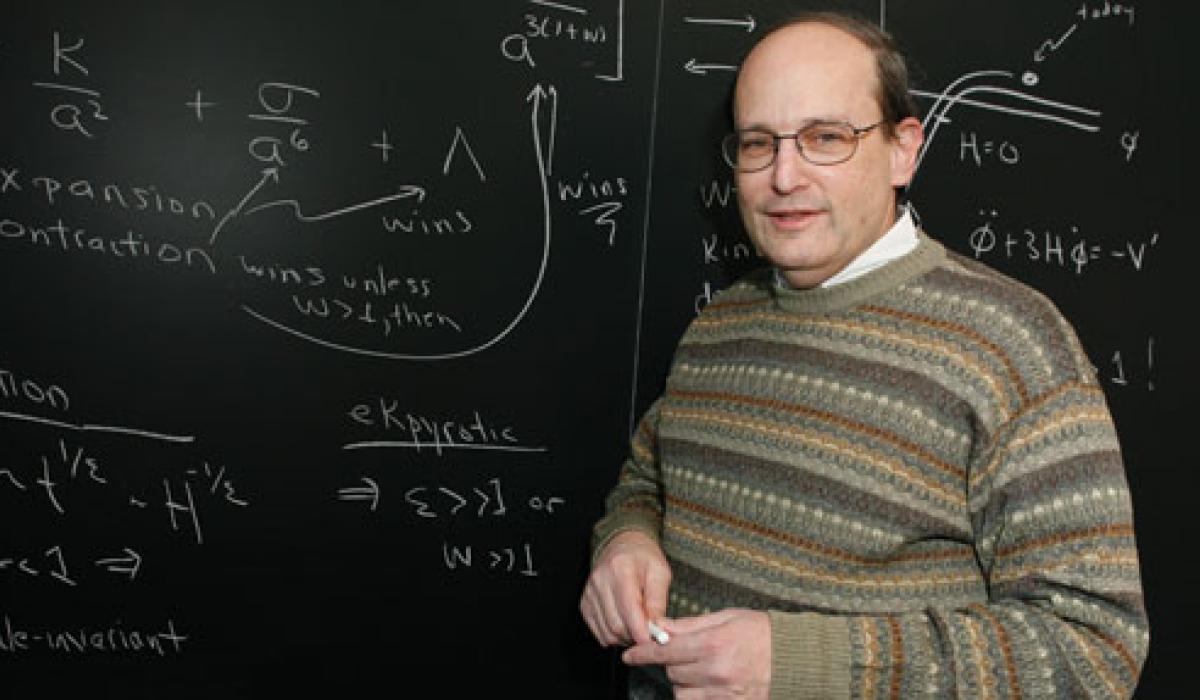
Steinhardt, who helped develop the theory of inflation during the 1980s, is now skeptical of that hypothesis. Although he doesn’t fit the conventional image of a scientific rebel — he’s an easygoing professor with a tidy office in Jadwin Hall — he has a feisty, independent spirit. In 2001 he and Neil Turok of Cambridge University published their first paper on an alternative to inflation called the ekpyrotic model. (Ekpyrosis is the Greek word for conflagration.) The model was inspired by string theory, which posits that the fundamental particles and forces actually are minuscule strings vibrating in extra dimensions of space that we can’t perceive. In one variant of the theory, most of the strings in our universe are attached to a three-dimensional boundary called a brane. Although these strings are stuck to the brane like magnets on a refrigerator, the brane itself can travel through the extra dimensions. But gravity also can extend into the extra dimensions, which raises the possibility that one brane could attract another. When Steinhardt and Turok considered what would happen if another brane collided with ours, they found that the impact would infuse our universe with energy and force it to expand — an event that looks very much like the Big Bang. And because the branes would ripple slightly as they approached each other, the collision would produce the small fluctuations in density observed in the CMB studies.
Better yet, Steinhardt and Turok later realized that their alternative hypothesis also can explain cosmic acceleration. After the collision the branes would bounce apart, but they would still be gravitationally attracted to each other, and this attraction would speed up the expansion of our universe. Eventually the branes would stop moving apart and hurtle toward each other again, causing a slow contraction of our universe and finally another Big Bang. Then the cycle would repeat indefinitely, with the branes clashing like a pair of cosmic cymbals. This updated version of the hypothesis, which was renamed the cyclic model, is quite different from the earlier idea of the Big Crunch, in which the universe would collapse under the force of its own gravity. In the cyclic model, the matter in our universe doesn’t re-concentrate; rather, the gravitational field between the branes periodically pumps new energy into our cosmos.
Of course, there are reasons to be skeptical of the cyclic model, too. Researchers can’t say exactly what happens at the moment when the branes collide. And, as with eternal inflation, theorists aren’t sure whether the cycling had a beginning, and if so, what could have started it. Still, the cyclic model appears to be a viable competitor to inflation. Best of all, the rival theories make different predictions about the detailed characteristics of the CMB, and upcoming observations of the radiation may soon determine which hypothesis is closer to the truth. Princeton cosmologists are taking a leading role in these studies, and even some undergraduates have joined the effort by focusing their junior papers and senior theses on the distinctions between inflation and the cyclic model.
One of the most important distinctions involves something called non-Gaussianity. Most inflationary models predict that the temperature fluctuations in the CMB should be very close to Gaussian — that is, the probability distribution of the fluctuations should follow the classic bell-shaped curve, with virtually equal numbers of hot and cold spots (no matter how big or small the spots are). The cyclic model, however, would produce a slightly lopsided, non-Gaussian distribution, with more cold spots than hot. The results from the Wilkinson probe have not yet shown convincing evidence for non-Gaussianity in the CMB, but this year the European Space Agency plans to launch a spacecraft called Planck that will deliver a more fine-grained map of the temperature fluctuations. If their distribution turns out to be more non-Gaussian than inflation predicts, the case for the cyclic model will be strengthened.
Another way to test the hypotheses is to look for signs of gravitational waves in the CMB. According to Einstein’s theory of relativity, when a mass accelerates in a certain way, it creates ripples in the surrounding space, just as a stone thrown into a pond creates ripples in the water. If inflation triggered the Big Bang, it would have released a flood of gravitational waves that would have polarized the CMB. (Polarized light is oriented in a particular direction; polarized sunglasses reduce glare by filtering out horizontally oriented light.) Because the cyclic model would not produce such strong gravitational waves, the detection of this kind of polarization in the CMB would be compelling evidence for inflation. Unfortunately, the Planck spacecraft cannot identify this elusive polarization signal, but cosmologists may be able to search for it using new telescopes controlled from the ground and carried by balloons.
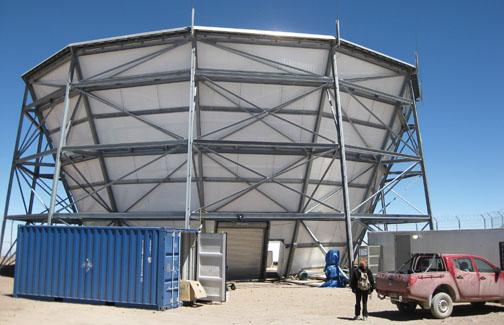
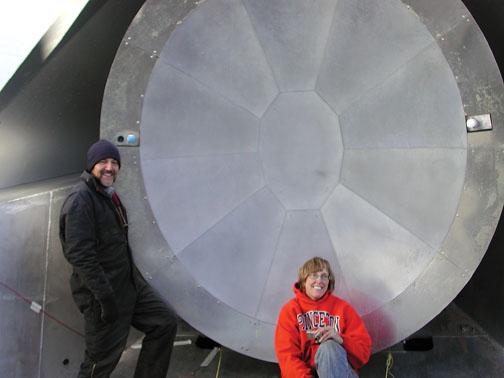
Fresh from their success with the Wilkinson probe, Spergel, Page, and several other Princeton researchers are now analyzing data from the Atacama Cosmology Telescope, a microwave observatory on a mountain called Cerro Toco in the Atacama Desert of northern Chile. It’s the highest fixed telescope in the world, situated at an altitude of 17,000 feet to minimize the interference from microwaves emitted in the atmosphere. The site is so high that oxygen deprivation is a job hazard for the professors and grad students who run the telescope; they usually stay on the mountain for only six hours at a time. “If I stay up there any longer, my brain slows down a bit,” says Joseph Fowler, a cosmologist in Princeton’s physics department. “I start to lose my energy and alertness.” The hard drives that store the telescope’s observations — about 1,000 gigabytes are collected every four days — must be kept in pressurized boxes because the drives would crash in the thin air. The flood of data is too torrential to be transmitted over the Internet, so the researchers retrieve it using a method that Fowler calls HDOA: Hard Drives On Airplane.
Unlike the Wilkinson and Planck spacecraft, the Atacama telescope doesn’t provide full-sky maps of the CMB, but it offers better resolution for the sections it scans, measuring temperature fluctuations as small as one arc-minute across (one-sixtieth of an angular degree). At that scale, researchers expect to see subtle changes in the CMB caused by the passage of the primordial photons through and around the galaxy clusters that have formed since the radiation was emitted. The results may help cosmologists chart the development of the clusters and determine when dark energy began to accelerate the expansion of the universe. Meanwhile, another team from Princeton, led by Suzanne Staggs *93, is contributing to the design and construction of a microwave telescope called QUIET that soon will begin operating at a nearby site in the Atacama Desert. QUIET will measure the polarization of the CMB, concentrating in particular on a signal that would be generated by inflationary gravitational waves.
Other Princeton researchers are pinning their hopes on a balloon-borne observatory called Spider that will observe the CMB while floating through the upper atmosphere. Bill Jones ’98, an assistant professor in Princeton’s physics department who worked on the design of the Wilkinson probe when he was a Princeton undergraduate, says Spider is scheduled to go on a qualifying flight above Australia in the spring of 2010. If that flight goes well, Spider will embark on a 45-day mission in 2011. Its instruments are designed specifically to look for the polarization from gravitational waves. And because Spider will cruise at an altitude of 85,000 to 110,000 feet — well above the thickest part of the atmosphere — the observatory will get a clear view of the CMB across 60 percent of the sky.
The fact that so many scientists are studying the CMB is a reflection of how much cosmology has changed in the past 20 years. A field that once was dominated by blue-sky thinkers — the kind of theorists who delight in constructing elegant mathematical frameworks for the universe — is coming down to earth. The precise observations from new telescopes are putting more and more constraints on cosmological theories such as inflation and the cyclic model. Theorists can try to tweak these hypotheses so that they fit the new data, but eventually the weight of evidence will rule out one of them -- or perhaps both. “That’s the way things are supposed to work in science,” says Steinhardt. “Nature will tell you that it’s time to move on.”
Spergel, who is familiar with both the theoretical and observational sides of cosmology, believes that some questions about the universe may be easier to answer than others. Over the past decade scientists have firmly established our universe’s size (infinite), shape (flat) and age (13.7 billion years), and in the next 10 years researchers finally may determine the nature of dark matter. This mysterious material, not to be confused with dark energy, never has been directly observed because it doesn’t emit or absorb light, but most astronomers believe that it pervades and surrounds all galaxies, which would fly apart at the seams if not for dark matter’s gravity. Theorists have proposed several exotic particles as candidates for dark matter, and researchers are hunting for their fleeting signatures with the help of particle accelerators, underground detectors, and spacecraft observatories. But dark energy, Spergel believes, won’t be as easy to pin down. “We need a lucky discovery to figure out dark energy,” he says. “We need another hint.”
Learning how the universe began and how it may end would be an even bigger prize. Although inflation and the cyclic model can explain an impressive number of observations, Steinhardt acknowledges that both theories could be wrong. But the fact that researchers can use astronomical observations to test these ideas is encouraging. “I don’t see how you can’t be fascinated by the fact that we can do measurements to decide the issue,” he says. “We don’t have to leave it to philosophical discussion. And that’s amazing.”
Mark Alpert ’82 is a contributing editor at Scientific American and the author of Final Theory (Touchstone, 2008), a thriller about Albert Einstein and the search for the “theory of everything.”