

Here’s a question of the tantalizing would-you-rather variety: If you could live on an island with the most beautiful man or woman in the world and never die, or you could go home, knowing that doing so meant you would suffer and eventually die, which would you choose?
That’s the choice the sea nymph Calypso offers Odysseus at the end of the seven years he spends on her island. It’s also the bait that Steve Fallon ’76 and Clark Power use to entice students into the World Masterpieces Seminar they teach at the South Bend (Ind.) Center for the Homeless. Not that it takes much persuading. At the start of each term the two friends — both are professors and volunteers — appear at the center’s weekly residents meeting and tell the story of Odysseus and his wanderings. After a discussion period that’s short but always lively — who in this unusual audience can’t relate to a man struggling to get home? — they leave the residents with the Great Books equivalent of those old Saturday matinee cliff-hangers: Well, which would you choose?
“We often hear that they feel as far from home as Odysseus does — that home is there, but inaccessible,” says Fallon. “What surprises me always is how quickly they make up their minds. Very, very few people have ever said, ‘I’d rather stay on the island with Calypso.’ There’s usually an immediate groundswell of the idea that one isn’t really living if one is hiding away from problems.”
“Oh yes, I could relate to that struggle,” says 42-year-old Danae Wood, who is in her third year of sobriety after years of smoking cocaine. One thing Wood longed for during her struggle was something most Princeton alumni would take for granted: “I always wanted to be part of a book group,” she says.
The World Masterpieces Seminar has been running for 12 years. Fallon and Power, each of whom has served as chairman of Notre Dame’s Program of Liberal Studies, offer three different units of the course each year. In the fall the theme is “Justice and Tyranny,” in the winter it’s “Self Discovery,” and in the spring, “God and Nature.” They’ve compiled an incredible reading list: not just Homer, but Plato, Sophocles, and St. Augustine — the Confessions seems to be a favorite — on through Machiavelli, Shakespeare, and Milton, and up to modern writers like Lincoln, Frederick Douglass, Freud, and Martin Luther King. Take all three units, and you’d have sampled many of the world’s greatest writers and thinkers.
Not that every text has worked. With some classes they read Hobbes; with others, they judge him too difficult. And much as Fallon loves Thucydides, he, too, has been dropped from the syllabus.
Despite that, Fallon insists that the students he’s met at the center are not so different from the undergrads he teaches a few miles away, at the university. “Our best students in the center are like our best students [at Notre Dame],” he says. “I don’t see any dropping off.”
Indeed, if there’s one thing Fallon has learned in those dozen years of working with the homeless, it’s this: “The homeless have great potential. They are not a problem, but a resource.”
A generation ago, it would have seemed unimaginable for a college town like South Bend to have a large homeless population. Once a thriving manufacturing center, South Bend still has neighborhoods populated by the grandchildren of those who came to work at the Singer factory or for General Motors at its big RV plant a dozen miles east, in Elkhart. But that steady hourly work has dried up, and at an accelerating pace of late. The town is hoping to rebuild itself through nanotechnology, but that’s still off in the future. South Bend, situated as it is on the corridor from Detroit to Chicago, finds a lot of people washing up on its streets, drawn, at least in part, by the center’s reputation for treating the homeless with kindness and respect. “In the back of my mind, I always knew I could come to the center and have a place to stay,” says Wood.
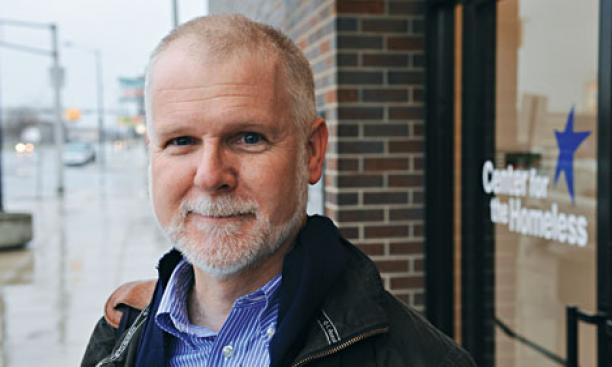
The homeless center sits on a corner on the south side of downtown in a former industrial neighborhood that feels tired and empty. Inside, though, the place bustles with activity. Each night 200 people sleep at the center, which serves three meals a day, every day of the year. Twenty-two families were living there in mid-March. Jacqueline Kronk, who handles public relations for the center, offers the sobering statistic that the average age of the homeless population in America is now 7. There’s a doctor on the premises, as well as the only Montessori School in the country for homeless children. One center rule is that residents are to be referred to as “guests,” and each guest, whether 7 or 70, is assigned a “coach” who oversees his or her trek back into society. It seems to work: The center has a 71 percent success rate in finding jobs for guests who complete its STAR (Skilled, Trained, Able, Ready) program in job readiness.
Ashley Gibson is a 51-year-old former long-haul trucker who came to the shelter after going through rehab for a crack-cocaine addiction. On the night he decided he’d finally had enough, he had bought and shared nearly $3,000 worth of the stuff at a drug mart in Gary. He padlocked his truck and walked 10 miles to a rehab facility. There was no room for him that night, but he was given $8.75, the exact bus fare to another facility, in South Bend. Having completed rehab, he has come to the homeless center with the hope of returning to the life he knew before addiction. He grows teary trying to describe the debt he feels he owes to the center and to his coach. It was the coach who suggested he sign up for the Masterpieces class, a big step for someone who, upon finishing Manhattan College, vowed he would never read a book again. “I’m reading for purely selfish reasons,” he says. “To rejuvenate my brain cells” — via Shakespeare and Montaigne.
You don’t have to be particularly cynical to wonder if reading Homer is the most practical way for a homeless addict to re-establish his life. Years ago, when a reporter from The New York Times came to do a story on the class, he asked the obvious devil’s-advocate question: Wouldn’t it be better for someone like Gibson to spend his time learning to write résumés, sitting through mock job interviews, or knocking on doors?
“Luckily, they’re already getting all that at the center,” says Fallon. What is harder to come by, he says, is the confidence and self-respect that fade away in the face of an overpowering addiction. “What we’ve seen in some cases is a flowering and blossoming of self-confidence,” he says. “You hear it again and again: I never thought I could do this.’”
He brings up Carmen Ware, an elderly woman in one of the early classes who spoke up jubilantly one day: “I never thought I’d be reading Shakespeare; I never thought I’d be reading Plato. Here I am at the University of Notre Dame, and I think I can do anything!”
Not all the students reach that point. One very promising student died of a heroin overdose; others simply disappear. The term usually starts with 15 or so students, but dwindles to perhaps half that by the end. Danae Wood is one of the happy dropouts. She had just gotten a job with a cleaning company. For now, her schedule conflicts with the class, but she hopes to rejoin when it changes.
Fallon and Power started the Masterpieces class in 1998, after casting about for a way to serve the community. Notre Dame’s Liberal Studies program sends many graduates out to perform “good works” in far-flung corners of the world and also to the center, which rents its building from the university for a token $1 a year. The two friends were eager to do something themselves. “For us, it was part of the Catholic ‘preferential option for the poor,’” says Fallon. “But I also had Prince-ton’s sense of service in mind. What could I do to serve?”
Habitat for Humanity was out, since both men were lousy with hammers. As an undergraduate, Fallon had tutored inmates at the Garden State Youth Correctional Center in Yardville, N.J., outside Trenton. He still recalls his “amateur sociologist’s” sense that his students there, like the ones he meets at the center, fell into one of two categories: either they were too smart to have had their imaginations fired by high school or they found the work too challenging and gave up, demoralized. The smart ones were very smart indeed, making him keenly aware of his own good fortune in receiving a great education. Education, and not merely technical education, but education in the humanities, is “too valuable to be restricted to those who can spend four years at Princeton or at another college,” Fallon says. “Education is a privilege, but it should not be restricted to the privileged.”
He did not have to look far to find a glowing example of how he might share his own education with others. Fallon’s late wife, Nancy, had been teaching a Great Books program for children, and she had approached the center about starting a book club for mothers and children. After listening to her husband and Power bat around ideas for a useful and viable service program, she called their bluff: “Are you two going to do something, or just talk?”
They found inspiration in an article in Harper’s by the activist-educator Earl Shorris in which he described his work bringing great books to marginalized people. Shorris had asked a woman in prison what she would do to combat poverty. “Show them the moral life of downtown,” she replied, meaning, give them access to the same sort of inspiring culture that the rest of society enjoys. “Now we had a model,” says Fallon.
The two professors faced skepticism from colleagues who admired their ambition but doubted whether this population could handle such complicated texts. “We didn’t think that was true, but we held our breaths when we started teaching,” admits Fallon. They also wanted to award credits from Notre Dame (which waived tuition fees) to those who completed the course. That took further negotiation, but those who complete the seminar — which means not just attending and contributing, but also writing an essay — get one credit per class, a source of great pride to the students.
On a March night the students sit at desks in a circle in the center’s big upstairs classroom, waiting for the first of three classes on Hamlet to begin. “The movie was good,” offers Omar Morris, a 39-year-old electrician by training, referring to the Mel Gibson version, which they’d all watched to get a basic idea of the plot. “The book ... not so much.”
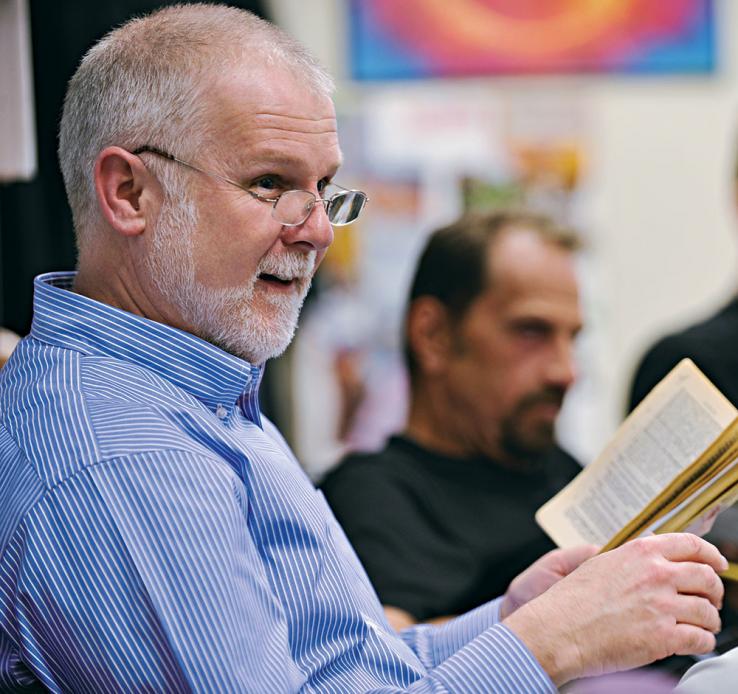
Shakespeare’s language seems to have flummoxed everyone, which may explain why only five students, all men, have shown up. It feels as if the next 90 minutes are going to be a tough slog. Not to worry. Fallon is one of the top Milton scholars in the world, having written several highly praised books on the poet (most recently Milton’s Peculiar Grace) and edited, along with William Kerrigan and John Rumrich, The Complete Poetry and Essential Prose of John Milton, a Modern Library edition. Still, it’s teaching that gives Fallon the greatest pleasure. He has won Notre Dame’s Charles Sheedy Award for Teaching, given to the best teacher in the College of Arts and Sciences — and even in a class of Shakespeare-phobes, it does not take Fallon long to show his students why. He is an enthusiast, unselfconsciously eager and endlessly supportive. As students make their points, Fallon’s blue eyes widen and he nods his head in a crescendo of excited encouragement. He employs the same Socratic approach he uses with Notre Dame undergraduates: “They pose a question and we all get a turn at it,” says Wood. “They really want to know what we think and what we get out of the reading.”
Fallon begins the Hamlet class by talking about iambic pentameter, which, he tells the students, is the meter closest to the rhythm of normal human speech. He then describes an intriguing technique he’d been shown in graduate school by the great Shakespearean actor Ian McKellen. The trick, if that’s what it is, is to wait out the full five beats of each line even if there are no words to deliver. So, the play’s opening line, “Who’s there?” gets followed by four iambs worth of silence.
Fallon asks Ashley Gibson and Kelly Hughes, a goateed and muscular Gulf War veteran of 41, to take the parts of Bernardo and Francisco, the two sentries who speak the play’s opening lines. It takes a few minutes for the men to get the hang of the herky-jerky rhythm. But when they do, there are wide smiles of pleasure and recognition.
“Shakespeare is writing out stage directions through his poetry,” Fallon tells them. “What’s the effect of all those pauses? What kind of scene does it yield?”
“Of suspicion, uncertainty, fear,” Gibson replies.
Whatever concerns there might have been that Shakespeare’s language would kill the class vanish. Everyone seems to have opinions. Fallon walks them through a number of questions about the play: What kind of families are these in Elsinore? How does Hamlet talk to his mother? Is she complicit in her husband’s murder? How does Hamlet talk to Polonius?
“To Hamlet, Claudius is like a circus clown juggling balls,” says Gibson. “And he’s just waiting for them to drop, so he can spring in on him.”
“Wow! That’s brilliant!” Fallon cheers.
Fallon’s deft touch and ability to draw students out continues to amaze his friend Power, who specializes in moral and developmental psychology. “He communicates genuine puzzlement,” Power notes later. “Obviously, he has his own views, but he convinces us that it would be worthwhile to solve whatever the puzzle is.”
“See why I love coming to this class?” whispers Gibson, a huge smile on his face.
It’s clear that the students revel in this chance to discuss important ideas and, even more, to have two respected Notre Dame professors listen as carefully as they do. What’s not so obvious is how much the two teachers take from the class. Fallon has faced some difficult times over the last 10 years. In the winter of 2000 Nancy Fallon died suddenly, at 44, from an aneurysm of the descending aorta, a rare condition. Fallon was in a classroom, teaching King Lear, when someone came to give him the awful news. Suddenly he was a single father to three children, at least two of whom would follow their dad to Princeton: Sam ’08, who is now studying at Oxford on a Fulbright; Claire ’10; and Dan, who has been accepted to the Class of 2013. It took Fallon some time to return to the classroom and even longer to get back to research and writing. Eighteen months later, on Sept. 11, his older brother, Bill, a Port Authority executive, died in the north tower of the World Trade Center.
Fallon says he had “great support” both at Notre Dame and at the homeless center. The support from those at the center was especially meaningful, because “these are people, in most cases, to whom tragedy was not a stranger. They had lost family, lost friends. And they were so clearly moved by what had happened to me. In some ways I felt it was a kind of acceptance, of being brought into the group.”
Those who teach Sophocles or Shakespeare do so with the assumption that great art teaches something of lasting value. But what are the consolations of philosophy, really, in the face of such devastating events? Is it some ineffable wisdom in the texts that helps us bear the unbearable? Or is it simply the passing of time as we make our way through them? “I did find comfort in the texts,” says Fallon. “I also understood them viscerally, in a way that I hadn’t before.”
He says he never can read King Lear without remembering the terrible day his wife died, but he believes he is a better teacher for having gone through that. “It made me more empathetic, more sensitive to the trials that other people are going through,” he says. “In teaching, you can be so caught up in the texts and making sure the class is going well, that you don’t notice the person in the class who’s unusually quiet.”
And just as the world surprises us in awful ways, it sometimes surprises us in ways that are joyful. Fallon met Joan Wulff online in 2002 when, he says, they were “mutually intrigued” because both were widowed after very happy marriages. For three years they dated long distance — it’s a 208-mile round trip from South Bend to Oak Park, Ill. — and when they married in 2005, the priest joked that they were doing so only to save themselves the tolls on I-80. Fallon now has two stepchildren, Anna and Martin Duchossois.
The Masterpieces seminar is going well, too. An actor visited for the second Hamlet class, and in April the class was scheduled to attend a showing of the 1950 Japanese film Rashomon. Fallon and Clark are hoping to raise what seems a modest endowment — enough to generate about $10,000 a year — for books, tickets, and transportation to cultural events, and for a part-time administrator. Fallon says an endowment would provide resources to follow up with those who have taken the course. “The question we always get is: What happens to these students afterward? The simple answer is that in some cases we know, but in the vast majority we just don’t know.”
The sad fact is that we are likely to see more homelessness, not less. Kelly Hughes has a job at a resource center in town, the Homeless Community Alliance, helping other homeless people locate birth certificates and obtain drivers’ licenses. He says, “What really stings is that with this recession putting people out of work, homeless people actually sink lower.”
In his class on Hamlet in March, Fallon ends the discussion by reading aloud the speech that begins with Hamlet lauding Man as “noble in reason” and “infinite in faculties” and ends with him asking, “What is this quintessence of dust?” Perhaps the very existence of the Masterpieces class suggests an answer. The students might have lost everything else in their lives, but they still hunger for ideas — which Fallon and Power feel honored to share with them.
Merrell Noden ’78 is a frequent contributor to PAW.