
For the Class of 2009, senior year was marked by economic turmoil. A few days after fall classes began, Lehman Brothers failed, markets plummeted, and job prospects on Wall Street and elsewhere began to vanish. On the morning of Class Day, near the academic calendar’s other bookend, the soon-to-be-graduates gathered for a few hours of levity on Cannon Green while executives in New York announced the bankruptcy of General Motors.
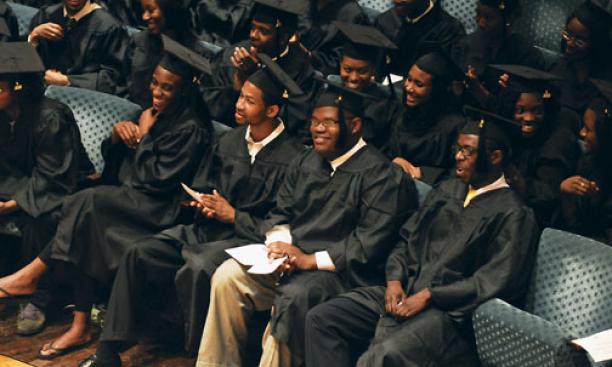
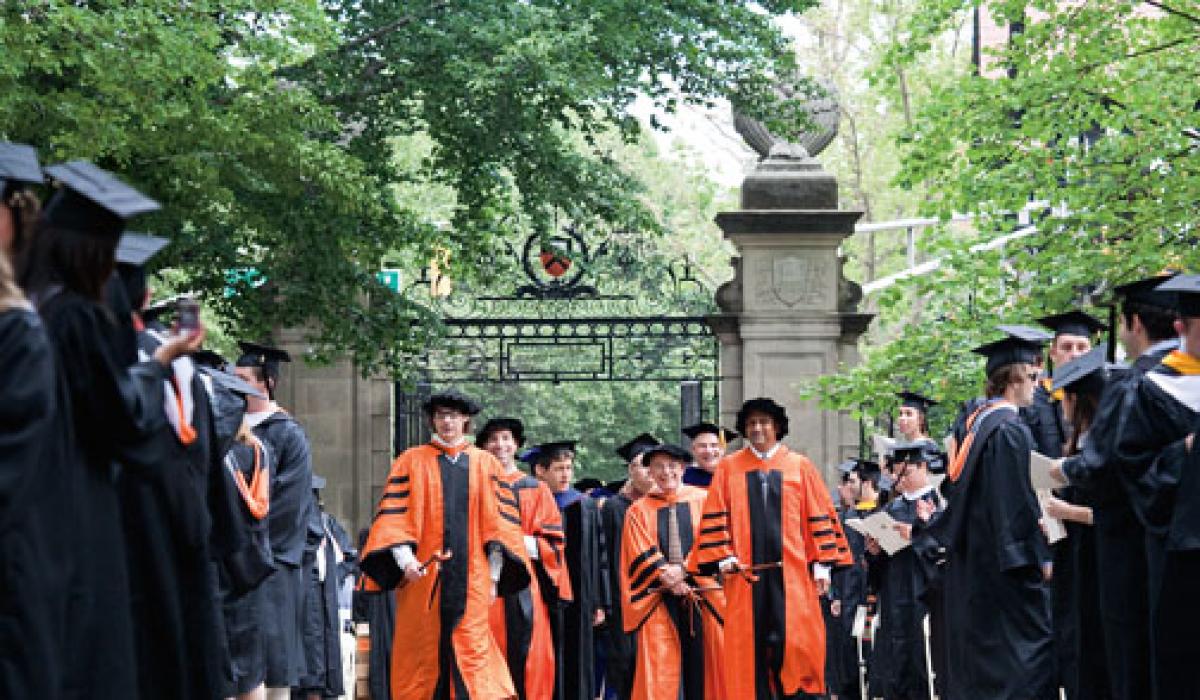
So it was no surprise that when 1,121 graduating seniors and 753 Ph.D. and master’s degree students gathered for Commencement June 2, two of the prominent speeches mentioned the recession’s impact.
President Tilghman said she suspected that everyone in the audience had been touched by the economy’s decline, but she offered some comfort to graduates, assuring them that they could thrive in uncertain times. A Princeton education, she said, “does not prepare you for one job, but for many jobs.”
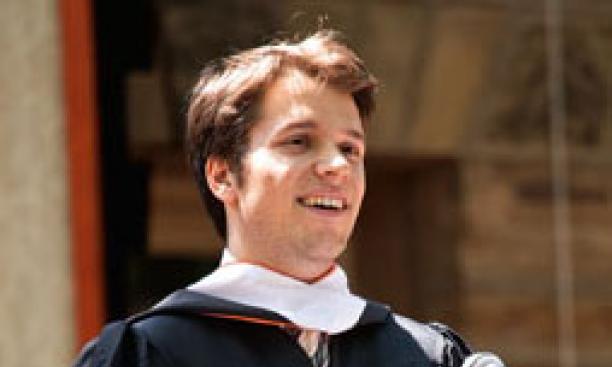
Staude’s statement might sound hyperbolic, but it is rooted in family history. In 1980, his parents made a circuitous, illegal journey from East Germany to West Germany, leaving everything — their families, their careers, and their possessions — in hopes of finding a better life. Education helped to make that new life a reality. “It was academics that ultimately enabled them to find work as high-school teachers,” Staude explained.
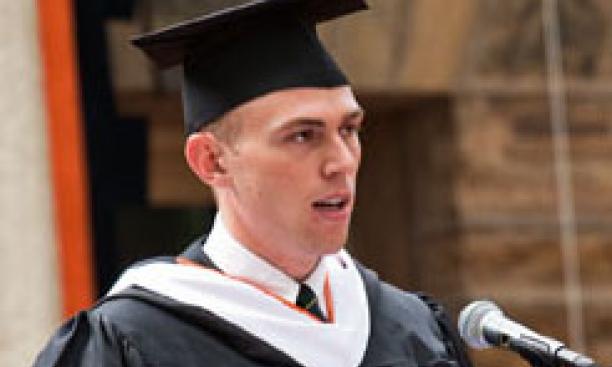
Tilghman, in her speech, urged the Class of 2009 to take on challenges after college, noting a few daunting but important areas like creating green alternatives to a carbon-based economy and advocating for tolerance among religious and ethnic groups. She also celebrated “the exploration of ideas for their own sake,” particularly in the creative and performing arts. The University’s Lewis Center for the Arts received its founding gift in 2006, midway through the Class of 2009’s freshman year, and Tilghman said that if the center has succeeded, this year’s graduates someday would be patrons of the arts. “In difficult times like these, we must be doubly protective of the arts,” she said.
Artists were well represented among this year’s five honorary-degree recipients: Academy Award-winning actress Meryl Streep; actress, activist, and author Ruby Dee Davis; community organizer and civil-rights proponent Ernesto Cortés; chef and sustainable-food advocate Alice Waters; and mechanical engineer Irvin Glassman, an emeritus professor at Princeton and an authority on combustion in energy production and propulsion.
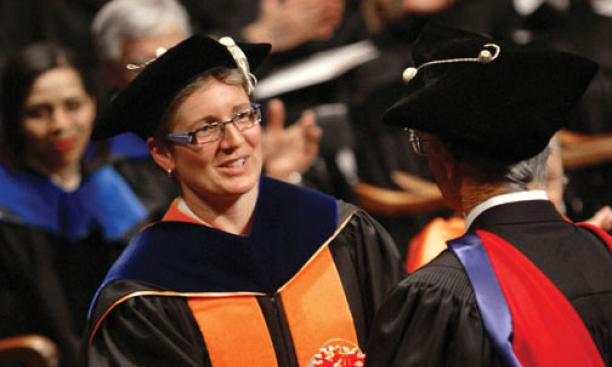
Four current faculty members received the President’s Awards for Distinguished Teaching: Mitchell Duneier (sociology), Eddie S. Glaude Jr. *97 (religion and African-American studies), Sharad Malik (electrical engineering), and Valerie Smith (English and African-American studies). The University also honored four exceptional secondary-school teachers from New Jersey.
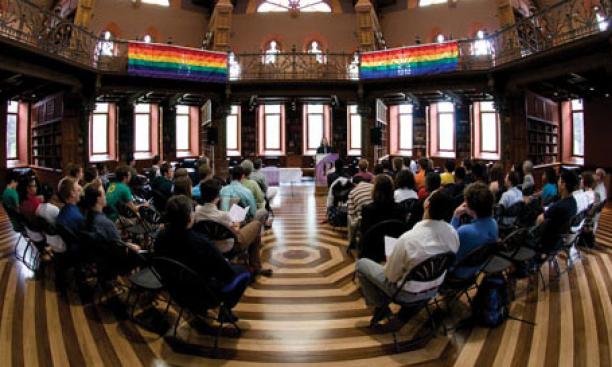
Commencement was the culmination of a series of graduation events, most of which took place in the two preceding days. Seniors celebrated at Baccalaureate May 31, where Gen. David Petraeus *87, commander of the U.S. Central Command, was the featured speaker; Class Day June 1, headlined by CBS Evening News anchor Katie Couric; and the senior prom June 1. Academic hoods were presented to advanced-degree recipients June 1. Other campus gatherings included the senior step sing; the lavender graduation co-sponsored by the Lesbian, Gay, Bisexual, and Transgender Center and the Fund for Reunion, May 9; a ceremony for Latino graduates May 31; and the Pan-African graduation May 31, where Georgetown sociology professor Michael Eric Dyson *93 delivered the keynote address (see page 52).
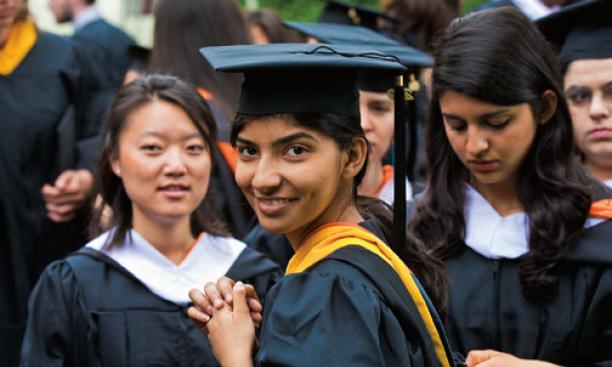
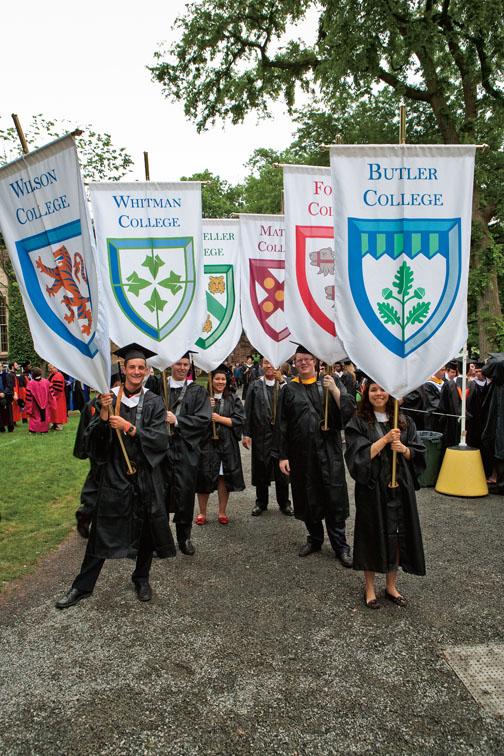
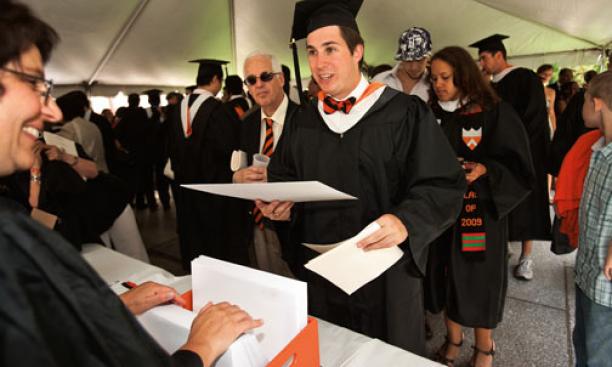
Before the graduation ceremony, as seniors lined up for their procession, some reflected on the things they were about to leave behind. Emily Norris ’09 described the emotions of Commencement as “euphoria, with undertones of nostalgia.” Jennifer Visconti ’09 said she would miss the serene mornings, walking among gothic dormitories on the way to class. Beau Thomas ’09 said he enjoyed being surrounded by so many intelligent and talented peers.
The Class of 2009 shared a range of experiences, from storming the field at the Yale Bowl in 2006, after the football team secured its first Big Three bonfire in a dozen years, to closely following the presidential election of 2008.




PAW partnered with the senior class to ask students to capture the last four years in “six-word memoirs.” Here is a sampling of their responses.
Click here to read more. Comment on your favorites and add your own!
LOST MY ACCENT, FOUND MY VOICE.
NANCY EDWARDS
TWICE A YEAR WE HAD SANGRIA.
LOGAN SCHERER
RULE ONE: FINISH YOUR THESIS, SON.
CAITLIN LUDWIGSEN
STILL PROCESSING THE EVENTS AT HAND.
SAM ZETUMER
LEARNED MORE FROM FRIENDS THAN CLASSES.
DENALI BARRON
CAREER SERVICES SAYS I AM “PENDING.”
KATHARINE GILMAN
CAN I PLEASE DO IT AGAIN?
FIONA MILLER
REMEMBER TO LIVE, NOT JUST WORK.
UGOCHI MADUBATA
WEIRDER THAN I THOUGHT IT WAS.
NADYA SOTO FERNANDEZ
THANK GOD FOR THE EATING CLUBS.
BARRY CARO
I DARED TO DISTURB THE UNIVERSE.
JADE FAUGNO
SEEING OLD IDEAS FROM NEW PERSPECTIVES.
NICK MORGAN
OVERALL, THOROUGHLY EXHAUSTING BUT COMPLETELY WORTHWHILE.
BEVERLY NWANNA
IT’S BEEN ALL ABOUT THE PEOPLE.
STEVE PEARSON
GO TO CLASS, FOR PETE’S SAKE!
ANONYMOUS
CHERISHED MEMORIES SQUIRRELED AWAY UNTIL REUNIONS.
CANDICE CHOW
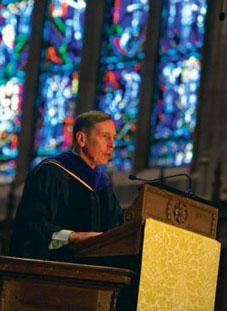
Gen. David Petraeus *87, leader of the U.S. Central Command, challenged members of the Class of 2009 to commit themselves to public service and the meaningful life such work offers.
“More than ever before, your community, your nation, and our world need talented people like you to tackle the pressing issues we face,” Petraeus told students during the Baccalaureate ceremony, held May 31 in the University Chapel. Princeton, he said, “has uniquely prepared you for such service.”
The general praised the University’s ROTC program and described how his Army career has enriched his life. But he emphasized that public service need not be military or even within the public sector. “History is full of examples of captains of industry and masters of the universe who made tremendous contributions to good citizenship,” he said, discussing the ways in which civil-service jobs provide camaraderie, self-satisfaction, and intellectual stimulation.
Petraeus, who graduated from the U.S. Military Academy and earned his master’s degree and Ph.D. from the Woodrow Wilson School, thanked Princeton’s professors and praised President Tilghman’s leadership. Tilghman lauded Petraeus for rethinking American military strategy through his principles of counterinsurgency, and noted that he has been described by many as “a genuine American hero.”
By Catherine Mevs ’09
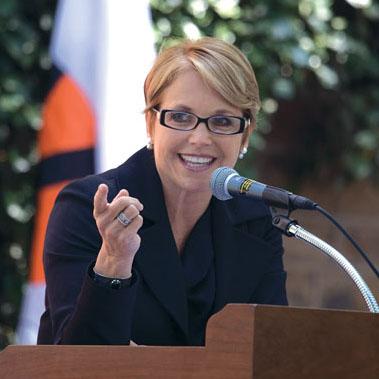
CBS Evening News anchor Katie Couric delivered the Class Day address June 1, becoming the first woman to headline the event since seniors began inviting speakers from outside the University in 2001.
Couric’s lively and often-irreverent speech was peppered with Princeton slang and pop-culture references. She joked about eating Wawa hoagies and attempting to complete the Prospect 10 by drinking a beer at each eating club. (Later, she confessed that two students, Jonathan Shifke ’10 and Caroline Shifke ’12, had provided a primer on campus life.)
Coming to speak at Princeton was a no-brainer, Couric said: “I can see New Jersey from my house.” She fired off one-liners about alumni including actor David Duchovny ’82 and Donald Rumsfeld ’54. Not all of Couric’s jokes were hits, but she seemed unfazed. When a line about Eliot Spitzer ’81 drew more groans than laughs, she quipped, “They told me I could be racy here — work with me, people!”
Couric completed her address with some sober advice for the Class of 2009, which enters the workforce during a historic recession. “Maybe the silver lining of these tough economic times is that it’s a wake-up call that can help us recalibrate our values,” she said. “What really matters in the end is how you played that game of life, that you’ve lived it with honor, integrity, and character — old-fashioned qualities that never go out of style.”
In addition to Couric, the Class of 2009 inducted three honorary classmates: Claretta Carter, a friendly cashier at the Frist Campus Center’s convenience store; Michael Maltabes, co-owner of Hoagie Haven; and Sean Weaver, director of student agencies and special projects in the Office of the Dean of Undergraduate Students.
The day’s student speakers — class president Grant Bermann ’09, religion major Jackie Bello ’09, and English major Jason Gilbert ’09 — joked about grade deflation and the cultlike devotion that Princeton students and alumni have for all things orange and black. But the overarching theme was appreciation for one another.
By Brett Tomlinson

Jason Gilbert ’09: The chorus of our school alma mater has us all waving an imaginary hat while pledging eternal worship to an ancient stone building: fairly cultish. And if I didn’t know any better, and I saw us at Baccalaureate yesterday, droning out a solemn entreaty to the heavens to raise Princeton’s endowment, over the blare of threatening organ music, and all of us wearing long black robes and boat shoes from Sperry’s rainbow collection, I would have assumed not that we were graduating, but that a psychotic yet charismatic leader had indoctrinated the members of a yacht club.

Jackie Bello ’09: There were many things I did not know about my future Princeton career when I first received this [admission] letter. ... [I did not know] that a naked sophomore would knock on my door at 5 a.m. one night and demand his clothes back; I had never seen him before in my life, but I remembered Princeton’s motto of service, and handed him two empty trash bags. He actually made leg holes. Now, that’s what I call ingenuity.
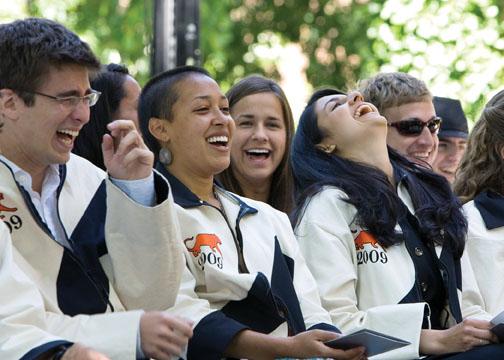
HAROLD WILLIS DODDS *14 PRIZE (to the senior who best embodies Dodds’ qualities of scholarship and service): Sarah Dajani and Fiona Miller
ALLEN MACY DULLES ’51 AWARD (to a senior whose actions fulfill Princeton’s motto of service): Emily Weigel
FREDERICK DOUGLASS AWARD (for contributions to a deeper understanding of the experiences of racial minorities): Adam Berry
W. SANDERSON DETWILER 1903 PRIZE (awarded by the class to the senior who has done the most for the class): Grant Bermann
CLASS OF 1901 MEDAL (awarded by the class to the senior who has done the most for Princeton): Josh Weinstein
THE PRISCILLA GLICKMAN ’92 MEMORIAL PRIZE (honoring independence and imagination in community service): Dexter Doyle

Georgetown sociology professor, author, and radio and TV personality Michael Eric Dyson *93 employed jokes and even some rapping in remarks at Princeton’s Pan-African graduation ceremony, advising graduates to appreciate their roots without allowing the past to stifle them.
At the ceremony in Richardson Auditorium May 31, Dyson, a religion and African-American history scholar known for his CNN and NPR commentary as well as his own radio program, discussed topics that ranged from resistance to gay rights among some in the black community, to pride in the first family.
Revising the oft-repeated comment that Barack Obama’s election proves there are “no more excuses for black people,” Dyson said the historic presidency actually proves there are “no more excuses” for racism in America. Obama “isn’t the first brother that could have been president,” he said. “He’s the first brother that got the job.”
By Catherine Mevs ’09