

Mozart called the organ the “king of instruments,” which is true but doesn’t do the organ full justice. Organs — at least the thundering, celestial kind found in the world’s great cathedrals — are massive contraptions of mind-boggling complexity. And they are well named, for, like our own organs, each is a system of linked parts — from the blowers in the basement, to the console where the organist sits at multiple keyboards, up through the thousands of wood or metal pipes that produce the sound — and requires air to bring the whole thing to heaving life. The organ bears some resemblance to its domesticated brother, the piano, but only a slight one.
“I had a wonderful teacher who used to say that the only thing the two have in common is the color of the keys,” says Eric Plutz, who marked his fifth anniversary as University organist in January.
When it was installed in 1928, Princeton’s Chapel organ was a departure from the organs of its time. Given by Helena Woolworth McCann in memory of her father, the five-and-dime magnate Frank Winfield Woolworth, it was designed by E.M. Skinner of Boston, then the leading organ maker in the country. Skinner’s “Romantic” organs were widely admired for their rich sound. But in the wake of World War I, American organists became smitten by the organs they heard in England and France, and returned home raving about those organs’ power and clarity of tone.
In 1924 Skinner traveled to England to hear for himself. He met with the country’s leading organ maker, Henry Willis III, whose organs, including those at Westminster and Liverpool cathedrals, were famed for their strong foundations, clarity of pitch, and the way their upper harmonics mixed with other sounds, allowing them to project better into the vast interiors of English cathedrals. Willis became Skinner’s friend and generous adviser.
Back home, Skinner struggled to reproduce the sounds he’d been hearing. His labors were starting to pay off when he was chosen to build the new organ at Princeton. Here was the perfect chance to put his new ideas to the test, to design an American organ to rival those of Europe.
Skinner made one noteworthy addition to the new organ. Alexander Russell, who as Princeton’s director of music had led the committee that had chosen Skinner, wanted a stop that would produce a low string sound. That would have required pipes that were prohibitively large, so Skinner invented a new stop producing a low-pitched double bassoon sound that could mimic the sound of a bow drawn across strings. The new contra fagotto stop became an object of great fascination in the organ community, and many Skinner organs built after Princeton’s had one.
The installation of the new organ took place even as finishing touches were being put on the Chapel itself. So eager were organ lovers to hear the new instrument that a recital was held on Memorial Day 1928, before it had been fully assembled. It got a proper christening in a gala event Oct. 13, 1928. The Skinner company arranged with the Pennsylvania Railroad to provide special cars to carry organ enthusiasts down from New York City and up from Philadelphia. Some 350 people attended the opening concert, which featured no fewer than six of the instrument’s leading performers. Early reviews of the instrument itself were rapturous. Wrote organist Marcel Dupré to Skinner: “It was such a thrill to play on your wonderful organ again and to open my tour with a recital on that recent masterpiece ... ”
Not everyone was so ecstatic. Ralph Downes, an Englishman who served as Chapel organist from 1928 to 1936, later confessed that while the organ looked good on paper, it was a bitter disappointment to hear. Why? Because the Chapel’s acoustical properties had been severely compromised to boost the spoken word. Porous tiles had been affixed to the ceiling and upper walls, deadening the reverberations composers count on when they write for the organ. “Speaking was easier,” says Plutz. “But music suffered.”
In the 1950s, with the music of the early 18th century in vogue, University organist Carl Weinrich altered the instrument to better suit that style. Eventually the organ fell into disrepair. In 1985 an anonymous benefactor gave $450,000 to restore it, and a Princeton committee decided to tackle the building’s acoustics first. A polyurethane sealant was sprayed on the tiles, making them hard as stone. In 1991 the organ was packed up and shipped by truck and boat to the N.P. Mander Company of London, where 30 specialists spent 15 months adding new pipes, restoring old ones, and refurbishing its many moving parts. Mander’s experts restored the majesty of the Romantic conception of the original organ, retaining “all that was best and characteristic of the Skinner work,” according to the company’s account, while pushing the organ “toward a broader usefulness.”
Today, the Chapel organ is a magnificent instrument. “What’s really great for me,” says Plutz, “is that during our concert series I get to sit in the back of the Chapel and hear how different organists make the organ sound.” It’s a brilliant instrument for French organ music and for Bach, but Plutz thinks it sounds best when playing English music, which surely would have delighted Skinner.
Merrell Noden ’78 is a frequent PAW contributor.
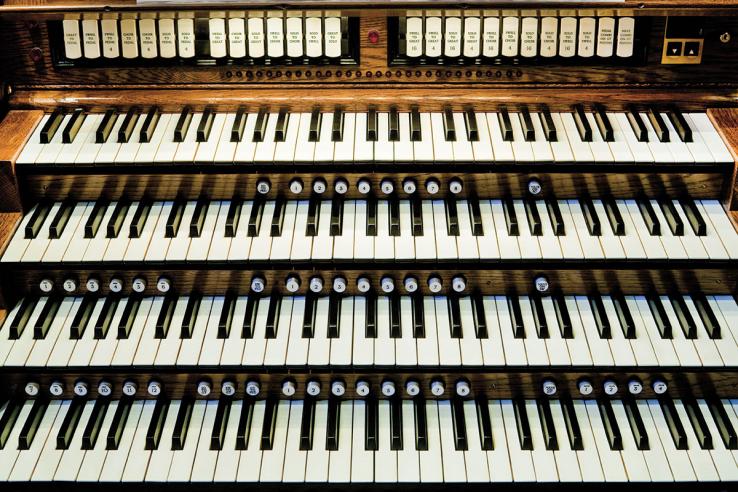
The Chapel organ – known as the Mander organ for the company that restored it in 1991 – has four keyboards, or manuals. From the top, they’re the Solo, the Swell, the Great, and the Choir. The Great sounds the loudest, while the Swell operates pipes in a huge box with movable blinds on one side. Though it plays at a single volume, when the blinds are opened the sound swells dramatically.
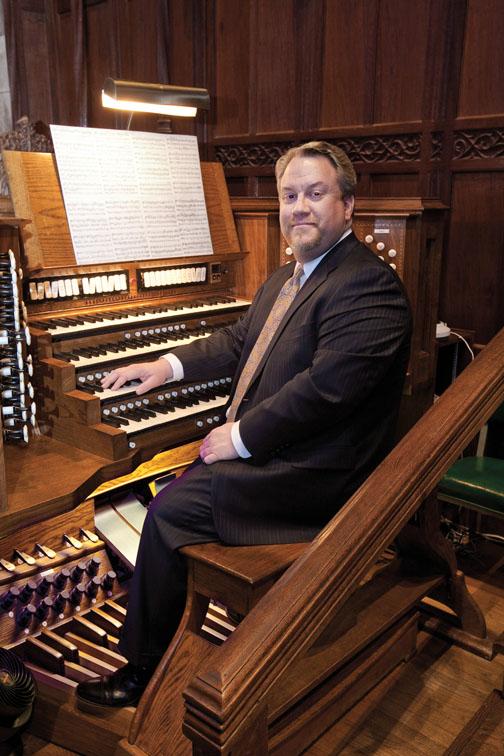
Even when the Chapel is full, playing the organ is a “very solitary” experience, says organist Eric Plutz, above. In the Chapel, Plutz sits up front, beneath the chandelier. “People don’t know I’m up there. I feel a little bit like the Wizard of Oz, behind the curtain.”
![And there is a bit of Âtrickery at work, for the pipes directly above the organ console donât actually make any sound. âTheyâre dummy pipes,â says Plutz. âPart of the Âaesthetic [in 1928] was that they Âdidnât want the organ to sound too â](https://paw.princeton.edu/sites/default/files/styles/portrait_feature/public/images/content/LIVE.Organ_interior.jpg?itok=M_Qlh-Dk)
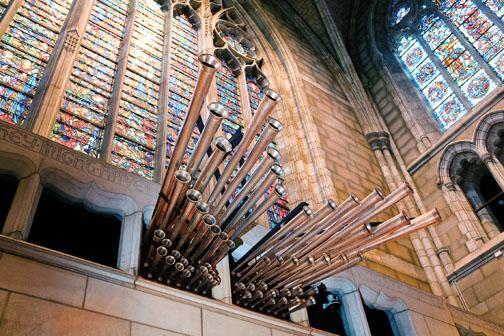
And there is a bit of trickery at work, for the pipes directly above the organ console don’t actually make any sound. “They’re dummy pipes,” says Plutz. “Part of the aesthetic [in 1928] was that they didn’t want the organ to sound too ‘present’ or too raw. So those pipes in front don’t speak.” Still, there are nearly 8,000 pipes that are capable of doing so, including the “en chamade” pipes, below, which replicate the piercing sound of a military trumpet summoning troops to parley.
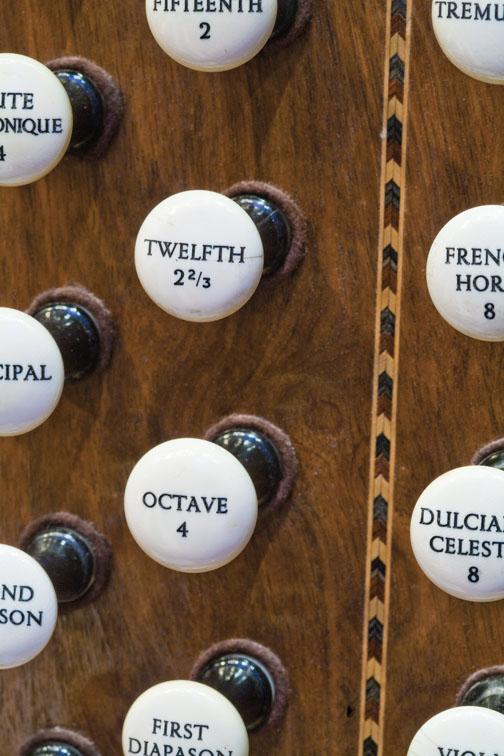
The “stop” knobs determine which ranks play, ultimately controlling the air flowing into the pipes.
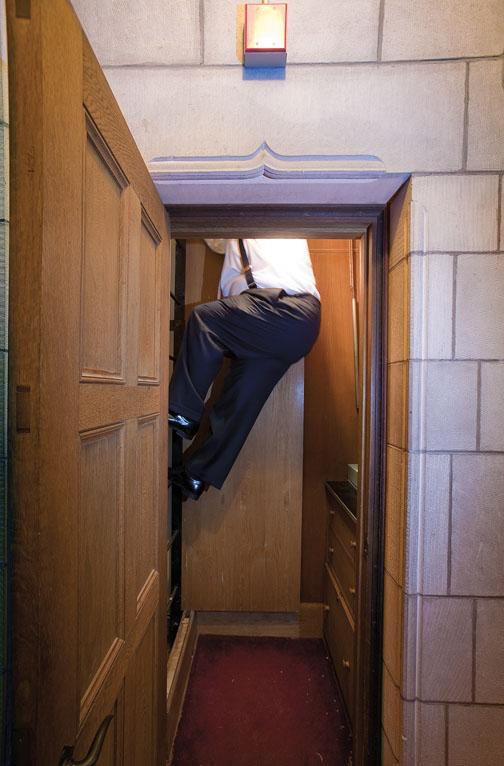
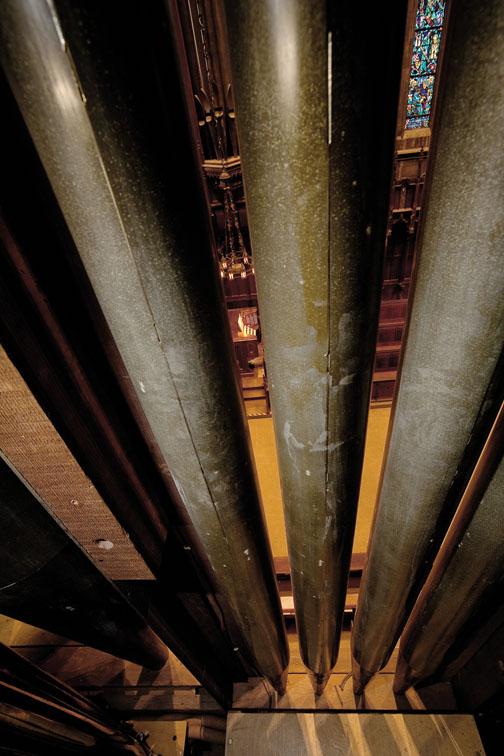
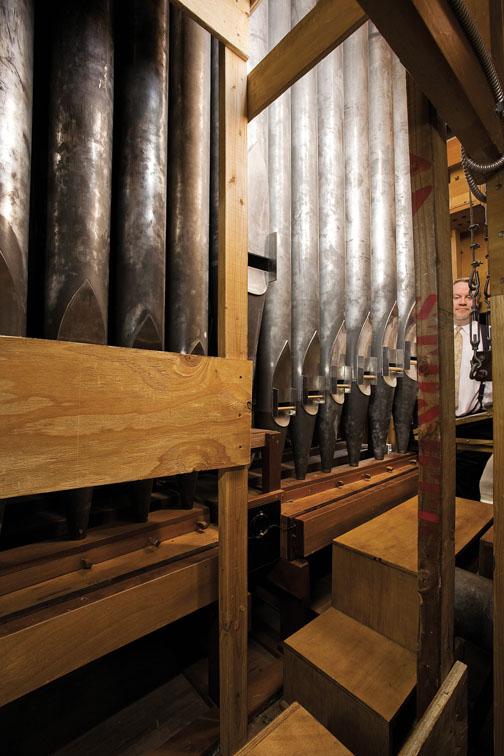
A small wooden ladder gives Plutz access to the pipe room on the south side of the Chapel, directly behind the façade pipes. Crowded as it seems to a visitor, Plutz insists that it is actually quite roomy. There are two kinds of organ pipes, though both use moving air to create sound. Flue pipes, made almost exclusively of wood, have no moving parts and work on the same principle as a whistle. In reed pipes, air passes over a slender metal reed, causing it to vibrate and create sound. Reed pipes can be tuned — every other week in the case of the Princeton organ — by adjusting the length of the reed with a small Z-shaped wire. They are made of a metal so soft that “if not made correctly, they can collapse in on themselves,” Plutz says. Another concern is their cumulative weight. Since size determines pitch, ranks are arranged not chromatically but in whole-tone scales; that is, a C is placed at one end while the C# — just a half-step away on the keyboard – is placed at the far end of the rank. The next pipe inside the C is D, while the next inside the C# is the D#. This gives each rank a smooth, parabolic look.

Free lunchtime organ concerts will be given April 29 and May 6 at 12:30 p.m. Eric Plutz will present a Reunions concert Friday, May 28, at 3:30 p.m.