
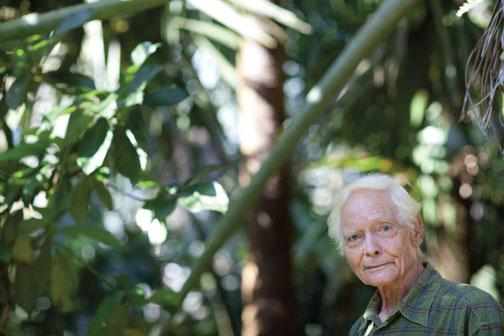

In 1976, the poet W.S. Merwin ’48 bought a 20-acre patch of dirt, weeds, and ferns in Maui and decided to turn it into a palm forest. It was “exactly that simple,” says his wife, Paula, though even she can see how others might think it was absurd. Merwin had moved to Hawaii to study with a Buddhist master, and he and Paula decided to spend their lives there, closer to nature. And so they transformed their land — a failed pineapple plantation — by hand, hacking away at ferns with machetes and planting trees one at a time; shunning heavy bulldozers and backhoes that would have made their lives easier but further compacted the already ravaged earth. The point, after all, was not simply to have the forest, but to grow the forest.
Over the last three-plus decades, the land flourished so much that today it cannot be recognized for what it once was. The plantings grew acre by acre, and the land teems with life; Merwin still tends to most of the forest himself. More than 700 species of plants populate the forest, and dozens of species of rare or endangered palm trees — the poet has a network of growers who help him track down new ones all the time — house everything from geckos to raspy-voiced myna birds. Under the palms, it is hard to tell what time it is. It’s not dark — beams of sun permeate the canopy and dapple the forest floor — but the light is distinctly green and seems thicker than elsewhere.
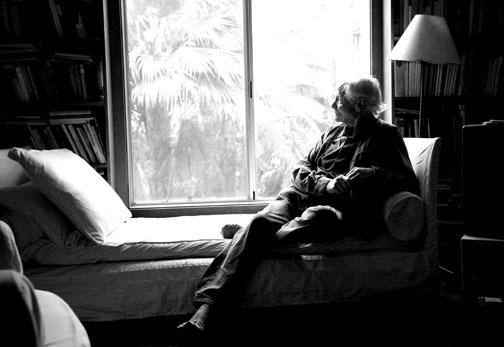
The house Merwin built is invisible from the road, nestled halfway down a path on the lip of the dormant volcano Haleakala that winds mazelike into the valley of the forest. It juts out like a tree house into the palms, creating the impression of hovering in the canopy. He and Paula kept the house off the power grid, and electricity comes from the solar panels that cover the roof. He helped to design a series of water catchments, cisterns, and filters so that they get by using only rainwater, stockpiled during the wet season. Drought, Merwin admits, is inconvenient, but he is not about to start compromising now.
It is not in W.S. Merwin’s nature to compromise — just as he decided to plant a forest, he resolved, as a junior at Princeton, to be a poet and nothing but a poet. Over the years he has done just that — writing more than 30 books of poetry and prose, translating poetry written in other languages, and amassing some of poetry’s most important honors along the way, including the first Tanning Prize for “outstanding and proven mastery” in poetry in 1994, two Pulitzer Prizes (for The Shadow of Sirius in 2009 and The Carrier of Ladders in 1971), and the 2005 National Book Award for Poetry (for his retrospective collection Migration: New and Selected Poems). This summer, he was appointed national poet laureate by Librarian of Congress James H. Billington ’50, becoming the 17th poet to hold that position.
In the news release, Billington described Merwin’s poems as “often profound and, at the same time, accessible to a vast audience” — a poet who “leads us upstream from the flow of everyday things in life to half-hidden headwaters of wisdom about life itself.” Speaking to PAW, Billington cites the three-line poem “Separation,” a sparse yet deeply resonant work that Merwin wrote as a young man, in 1962:
Your absence has gone through me
Like thread through a needle.
Everything I do is stitched with its color.
The poem, Billington says, illustrates Merwin’s ability to create out of “something ordinary” an insightful observation about life, relationships, language, or nature.
Or, consider “For the Anniversary of My Death,” one of Merwin’s most frequently anthologized poems, written in 1967:
Every year without knowing it I have passed the day
When the last fires will wave to me
And the silence will set out
Tireless traveler
Like the beam of a lightless star
Then I will no longer
Find myself in life as in a strange garment
Surprised at the earth
And the love of one woman
And the shamelessness of men
As today writing after three days of rain
Hearing the wren sing and the falling cease
And bowing not knowing to what
Though the poem’s subject is vast, its language is distilled. It expresses not only the sadness of mortality, but the strangeness and improbability of life to begin with, along with the connection to nature that defines so much of Merwin’s life. Such poems, Paula says, help explain why her husband often gets letters from “people writing from the depths of their hearts,” saying that “he’s been their companion for many years, through their lives or through difficult times.” He puts our anxieties into words.
Gentle, fiercely intelligent, and quick to laugh, Merwin, now 82, is willing to lead a conversation about his life and his writing through loops and digressions for hours. As a young child in working-class Union City, N.J., during the Great Depression, he found comfort in gazing at the Hudson River. A few times he accompanied his father, who could be distant and punitive, to study in the church where he was a Presbyterian minister, and young Merwin gazed through the window at the river, with the ferries and freighters passing by. He was, he writes in his 2005 memoir Summer Doorways, “utterly rapt in the vast scene out in front of me ... Whole trains were crossing the river on railroad ferries, all shades of orange in the sunlight. White puffs of steam climbed out of unseen whistles and horns, the distant sounds arriving, faint and faded, a long breath afterward. I was seeing something that I could not reach and that would never go away.” His love of the water would remain, fueling a desire to travel as well as a tug toward the author and mariner Joseph Conrad.
Merwin was moved by the rhymes and rhythm of the hymns in his father’s church, first in Union City and then in Scranton, Pa. He delighted in the poetry that his mother read aloud. For Merwin, poetry was first an aural sensation, and to this day he has a strong sense of the music of a poem and believes that a poem must be read aloud to be truly understood. The young boy began writing poems himself — “atrocious poetry, as children do,” he says of his earliest efforts — but he kept at it through adolescence.
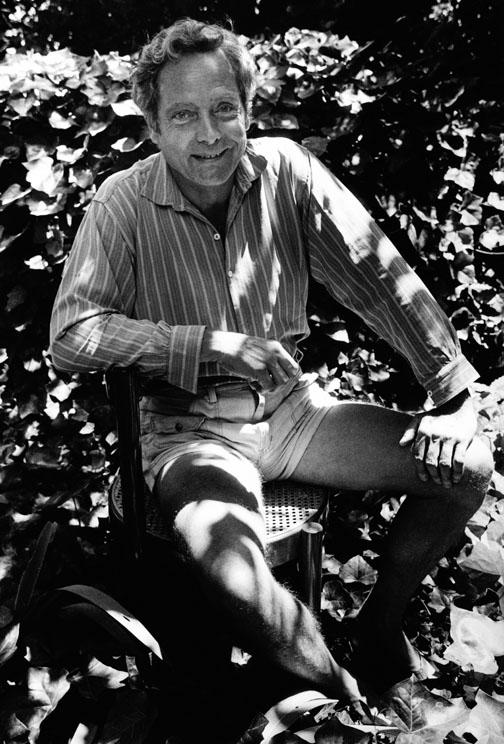
When it came time to think about college, at 15, he set his sights on the Navy: “I wanted to go to Annapolis ... I was in love with a doctor’s daughter, and I thought the uniform would impress her. That was the only reason!” He says this laughingly, and adds that he yearned to escape the “absolutely stultifying” world in which he grew up. But he was too young to enroll at the Naval Academy, and so he took the college entrance exam, writing “Princeton” along with the names of a few other schools on the form. Only later did he realize that “the Princeton I’d heard of was not the University at all. It was Princeton Theological Seminary, because my father was a minister.” But a friend advised that it would be smart to spend some time studying the humanities at Princeton, and the University gave him a scholarship, so he was on his way.
As an undergraduate, he was a “maverick and a misfit,” he admits. When he found something interesting, he went off on his own and read as much as possible about it, often forgetting his class work or skipping class altogether. He spent most of his free time at the stable on campus, exercising the horses. At the time, Princeton’s nascent creative writing program was run by the poet and critic R.P. Blackmur with the assistance of poet John Berryman, and both men became mentors. With Blackmur — “the wisest man and the greatest literary intelligence I ever knew” — Merwin spent hours discussing literature and life. He didn’t show poems
to Blackmur, though. “I showed them to Berryman, and Berryman was absolutely ruthless. It was very good for me,” he says. The two teachers planted in Merwin the idea that poetry was a lifestyle.
Then, at 17, Merwin enlisted in the Navy. Within months, he knew he had made a terrible mistake. He couldn’t stand the idea of being trained to kill on orders. He could not muster the emotions he would need to take the life of someone he didn’t know, someone who never had done anything to him. He realized that he was, without a doubt, a pacifist. When he informed the Navy of this fact, asking to be sent to the brig, he was locked up in the psychiatric ward of the Chelsea Naval Hospital for a year before he returned to campus.
Back on campus, Merwin focused on what mattered to him most. He was a great admirer of the poetry of Ezra Pound (like many of his contemporaries, Merwin did not know about Pound’s anti-Semitism or political beliefs until much later, and remains disturbed and puzzled by those things) and sought him out in the psych ward at St. Elizabeth’s Hospital in Washington, D.C., an environment to which he could relate. Pound treated Merwin as a peer, telling him to write every day and to learn to translate, because translation was “one of the best schools there is for learning your own language.”
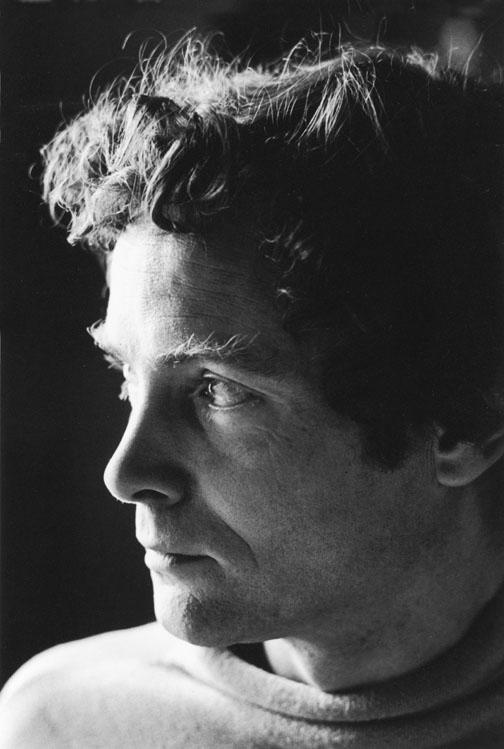
Merwin was “the only person I’ve met in my whole life who absolutely trained himself to be a practicing poet in his 20s,” says his friend and fellow poet Galway Kinnell ’48. “Most people struggle, but he appeared to know what his calling was.” Merwin remembers that he didn’t want to look for a job; he wanted to “be in the world, to meet people and go places and try to write, and learn from languages.” He found his way to Europe, tutoring the son of poet Robert Graves in Majorca and then taking a translating job at the BBC, writing poetry at the same time. At age 24, in 1952, he published his first book, A Mask for Janus, which was selected by W.H. Auden as the winner of the Yale Younger Poets Award — a prize known to launch the careers of many young writers.
The writing process, Merwin says, is all about time and environment. He will be the first to tell you that poetry “is something before it is about something,” and that if you try to force a poem to take a stance, it is likely to choke: “I think a poem begins out of what you don’t know, and you begin not by having a good idea but by hearing something in the language.” Where it leads after that should be left to the wandering mind. His poems end up being about war, extinction, loss, or passing time because those are his preoccupations, but he never sits down with the intention of writing a poem about a specific topic.
Each morning he wakes up early and sits in front of a page, and even his wife, Paula, has no idea what he’s working on until it’s finished. He writes in longhand, and there is nothing fancy in his routine — no special pen or leather-bound notebooks — because the more conscious he is of the act of writing, he says, the less likely it is that he will produce something good: “I think that part of it comes to you. You can’t do it by an act of will. Part of it is just pure chance, the universe is going to allow you to do this ... or you may just have to wait.” He shuns much technology — he has no cell phone or e-mail — because he feels that it makes people obsessed with speed: “The idea is that the faster you do it, the more you accomplish,” he says, “but that’s not true. The faster you do it, the more you’re expected to provide,” and so, he says, the speed becomes a kind of slavery. He guards his own privacy and his time; he is not antisocial, but he sees and speaks with people when he’s ready, and not before.
In the early days of his writing, at Pound’s suggestion, Merwin would translate when he could not compose. There was satisfaction in finding a good way to translate a line, then in coming back to it and finding an even better way. It was a relief to set goals and reach them. If he set out to translate 50 lines, barring some impossible phrase, he could do it — but a poem might or might not come to him. Even now, he is grateful and surprised each time he writes. “All my life I thought that when I finished a poem I might not write another one, because I don’t think you have any control over it,” he says. “Having said that, I think that the important thing is to keep trying as regularly as possible.”
Over the years, his poetry has evolved. Merwin often is called a poet of nature, particularly since he became drawn to Zen Buddhism and moved to Maui. In the late 1950s, his poems grew introspective and personal; in the 1960s, more political. He stopped using punctuation around that time: “I had come to feel that punctuation stapled the poems to the page,” Merwin wrote. “Whereas I wanted the poems to evoke the spoken language, and wanted the hearing of them to be essential to taking them in.” He often used mythology to address personal and political ideas. Those themes are most evident in The Lice (1967) and in The Carrier of Ladders (1970). Critic Jarold Ramsey wrote that The Lice was special because of its “eerie sense of bearing witness to a world already in mid-apocalypse. These are not portentous poems so much as notations on the experience that it is all but over and done with, that we are merely ‘the echo of the future,’” citing a line from Merwin’s poem “The River of Bees.”
When Merwin won the Pulitzer Prize for The Carrier of Ladders in 1971, he took a public stand against the Vietnam War in the form of an open letter to the New York Review of Books: He said he was “pleased to know of the judges’ regard” for his work, but “after years of the news from Southeast Asia” he felt “too conscious of being an American to accept public congratulation with good grace. Or to welcome it except as an occasion for expressing openly a shame which many Americans feel, day after day, helplessly and in silence.” He directed that the money should go instead to a painter who was blinded by police in California while watching a protest, and to the “draft resistance.” This gesture alienated him from Auden, who, while he shared Merwin’s antiwar sentiment, wrote a letter to the editor of the Review that the action sounded like a publicity stunt. Looking back, Merwin regrets that his action so disturbed Auden, whom he greatly respects, though he has not changed his mind.
Despite Merwin’s private nature, says his friend Edmund Keeley ’48, the poet is not a hard man to know. He has “one foot solidly on the ground and one hand reaching out beyond himself into another world,” says Keeley, a novelist, translator, and former director of Princeton’s creative writing program: “It’s a cliché to say it, but it’s a fact — the man is in his poetry ... the essence of the man is there.”
Merwin was humbled and honored at his appointment as poet laureate, though he worries about what it will do to his beloved quiet and routine. The job description lists few specific duties — the laureate must open the Library of Congress’ literary season in October and close it in May — but recent laureates have launched projects meant to broaden poetry’s audience. In 2009–10, Kay Ryan created “Poetry for the Mind’s Joy,” a program of poetry workshops for community-college students. Earlier, Billy Collins started the website Poetry 180, which brought a poem a day into high school classrooms, and Robert Pinsky began the “Favorite Poem Project,” in which ordinary people were encouraged to nominate for an anthology poems that had moved them deeply.
Merwin, who travels infrequently and so will not be spending much time at the Library of Congress, says he, too, is eager to develop a project that is close to his heart. It almost certainly will involve nature. “The connection between poetry and the natural world seems to me to be a given,” he says. “I think that’s where poetry comes from, and any attempt to make a separation is unnatural and is going to be temporary.” This, he explains, is what led him to Hawaii and his palm forest, what pulled him to Zen Buddhism and his belief that no single entity is more significant than another. This is why he still plants a tree every day during the rainy season, and why he remains a pacifist. An act of violence — whether against humanity or nature — fundamentally changes a person, he says: If we mistreat the world, we mistreat ourselves — not by reaping the consequences of our actions in the form of global warming or acid rain, but by becoming people who can be disrespectful and not feel the weight of it; who can destroy without empathy or a sense of loss; who can make excuses for the inexcusable.
Merwin’s palm forest helps spark memories, and reminds him that he is part of something larger. He hopes every writer gets to experience such a sensation at some point, which is one of the reasons he and Paula are turning the property into a nature preserve. When they no longer live there, it will be handed over to his publisher, the Copper Canyon Press, and the Maui Coastal Land Trust. Forever protected from developers and tourists, it will become a refuge where poets can come to write, or at least to gaze out over the trees that have been his passion and his project for more than three decades. It’s here that he feels the strongest connection with nature, but he has always felt its pull and joy, even as a 4-year-old boy in New Jersey, and even if he could see only the smallest bit of it: “I remember walking along the sidewalk, and the grass was growing up between the flagstones. I asked my mother where it came from, and she said the earth was right underneath those flagstones.
“I felt so happy to think of that,” he says, “that the real world was down there.”
Catherine Richardson ’08 is a creative writing student in the M.F.A. program at New York University and a freelance poetry reviewer.