

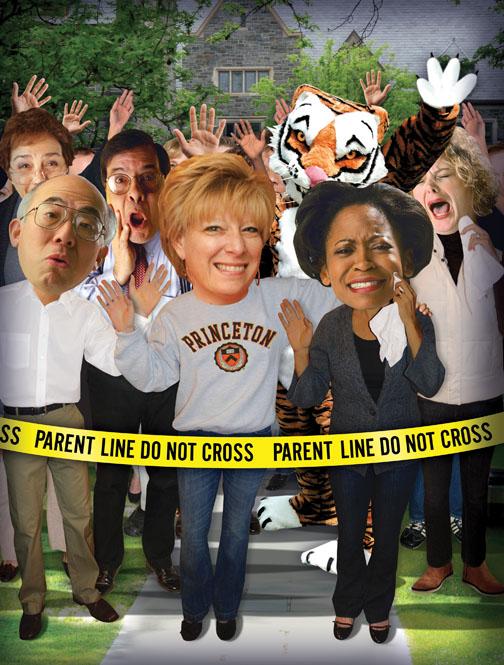
The line winds around Baker Rink on this somewhat steamy September morning, and outside it feels much like a carnival. There are tubs of orange and black candies for the taking, along with Princeton key rings and striped water bottles. Someone in a tiger suit wanders about, posing for photos with the members of the Class of 2015, who are queuing with their families, waiting to check in.
“Are you drinking enough water in that thing?” one parent asks the tiger, who does, indeed, look warm.
“You’re not his mother,” her own daughter teases.
“Even tigers need their mothers,” she answers, then quickly slips on her very dark sunglasses.
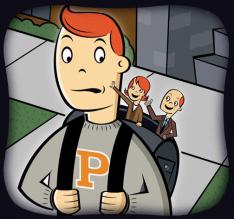
A bit closer to the entrance, Peck Ferg is wearing her darkest lenses, too. Andrew Ferg ’15 is her only child, and she’s been crying for two nights already in anticipation of this day. “When they are little, they have the separation anxiety,” she says. “Now, I have it. I know it’s good for him. But at the same time, I know I’m going to miss him.”
Andrew gives her a buck-up kind of a hug.
The entrance to the building marks a before-and-after moment, the families know. The heat of the day would give way to the cool of the Baker Rink ice; the students would get their welcome packets and start off on this next chapter.
It has been 33 years since I played the student in this annual tableau. Now I am back to write about how freshman move-in has changed, through the eyes of a parent.
After all, it is the parents who are most different decades later. True, there are changes in the process: Everything is far more organized than I remember, with signs on the buildings and large rolling orange carts to help ferry mountains of stuff from car to dorm. There are changes in technology — huge stereo speakers have given way to huge flat screens. But the biggest change is the roles of Mom and Dad. A drama in which they once had bit parts now has become much about them.
“In my generation, you went to college to spend time away from your parents and make decisions [and] live your life without checking in more than once a week, if that,” says Robert K. Durkee ’69, who has spent virtually his entire career at Princeton and is now the University’s vice president and secretary. “For this generation, it is much more like their parents have come to college with them, and both the students and the parents seem to enjoy the opportunity to share the experience.”
Technology is one of the main motors of this shift, says Kathleen Deignan, Princeton’s dean of undergraduate students. That weekly call has been replaced with an ongoing conversation that can continue all day across a variety of devices. Parents know details of their child’s college life and “sometimes also face the temptation to manage that experience,” Deignan says, “especially when it comes to handling adversity or making difficult decisions.” That’s regrettable, she adds, because “there is a great deal of learning that goes on when students sort through these issues themselves and learn to draw on their own values, instincts, and resources.”
Parents even can follow children much further afield than Princeton. Nancy Kanach, director of the Office of International Programs, recalls one or two parents who went along with their children when they headed for a semester of study abroad “to check it out.” (No, the parents did not stay for the whole semester.) The involvement of parents is “a big topic in the field of study abroad,” she says. “Many worry that this means that the immersion aspect of study abroad gets undermined.”
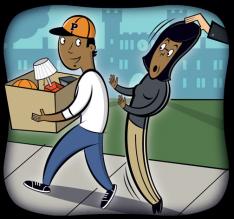
Because parents are now more involved in managing their children, the University has become more active in managing the parents from Day One. Before freshman move-in would end, parents would have a reception with the dean of their child’s residential college. They would attend a meeting at McCormick Hall at which they could ask questions about the health care their kids would receive. And, at 5:30, the schedule stated, they would be asked to leave campus: “Subsequent orientation events are intended for students only.”
That not so subtle message isn’t heard just at Princeton. “There is no question that this is happening nationally, perhaps internationally,” Durkee says. Everywhere, administrators must peel parents away, sometimes gently, sometimes with a thud. At Morehouse College in Atlanta, move-in day ends with a formal ceremony: The incoming class marches through the gates onto campus, and then those gates swing shut — literally, in the faces of the parents who remain standing on the other side. At Grinnell, in Iowa, there is a welcoming speech in the gym, where the university’s president stands facing the students with his back to the parents, a gesture meant to communicate, among other things: “Back off.”
This wasn’t necessary back in my day, when, metaphorically, my parents slowed the station wagon down as we approached Walker Hall, pushed me out, and headed home. Today’s parents are more entwined with their children than ours ever were. It starts with the double-edged knowledge that what we eat and drink and experience during pregnancy can influence the rest of their lives. It continues in a world that feels more dangerous and more competitive and more complicated, one that requires more than just letting our children figure it all out themselves. So we step up to the challenge and enroll them in enrichment programs, and monitor their technology, and send them to T-ball (where you get as many swings as you need, and everyone gets a trophy), and try to brace them for college applications (where even the most talented might not bring home the prize).
Then one day — on a day like freshman move-in — we are told to stop.
We try. Honestly we do. But the tools that changed their childhoods continue to shape our bonds with them as young adults. Endless texting and Skyping have replaced those once-a-week phone calls that we made to our own parents (usually on Sundays while the rates were still low) and the actual letters in envelopes with stamps that we once sent. It’s a conversation so constant that some colleges have banned cell phones in the registrar’s office so that students might choose classes on their own, without calling Mom and Dad for approval. And it has created boundaries so blurred that professors tell of receiving phone calls from parents questioning a student’s grade.
Educators have lots of names for these parents. They are “helicopters” (always hovering), and “Velcro” (stuck to their children), and “curlers” (like the sport played on ice, because they race ahead of their children, sweeping obstacles from their path). Whatever the name, you probably won’t ever meet any of them, because there are no parents out there who describe themselves this way.
In years of writing about parenting I’ve met many an involved specimen, but from the inside looking out, none of these parental acts feels like a “trend” or a “symptom”; each just feels like love. Instead of Helicopter Parents, I have met Confused Parents, or Making-It-Up-As-They-Go-Along Parents, or Proud-To-Be-So-Close-To-The-Kids Parents, or Parents-Who-Will-Miss-Their-Children-When-They-Leave. In other words, parents like the ones I met on freshman move-in day. And like the one I have become.
The Kelly family’s Dodge Durango is filled past the brim, and Tom Kelly ’15 is hauling a desk chair, mini-fridge, countertop ironing board, laundry basket, bicycle, and entire rack of suits out of the back as though it were a magic trick. Everything ends up in the large rolling bins that he and his parents, Jeb and Mary, then push and pull and carry into his Whitman College room.
The whole family is tired — from the 10-hour drive from North Carolina the day before, and from the anticipated goodbyes looming at the end of the day. The Kellys have sent two other sons to college in recent years, and while that kind of practice makes the packing easier, Mary Kelly says, it doesn’t ease the parting.
Still, letting go “is harder for a lot of my contemporaries,” she says. “I think they have invested too much in their children’s lives and forgotten about themselves. I saw it all the time at school sporting events and at academic-achievement programs. It was as if they were trying to relive their teenage years.”
Once their children leave, she says, parents “have a hard time adjusting back to it just being them.” As each Kelly child has left, Mary and Jeb have filled the absence with a dog. They are now up to one dachshund and two Weimaraners. “I guess we feel the need to nurture something,” she says.
“I can’t BELIEVE it! I just can’t BELIEVE it!”
Donnica Moore ’81 stands by the first-entry steps into Gauss Hall, hugging a uniformed maintenence worker who is hugging her back. More than 30 years earlier, Moore’s father had been dragging her own belongings into the third entry of Foulke, and the first person she’d met there was Jesus Romero, who at the time was a campus custodian. Now he is a maintenance supervisor, and he happens to be standing ready to help as Moore’s son, Brian Bernard ’15, arrives.
There is both a nostalgia and a disconnect created by sending your child to a place you know so well, yet has changed so much. And there is a special challenge in letting them make that place their own. Romero is the same. So many other things are different.
“Everything now revolves around residential colleges, which is a language I don’t speak,” Moore says. “And where did these buildings come from?” she asks, sweeping a rhetorical arm to include gleaming dorms with names like Bloomberg, Bogle, and Yoseloff, with comforts like elevators and air-conditioning and beds that don’t creak.
It is tempting to say, “Back when I was there ... ,” Moore notes, but the reality is that “back then” is irrelevant. Most parents of today’s legacies remember a campus where Ivy, Cottage, and Tiger were all-male, there were three men to every woman, there was no policy of grade deflation.
Isn’t this true, though, of all parenting? The world our children occupy at any moment is the same, but different, when compared to the one in which we lived. Preschool is competitive now. Adolescence comes earlier. Parents don’t worry that children are frittering away study time on the phone, but rather on the Internet. Commons is now the Mathey College Common Room. The tennis courts are now Whitman College.
While Moore reminisces, her son searches for outlets to power equipment that wasn’t invented when his mother moved in. Upstairs someone has directed iPod speakers out the window. Andrea Bocelli is singing “Time to Say Goodbye” in Italian, and Moore is trying not to cry.
Mindy Himelman is in the U-Store on Nassau Street, buying a Princeton sticker for her car window. Her son Aaron ’15 would not let her buy it sooner because it embarrasses him. He wants her to opt for the version that is just the letter “P,” rather than the larger and longer block-letter school name toward which she is leaning.
“I’m not boasting; I’m just proud of you,” she had told him all summer, but he made her wait to make her purchase until just hours before she would leave campus. Home is close by, in New Brunswick, but Aaron has set ground rules about that, too. His mother is not allowed to come to town at all. He doesn’t want to happen to run into her “by accident.”
Anne Marie McShea would have farther to travel, from Doylestown, Pa., but the rules are understood to be the same. She and her daughter, Olivia ’15, are ticking down the clock toward farewell at the other U-Store location — the one next to Blair Arch, on University Place — surrounded by stacks of box fans, Brita water pitchers, and an entire wall of pens. Olivia’s arms are filled with toothpaste and shampoo, among the things she realized she’d forgotten when she left home that morning.
Like the Himelmans, the McSheas spend a lot of time in front of the display of car-window stickers — those announcements of parental pride. Olivia, like her classmate Aaron Himelman, votes for small and understated; her mother decides in the end that “if I’m going to do this, people should be able to read it,” and chooses the full-out orange and black PRINCETON.
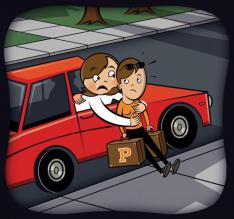
The prediction in Bocelli’s song eventually comes to pass, and it is time to say goodbye. This goes more smoothly for some than for others.
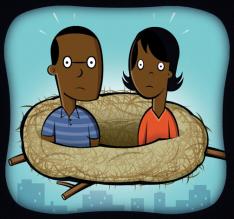
Patricia Connelly had spent the weeks before moving Louise ’15 into Butler College “making fun of mothers who had a hard time separating from their college-bound child,” she says. “I was rationalizing the whole thing: It’s normal; that’s what we aim for, it’s time they fly out from their nest; I can take this ... . ”
And, at first, she does remain perfectly rational. The whole family has come up from Delaware for the day — Louise’s dad, Tom ’74; her brothers Thomas and Peter, who are 15 and 6; even her aunt, who has driven in from New York to help out. Move-in goes quickly with all those hands — too quickly for Patricia Connelly, who feels empty when the job is done. For the next several hours the Connellys fill the time until they would have to part, visiting the Butler cafeteria, finding Louise’s mailbox at the Frist Campus Center, having lunch at the Nassau Inn.Suddenly it is 3 p.m., and Louise is late for her Outdoor Action meeting at Dillon Gym. Goodbyes are quick, which is a blessing. “No time to be emotional,” Patricia says.
That would come later:
After the parents’ reception in Butler, the Connellys — less their daughter — piled into the two cars it had taken to get everyone there that morning. At the wheel of one, Patricia “focused hard on the road,” she remembers. She was fine — until she walked into her empty house. “There was simply not enough air to breathe,” she says of her most unexpected reaction. “It came from the gut, went up the throat, and I just couldn’t get enough air inside of me.”
The tears came in a “tsunami,” she says. She managed to compose herself before her husband and older son arrived, “only to break down in Thomas’ arms a few hours later. I needed to hug one of my children!”
For the next day or so she kept the door of Louise’s room closed “because I couldn’t face the emptiness,” she says. “It was like trying to tame a wild animal, getting used to the new state of things.” It was made harder, she says, because Louise was backpacking with Outdoor Action and out of texting and calling range. “It was a little like she was gone forever,” her mother says. “Which I knew was not true, but then, part of it was true indeed — things will never be the same again. Those days of having all three kids in the nest are gone.”
A milestone that she had seen as only Louise’s turned out to be a turning point for the mother, too. “It was a little bit like giving birth a second time,” she says. “All good, but it requires some ‘letting go’ and comes with a load of ‘baby blues’. I called my own mother and said, ‘You never told me I would feel this way!’ ‘Oh yes,’ she said, ‘I did tell you, but you can only understand it when you go through it’. I guess it’s really a mother’s thing.”
Her husband, she is quick to point out, suffered none of these symptoms.
“He’s an alumnus,” Patricia figures. “For him, Louise is just in his ‘second home’. ”
Lisa Belkin ’82 is the senior columnist for life/work/family at The Huffington Post.