
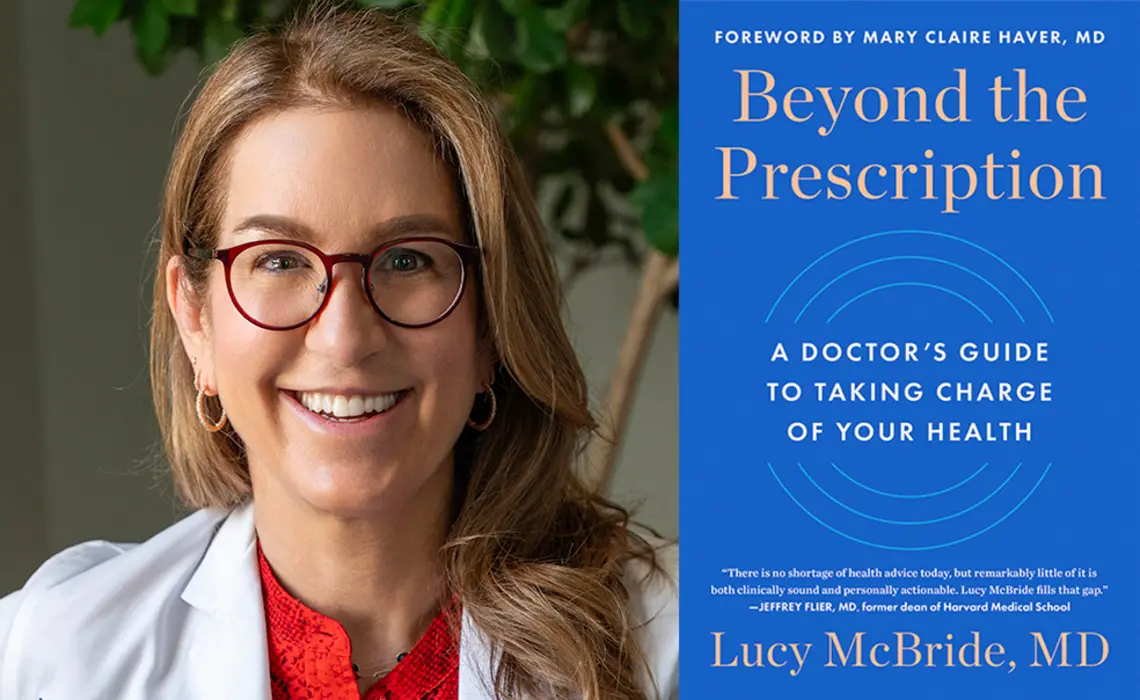
Dr. Lucy McBride ’95 Wants a Sea Change in Healthcare
“I have massive amounts of hope. … We have so much more agency over our health than we think”

Published Aug. 14, 2026
Dr. Lucy McBride ’95 has a message for anyone frustrated with our nation’s broken healthcare system: You have much more agency than you think. In her new book, Beyond the Prescription, McBride, a primary care physician, offers a detailed guide for seizing that agency, from looking at labs in context, to getting your doctor to understand you as a person, to defining what health means on your own terms. “Health isn’t about getting all the answers,” she says. “It’s about asking better questions of yourself and of the people responsible for your care.”
Listen on Apple Podcasts • Spotify • Soundcloud
TRANSCRIPT:
I’m Liz Daugherty, and this is the Princeton Alumni Weekly’s PAWcast, where we talk with Princetonians about what’s happening on campus and beyond.
Have you ever walked out of a doctor’s appointment feeling rushed, unheard, or misunderstood? If so, you’ve experienced a symptom of a much larger ailment affecting our healthcare world. Dr. Lucy McBride, from the Class of ’95, is a primary care physician in Washington D.C., who during the COVID pandemic began her transformation into a public voice, pushing for a data-driven, patient-centered, holistic approach to healthcare. She has a newsletter and a podcast, and now her many thoughts have bubbled over into a new book. Titled Beyond the Prescription: A Doctor’s Guide to Taking Charge of Your Health, it’s meant as a handbook, a guide for all of us seeking a healthy and fulfilling life. Sick or well, young or old, tiger or no.
Lucy, thank you so much for coming on the PAWcast.
LM: Liz, thanks for having me.
LD: I have to start by telling you that I am a big fan of your newsletter, and I have been since it first began during COVID. I loved the common sense approach that you take and how you encouraged us all to use good information to make decisions that are right for our individual health situations and risk tolerance, which of course, that varies huge. And I got the same feeling from reading this book.
So, tell me about this book. Where did you get the idea for it and what are you trying to accomplish?
LM: Thank you so much for reading my newsletter. This book is basically my ode to anyone who’s left the doctor’s office with a prescription and no clear plan, who then goes on the internet to find out what’s wrong with them and is equally confused by what they read online. Through no fault of physicians, patients are hurried through transactional appointments. They’re treated like a set of labs or a bag of organs. And also, understandably, people are drawn to experts online and sometimes people who aren’t experts, who are selling the illusion of control and sometimes pseudoscientific advice.
So, this book is really designed to help people who don’t have time with their doctor, who are confused, and who want to be healthy. It’s a way to transfer power, so to speak, from my office and from forces online to the individual, so that you can have a better sense of agency over your own health.
LD: I’ve had that experience of being in a doctor’s office and feeling like I’m being rushed out the door and it’s a short conversation. It’s not a very detailed conversation. The doctor doesn’t really know me. And you wonder, how did we get here? You know what I mean? How did this happen?
LM: So, primary care has been hollowed out. Ninety-five percent of healthcare spending in the U.S. goes to damage control, downstream problem-based care. Hospitalizations, ER visits, prescriptions, and procedures. Only 5% of healthcare spending goes to primary care prevention. The conversation between patient and doctor, a conversation that has to be built on trust and rapport, that can only come from time spent. Doctors in the U.S. are rewarded for volume, so seeing as many patients as possible in a short amount of time. We’re not rewarded for outcomes or that relational aspect of care. When, what do patients want and what do doctors want?
We want the same thing. We want a place to be known, understood, reassured, and given information and guidance that actually fits our life. The sad thing is that, like I said, doctors and patients want the same thing, but the system is so broken because of the way the payment model is. We end up shortchanging patients and also, as a result, physicians are leaving primary care and medical students are not going into primary care fields like they used to. We are facing a massive shortage of primary care doctors right now, and it’s only going to get worse.
LD: Like medical students look at it and they go, “Wow, that is not the place to be. That’s no fun, that’s stressful”? Is that what’s happening?
LM: You said it.
LD: Oh, wow.
LM: You said it. I mean, if you leave medical school with loans and you’re thinking about quality of life, you’re looking at primary care with some trepidation, because they see, these medical students and residents see the writing on the wall. That you are given say 15 minutes to care for my patient I saw last week who’s 80 years old, was just hospitalized for a hip fracture, she’s on three or four medications for her heart. She’s just lost her husband two months ago and is grieving and can’t make it to the pharmacy to get her prescriptions and doesn’t have help.
That visit requires more than 15 minutes. And if you’re a medical student or resident thinking about what field to go in, you want to go into a field where you feel morally whole. You feel like you are actually helping people. And I’m not saying that medical school students shouldn’t consider primary care. I want them to. I think we need system-wide reform, however, for it to be more appealing to graduates.
LD: Tell me, so you’re a primary care physician and you have been for a really long time. You have a ton of experience here. How do you handle that? Because the stories that you offer in the book, and there’s a ton, and they were all really interesting, you are clearly taking the time to really get to know your patients. How do you do it? Are you doing all this in 15 minutes? Or have you cracked the code here?
LM: So, a couple things. One, I’ve built my own practice. So, I left the system. I was part of hospital systems in my training and afterwards. And I realized pretty early on that I wasn’t going to be able to practice medicine the way I was trained to and in a way that served patients and my own sense of duty to the whole person. So, I started my own practice in 2024. And this book is basically my ode, again, to anybody who doesn’t have a doctor who has more than 15 minutes with them.
I’ve also realized in caring for patients for 25 years, the set of questions to ask that then elicit the kinds of solutions patients are looking for. And that just takes practice and time and a curiosity about human beings.
Since I was a medical student, I was always interested in the human experience of illness, how your perspective, your past experiences, your everyday life informs how you make decisions and how you live with uncertainty. And so, I’ve just honed that scale over time with my patients being my best teachers, because the questions that we tend to ask patients in a 15-minute appointment are transactional and checklist-like. And that works if that’s all the time you have. But if you have the luxury of time and/or you have a really empowered patient who knows exactly how to squeeze the juice out of that 15 minutes — hence my book — then you really get to understand what is at the root of a lot of people suffering and what people need. It’s not all one thing. But you have to understand the human in front of you before you give them recommendations and guidance.
LD: Well, and the thing that you seem to find over and over again is just the incredible interconnectedness of all of our symptoms or all of our systems, I should say. And this has been one of your things for a long time too. I remember you saying over and over again during our PAW panel a couple of years ago that mental health is health. And you’re finding these mind-body psychology physiology connections that seem to get lost when you don’t have a doctor who’s kind of fully listening, right?
LM: That’s right. The most important data for your health doesn’t live in a lab test. There’s no blood test for despair or social isolation. There’s no MRI for a history of childhood trauma that then informs your relationship with food or alcohol or other people. So, it’s only in conversation and in relationship with a trusted guide that those invisible metrics can be elicited. And even before a trusted guide, you have to build rapport. And if the pandemic showed us nothing else it’s that we are living in a trust desert. The patients don’t know who to trust. And sometimes doctors aren’t the ones to trust either. I’m just saying that trust is at such an all-time low in health institutions, in physicians, in the medical establishment, that it’s even more important than ever to establish that trust by seeing the person, putting my laptop down, looking people in the eye.
The bar is pretty low, Liz. Patients are surprised sometimes, new patients, when I ask them questions like, tell me about how long you’ve been married? Or how do you manage work-related stress? Or not just how much do you drink, but what does alcohol do for you or against you? What purpose does it serve in your life? They’re like, “Oh, gosh, I’ve never been asked these questions.” I’m like, that is so nuts because these things have everything to do with your life. They also have everything to do with whether or not you’re going to trust me and take my advice. I could tell you to quit drinking and work on stress and give you prescriptive advice, but it doesn’t land if there isn’t trust there to begin with.
LD: Are you hoping that this book gets in front of doctors, as well as patients? Because I was wondering if the problem is that there are doctors out there who want to do what you’re doing, but they don’t have the time. Or whether they’re not really trained to think this way, that they’re trained to be like, “Oh, here’s what your blood work says. Here’s your statin.” You know what I mean?
LM: Absolutely. I think, doctors, first of all, we want to help people. No one goes into primary care as a field without an eye for the human being, the human experience of suffering or the human experience of tolerating risk. But even the most well-trained physicians don’t always have time. So, the audience is the consumer of healthcare information and the patient, but the audience also is physicians, to help them mind the gap between their desire to ask patients more nuanced questions and the execution of it.
We need lots of reps to get comfortable asking patients sensitive things. But if I’ve learned nothing else in my practice over 20 plus years, sometimes the most important question you can ask somebody after you’ve established rapport is, what’s the thing you’re most embarrassed to say out loud to me? Or what’s the thing that holds you back with regard to your health habits? The things that they are embarrassed or afraid to mention are often where the conversation should live and often elicit the most relevant information for that patient’s health.
LD: That’s so interesting. So, if you’re the patient and you’re going to go see your doctor, should you be thinking along those lines? Dig deep. What is going on in your life, and try to convey that in a way to your doctor. You know what I mean? Can you make a doctor, who maybe is going to give you those 15 minutes, listen to you?
LM: So, this is why I wrote this book. It’s literally a roadmap. It’s not a here’s-what-to-do book. It’s a here’s how to think book. Here’s how to think about yourself first. Here’s how to ask yourself your own internal library of material that you have at your fingertips. And here’s how to put it on paper. And then here’s how to bring a more robust rendering of your health ecosystem to your doctor’s appointments. And here’s some questions to ask your doctor that are going to elicit the kind of answers that you want, not someone else wants, but that you want.
So, basically, the first step, Liz, in the book for patients is to redefine health on your own terms. If you don’t define health on your terms, then you run the risk of your doctor defining it for you or the wellness industry defining it for you. For example, you may be somebody who in five years wants to be working less and having less stress and lose 10 pounds. You may be in five years someone who wants to be on fewer medications. You may want to be somebody who in five years is optimizing every body part, that you are optimizing your sleep, optimizing your steps, optimizing your protein intake, and you will do whatever it takes to do what the gurus tell you to do. In other words, you want to understand what health is for you and what it means for you before you let someone else give you advice on it.
If you think about it, if you’re a management consultant and you’re helping a company be more efficient or be more purposeful or have more impact, you’re not going to execute a strategy or a plan for that company until you understand what their goals are. What are their mission, vision, and values? So, I’m asking the patient to do the same thing. Step back from the lab tests and the rote questions your doctor asks you and think about, first of all, what does health mean to you? What do you want that to look like in a year, five years, 10 years? What matters to you? Why are you alive in the first place? It turns out those questions matter because it’s a lot easier to make decisions when you know why you’re alive and what your core values are to begin with.
LD: That makes a lot of sense. And I think going through that process, and it’s a very detailed process. If you read this book, you will go through quite the internal conversation.
LM: Excavation.
LD: Yes, excavation. Way better than what I think a lot of people are doing, which is the wellness culture thing. Being bombarded on social media or even in mainstream publications, sometimes I feel like there’s just a lot of health advice, right?
LM: Yes.
LD: And I’m looking at how to avoid microplastics and coffee is good for you. Wait, it’s bad for you and take magnesium and try a beta blocker. And it’s exhausting and it’s piecemeal. It’s not tailored to who you are. What do you think is happening with all of that? Why are we seeing this explosion of wellness stuff out there? What’s happening?
LM: Well, I think the wellness industry is, first of all, well-intended in many ways. I am a fan of wellness. I believe in longevity. Those are good things. What I think wellness is doing, big wellness as an industry: Wellness has met the moment. It’s giving people what they’re looking for, which is the feeling of being understood, being validated. And by the way, giving a lot of good advice. Who doesn’t recommend meditation and yoga and exercise to their patients?
The problem is that it is prescriptive in many ways. It’s protocolized. It’s also for-profit. So, it’s not tailored to the consumer who’s sitting in front of their computer, wondering why they’re tired and have brain fog. It is aspirational and often gives the illusion of control where there isn’t control.
So, I want the average consumer of health information to be able to first ask themselves, is this person credentialed in the thing they’re giving advice on? Credentials aren’t everything, but they do matter. So, I wouldn’t, for example, want a patient of mine to get nutritional advice from someone who is a physical therapist or a trainer. I wouldn’t want someone to get cardiovascular medical advice or advice about a GLP-1 from an online provider who knew them for 10 minutes. The decision to take a supplement, the decision to start a GLP-1 or to take hormone replacement therapy is so nuanced. It’s why we go to medical school. It’s why we do training. It’s why we sit in front of patients every day and learn from patients themselves.
And so, I worry about people taking advice for problems that they may not even have in the first place, and then leading themselves down rabbit holes that are expensive, sometimes pseudoscientific, and that don’t actually solve their actual problem.
Take someone who’s sitting in front of ChatGPT, who types in, should I take a GLP-1 for my weight gain and prediabetes? So, it will spit out a good answer. It will spit out a sophisticated answer. It will spit out an answer that’s quick and sometimes more empathetic than the doctor, if you were even to get them on the phone. The problem is that the question the person’s asking may not be the most salient question. This person may be dealing with a binge-eating problem or a stress eating problem or a body image problem, or they may not have access to healthy foods. They may not know that granola and yogurt and berries they eat every morning has lots of sugar.
In other words, ChatGPT and these online bots and a lot of nutritional influencers will give you solutions. But first, you want to make sure you’re asking the right questions. And that requires surfacing that question in front of a trained physician who can connect the dots between how you feel, how you think, how you behave, and your labs. And then execute a plan or help you formulate a plan based on your actual life, not aspirational prototypical advice.
LD: That makes a lot of sense. I noticed in the book that you very accurately noted the pessimism that a lot of people approach their healthcare with. And it could be it’s sort of ambient in the water right now, or they’ve had a bad experience or the cost that they end up turning to something like ChatGPT. Can you offer us some hope and encouragement here?
LM: Yeah.
LD: If we go through this process of excavation, can we get there? Can we find people who are going to connect the dots and make us healthier? You know what I mean? Give me some encouragement.
LM: So, I have massive amounts of hope. First, we have so much more agency over our health than we think. That’s the whole point of this book is that you have much more control than you think. It’s just not always in the places you’re looking for it.
I want people to understand that they hold in their own bodies and minds an immense amount of information and data that can be deployed in a sophisticated way if they only bring it out. So, this book is trying to help people elicit all the questions that their doctor would like to ask them if they only had time. And then step two is to map your health ecosystem. After you redefine your health, map your health ecosystem. What do I mean by that? You are more than just the sum total of your lab tests. You make decisions every day about your health, whether you know it or not. You make decisions about risk tolerance every day, whether you know it or not.
So, what I’m asking you to do in the main book of the book is to map your health ecosystem. Understand what’s your relationship with food, not just how much fiber and protein do you get, although the amount matters as well. Let’s think about your body as a container that drives you through life. And let’s think about how you maintain it. Probably less well than your car, if you’re like most people. So, let’s think about pain, mobility, flexibility, in a way that you’re maintaining your skeletal health and connecting how you feel in your body to your lab tests. And then let’s talk about mental health. And let’s talk about the stories you tell yourself and how the shoulds and the “I’m not the kind of person who takes a pill,” how those narratives that we live by and sometimes that aren’t rooted in fact inform your health decisions.
So, I’m asking you to do a whole lot of work. This is slow medicine in this book. Because your doctor’s not going to have all the time in the world to ask you these questions, you can do the work on your side of the table and then bring better questions to your doctor when you have the chance.
So, to answer your question, Liz, I’m optimistic that patients can be more empowered, and that’s why I wrote the book. I think it takes work and it takes time. It’s much easier to get a readout from ChatGPT than it is to sit down and ask yourself, where did that internal narrative about worthiness, shame, come from, and how does it inform whether or not I take my doctor’s advice or whether or not I start an exercise program, or whether or not I start physical therapy? Or how does it inform why I keep refusing to get a mammogram or a colonoscopy?
And I’m not saying that everybody has some deep-seated psychological problem that’s holding them back. I’m saying that every human being defaults to factory settings when they’re under stress or when the circumstances aren’t perfectly aligned. So, you just want to know yourself. Self-awareness is a superpower and you’re not going to become self-aware in the doctor’s office in real time. You’re going to do it on your own time.
LD: I think that that makes so much sense. And I really like how the approach, it’s individual. Because some people are going to be able to get to that optimal exercise program and some people just aren’t. So, it’s like what is going to work for you? And be realistic about it and find a way that’s going to work for your goals. You know what I mean? It seems like the doctors always want to do the same thing, and this just makes sense.
LM: Yeah. I mean, it’s very easy for me to say to a patient, eat less processed food and less sugar. Drink less, exercise more, and your cholesterol and blood sugar will be better and you’ll feel better. It’s very easy to say those words. The problem is that mortals, regular people have real lives. They are caregiving, they’re parenting, they are anxious, they’re avoidant. They have internal narratives that cause them to self-sabotage unintentionally. So, it’s only when you can really get honest with yourself, and understand how your habits are informed by the actual time in your day, and the decisions you have made, and the priorities you have, that you can then take some ownership over your health.
I can tell people all day long how to reduce their blood sugar and improve their diabetes. And I believe in that advice and I believe in prescriptions and I believe in medications as well, but applying it in real life is a whole other endeavor. And that requires a partnership with the patient. The patient has to be self-aware first.
LD: And treat the person, not the paperwork.
LM: That’s right. That’s right. Yeah. I mean, for example, Liz, you can have two patients with very high cholesterol. One patient has high cholesterol despite exercising most days of the week, despite not eating red meat, and adhering to a high fiber or high protein, low cholesterol diet. And their cholesterol is high because of genetics. And their dad had high cholesterol. And it’s no mystery as to why their cholesterol is high, but they’re trying to exercise their way out of having high cholesterol or even heart disease as a result of it.
And then you have a patient who has high cholesterol because they’re stressed, they’re anxious, they’re stress eating, they don’t have time in their day to go to the gym or to prioritize themselves. Maybe they’re caregiving for somebody and they can’t take time to chop broccoli.
And then you have people all in the middle. So, who gets Lipitor? Well, if you have five minutes with those two patients, both do. But to empower the patient is for patient one to say, look, this is not your fault. And also, there’s no amount of exercise that is going to drop your genetically informed LDL. And so, you probably need Lipitor to prevent heart disease. And then remove the stigma and shame of needing Lipitor in the first place because they think they can optimize their way out of it. The second person needs permission to be human. And they may need Lipitor just to bridge the gap between their caregiving responsibilities and the time during which they have more bandwidth to exercise. Or they just need permission to take time out of their busy caregiving day to take a walk around the block. Or maybe they need a little bit of both, a little Lipitor and a little bit of self-compassion.
That is personalized medicine. That is what everybody deserves and should have a right to. It’s not complicated. It does, though, require a conversation.
LD: Well, in the end of your book, I loved how you got back to this idea of if everybody starts to push all this information on their doctors and bring this to them, maybe we would see a reaction from the healthcare system, which that might be really optimistic, but boy, do I love that idea.
LM: Yeah. I don’t think doctors are the bottleneck. I think the number of primary care doctors is the bottleneck. And as a primary care doctor who has patients bringing reams of information, and tracker data, and internet, and news headlines to my office, I can acknowledge that doctors don’t love being told what to do.
LD: You don’t say.
LM: And they already are burnt out and frustrated.
So, I think that systems change because of one person at a time. So, one empowered patient becomes two empowered patients, becomes four. There’s an exponential increase in power when people realize what they can expect or what they should expect from the medical system. And I think people vote with their feet. And I think people, when they realize what they’re not getting and what they should be getting, that creates systemic change over time.
LD: Well, a systemic change, maybe we’d see more people who want to be primary care doctors, right?
LM: That’s right. That’s right.
LD: Fingers crossed. That’d be amazing.
LM: It would.
LD: So, we’ve actually gone through a lot of my questions. Is there anything else that you want to touch on or anything you’d like people to know?
LM: I think if I had one desired outcome from this book, it would be that patients realize they have more control over their health than they think. And that they would reframe health as something that happens to them. And instead, health is something that happens with them and because of them. And know that health isn’t about getting all the answers. It’s about asking better questions of yourself and of the people responsible for your care.
LD: I love it. Well, thank you so much for taking the time for this. I’m going to include links to the book, to your podcast, to your newsletter, all on the PAW website so that people can check it out.
LM: Great. Liz, thank you so much. I really appreciate your taking the time.
LD: Yeah, absolutely.
PAWcast is a monthly interview podcast produced by the Princeton Alumni Weekly. If you enjoyed this episode, please subscribe. You can find us on Apple Podcasts, Spotify, and SoundCloud. You can read transcripts of every episode on our website, paw.princeton.edu. Music for this podcast is licensed from Universal Production Music.
Paw in print
October 2026
Holding on to Jewish life; Katy Anderson Keating ’08’s career in wine; Hollywood loves Princeton.
No responses yet