
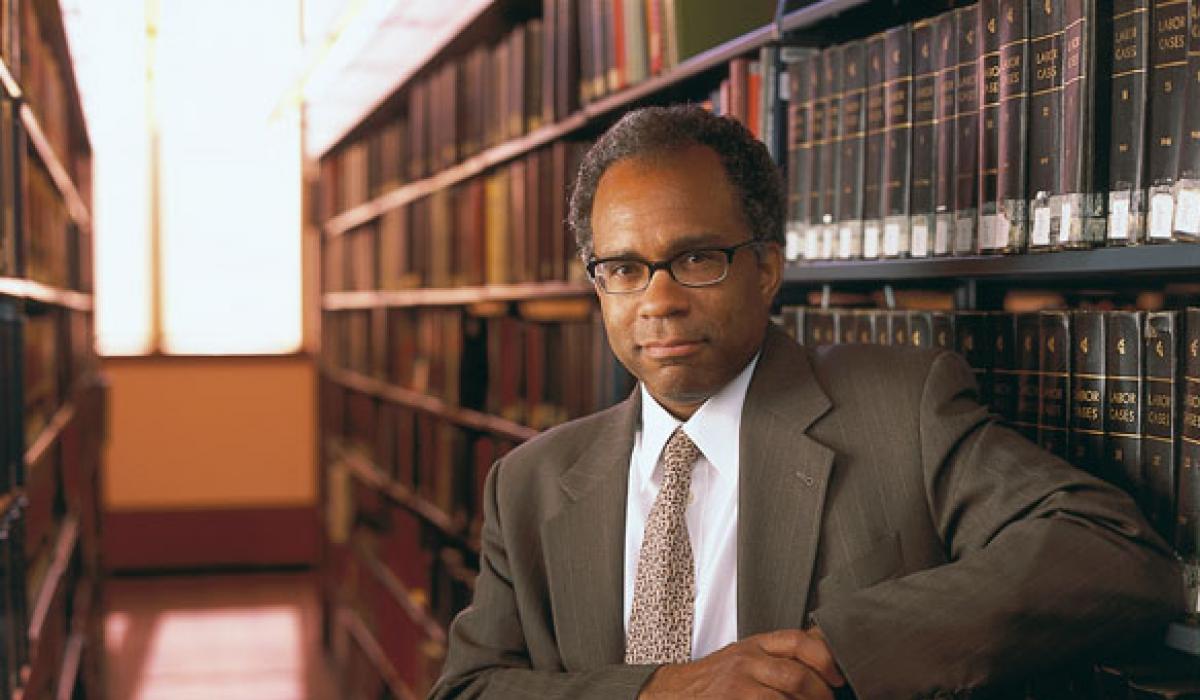

Each spring, the Harvard Black Law Students Association hosts a conference in which black alumni return to share their experiences since graduation. Invariably, writes Randall Kennedy ’77, a Harvard law professor, the older alumni exhort students to avoid “forgetting where you came from,” to “give back,” and to “stay black.” Some of the speakers insist that these soon-to-be lawyers forgo bond work and big-firm salaries, eschew middle-class comfort, and dedicate their careers to helping less fortunate African-Americans share the benefits they have enjoyed.
Kennedy looks on skeptically, and believes that many of the black law students do, too.
“Most people in the audience silently dismiss the demand for maximalist sacrifice,” Kennedy, who is African-American, writes in his new book, Sellout: The Politics of Racial Betrayal (Princeton University Press). “They have come to Harvard because they want to enhance their upward mobility.” Like their white classmates, many of the black students want to pursue high-paying careers at powerhouse law firms, not jobs where they would work on behalf of the underprivileged. But the black students often join the big firms apologetically.
“I tell my students that they should not permit an inflated conception of racial obligation to weigh them down,” Kennedy says. “I tell them that they should pursue happiness untrammeled by excessive racial dues. I tell them that if civil rights law or some similar enterprise is their passion, then they should certainly pursue it — not as an exercise in martyrdom, but as a fulfilling expression of what they most want to do with their talents.”
It might not seem an exceptional sentiment to say that people should be free to follow their passions, but if the choice is framed as one of putting loyalty to self ahead of solidarity with one’s race, it stirs more than a little controversy. African-Americans who are thought to turn their backs on their brethren are sometimes branded “sellouts,” Kennedy says. He himself has been called one — and, not surprisingly, he rejects the label. He studies this explosive issue in his latest book, exploring the idea of selling out one’s race by beginning with the provocative question: “Who is black?” Over the next 194 pages, he ranges from an examination of Barack Obama’s ability to “choose” to be an African-American, to a defense of Supreme Court Justice Clarence Thomas against charges of race betrayal.
The subjects should come as no surprise from an author whose previous books have taken on such charged topics as the treatment of African-Americans in the criminal-justice system (Race, Crime, and the Law, 1997) and interracial marriage (Interracial Intimacies: Sex, Marriage, Identity, and Adoption, 2003). In his most famous and controversial book, Nigger: The Strange Career of a Troublesome Word (Pantheon 2002), Kennedy meticulously dissected an epithet that cannot even be uttered in polite company.
Any good scholar is unafraid to confront the unconfrontable, while any good lawyer can wade against the conventional wisdom to argue a case wherever it may lead. But if race is one of the third rails of American social discourse, to be avoided altogether or approached with extreme delicacy, Kennedy not only touches the rail, he seems to grab it with both hands.
Kennedy is no polemicist, however; his books have been praised for their original, even-handed, and scholarly treatment of controversial subjects. The professor “frequently throws the cold water of common sense upon issues that are too often cloaked in glib histrionics,” wrote The New Republic. Historian Arthur Schlesinger called Race, Crime, and the Law “an original, wise, and courageous work that moves beyond sterile arguments and lifts the discussion of race and justice to a new and more hopeful level.”
“It’s so standard Randy,” Eddie S. Glaude Jr. *97, the William S. Tod Professor of Religion and the Center for African American Studies, says of Sellout. “He has this wonderful and provocative voice that is so important to forcing a vibrant conversation.”
But Kennedy’s work also draws criticism, much of it from other African-American scholars and much of it directed at his attempts to criticize blacks and excuse whites when he thinks they deserve it. Glen Ford, co-publisher of the online journal The Black Commentator, has scorned Kennedy as “a specialist in telling white people exactly what he thinks they want to hear.” Reviewing Sellout in The New York Times, Jill Nelson called some of Kennedy’s ideas, such as his suggestion that some slaves may have had legitimate reasons for warning their masters of planned uprisings, “deeply disturbing.” In a 1998 article titled “The Strange Career of Randall Kennedy,” Derrick Bell, formerly Kennedy’s colleague at Harvard, cried, “Come home, Randy! We advocates of racial justice need you on our side, not in our way.”
Melissa Harris-Lacewell, an associate professor of politics and African-American studies at Princeton, chooses her words carefully when assessing Kennedy’s work. Though she respects his scholarship, she is troubled by some of Kennedy’s suggestions, such as one in Race, Crime, and the Law that the incarceration of black lawbreakers actually might benefit the broader black community because its members are disproportionately the victims of violent crime. “It’s not that I perceive Randall as a sellout,” she explains, “but it’s not brave to attack marginalized people.”
None of this criticism, Kennedy says, bothers him in the least. “There are other people ... who have had tough things to say about me, and my feeling is, no hard feelings,” he insists. “Life goes on. I have tremendous respect for my fellow ... professors, including those who have been extremely critical.”
In his personal life, Kennedy has navigated between the hope that race can be transcended and the belief that racial identity may be immutable, a split reflected within his own family. He was born in Columbia, S.C., the middle child of a postal worker and a schoolteacher who fled the Jim Crow South for a mixed neighborhood in northwest Washington, D.C., when Randall was a boy. From his mother, Kennedy says, he inherited a “South Carolina sensibility” that stressed the importance of manners and good behavior. If Rachel Kennedy’s children came to breakfast without saying good morning in a cheerful voice, she would send them back upstairs and make them come down again to do it properly. If anyone ever directed the “N-word” at him, Kennedy once told an interviewer, his mother instructed him to ignore it. His father’s advice, on the other hand, was “to go to war.”
Henry Kennedy Sr., who had been orphaned in Louisiana, “was deeply scarred by racism and never forgave American society for it,” his son recalls. Randall remembers him as someone who would choose sports teams to root for based on which had more black players or a black coach. Randall Kennedy’s older brother, Henry Kennedy Jr. ’70, now a judge on the U.S. District Court for the District of Columbia, recalls their father praising Stokely Carmichael and H. Rap Brown, the leaders of the radical Black Panther Party.
Looking back, Kennedy says that although he was influenced by his mother’s pragmatic optimism, his work still reflects an inner struggle with his populist, sometimes angry father. While Henry Kennedy Sr., who died in 2002, would have celebrated his son’s success, he also was a “staunch ‘race man’” and would have objected to some of his work — for example, an article Kennedy wrote for The Atlantic in 1997 in which he rejected racial kinship or even racial pride in favor of an ideal in which (quoting the philosopher Michael Sandel) “the self is installed as sovereign, cast as the author of the only obligations that constrain.”
Though the two never discussed that article, “My father would have been totally against what I wrote,” Kennedy says.
The civil rights movement was at full tide during Kennedy’s childhood, and he remembers family debates about the wisdom of “getting in trouble” when his South Carolina cousins were arrested during sit-ins. Whatever his father’s opinions about going to war over slights and taunts, the Kennedy children were not going to be demonstrators. “We were expected to get a great education and be excellent at whatever we did,” recalls Randall’s brother, Henry. “Racism? So what? Overcome it by being better.” All three siblings — the youngest is Angela ’85, now a lawyer in the Washington, D.C., public defender’s office — went to Princeton.
In addition to using their talents, the Kennedy children overcame racism with the help of influential whites. Henry, a star tennis player in the D.C. public school system, had a job tending the courts at the St. Albans tennis club, adjacent to the tony St. Albans private school on the grounds of the National Cathedral. Randall frequently went along and, when the courts were empty, the brothers would play. He remembers doubles matches on Sunday mornings in the late ’60s against Defense Secretary Robert McNamara and National Security Adviser Walt Rostow when the courts were supposed to be closed for cathedral services. A wealthy white member of the tennis club took notice of Randall and suggested to Kennedy’s father that he apply to St. Albans.
A scholarship student, Kennedy admits that during his first several years at prep school he was only a mediocre scholar and cared more about playing tennis. It was not until his junior and senior years that he began to apply himself to his studies, strongly influenced by the late John F. McCune ’52, a history teacher who Kennedy says first instilled in him a love of historical research and writing. Well respected by his classmates, Kennedy twice was elected class president.
At the urging of another St. Albans alumnus, Harvey Freishtat ’68, his brother Henry had gone to Princeton, a decision that Randall Kennedy remembers as a turning point in both their lives. “There was a sense of excitement and accomplishment that was truly transformative,” he says of the day in 1966 that his brother received his Princeton acceptance letter. “It transformed the ambitions of the family.” Seven years later, Randall was persuaded to go to Princeton by Thomas Hudnut ’69, then a teacher and college counselor at St. Albans, passing up a full scholarship to the University of North Carolina.
Once at Princeton, Kennedy largely kept to himself. He had to work to pay his tuition, manning the desk at the Woodrow Wilson School library and washing dishes at Colonial Club, where he says he preferred to work alone, with the radio blaring in the background. He rarely visited Prospect Avenue and says he “would have felt funny being in a club.” Though some of his roommates belonged to Cottage Club, he recalls a club steward looking at him during one of his few visits in a way that made Kennedy uncomfortable, and he did not go back.
Over the years, Kennedy would return to Princeton as a trustee in the 1990s and for a second term beginning in 2005. He would see a campus that was much more integrated than the one he knew as a student. The current administration, he says, has shown more commitment to building a campus that is welcoming to black students. “When I was there, black students didn’t feel that it was their university. There was a considerable amount of alienation.” Yet when asked if he felt alienated, Kennedy insists that he did not, that he did not mind the isolation because he did not expect Princeton to provide a social network for him. “What I wanted from my college was a great library, great teachers, and a great classroom experience. And I got all those things.”
Indeed, Kennedy shone academically. James McPherson, the George Henry Davis 1886 Professor of American History, emeritus, remembers Kennedy as the only undergraduate in his graduate seminar on the Civil War period and holding his own with the more advanced students. Kennedy recalls, almost wistfully, spending his evenings working alongside the history graduate students on the C Floor of Firestone Library. For fun, he would go to the Annex on Nassau Street and argue historiography with classmate Pope McCorkle ’77. Under McPherson’s guidance, Kennedy wrote his thesis on historian Richard Hofstadter and graduated near the top of his class, his undergraduate career capped off by a Rhodes scholarship.
From Oxford, Kennedy went to Yale Law School, to clerkships with Judge J. Skelly Wright on the U.S. Court of Appeals and Thurgood Marshall on the Supreme Court, and quickly thereafter to a teaching position at Harvard Law School, where he has been ever since. But his role has not been that of a typical academic. Rather, like Cornel West *80, the Class of 1943 University Professor in the Center for African American Studies, Kennedy has tried to speak to an audience beyond the walls of the academy and to carve out a role as a public intellectual. A former member of the editorial boards of magazines such as The Nation, Dissent, and The American Prospect, Kennedy describes himself as being “on the left end of liberalism” (he is a strong Obama supporter this spring), though he quickly adds that he is “wary of labels, because they become a shortcut to thinking.”
But when Kennedy declines, for example, to denounce the use of the N-word in all cases, suggesting instead that it “depends on how somebody’s using it because ... like every other word [it] takes its meaning from the circumstances,” there are those who are ready to label him as insufficiently sensitive to or willfully dismissive of the concerns of other African-Americans. Though no one questions Kennedy’s erudition, some have challenged his motives. Why rush in to such charged arenas? Whom is he trying to serve? Is Kennedy an advocate? A contrarian? Or simply an honest interpreter?
“I hope to shed light on topics that interest me,” Kennedy says, explaining why he writes his books. “That’s it. Behind it is a faith that people make better decisions with more information and better ideas. So I hope the people who read my books will make decisions for purposes of creating public policies or finding happiness in their own lives. I’m not running for anything. ... I’m pretty much of a loner. I like going my own way; I choose my own topics. I try to explore them in an interesting way.”
Glaude suggests that most people “want to flatten the complexity of African-American thought. Randy’s writings aim to prick the conscience of his readers. I don’t think he’d be happy if everyone agreed with him.”
Kennedy suggests that the criticism directed against him comes because he has been willing to grab those racial third rails, including one of the most electrified: affirmative action. Many on the left want to know: “Are you an uncritical, unwavering, unquestioning advocate of affirmative action?” he says. “Well, I’m a proponent [of affirmative action], but I ask questions about it.”
So does Clarence Thomas, and in an exercise certain to send up howls, Kennedy tries to show in Sellout that Thomas cares deeply about his fellow African-Americans and, in fact, consciously takes into consideration the effects his decisions will have on them — much more than the other conservatives on the bench with whom he often is lumped. Thomas simply sees those interests differently than do many liberals. Kennedy goes on to rip much of Thomas’ jurisprudence as simplistic, inconsistent, and sometimes sloppy. That makes him a weak justice but not a racial sellout, Kennedy says.
“I simply insist,” Kennedy concludes in the Thomas chapter, “that assessments [of selling out] be scrupulous in the handling of evidence, attentive to the complexity of motives, attuned to the costs of surveillance, and aware that sensible people can, in good faith, seek common aims by different, even fiercely conflicting means.”
As for that provocative opening question — “Who is black?” — Kennedy writes that the answer is uncertain. But his aim is not so much to produce an answer as to tease out the premises of the question and then play with their applications. To pick one example, he concludes that Obama, the son of a Kenyan father and a white American mother, did “choose” to be black, despite Obama’s contention that he had no choice and despite the contention of a small number of African-Americans that the only people who can call themselves “black” are those descended from West African slaves. Obama could, Kennedy posits, have emulated Tiger Woods and identified himself as something other than an African-American — but he did not, and then he reinforced that decision by marrying a black woman, living in a black neighborhood, and worshipping at a predominantly black church.
“Sometimes I do something that some people find irresponsible,” Kennedy admits. “It’s very often the case that I don’t truly know what I think about something until I have written about it and essentially tried it on. ... I think people sometimes say that the problem with that is: Aren’t you afraid somebody might say that’s a good idea, when you think later that it’s a bad idea? And that has happened.” As an example, Kennedy cites his earlier support for the strict enforcement of drug laws, which he now thinks unfairly harm blacks. But he continues: “I can’t control what people do with things I write.”
His books, Kennedy says, “are part of a conversation. So I’ve got several hundred pages where I go on with the conversation, and at some point I subside. I don’t believe in the definitive treatment. There is no such thing. Ten minutes after I get the first copy of the book, I look at the first page and immediately I’m starting to edit.”