

Campus Building Boom Enters a New Phase
After completion of the art museum and health center, next projects include two science buildings and Hobson College

Construction is slowing at Princeton after nearly a decade of expansion, but there are still plenty of workers in high-visibility vests around to complete major projects such as Hobson College, the Quantum Institute, the transformation of Guyot Hall into Schmidt Hall, and the campuswide switch to sustainable energy and water systems.
Hobson College, the newest residential college, is on track to be completed in the spring of 2027 and to house its first 510 occupants that fall. Named for Mellody Hobson ’91, co-CEO of Ariel Investments, the college is located on the site once occupied by First College (formerly Wilson), north of Poe Field.
“The interior finishes are happening, landscape is happening, pathways are happening,” Ron McCoy *80, the University architect, said of Hobson during the summer. “It’s completely coming together right now.”
According to McCoy, Hobson’s landscape includes seven distinct gardens, and the inside features mass timber and bright colors, with the intention of being warm and inviting. Facilities incorporated feedback from the community into design plans, such as requests for abundant natural lighting, informal meeting spaces, and a space large enough to host the entire college.
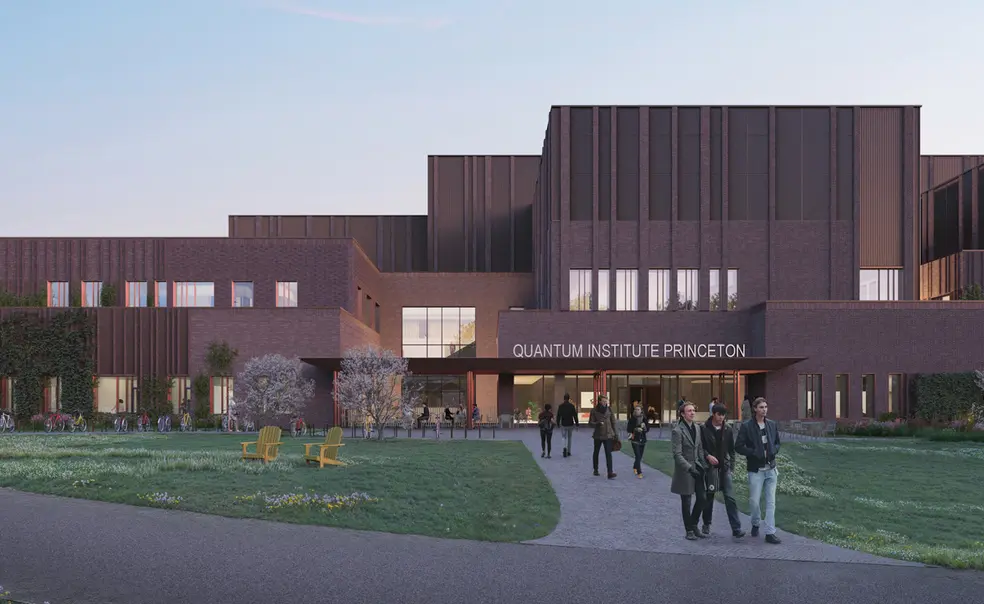
Construction of the new Quantum Institute, which will be situated south of Ivy Lane and north of Roberts Stadium, is still in the early stages. For the last few months, drilling has taken place to install 131 geo-exchange wells. The institute should be completed and occupied by the end of 2029.
McCoy described the building as a “Formula One racing car wrapped in the brick skin of a humanities building.” It will house sophisticated laboratories, but the exterior will be inspired by classic masonry and brick traditions. The most striking feature is likely to be the ivy. “I cannot tell you how much time we have spent on this project in order to design the locations for the vines in ways that our grounds crew can manage them,” said McCoy with a laugh.
The conversion of Guyot Hall into Schmidt Hall symbolically started in May with a groundbreaking ceremony featuring President Christopher Eisgruber ’83, Provost Jennifer Rexford ’91, and Eric Schmidt ’76 and his wife, Wendy, for whom the building is named. Eric was formerly CEO and executive chairman of Google, and then chairman of parent company Alphabet, and together with Wendy created the Schmidt Family Foundation in 2006.
Related coverage
Where Old and New Meet
As part of its biggest expansion ever, Princeton is transforming its campus while attempting to balance tradition and change
Guyot Hall was built in 1909 to bring together the geology and biology departments, while Schmidt Hall will become a computational hub and be home to the Department of Computer Science. When originally announced in 2019, Schmidt Hall was slated for completion by 2026; PAW reported in 2024 that it was scheduled to open in 2029, but McCoy told PAW that occupancy isn’t expected until the second quarter of 2030. Frances Hannan, facilities communications manager, said via email that the delay allowed “time for other projects to be completed and [to] move out Guyot Hall researchers.”
Schmidt Hall is being “totally gutted,” according to McCoy, but will still look like Guyot from the north once complete. Laboratory additions from the 1960s and 1980s will be removed, and an addition of 136,000 square feet will more than double the footprint. The new building will feature mass timber and “a beautiful set of gardens on the inside courtyard,” McCoy said, similar to an original design that was never realized. Challenges include untangling the building systems from adjacent neighbors, as well as asbestos removal.
Pursuant to Princeton’s goal to achieve net-zero emissions by 2046, as of June about 32% of campus has switched to the new geo-exchange system — which uses pipes underneath the ground to capture and store heat that can be used to warm and cool buildings — as well as converted to a hot-water system rather than steam. The West Plant near Theater Drive Garage is also being converted from a gas-fired to a hybrid utility plant that will be part geo-exchange, like the TIGER facility that was completed in 2024, and part traditional energy.
Facilities is also just starting to create a roadmap for dormitory maintenance projects. McCoy said all dorms will be reviewed “holistically to see how we can calibrate our major maintenance investments over the next 15 years to tackle things that are most necessary in terms of current functionality and most desirable in terms of impact for the investment.” This includes Forbes College, which, following the opening of Hobson College, will be used as a swing space, though its long-term future is still being decided. “If a building has to come offline during the academic year, then we’ve got Forbes as a home for students,” said McCoy. Projects may be as short as a couple months, while others will take longer.
McCoy described most of the major work as on “the edges” of campus. Given the completion of buildings in the core of campus over the last couple years, such as the Princeton University Art Museum and Frist Health Center, he hopes “people are rediscovering the campus rebuilt and reconnected and refreshed, but also retained.”
The Latest
See all


Related News

McCarter Theatre’s First South Asian Play Took Me Back to Forbes Basement
A Beat of Our Own is about a college dance team not unlike Princeton South Asian Theatrics



1 Response
Rocky Semmes ’79
1 Month AgoOn Classic Masonry and Brick
The comments of University Architect Ron McCoy *80 can cause constant curiosity regarding their candid sincerity. They seem sometimes intentionally hypocritical platitudes, intended primarily to perpetuate the positive public relations of his office. One wants to favor him with the benefit of the doubt, because surely he is not any disciple of deliberate deception.
But in an earlier PAW review of the new Art Museum, he projected what might be perceived as double-speak in addressing that monstrously majestic mass as a building that “embraces the landscape around itself and brings that landscape into the room.” Then, in the most recent PAW (in apparent attribution to Mr. McCoy), it is reported that the exterior of the new Quantum Institute on campus “will be inspired by classic masonry and brick traditions.”
The dependably defining faithful features of “classic masonry and brick traditions” are the arch and the massive stone lintel. Neither of these two features is anywhere evident in the box-like rendering of the Quantum Institute. One wants to be charitable, but there is some strain.