Slide Show: Alexander Gardner's Civil War Photographs
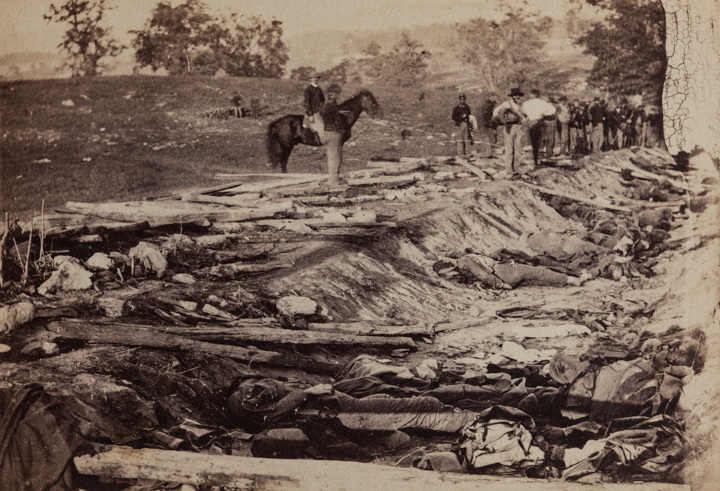
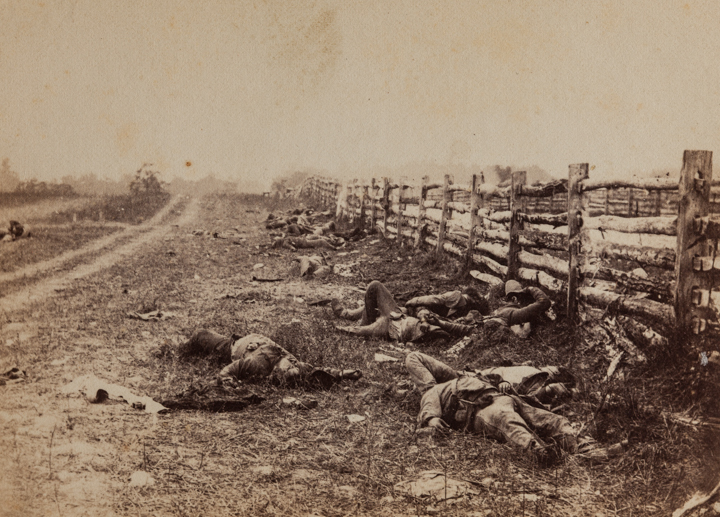
“View of Ditch” — The ditch was used as a Confederate rifle pit during the Battle of Antietam.
Manuscripts Division, Department of Rare Books and Special Collections, Princeton University Library/Ricardo Barros

“View in the Field” — Two days after the battle of Antietam, Gardner shot this image of Confederate corpses lining the Hagerstown Road.
Manuscripts Division, Department of Rare Books and Special Collections, Princeton University Library/Ricardo Barros

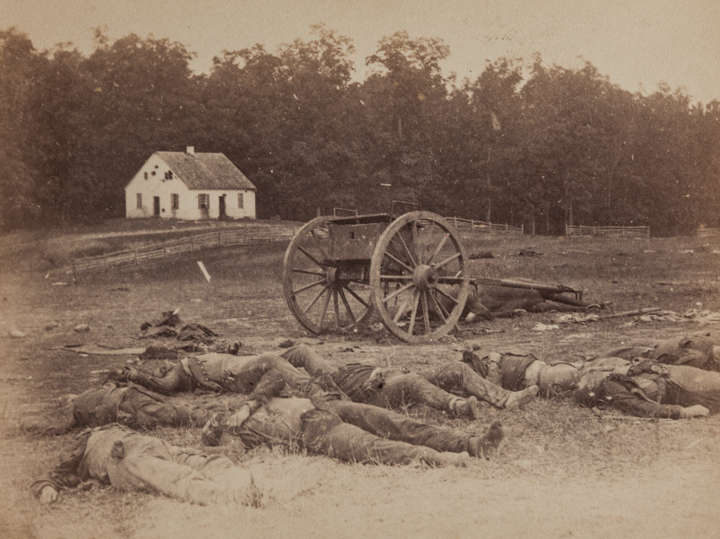
“Completely Silenced” — Dead Confederate artillerymen as they lay around their battery following the Battle of Antietam. In the background is Dunker Church.
Manuscripts Division, Department of Rare Books and Special Collections, Princeton University Library/Ricardo Barros

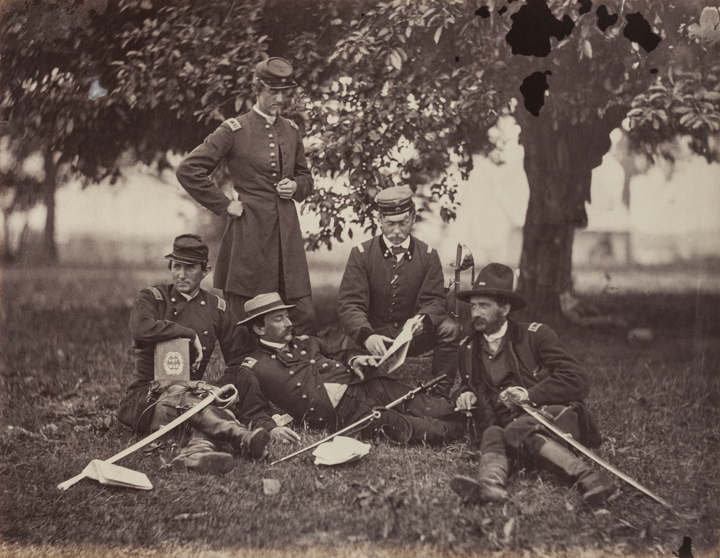
“Studying the Art of War, Fairfax Court-House, June 1863” — The five men shown here, including a Prussian and a Swede, underscore the international flavor of the war. Gardner singled out for special praise Col. Ulric Dahlgren (standing), “handsome, chivalric, one of the bravest of the brave,” who later was killed while leading an attack on Confederate headquarters in Richmond.
Graphic Arts Collection, Department of Rare Books and Special Collections, Princeton University Library/Ricardo Barros

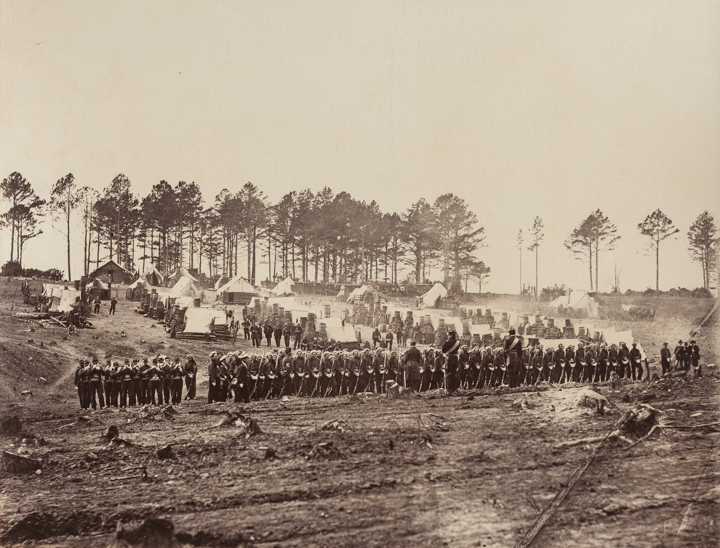
“Guard Mount Headquarters, Army of the Potomac” — The 114th Regiment of Pennsylvania Volunteers, under the command of Captain Collis, chose to fight in the gaudy red uniforms of Zouaves, French soldiers in the north of Africa. Wrote Gardner: “The affection of the soldiers for color is extraordinary; no statistics, showing the large increase of casualties in showy uniforms, could induce the Zouzous to part with theirs, and in this dress the 114th … participated in some of the bloodiest battles.”
Graphic Arts Collection, Department of Rare Books and Special Collections, Princeton University Library/Ricardo Barros

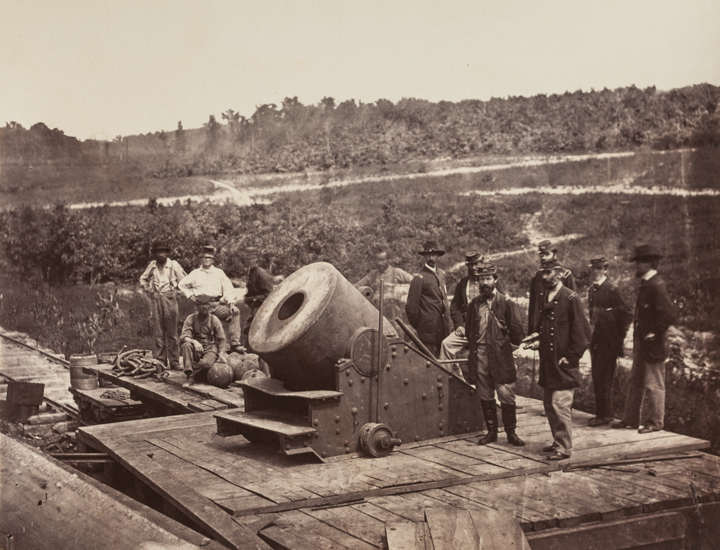
“Mortar Dictator, Front of Petersburg, October 1864” — This mortar weighed 17,120 pounds and was capable of firing a 200-pound shell more than 2.5 miles, as it is believed to have done during the siege of Petersburg. “The bursting of the shell was described as terrific,” wrote Gardner, “an immense crater being formed in the ground where it fell, and earth, stones, and sod being scattered in every direction, much to the consternation of the inhabitants of the place.”
Graphic Arts Collection, Department of Rare Books and Special Collections, Princeton University Library/Ricardo Barros
The Latest
See allRelated News
These Three Tigers Are Working to Elevate Pro Women’s Lacrosse
WLL players Marge Donovan ’22 and McKenzie Blake ’25 and executive Rachael DeCecco ’03 see big potential in a new league
Screenwriter and Producer Jennie Snyder Urman ’99 Brings Bold Women to the Screen
Urman’s fingerprints are on Gilmore Girls, Jane the Virgin, and most recently the Matlock reboot
Songwriting Class Is a Princeton Atelier Tradition
Laura Hwa ’26 estimated that she and her classmates collectively wrote around 70 songs this spring


No responses yet