

Where Are All the Small-Town Folks at Princeton?
Students from rural communities make a case for why more ‘small-townness’ could make the University a better place

I come from a small town in South Carolina called Edgefield, home to acres and acres of peach trees, Southern accents, and a tight-knit community — all the small-town feels. Upon arriving at Princeton, though, I soon realized that not too many students are from places like Edgefield. Since 2022, less than 10% of freshmen responding to the Daily Princetonian Frosh Survey have said they are from a rural area; nationwide, 20% to 25% of Americans live in rural communities. Why are rural students underrepresented at Princeton?
According to geography-rooted admissions records of the Seely G. Mudd Manuscript Library, Princeton started to emphasize “regionalization,” or the process of locating high-achieving students from all regions of the world, as it witnessed an increase in applicants near the latter half of the 20th century. Becoming coeducational in 1969 and welcoming more students of marginalized backgrounds around the same time, the University began to attract a wider audience. Nonetheless, after interviewing students, faculty, and alumni from rural backgrounds, I found that regional representation does not guarantee rural representation.
Shelby Bussey, a sociology graduate student whose research chiefly involves rural issues, stresses the simple idea that admissions representatives of top-tier universities often do not reach out to rural high schools. “If you were running a business, are you going to go to the small town with 10,000 people to recruit the best of the best for your [business], or are you going to go to the big metropolitan area where you can attract everyone and then weed out the best and the brightest from there?” she asked.
But Princeton Dean of Admission Karen Richardson ’93 told PAW this is a misconception, both for Princeton and its peers in STORY (Small Town Outreach, Recruitment, and Yield). In the fall of 2025, Richardson said in a statement, Princeton admissions visited “over 300 schools where we didn’t have a prior visit on record,” many of which are in rural areas.
“Rural outreach is an important and intentional part of our admissions outreach strategy,” Richardson said. “Students from rural areas have lived experiences that contribute to Princeton's robust and diverse student body.”
The priorities of high schoolers from rural areas may not include going to a school like Princeton. Sociology professor Kathryn Edin, a leading poverty researcher from Staples, Minnesota (population: 2,989), contends that “the deepest disadvantage in the U.S. is found in not urban places but rural places.” In rural areas, where many families are “just trying to survive,” said Edin, researching information on top prestigious universities is not top of mind.
Further, for the handful of rural high schoolers who do consider attending a highly ranked university, they are frequently met with what Jack Busche ’19 calls “reverse prejudice.” Busche, a pastor from Stratford, Wisconsin (population: 1,581), maintains that his family was very supportive of his decision to enroll at Princeton, but when engaging with his wider small-town framework, he was regularly met with criticism. People asked, “What do you need to go there for?”
A place like Princeton can “feel like somebody else’s reality,” according to Ally Lloyd ’26, a School of Public and International Affairs major from Reardan, Washington (population: 637). For many small-towners, the collegiate Gothic walls, five-star-buffet-level dining halls, and mostly Northeastern dominance of Princeton seems meant for another kind of person.
At the same time, rural students who come to Princeton are an asset to the campus community. Lloyd said growing up in a place where community members wholeheartedly know and support one another taught her to not “brush by” people but to rather treat them as individuals. Such profound levels of collectiveness and selflessness are what prompt Lloyd to, for example, hold the door open too long for others and try to make small talk in scenarios that may seem mundane, like ordering pizza.
Like Lloyd, I feel that my rural roots enable me to appreciate the importance of what most would deem “unimportant.” On campus, one can easily fall victim to a “go-go-go” nature, sweeping past the ordinary and solely fixating on the extraordinary. However, if there is anything I have learned from growing up in my small town, loving the little things would be one. As I go about my day-to-day routine on campus, my “small-townness” reminds me to, for instance, greet the custodian of the dorm in which I reside, push in my chair and clean up after myself after finishing a meal at RoMa, pay close attention to my professor as she delivers a lecture that she has spent hours meticulously crafting, and, simply, strive to keep a smile on my face.
Rurality does not take away from the Princeton experience; it adds to it. My rural upbringing has taught me to treat the mundane as momentous, something that often can be undervalued at Princeton. As Lloyd told me, “The way that [a rural person] shows up for people is so elite in a way that elite institutions could use more of.”
The Latest
See all


Related News
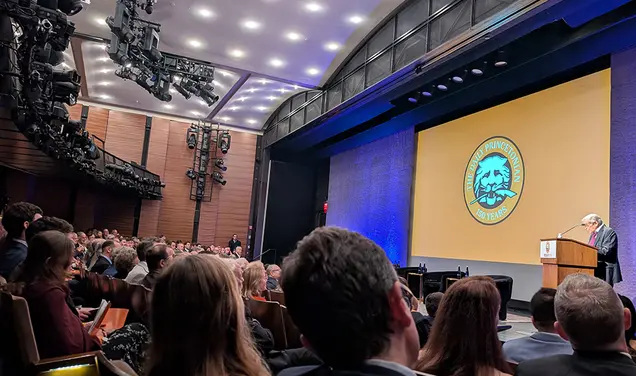
With Prominent Journalists and Hoagies, the ‘Prince’ Celebrates 150 Years
A gala at the New York Historical raised roughly $400,000 for the independent student newspaper

2 Responses
Ken McCarthy ’81
3 Months AgoAppreciating Courtesy and Respect
The natural courtesy of small town folks is an under-appreciated superpower as many “country boys” who‘ve made it in the “big city” have demonstrated over the centuries. Drive and intelligence alone without universal respect is like a three-legged stool. Sharp elbows will only get you so far.
Paul A. Hager ’64
3 Weeks AgoSmall-Town Student Experience from an Earlier Era
I read your piece with great interest, nostalgia, and empathy. I grew up in the 1950s on a dairy farm in upstate New York on the northern edge of the Catskills. I attended school in the small town of Bainbridge, population about 1,800. I graduated valedictorian in my class of 37, including my twin, who attended Lafayette College. Unlike many of my classmates, we were children of college educated parents. My mother graduated from Elmira College for women, while my father attended a two-year state agricultural college. The family had no connection with Princeton, but I had learned of it through the football exploits of Dick Kazmaier, although I never played the game. To the best of my knowledge, no other student from Bainbridge Central School has ever attended the University.
In those days, Princeton was just beginning to “diversify” its student body, although its culture was still heavily driven by the prep school sons of the wealthy. It was many years later that I began to think of myself as an affirmative action rural admit. Needless to say, my two public (but urban) school roommates and I were not bickered by Ivy or Cap. In general, however, I did not feel the sting of class prejudice often, as we were much too busy with our schoolwork to attempt to have much of a social life. Remember in those days, Princeton had not gone coeducational and rarely admitted racial or ethnic minorities. I vividly recall my course schedule: English, history, German, physics and architecture (both with labs), mandatory freshman phys ed, Army ROTC, and drill team — 28 hours first semester, 27 the next with a Saturday morning German class. I practically lived in Firestone and still barely survived academically. My little high school did not teach anything remotely like AP courses.
But in my sophomore year, I switched to a history major and graduated with honors at a time when no more than about a third of all graduates did so. I then got accepted into a history Ph.D. program at the Johns Hopkins University. I spent the rest of my career teaching and administering at three prep schools and saw my daughter graduate from Princeton in 1991. Attending Princeton was one of the greatest honors of my life. In my retirement, my wife and I returned to upstate New York, but Princeton is still not getting the best students from our rural public schools, which like you is unfortunate for Princetonians coming from urban areas. Not all of us are country bumpkins lacking in the social graces or political troglodytes.