


Calculating Fortune
Why operations research and financial engineering has become one of Princeton’s most sought-after majors

Katy Milkman ’04 still remembers the opening lines of a lecture by Princeton probability professor Erhan Çinlar: “To understand the importance of this class, you first have to recognize that it’s really about Tyche, the [Greek] goddess of chance, and the hand she holds and the role she plays in every aspect of our lives.” With awe, Milkman recalls how Çinlar outlined the many outcomes in life guided by this “uncontrollable, but predictable to some degree, element of choice.”
Today, Milkman is a professor of operations, information, and decisions at the University of Pennsylvania’s Wharton School whose podcast Choiceology explores true stories about making high-stakes decisions. “Now I study judgment and decision-making,” she says. “A huge aspect of this are the ways that people misunderstand Tyche.”
The epicenter of Tyche-related research at Princeton takes place on a quiet corner of campus between the Friend Center and Mudd Library, home to Sherrerd Hall, a building that former Princeton communications officer Chris Emery once described as a “deceptively simple glass cube.” Inside, you’ll find quiet study spaces, screens displaying the names and photos of undergraduate and graduate students, chalkboards marked with long and mystifying equations, and above a stairwell, a painting of a lecturing Çinlar, who retired in 2015.
If Sherrerd Hall appears “deceptively simple,” the academic department the building houses is anything but. Operations research and financial engineering, better known as ORFE (pronounced OR-fee), is one of the most in-demand majors at Princeton, but to outsiders, it may also be the least understood. “It’s a slightly convolved name, and it either means nothing or means many things to many people,” professor and former ORFE chair Ronnie Sircar says.
To explain to loved ones or friends what they do, some students in the department say they study a more legible subject, offering recognizable terms such as “applied math” or “probability.”
“Even now, I still struggle to explain really what ORFE is to someone who has no idea,” says Christina Li ’26, now an investment analyst at the Princeton University Investment Co. (Princo).
ORFE’s instruction rests on the intersections of statistics, probability, and optimization, analytic skillsets that provide quantitative insight vital to many fields. Some ORFE graduates found startups in Silicon Valley, but others take their research into various niches — from predicting the probable path of a pollen particle in the wind, to automating the rating process for diamonds, to evaluating trends in literary fiction published in The New Yorker.
And despite the awkward explanations ORFE students must endure at their Thanksgiving tables, ORFE has the highest student-to-faculty ratio of any Princeton department (22-to-1, compared to the University’s overall 5-to-1 ratio), with packed lectures and enrollments that creep up every year. According to Sircar, a record 102 undergraduates in the Class of 2029 have chosen the major, and about 500 Ph.D. applicants vie for 25 spots in the department annually. What accounts for ORFE’s enduring popularity?
“That’s an easy answer,” says emeritus professor Robert Vanderbei, one of the former chairs of the department. “It leads to a career of making billions of dollars.”
Vanderbei is exaggerating, but only slightly. Though some ORFE grads pursue academic paths, a majority of the department’s graduates leap into careers as analysts at elite asset management firms such as BlackRock, investment banks including Goldman Sachs, or hedge funds like Citadel.

To understand what operations research entails, consider the predicament of a traveling salesperson. This professional wants to visit four cities before returning home to New York — say, London, Istanbul, Paris, and Frankfurt — and they want to do it in the most cost-effective way. To calculate that, one might have, as an input, the cost of a flight between any of the two cities: For example, the cost for a flight from Paris to London, London to Istanbul, and so forth, until one has priced out every point-to-point combination. Then, one might ask, what is the optimal order for visiting the cities to minimize the cost? Would it be cheaper to fly from London to Istanbul, then Istanbul to Frankfurt, followed by Frankfurt to Paris? Or is there a better combination that results in a lower total fare?
“It’s a classic problem in operations research,” ORFE professor and department chair Amir Ali Ahmadi says. “This is a hard problem to solve, and we teach our students different optimization tools to approximately solve it.”
However, in real life, Ahmadi says, the traveling salesperson problem is even more complex. To truly find the most efficient route, one would have to consider the price of hotels on particular days, and whether there might be other constraints. Perhaps the salesperson needs to be in a specific city on a certain day to attend a conference, or he or she is required to spend at least two days in each city.
“This is no longer the problem they saw in my class,” Ahmadi says, explaining that for his students, they must now determine if “the algorithm they had for the simple problem extends to the more complex problem,” and if not, they’d have to try to design a new algorithm to address that more sophisticated question.
“We teach the right way of thinking about these problems in an application-agnostic way,” Ahmadi explains. “The problem they’re going to have in their first job is never going to be exactly what they saw in the classroom, so they need to be able to modify whatever they learned to [address] the problem that they now have at their company.”
And the potential optimization problems are endless. Another example: An airline must decide how much to charge for a seat on a given flight. If the seat is too expensive, it may not be purchased. If it’s too cheap, the airline may lose money. Then, imagine the flight is two weeks out, and only half the seats are purchased. Should the airline raise or lower its prices?
“These are all situations where a large-scale decision needs to be made,” Ahmadi says. “We’re talking about decisions on prices of thousands of flights. There is uncertainty of some sort — in this case, the demand for these flights. And there is an objective function. There is something you want to maximize. Maybe it’s the satisfaction of customers; maybe it’s revenue.” (Hint: It’s probably revenue.)
Put another way, ORFE, according to recent graduate AbdurRahman “AR” Bhatti ’26, “is the study of how we apply order to chaos.”
The field of operations research traces its origins to World War II, when mathematical models were applied to problems of logistics and management. Princeton mathematicians and professors played a starring role in the burgeoning discipline: John von Neumann contributing to the Manhattan Project; Albert Tucker *32 and Harold Kuhn *50 in advancing the theory of convex optimization; and John Nash *50, the inspiration for the 2001 film A Beautiful Mind and Sylvia Nasar’s book of the same name, in developing game theory. In the field of probability, Gilbert Hunt conducted foundational work on Markov processes, a type of forecasting. Meanwhile, the development of early computing went hand in hand with Princeton’s early forays in operations research, notably through the work of Alonzo Church 1924 *1927 and Alan Turing *38.
Though the University was influential in developing many of the quantitative principles that ORFE’s scope would eventually encompass, its formation as a distinct department took longer to materialize. In 1965, a statistics department was spun out of the math department, only to be shuttered 20 years later with its statisticians embedded in other departments, including civil engineering, which in 1986 appended “operations research” to its title, reflecting its new duty of teaching statistics and probability.
The faculty teaching operations research then consisted of a small group, including John Mulvey, René Carmona, Vanderbei, and Çinlar. According to Carmona, their classes were immediately popular, exceeding demand for courses in traditional civil engineering. After founding a master’s program in financial engineering, the operations research faculty increasingly found themselves a victim of their own success.
“Not only [did we have] this huge undergrad population and not enough faculty to teach all the courses,” Carmona says, “but we now had this master’s [program] we were creating classes for, and we didn’t have the personnel to teach them.” In Carmona’s telling, most finance master’s students were more keen on finding a job in industry than pursuing academic research, creating a mismatch between the theoretical basis of the department and what some of these graduate students were after — a preprofessional track.
In 1997, Ben Bernanke, chair of the economics department and future Federal Reserve chairman, spearheaded the creation of the Bendheim Center for Finance, which joined forces with operations research faculty to set up a master’s program in finance; this degree replaced the previously overwhelmed financial engineering master’s program.
In 1999, the disconnect between the civil engineering and operations research wings of the department became untenable, and the University decided to split the departments. “The faculty [in civil engineering] were nice people, but I still don’t know anything about what they do,” Vanderbei says. (Indeed, the “ancient” schism is memorialized by the ORFE summer softball team, coached by the department’s longtime professor Alain Kornhauser *71, nicknamed “Civil Disobedients.”)
“That was a very natural split,” concurs professor and former ORFE chair Mete Soner, adding that “it made sense for the school to have some activity in finance, given the fact that we do not have a business school.” In effect, Soner says, the new master’s program formed the Princeton alternative to a traditional MBA-style program in finance.
According to Carmona, it was Jerry Ostriker, provost at the time and an astronomer by training, who coined the name “operations research and financial engineering,” which was initially controversial among associated faculty.
“A lot of e-commerce players don’t look at it as a three-part optimization problem. The great thing that ORFE brings, as a mindset, is that ability to look at things from a more crosscutting lens — being able to dive in deep and get into the details when
it does matter.” — Nate Faust ’02

“Some of us, including me, were very nervous of the idea of putting together ‘financial’ and ‘engineering,’” Carmona says, “because it sounded too much [like] we would teach [students] how to cook books.” On the other hand, the name presented intriguing symmetries with other departments. “After all, there is ‘chemical engineering,’ there is ‘civil engineering,’ there is ‘electrical engineering,’ why not ‘financial engineering’?” Carmona says.
Christened with its unusual acronym, ORFE was officially born, and like its antecedent programs in the civil engineering department, it quickly attracted a following. One of the department’s earliest graduates was Nate Faust ’02, who declared for ORFE as soon as it became a major. “It seemed to be this perfect intersection of math, finance, and economics,” Faust says. “It was a little bit more mathematically rigorous than econ, but less so than the other engineering [degrees] and more applicable, in my opinion, than many other engineering tracks.” Faust went on to co-found Jet.com in 2014, an e-commerce company that was acquired by Walmart in 2016; he was the senior vice president for Walmart’s domestic e-commerce supply chain and logistics department until 2020.
Faust says that he applied many aspects of the ORFE skillset to his e-commerce career, where he sought to optimize steps in the supply chain between inventory, fulfillment, and transportation. According to Faust, within the e-commerce field these three aspects were typically siloed so that each one’s optimization came at the expense of the others. For example, a Walmart warehouse might be located in a rural area where workers could be paid less and facility costs were lower, but that might be very far from the urban area that the warehouse served, therefore driving up shipping costs.
Another factor was where companies inventoried different types of products. For example, apparel was lighter in weight and didn’t take up as much space relative to other product categories. And since clothing styles changed in demand by season, it made sense to put those products in a more centralized location, rather than rotate out supply at multiple warehouses continuously. On the flip side, because everyday consumable products such as toilet paper and soap were always in demand and tended to be heavier, one wouldn’t want to ship them far because of prohibitive costs; instead, these would ideally be stocked in warehouses closer to urban centers.
“A lot of e-commerce players don’t look at it as a three-part optimization problem,” Faust says. “The great thing that ORFE brings, as a mindset, is that ability to look at things from a more crosscutting lens — being able to dive in deep and get into the details when it does matter.”
That intersectional lens could even be brought to bear on subjects that were not traditionally connected to probability and logistics. Milkman was an ORFE major and an American studies minor, so her senior thesis needed to incorporate both fields. In a much-publicized project, she ended up using 1990s fiction published in The New Yorker to test an assumption made by humanists that contemporary literary fiction tended to be autobiographical. From a sample size of 250 short stories, she classified the texts by their protagonists’ race and gender, as well as other elements, like the perspective of the story (first or third person) and its themes,and then compared these data points with each author’s individual background. Milkman discovered that, yes, people wrote about their own groups and experiences more than other perspectives. However, she also found that “women and minorities were much more likely to write about the dominant group [for example, straight white men] than the dominant group was likely to write about minorities.”
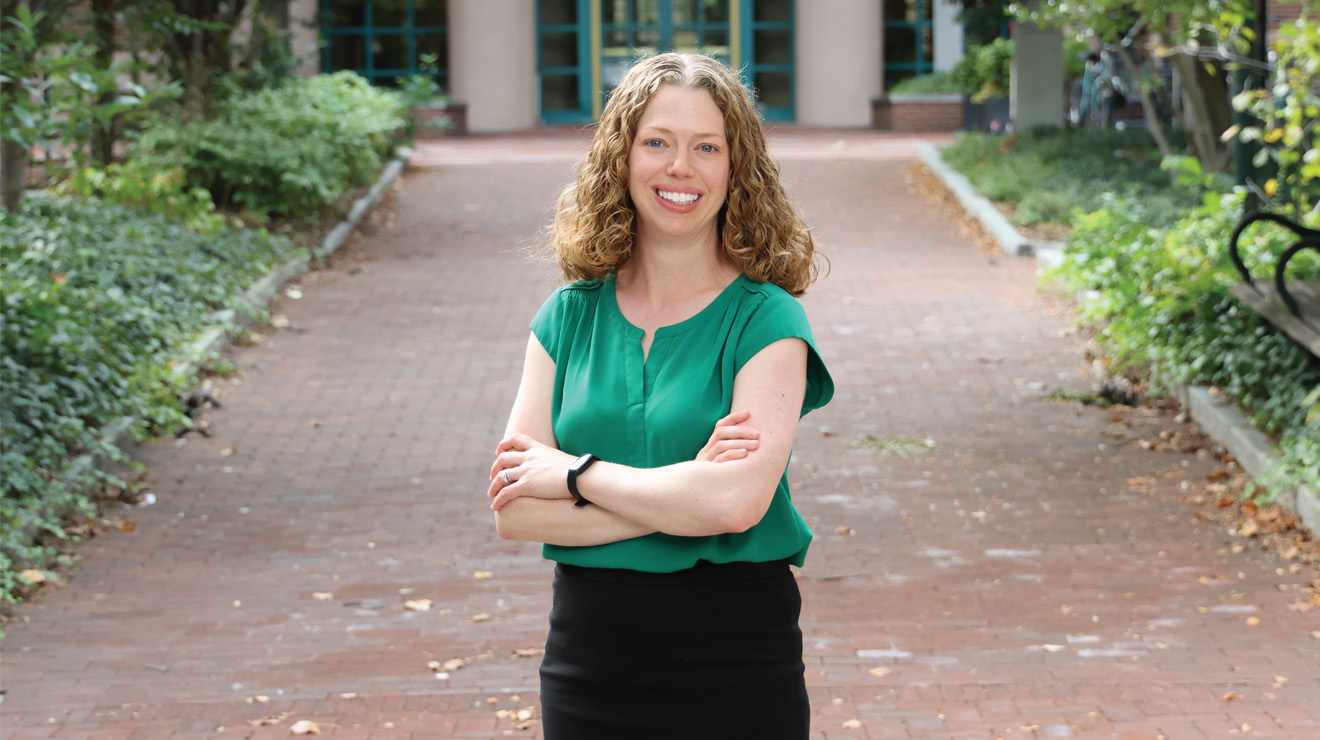
“We step out of our skin more if we’re more underrepresented, which was also really interesting,” Milkman says.
Milkman, who serves on the ORFE advisory council alongside Faust, touts ORFE’s interdisciplinary possibilities. “Being a quantitative, souped-up person is really useful in this day and age,” Milkman says. “I guess you can’t be a curator at a museum with an ORFE degree, though probably there is one.”
Other students have researched topics that are either more traditional to operations research or followed the yellow-brick road to Silicon Valley. Ben Budway, a graduate student in the department, conducts research on the probable route a grain of pollen takes through the air.
Meanwhile, Bhatti took a semester off from Princeton to sell Peloton his startup Ghost Pacer, which developed augmented-reality sunglasses for distance runners. Bhatti’s ORFE thesis, on methods for preventing large language model hallucinations in the patent-drafting process, was part of a Princeton startup called Paragon, formed with computer science majors Ethan Haque ’25 and Claire Shin ’25. Tradespace, an AI intellectual property management platform, acquired Paragon in a seven-figure deal in November; Bhatti is now a vice president at the company.
Occasionally, ORFE majors have brought their own backgrounds to research problems that surprised even their professors. Naman Jain ’17 grew up in a Dubai family in the diamond business, an industry that had been vexed by the process by which diamonds were rated in terms of quality. In his family’s experience, stones were sent to a central agency that charged a hefty fee and took weeks to evaluate an individual diamond in terms of the traditional “four C’s”: color, clarity, carat, and cut. Jain hypothesized that a facial recognition algorithm could be repurposed to rate the diamonds based on a dataset of high-resolution photos. With software based on this algorithm, he could cut out the middleman in the form of the rating agency, saving his parents’ business time and money. But it was only after Jain produced a dataset sourced from his family’s business that Ahmadi told Jain that the project was feasible. In the end, Jain’s algorithm “was almost as accurate as what the experts predicted,” says Ahmadi, Jain’s adviser. “So that was pretty cool.”

In 2020, IBM came out with its own product that superseded Jain’s prototype, but still Jain felt validated that he had anticipated a real need in the market. Now a partner at the investment firm Millennium, Jain has given back by setting up a travel fund named for his late grandfather to support ORFE students interested in pursuing summer internships abroad. “Sometimes it can be difficult while you’re a student to find summer roles or experiences where you can really apply what you’re learning,” Jain says, noting that securing out-of-industry summer placements might be more challenging for ORFE majors, given that the department’s scope of study remains opaque to prospective employers who might never have heard of such a discipline.
In recent years, ORFE has also increased its visibility on campus, producing two valedictorians, Nicholas Johnson ’20, Princeton’s first Black valedictorian, and Taishi Nakase ’21.
Challenges remain, with demand often exceeding capacity. In 2023, The Daily Princetonian reported that over-enrollment in the graduate program had led to a shortage of advisers, leading Prince writer Olivia Sanchez ’26 to quip that it had been a “failure in a different optimization problem — the optimal number of students to accept.”
For ORFE faculty, resources remain a concern, particularly as the Trump administration’s cuts to research funding and grants trickle down to all corners of the University. “I personally hope that we can recruit more faculty just to keep up with the demand from the student side and keep our classes smaller,” Ahmadi says.
Despite the rapid leaps made by the AI boom, ORFE has tried to keep up with the times. To build up its statistics offerings, Jianqing Fan joined the department in 2003 and helped establish the Center for Statistics and Machine Learning in 2012. “That is a testament [to the fact] that we are keeping ourselves modern,” Soner says.
While they mentor students, ORFE faculty have continued to engage with real-world problems. Sircar and Carmona’s research into the demand and performance of electric grids has culminated in the Princeton research group Operational Risk Financialization of Electricity Under Stochasticity, or ORFEUS — perhaps channeling another figure of Greek mythology, the musician who lost his love Eurydice to the underworld.
In Sircar’s course on energy and commodity markets, students use software called Vatic to model electricity usage and pricing on the Texas grid, particularly as demand soars with the growth of energy-sucking AI data centers. “As there is greater demand and prices are going through the roof, what’s going to happen to the grid?” Sircar asks. “Hyperscalers [giant cloud computing companies] would be willing to pay anything for electricity. You and I are not.”
This, Sircar argues, begins to generate troubling dilemmas. “Suppose there is a crunch, on a really hot day in August. Is a data center going to turn off their AI training so that air conditioning can run in homes? Or will they say, ‘No, the business is too important. But we’ll pay you $1,000 per megawatt hour.’”
Perhaps, contrary to Çinlar’s seminal lecture, in the age of AI we are no longer only under the spell of Tyche, the goddess of chance, but contending with a more troubling paradigm: Pandora, releasing unforeseen consequences from her deceptively simple box.
Harrison Blackman ’17 is a journalist and writer based in Los Angeles.
Related News

McCarter Theatre’s First South Asian Play Took Me Back to Forbes Basement
A Beat of Our Own is about a college dance team not unlike Princeton South Asian Theatrics



7 Responses
Richard Hughes ’84
2 Weeks AgoPowell ’77’s Research and Role in ORFE’s Foundation
The article identified a group of operations research faculty who broke away from civil engineering to form the ORFE department. Unfortunately, the article omitted professor Warren Powell ’77, a fantastic teacher and researcher. His teaching and mentorship inspired me to pursue graduate work in operations research and altered the course of my career. Dr. Powell retired a few years ago but continues to publicize his groundbreaking research on modeling sequential decision-making under uncertainty.
Rick Mott ’73
3 Weeks AgoExploring the Traveling Salesman Problem (With Punch Cards)
Seeing the traveling salesman problem mentioned in this article triggered a fond memory. Long ago, when woolly mammoths still walked the hills of New Jersey and I was an EE student, there was no separate ORFE or even CS department. It was all part of EE. Ken Steiglitz taught an algorithms course, and assigned a simplified version in which the goal was to search for a path which minimized total distance traveled. Recall that personal computers hadn’t happened yet, so you had to program on punch cards for the shiny new IBM 360/91 (in the middle of the night, when you had a prayer of getting access). I framed my work in terms of Frodo, a traveling ring salesman who had to visit all the cities of Middle Earth. If I recall correctly, Professor Steiglitz liked that enough to use the same framing for it in his 1982 book, and gave me an acknowledgment.
Rob Hill ’00
1 Month AgoOn Operations Research Pioneer Richard Bellman *46
As an undergraduate classics major who went on to graduate and doctoral degrees in operations research and management science, I enjoyed hearing about Katy Milkman ’04’s application of OR to 1990s New Yorker literary fiction in her senior thesis. It reminded me of a passage from the memoir of the great Princeton mathematician and OR pioneer Richard Bellman *46. Bellman is most famous for his important contributions to dynamic programming and control theory, which also are foundational to today’s reinforcement learning algorithms. In his Eye of the Hurricane, he discusses his time as a graduate student and assistant professor at Princeton, before going on to the RAND Institute, where much of modern OR was developed, recounting a string of adventures and troublemaking along the way, in the manner of Richard Feynman *42 (with whom we worked on the Manhattan Project). He later returned to work on the top-secret Project Matterhorn that became the basis of today’s Princeton Plasma Physics Laboratory. Probably all ORFE students have encountered the Bellman-Ford shortest path algorithm. In his memoir, the brilliant but mischievous mathematician recommends that operations research courses teach Mark Twain’s hilarious essay “Fenimore Cooper’s Literary Offenses,” a surprising recommendation. Although he does not specifically say why, the essay was both a parody but also instantiation of quantification applied to literature. For instance, a typical passage runs, “In one place in Deerslayer, and in the restricted space of two-thirds of a page, Cooper has scored 114 offenses against literary art out of a possible 115. It breaks the record.” The subtle point seems to be, which Bellman made frequently, that effective mathematical models have to be sufficiently complex, but not overly so (indeed he coined the concept of “the curse of dimensionality”), a lesson which is at the heart of OR.
Murphy Sewall ’64
1 Month AgoApplying Operations Research to Water Resources
From the article: “students use software called Vatic to model electricity usage and pricing on the Texas grid, particularly as demand soars with the growth of energy-sucking AI data centers.”
There’s a similar problem for which the same type of analysis is applicable. There are places in the Western U.S. where homeowners and farmers compete for ground water. As demand increases, the water table decreases and wells must be drilled deeper and deeper to find water. Larger and larger agricultural businesses can afford to, and are willing to, drill deeper than households and even whole residential communities, resulting in further decrease in the water table. The OR problem is how to balance the societal need for residential water with the profit oriented demands of agribusiness.
Mark Krosse ’72
1 Month AgoRemembering Past Engineering Offerings
ORFE is very interesting major in the engineering school. In the ’60s there was a major called “Basic Engineering” which, I recall, was a survey curriculum of the other engineering disciplines, but did not have any finance content.
Murphy Sewall ’64
1 Month AgoORFE Would Have Been a Perfect Match
I received my BSE with a major in Basic Engineering in 1964. That major was clearly designed for students who already knew they intended to pursue a graduate degree in engineering or business. After service in the Navy and a “gap year” of sorts, I eventually received an MBA and Ph.D. in business with a concentration in quantitative decision making. Had ORFE existed in the ’60s it would have been a perfect major for me.
Larry Rosenblatt ’75
1 Month AgoEvolution from Basic Engineering Major
As a Basic Engineering major graduating in 1975, and part of the civil engineering department, there was a large business/economics component coupled with heavy engineering as well as a survey of other engineering disciplines. I believe my year there were two or three of us graduating with this major.
Now with quite an evolution, it has gained a lot of popularity.