

Eddie S. Glaude Jr. *97 Examines Race As U.S. Approaches 250th


The book: As the U.S. approaches its 250th anniversary, Glaude offers an analysis of the country’s stated values of liberty, equality, and freedom for all against its long history of racism. While revisiting the words of W.E.B. DuBois, John Dos Passos, Herman Melville, Martin Luther King Jr., and others, Glaude addresses the cycle of contradictions that become especially evident around celebrations of the nation’s anniversaries. In America, U.S.A. (Crown), Glaude doesn’t mince words as he calls for an acknowledgement and reckoning of the country’s past, noting this is key to creating a better future for all.
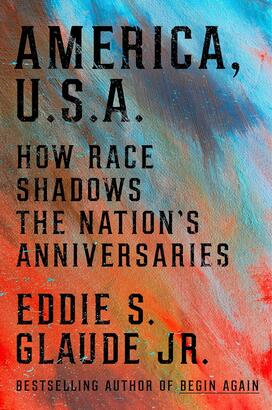
The author: Eddie S. Glaude Jr. *97 is the James S. McDonnell Distinguished University Professor in Princeton’s Department of African American Studies. An educator, author, and political commentator, he examines religion, race, and the American experience. He is the author of several books including Democracy in Black, In a Shade of Blue, and Begin Again. He appears regularly on news programs including Meet the Press and has written for Time magazine among other publications.
Excerpt:
Bitterness At the Bottom of the Cup
I do not love America, and never have, especially now. It seems to me misplaced or dangerous to love something so abstract and so morally dubious. Love is most often felt and experienced close to the ground — in the life lived in a particular place and time, and in memories that take up residence in the heart. I suspect “love of country” is shorthand for the heartfelt relationships and experiences that make us who we are — things that happen in the place we call home, no matter how complicated that place may be. James Baldwin was right: “Whoever is part of whatever civilization helplessly loves some aspects of it, and some of the people in it.” And I suppose that is why, in part, we are willing to risk our lives in defense of this place, and of what it might become.
But in America, those feelings and experiences have always been stained by the ugliness of what white people believe about color — that somehow, or in some inscrutable way, the color of one’s skin determines your value. You end up spending much of your life trying to prove to others and to yourself — not because you are obsessed with white people but because you want to live — that you are not a “nigger.” Some Americans may believe that this view is a relic of a past that we have long left behind. After all, they might say, we elected a Black president and vice president. Look how far we have come. Stop complaining, I hear them say.
You teach at Princeton University. You are not a victim. But I speak from the experience of a life lived in this country, and I trust what I know, what I have seen, and what now sits in the pit of my stomach. Each one of us must face the battle with this place to live fully, and to try to beat back the bitterness that threatens to consume us. It’s enough to drive you to madness. I can still feel the sting of my neighbor’s dad screaming at his son to stop playing with “that nigger,” wondering then what was wrong with him and asking myself what was wrong with me. An adolescent version of a familiar cry arose: Why did God make me a stranger in my own house? Would I resign myself to such a world, or slip into what W. E. B. Du Bois described as a “silent hatred of the pale world . . . and mocking distrust of everything white”? Either way, a wound deposited by a calloused heart made it difficult, if not impossible, to love the country that hurt me. I had to learn, instead, how to survive it.
Bitterness settles in the heart of a child and innocence is lost, because the world announces in stark terms that you, no matter how young you may be, do not belong here. This happens in every corner of the country. The hurt I felt all those years ago wasn’t an isolated incident or something unique to Mississippi or the South. America believed what that man said about me, and that word — that belief — did not die with the civil rights legislation of the 1960s or the election of Barack Obama. Its sentiments and sensibilities have not been relegated to the dustbin of history. Too many lives have been lost since then to believe that. Instead, these ideas about race and about Black people have lurked beneath the surface of American life like a Leviathan. Today, the monster is in full view, eating the souls of the damned.
I saw it with the election of Donald Trump in 2024 as millions of white Americans, and a smattering of others, declared that the country belongs to them. I can hear it in the summary judgments about diversity, equity, and inclusion (DEI): that, by definition, diversity (and the word always seems to refer to Black people) involves the compromise of standards; that Black people in leadership positions, or students who are admitted to Ivy League schools and elite state colleges, or professors like me really did not earn their place — that any attempt to address racism in this country amounts to reverse discrimination. I see the monster in masked ICE agents snatching people out of their homes, at courthouses, in front of schools as parents wait for their children — people the American government has determined do not belong here. Those who still believe themselves to be the “true” Americans repeat an old, insidious idea about white people that requires a certain view of Black and Brown people. The “true” Americans desperately need, and still want, their “niggers.”
No. I do not love America. I only wish that the country could be better, more decent and just, and in wishing that, I confess that I love deeply those who have borne and must bear the brunt of the country’s madness. Even if most Americans don’t see it, that love includes us all. I have set out in this book to assert a certain view of this country, one that I hope will help us make sense of our current malaise as we celebrate 250 years since the founding. America is at once a nation of laws that reflect, ideally, the equal standing of each individual and a white Republic. Freedom animates our way of life and it is the possession of white people to give to others and to take away. These values are irreconcilable and show that a paradox rests at the heart of the nation. When the tension between these two features of the country becomes unbearably felt and known, white America risks everything, including the well-being of the country, to resolve it. The Civil War is just one deadly example of an unsettling truth. Donald Trump’s ascendance is another: some white people would rather destroy the country than face the doubleness that makes it what it is.
I mean by this doubleness something akin to what W. E. B. Du Bois wrote about in his 1903 classic, The Souls of Black Folk, when he declared that the problem of the 20th century was the problem of the color line. It remains our problem, too. Du Bois used the metaphor of the veil to describe the separation between the worlds of Black and white folk, and he detailed the effects of that duality on the way Black people saw themselves:
It is a peculiar sensation, this double consciousness, this sense of always looking at one’s self through the eyes of others, of measuring one’s soul by the tape of a world that looks on in amused contempt and pity. One ever feels his twoness — an American, a Negro, two souls, two thoughts, two unreconciled strivings, two warring souls in one dark body, whose dogged strength alone keeps it from being torn asunder. But, to my mind, this peculiar sensation of “twoness” is not limited to Black folk alone. It is the condition, truly the inheritance, of all Ameri- cans. Its beginnings are found in America itself. American double consciousness is the consequence of a nation that defines itself with the foundational principle of the equality of men and, yet, holds others as chattel or resigns them to second-class status. The principle and the practice cannot coexist without contradictions, and to hold them together, as if they can, is a form of madness. American double consciousness is the outcome of a nation that represents itself as “the shining city on the hill” and, yet, sees itself darkly through the eyes of those who have borne the whip’s lash, who look upon the nation with contempt and pity, who inevitably judge and find the country wanting — a ruthless mirror that lives and breathes. It is the split that comes with the American promise and contempt for that promise — warring ideals, from the beginning, that have threatened and continue to threaten to tear the nation apart. America can never fully banish this sense of twoness — and, at times, it cannot bear the gaze that looks back at it in a haunting reminder. Desperately afraid of being exposed, particularly to themselves, most white Americans have been led by that fear, and continue to be led, into a kind of delirium that erupts, repeatedly, in unimaginable violence and draconian policies. They lash out. They destroy or render entire populations invisible, lock them away in prisons, push them to the edges of our communities, or deport them in order to keep the country, or their idea of the country, from being torn asunder. If the problem of the 20th century, as Du Bois announced, was the problem of the color line, and the color line was a consequence of American double consciousness, and that doubleness persists even today, then the problem of the 21st century is the problem of America’s desperate avoidance of selfawareness — its refusal to know itself fully, and the deadly consequences for people and the world that follow from that refusal. Ours is a time of shattered mirrors.
Excerpted from America, U.S.A. by Eddie S. Glaude, Jr. Copyright © 2026 by Eddie S. Glaude Jr. Published in the United States by Crown, an imprint of the Crown Publishing Group, a division of Penguin Random House LLC.
Reviews:
“With exquisite prose, stunning moral clarity, abundant heart and soul, and utter genius, yet again Eddie Glaude proves why he is so often referred to as the conscience of the nation. It makes the stakes of America’s complex, anguished, and beautiful story clear as a bell.” — Imani Perry, Harvard University, National Book Award-winning author of South to America
“This is a thoughtful, insightful, beautifully written book that is timely and welcomed in these perilous times.” — Bryan Stevenson, #1 New York Times bestselling author of Just Mercy
The Latest
See all


Related News


Janice Lee ’09 Worked to Renovate One of Hollywood’s Best-Kept Secrets
An engineer by training, Lee has been deputy project manager on the renovation of Hollywood Burbank Airport


No responses yet