

PAW Goes to the Movies: Classics Professor Breaks Down ‘The Odyssey’
Christopher Nolan’s hit film returns to one of Western literature’s oldest works: “There is something about The Odyssey that grips us very deeply,” says Johannes Haubold


Homer’s epic poem The Odyssey is one of the oldest works of western literature and also this summer’s blockbuster movie hit. Director Christopher Nolan’s adaptation, starring Matt Damon as Odysseus, was shot entirely on IMAX and is one of the most expensive R-rated films ever made. So far, it has been one of the biggest-grossing movies of recent years.
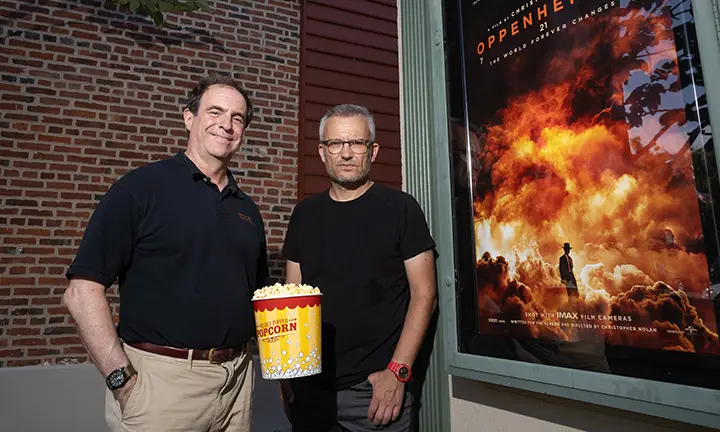
In our latest installment of PAW Goes to the Movies, senior writer Mark F. Bernstein ’83 invited classics professor Johannes Haubold to see The Odyssey and discuss its themes. Haubold, a scholar of Greek, Roman, and Babylonian literature, is the author of four books, including two on Homer. He has also taught several undergraduate courses on Homer and The Odyssey.
How did you like the movie?
I liked it very much. This was the second time I have seen it, and I think I liked it even more the second time. It’s a serious reading of the text. Nolan has his own agenda, and for that he does make sacrifices. But that’s OK because what he gives us is really interesting.
The law of Zeus, of hospitality for the stranger, is a leitmotif that Nolan introduces very early, in the scene with the Trojan horse. The Trojans are going to destroy it, and then someone says, “We and the Greeks share common gods. We share common values.” And so they take it in. But of course, the horse is a betrayal of those values. Odysseus and his men come out later, kill everyone, and open the gates. Everything unravels from that.
The setting of The Odyssey is in the aftermath of the Trojan War. That means also at the end of the heroic era and the end of a civilization. The value system of the heroes at Troy no longer works in quite the same way. Homer illustrates this in the Cyclops episode. Odysseus is so keen to establish his reputation and his fame, which is how you became someone in the world of the Homeric heroes. But that gets himself and his men into big trouble because it tells the Cyclops who he is, which enables the Cyclops to curse him and invoke the wrath of Poseidon. Nolan takes this idea of the end of a civilization and unraveling of a value system, and he runs with it.
In The Odyssey, the emphasis is very much on the man. That’s the first word of the poem, andra. After the war, how do you know what it is to be a man in this world? Yes, you are a husband, a father, a king, and you are from somewhere. You need to get back there. But how do you know that you’ve arrived? You need to be recognized. What does it really mean to be recognized? Nolan is very interested in the bigger picture of this civilization collapsing and how the individual fits into all this.
Related coverage
PAW Goes to the Movies: Professor Alexander Glaser Watches ‘Oppenheimer’
“The movie is a cautionary tale about science, scientific advice, and policymaking,” says the Princeton faculty member and global security expert
There have been many translations of Homer over the centuries, including some by Princeton faculty. Did Nolan rely on any one translation in particular?
Nolan has said that he was inspired by [University of Pennsylvania professor] Emily Wilson’s translation, which came out in 2017. That’s a translation that is deliberately for our time. [Former Princeton professor] Robert Fagles’ translation in 1996 was also very influential and started a modern push towards oralizing Homer. The Odyssey was originally an epic poem, of course, and Fagles wanted a translation that could be read out loud rather than simply read.
Were there any parts of the movie that didn’t work for you?
The Odyssey has broad shoulders. It can take a strong reading, and I think Nolan gives it one. The denouement in the palace is always difficult to pull off. Uberto Pasolini’s 2024 movie, The Return, covers the second half of The Odyssey. In Pasolini’s telling, Odysseus’ wife Penelope is genuinely appalled by the violence he unleashes when he returns. Nolan isn’t much interested in that, but of course that leaves the whole final scene dangling. What do we do with this mountain of dead bodies? Nolan’s solution is to have Odysseus and Penelope go into exile. He sends him west, which is also very suggestive in many ways.
The Odyssey is nearly 3,000 years old. Why does it still speak to us?
We go back to the classics as a way of interrogating ourselves and our culture. I am from Germany, and you saw this very clearly there during the 1990s. There was a massive revival of Homer after unification of the two German states, because Homer was in some sense a reference text for the entire society. Everything had changed. Where would this new Germany go? People went back to Homer to work through these questions.
In many ways, The Odyssey is a universal story. The struggle to return home when the home we return to never remains the same. The struggle for identity and belonging. There is something about The Odyssey that grips us very deeply, and not just for right-wing white males in the West. It is a funny and puzzling and glorious thing how these ancient texts just keep presenting themselves to help us answer these fundamental questions.
The Latest
See all


Related News

McCarter Theatre’s First South Asian Musical Took Me Back to Forbes Basement
A Beat of Our Own is about a college dance team not unlike Princeton South Asian Theatrics



2 Responses
Richard M. Waugaman ’70
1 Month AgoLessons on Hospitality to the Stranger
As professor Johannes Haubold commented, “In many ways, The Odyssey is a universal story.” I’d like to expand on the surprising universality of what he called “the law of Zeus, of hospitality to the stranger.” Most African languages, for example, still use the same word for “guest” and for “stranger.” Looked at more closely, precolonial societies put our claim to be more civilized to shame.
In indigenous Native American tribes, hospitality to the stranger was a sacred duty. There, as well as in Africa and ancient Greece, the host was duty bound to feed and bathe a stranger before even asking that person’s identity. Anyone who violated these duties was considered uncivilized, and offensive to the gods.
Tragically, however, Africans and Native Americans were so vulnerable to colonizers partly because they falsely assumed these strangers were civilized and would not take advantage of their hosts.
Perhaps we need to reexamine our assumptions about who is civilized and who is not.
Doug Eberhart ’80
1 Month AgoAncient Text Still Sparks Creativity
Thanks, Mark Bernstein, for your September piece analyzing The Odyssey, with perspectives from professor Johannes Haubold. I enjoyed the film and expect it to win many Oscars.
Years ago, I wrote a six-page parodical version to help my son in high school understand the plot. I ended, and I’ll end here, with a spoiler alert regarding the final palace scene: “The family that slays together stays together.”