


Editor's note: A previous version of this article did not include that Thomas P. Roche is a Princeton graduate. He earned a Ph.D. in English in 1958.
Place matters to Davis McCallum ’97. Permanence, less so — at least until recently.
That’s perhaps to be expected of a theater director. In college, McCallum co-founded the Princeton Shakespeare Company. Its earliest ephemeral happenings included A Midsummer Night’s Dream on the steps of Lockhart Hall and Macbeth in the East Pyne courtyard. Today, McCallum is best known for helming nine of Samuel D. Hunter’s Idaho plays, a drama cycle exploring life across the Gem State. (One of these shows, The Whale, later became a film with Oscar winner Brendan Fraser).
Twelve years ago, in 2014, McCallum became artistic director of Hudson Valley Shakespeare (HVS). HVS is a pillar of the Lower Hudson arts scene. It has many longtime patrons. Under McCallum’s watch, it also has eclectic taste, presenting new and recent works alongside Shakespeare.
What HVS lacked, until this year, was a home to call its own. Instead, the group performed under tents on other people’s lawns. Happily so, with stagings that cleverly merged theater and landscape: Picture battles fought on picnic lawns, and lovers hiding in trees.
Still, the lack of a permanent campus made it harder for HVS to accommodate out-of-town cast members. (Green rooms and showering facilities were makeshift; actors had to stay at roadside motels.) On the audience side, the tents posed challenges for wheelchair users and hearing-impaired guests.
All of that starts to change this summer, when Hudson Valley Shakespeare moves into the Samuel H. Scripps Theater Center in Garrison, New York. The first show on the schedule? As You Like It, which was also the first show performed at Shakespeare’s Globe theater when it opened in London in 1599.

As Jacques says in that play, “All the world’s a stage … And one man in his time plays many parts.” Sure enough, McCallum has juggled many roles to get this theater built: fundraiser, community board liaison, design partner, construction client, environmental steward.
It hasn’t always been easy, and not just because McCallum is an introvert. There’s also that matter of permanence.
“With theater,” he says, “you put a lot of heart and effort into making something that lasts for a very short time, and that’s part of what makes it beautiful. If you miss it, you’ve missed it. It goes away. Maybe we’ll get that group of people back together again for something else, or maybe another theater will take on that show and give it ‘more life,’ as people say.
“But no matter how much ‘more life’ [a theater production] has, there’s always an endpoint.
“It’s been quite shocking to work on an artistic project that will outlast me. I hope this theater is around when I’m no longer around. That’s a rare privilege in such an ephemeral art form.
“When you’re doing a play, you go to the grocery store and buy milk and the expiration date says ‘best by Aug. 25’ and you think, ‘Oh no, we’ve got a lot to do in the next 20 days, to get the play ready before the milk goes bad.’ That’s the tenure of the effort, typically.
“With architecture, it’s so different. It’s done in the time it takes for a credit card to expire. That occurred to me the other day, when I got a new card in the mail and saw the date on it. Thinking in years has taken some adjusting.”
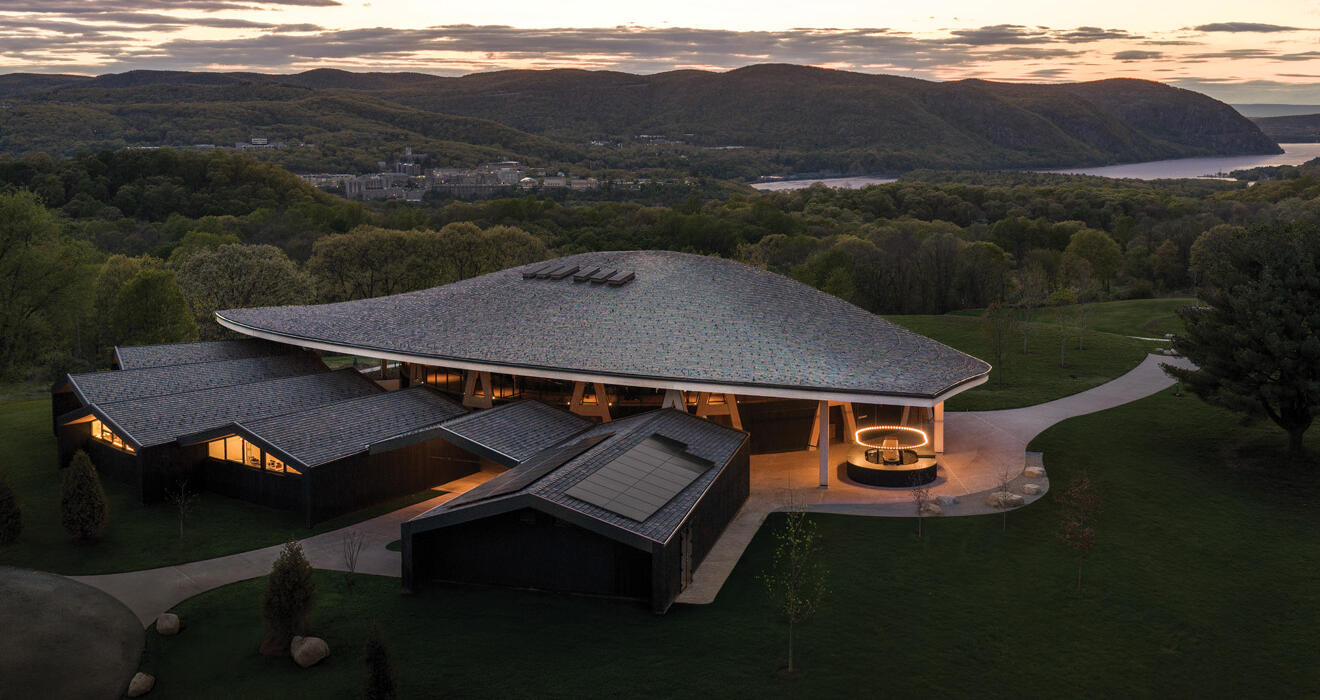
As it stands today — and should for decades — the Scripps Center does not resemble a bandshell, a tent, a bowl, or a covered amphitheater. Nor does it have much in common with the Globe. That’s because the Globe was built for an urban setting, while Scripps sits on the former 11th-hole fairway of a “rewilded” golf course. In architecture, as in dramaturgy, context matters.
All of this is fitting for HVS, which often goes its own way creatively. Its presentations have an unfussy looseness to them: Jesters roam the risers muttering ad-libs and sometimes find themselves upstaged by skunks.
“The way we do Shakespeare, 7-, 8-, 9-year-olds adore it,” says Frederic C. Rich ’77, an HVS board member. “And it’s interesting, isn’t it? I’ve been attending shows with my nieces and nephews for years. Adults become afraid of Shakespeare because it’s Elizabethan English. But kids just take it for what it is.”
This straightforward, interactive quality is what brought McCallum to HVS. He’s an intimist at heart, a champion of smaller-format shows that unite audiences and performers. The Scripps Center was built to fit this brief.
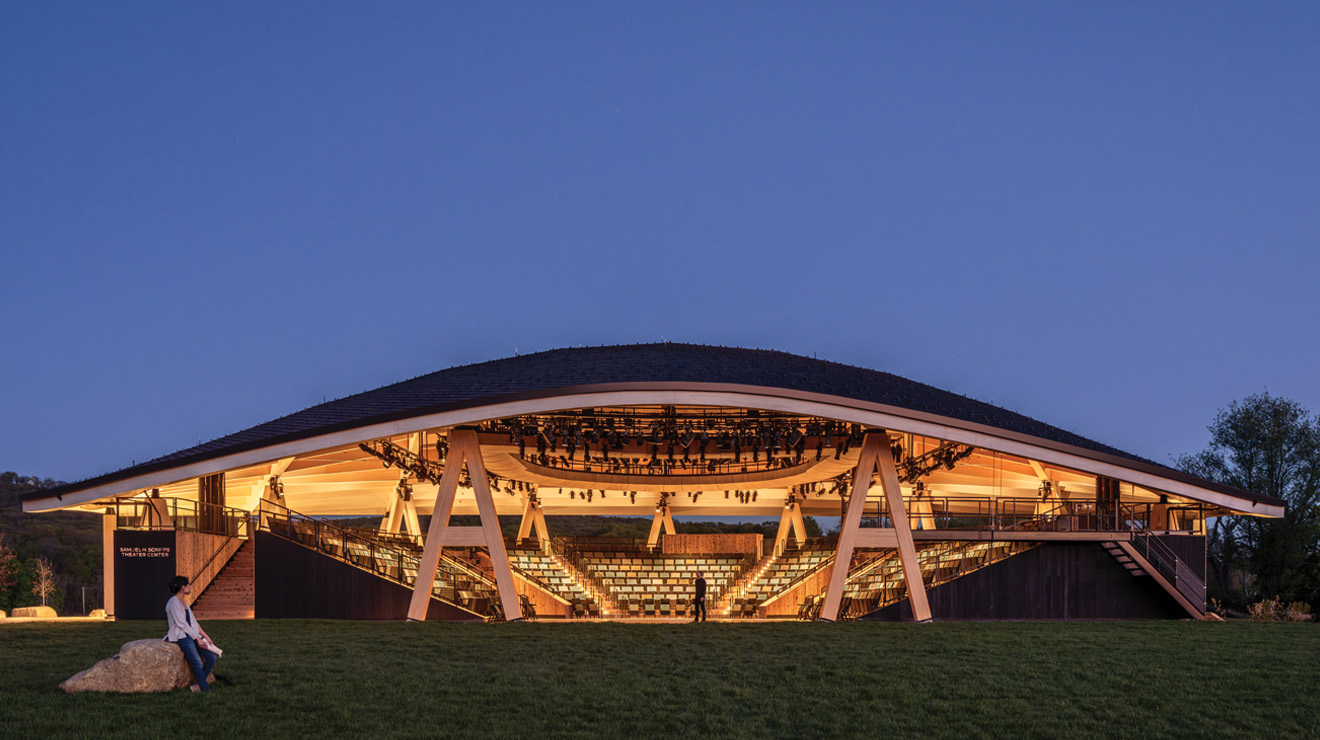
So what does an HVS-style theater look like, then? As designed by Studio Gang and architect Jeanne Gang, the Scripps is light and zoomorphic, with a floating grid-shell roof that evokes a Hudson River mussel. Inside, the space is intimate, warm, and accessible to a wider range of patrons than before.
Intimate, but also open. Most spectacularly, the Scripps’ stage looks out onto the “Wind Gate,” the narrows formed at the spot where the Hudson River passes between Breakneck Ridge and Storm King Mountain. It’s a vista that no one on the project could deny, much as they might have wanted to, at times, given the challenges of building on a ridgeside lookout.
“It’s not easy to do theater at the top of a hill, very far from every piece of infrastructure you would need,” says Teo Quintana ’08, project leader for the site and a member of Gang’s architectural firm, Studio Gang. “But everyone quickly realized, this is where the theater would go.
“Landscape has always been extremely important to Hudson Valley Shakespeare’s theater-making. They don’t use stage flats. They don’t use fly lofts. They don’t use a lot of [built] scenery.” Instead, their shows are in dialogue with the land. And so, too, is the theater Gang designed for them.
Jeanne Gang is, to put it plainly, one of the world’s most famous living architects. Collaborating with her was not something that McCallum could have anticipated when he took the job at HVS, back when his remit was to program summer theater under tents.
But then HVS received an unexpected windfall from a local donor named Chris Davis, and the next the thing McCallum knew, he and Gang were in a local high school auditorium, moving chairs around to test out seating plans for the theater of his dreams.
This is not to say the Scripps was, or is, a two-person show. Building it has taken the work of many partners, including an outsized number of Princeton alumni on the HVS board. These include Rich, James Stanford ’98, Raoul Bhavnani ’93, and Chip Loewenson ’79. On the design side for the Tigers, there’s Quintana at Studio Gang and Eli Gottlieb ’96, a managing principal at the structural engineering firm Thornton Tomasetti.
Another major booster? New York Gov. Kathy Hochul, who threw her weight behind the project early on and never wavered. “There’s going to be nothing like it. It will be the most exceptional place for the experience of theater on Earth,” she said at the theater’s groundbreaking in 2024.
Quintana also sees the Scripps as special. “You don’t get to work a site like this, on the edge of the Hudson Valley, on this kind of rise, very often. So many sites like this are protected. And then if it’s not a protected site, you’re usually building a really expensive private house [on it]. And that’s a completely different project. But this program is public, so you’re engaging with the site differently. [Designing for] one person’s view from a mountaintop is very different than a view for 500 people.”
(The late Samuel H. Scripps, meanwhile, was a publishing heir, philanthropist, and lifelong theater lover. In the 1990s, he played a big role in reconstructing Shakespeare’s Globe in London. His family sees the Hudson project as a bookend to that work.)
Now the time has come for summer theater ... in a theater! In addition to As You Like It, the Scripps debut season includes King Lear, which McCallum is directing, and a production of the blockbuster musical Les Misérables.
And why not? Under McCallum’s directorship, HVS has ranged widely and ambitiously in its non-Shakespearean programming. For example, last summer’s musical revival was Octet, an underseen a cappella chamber piece about internet addiction. Hamilton creator Lin-Manuel Miranda made multiple trips to HVS to see it; this year, he announced plans to direct a movie version of the show.
Les Misérables, for its part, made its English-language debut at the Royal Shakespeare Company. But even if it hadn’t, McCallum says, he still would have chosen it.
Les Mis is a big musical — so big that an “arena spectacular” version will play at Radio City Music Hall this summer. But what happens to Les Mis when you scale down all its grandness?
“I’ve wanted to try [Les Misérables] with this particular director for a long time. It’s a musical that’s so beloved, and I think we can do it in a very particular, actor-driven way, without some of the spectacle that normally goes along with a production of Les Mis,” McCallum says. “At the same time, there’s still going to be that amazing score, and the epic sweep of a narrative that goes across generations. It really feels like a Shakespearean musical.”
McCallum is staying mum on director Jenn Thompson’s exact vision for the show. But what’s certain is that when Javert, Valjean, and company take the stage in August for HVS’ take on Victor Hugo, they’ll be doing so in an unusual context: in an open-air theater designed less for grand tableaux, and more for intimate thrills.
How intimate? After much deliberation and fine-tuning, Studio Gang managed to fit the Scripps’s 450 seats into just nine U-shaped rows. What this means is that all of its sightlines will be close ones. Close enough for audience members to fully take in actors’ faces.
Why does that matter? Here’s how one of McCallum’s favorite books on theater design explains it: Every theater has a “limit of presence,” the threshold within which actors and crowds feel subconsciously “real” to each other.
When viewers sit close enough to see actors’ eyes widen, dart, and droop — rather than having to read emotion through voice and gesture cues — it builds a special kind of empathy. Or so the theory goes, anyway; a theory developed at the intersection of optics, architecture, and neuroscience. The important lesson being: Seat the bulk of your audience outside this ocular limit, and your theater’s energy will flatline. The drama will feel like it’s happening elsewhere, to figures who might as well be acting behind glass, or in a diorama.
This is doubly true if your stage is fronted by a proscenium arch, a kind of interior window frame through which the public takes in scenes. (If a theater can raise and lower a curtain, it’s got a proscenium arch. Most big ones do; the Scripps does not.)
Large houses, framed stagings. The problem with these features, McCallum says, is that they distance people, thus weakening theater’s case for itself in an age of screens and streaming.
“You can get an infinite catalog of content on the couch,” McCallum says. “What you can’t get is the sense that a group of people are actually gathering in a place where an event is transpiring. That’s real. That’s what’s actually happening in any active theater. The word theater gets used pejoratively, particularly in political discourse. ‘Oh, that’s just theater.’ Meaning, superfluous fakery. But I think the word should suggest something else, which is, ‘Here we are, together.’
“[Architecturally, that requires] theaters where the energy between stage and audience moves in a feedback loop that rolls and compounds over a performance. Not a model where the actors are in one room and the audience in another, with a cutout between the two. I think that’s one of the things Shakespeare really understood. If you think of the theater as the hardware and the plays as the software, his plays are written to work in [a certain] kind of hardware, in spaces that feel more organic.
“[Nowadays] when I see a Shakespeare play in a big proscenium theater, it feels more like I’m at a movie theater. It bums me out: Why am I sitting way back here, looking at people on a raised stage while we’re all in the dark? Why are we pretending we’re not in the same room together? Studio Gang understands this. It’s such an intimate theater they’ve built for us.”
So how did it all get built?
The story starts with Davis, a local Hudson Valley financier and environmentalist, who also happens to be the scion of two prominent Princeton alumni, Shelby Cullom Davis ’30 and Shelby M.C. Davis ’58.
Davis bought the Garrison Golf Course in the 1990s. His purpose, back then, was to protect its land from being developed into condominiums. To that end, he held onto the property for several decades, keeping it in business as a golf course while searching for a lower-impact purpose for the site.
How about a LEED Platinum certified, eco-conscious summer theater? Well, yes. So in 2019, Davis donated 98 acres to Hudson Valley Shakespeare. Crucially, his gift included ownership of the course’s inn and wedding businesses.
“What’s so smart about that,” says Rich, the HVS board member, “is that the wedding venue can be a real economic engine. It’s a great solution to the dilemma faced by non-profit theater organizations.
“Do you know the economics of the not-for-profit theater business? If you’re at 50/50 — meaning you meet 50% of your expenses with ticket sales — you’re well off. That means every year you have to raise the other 50% from philanthropy just to keep the lights on, which is a terrifying thing. … Weddings [give HVS] a more diversified stream of revenue.”
Of course, HVS’ hope was always that the site could become more than just a revenue stream. Enter Hochul and Sen. Chuck Schumer, who helped HVS tap into millions of dollars in government arts funds.
Soon after Davis’ donation, McCallum began polling friends about what architects they admired. Jeanne Gang came in at the top of the wishlist. HVS submitted a proposal, and McCallum crossed his fingers. Then, to his delight, he heard the firm was interested.
It helped that Gang began her career with a performing arts venue: the Bengt Sjostrom Starlight Theatre in Rockford, Illinois. Since then, every new theater commission that Studio Gang wins — spaced roughly a decade apart, as it’s happened — becomes a milestone in Gang's practice.
For this 2020s iteration of a Jeanne Gang theater, she was inspired by new possibilities in mass timber. These laminated-wood beams are budget-friendly, sustainable, and increasingly customizable at scale. They make up the majority of the Scripps’ overall frame, with additional detailing in Western red cedar, black locust, and charred wood.
“You go their offices and you’re just like, ‘Oh, so they’re the wood savants,’” McCallum says. “It’s just the most wonderful thing.”
The main departure from all that carpentry is the theater’s steel-beam central catwalk. As devised by Quintana and Gottlieb, it pulls double duty as a tension ring. This prevents the theater’s shallow dome from pancaking flat when it snows.
Blizzards aside, McCallum is excited for the cold seasonsto come. The plan is to host year-round workshops and readings in the center’s off-stage spaces.
That’s good news for New York’s performing arts community, which has struggled since the COVID pandemic. Nonprofit theaters sell fewer tickets these days, which means they have less money to invest back into artists. Major foundations have also pulled back. The result? A fragile creative pipeline, with many important theater labs, rehearsal spaces, and writing retreats either closing or on the brink.
HVS has been lucky to escape the worst of this downturn, McCallum knows. And so he wants to pay things forward. To that end, phase two of HVS’ construction master plan calls for building on-site housing for its summer company, spaces that could then be used for offseason residencies.
The challenge is that back-of-house infrastructure can be a harder sell to would-be donors, as the money’s not on stage. Given this, can McCallum speak frankly? “We are actively looking for donors to complete this phase-two capital campaign, where the remaining gap is around $6 million,” he says.
Ultimately, McCallum’s contention is that if company members cannot gather while in season — if they can’t commute on foot to each rehearsal, or bond in green rooms between shows — then there’s something missing from the mix.
McCallum learned this back at Princeton. What made theater so rewarding then, he says, were all those moments in between. The late summer weeks when Princeton Shakespeare Company would arrive on campus early for rehearsal. The nights after a show when they’d all celebrate at the house of professor Thomas P. Roche *58.
Enter Roche. An eminent don in the English department, he joined Princeton Shakespeare’s acting ensemble at McCallum’s request.
“He’d had this relatively quiet life on campus,” recalls Stanford, a company alum. “And then, through Davis, Roche got into the theater scene. And he just became this whole kind of larger-than-life person, completely unexpectedly, to him and everyone else.”
Off stage, Roche dressed formally, often wearing an ascot and a fedora. On stage, he cut loose, playing a nun, a king, a servant, and anything else the students needed.
“His house was on Regatta Row, and he would host us all for dinner,” Stanford says. “So many of us crammed into this little space. That became our community.” In the years after graduation, McCallum and his friends returned to campus to celebrate Roche’s birthdays, as well as his retirement in 2003.
When Roche died in 2020, it was at the height of the pandemic. There were no in-person funerals, only Zoom. McCallum rued this twist of fate. “He was just the greatest,” McCallum says, with a “very funny, dry, withering sense of humor. We became really close friends.”
In the months after Roche’s death, McCallum and his college friends kept talking about how to honor their mentor in some more lasting fashion. “Because there wasn’t that occasion to get together and celebrate him and grieve him,” McCallum says. “And I began to think, ‘Oh, he loved being among actors, the way actors congregate in a green room.’”
When it opens this month, thanks to contributions from his friends, Scripps’ new green room will be named in Roche’s honor. McCallum is also raising funds for a directing fellowship in his honor.
“If a theater is a house, the green room is the living room,” McCallum says. “Everyone’s there before their entrance, playing cards, telling stories, drinking throat-coat tea before going on stage. I liked the idea of his spirit animating that room.”
Theaters are houses — not just metaphorically, but in plain reference: house lights, house seats, a sold-out house. You can build them big and walled, or you can build them small and open. McCallum knows the kind of house that he prefers, and built it. Even when the summers end, he won’t be there alone.
David Walter ’11 is a writer in New York.
Related News


McCarter Theatre’s First South Asian Musical Took Me Back to Forbes Basement
A Beat of Our Own is about a college dance team not unlike Princeton South Asian Theatrics


No responses yet