


The King and Queen of Energy
Kwanza Jones ’93 and José E. Feliciano ’94 dream — and give — big

“Exuberant” hardly describes the mood at the dedications of Kwanza Jones Hall and José E. Feliciano Hall on May 5, 2023. Though the weather that day was cloudy, from the podium there was only sunshine.
The two dorms, built thanks to a $20 million gift by their namesakes, Kwanza Jones ’93 and José E. Feliciano ’94, are part of the sprawling New College West-Yeh College complex on the southern edge of campus. Between them, the dorms house about 250 students and all the latest amenities. They are the first Princeton dorms named for a Black or Latino alum.
“Today we celebrate the power of possibility,” President Christopher Eisgruber ’83 told a dedication crowd of more than 100, which included family, friends, and fellow alums, many decked in Reunions jackets. “We celebrate the generosity and love of two very special members of the Princeton community. And we celebrate and honor what it means to belong.”
But the real master of ceremonies was Jones herself. Although the marriage is very much a partnership “in business and in life” as Jones puts it, she tends to be the power couple’s public voice, with Feliciano content to keep a lower profile. (“You got one minute!” she joked when calling him up to say a few words.) Symbolically, a bridge connects the two buildings, fitting for the first dorms to be named after alumni spouses. Jones, though, saw an even broader metaphor.
“Princeton connected people,” she said, choking back tears. “It connects cultures, it connects thoughts, it connects ideas. It connects.” Concluding with a quote from her own 2023 song, “We Buildin’,” Jones rapped, “We makin’ change and there ain’t nobody stoppin’ us!”
Few Princetonians, it seems safe to say, know much about the people for whom their buildings are named, or the fortunes behind them. Kwanza Jones and José E. Feliciano certainly are different from the 19th and 20th century industrialists whose gifts built the Princeton campus. The reasons go beyond their race and ethnicity.
Jones is a recording artist, an influencer, and an activist whose media company focuses on self-development. Feliciano is co-founder of Clearlake Capital Group, L.P., a private equity fund, and part owner of the Chelsea soccer club in the English Premier League. Forbes reports his net worth as $3.9 billion. They are Democratic Party donors (although both are registered as unaffiliated) and live in a palatial estate in Pacific Palisades, in the hills above Los Angeles. The two serve on numerous corporate, educational, and charitable boards, including Stanford University, the Apollo Theater, Cedars-Sinai Medical Center, and the Susan G. Komen foundation.
They are also major philanthropists who have committed more than $200 million so far, supporting community groups and historically Black colleges and universities, among other causes. Though their charitable organization is officially known as the Kwanza Jones and José E. Feliciano Initiative, it has also been called the SUPERCHARGED Initiative. That word — all caps and now trademarked — is Jones’ mantra. She wrote it more than a decade ago to psych herself up, and it continues to define her personal outlook. Jones calls herself the Queen of Energy and her circle the “Kwanzaverse.”
The mantra is a series of 25 inspirational statements to get you moving, get you dreaming, get you reaching for more, she says. “They’re the words you repeat to yourself when you can’t get out of bed in the morning,” Jones writes on her website. “They’re the words you chant when you’re still working at 11:30 at night.” They’re also words that can be ordered on 12-by-18-inch posters, as well as T-shirts, hoodies, and various other merch. A sampling gives their flavor:
YOU ARE SUPERCHARGED.
DON’T DOUBT IT. JUST BELIEVE IT.
YOU HAVE WHAT IT TAKES, SO TURN IT UP.
EVEN IF THINGS SEEM TOUGH, CARRY ON.
YOU ARE ABSOLUTELY FLAWLESS.
LOOK IN THE MIRROR AND SMILE, BECAUSE IT’S TRUE.
“I think everyone should make a statement to themselves about who they are, what they want to do, and how they want to show up in the world,” she says.
To a cynic, the statements might read like Norman Vincent Peale and Oprah had a baby. But Jones is not a cynic. She does not do negativity. Or ennui. (Or lower case, if she can avoid it.) Neither does Feliciano. When it comes to their charitable and investment philosophies, they say they “dream in decades” and tend to speak in alliterations.
“Our pillars are education, empowerment, entrepreneurship, and equity,” Jones declares. “The vehicles through which we do a lot of the work to live those pillars are culture, community, and capital.”
Far more than just living the life of the rich and famous, they share a relentless emphasis on striving, improving, doing more. Both come from relatively humble backgrounds, light years from where they sit now, but they still believe they can do better every day. So can you. And they are here to help you do it.
It has been quite a ride. Sometimes, one can’t help but feel as though it’s Kwanza Jones’ and José Feliciano’s world and the rest of us are just living in it.
OK, maybe not. But a couple hundred undergrads in New College West are.

As fortune would have it, Jones and Feliciano Halls stand on about the same spot where Jones and Feliciano had their first date in 1994.
The daughter of two lawyers, Jones came to Princeton from Washington, D.C. Her mother was a graduate of Bennett College, an HBCU in North Carolina to which Jones and Feliciano donated $1.5 million in 2019. Jones majored in what was then called the Woodrow Wilson School of Public and International Affairs, a name that would figure into her relations with the University later on. She also ran track, specializing in the 800 meters, and made a close group of friends living in since-demolished 1942 Hall, who have remained sisters ever since.
“I remember her being fairly quiet in the beginning but always the most positive person you’ve ever met,” says one of those friends, Dean of Admission and Financial Aid Karen Richardson ’93. That positivity is obvious on Jones’ Nassau Herald page, which leads off, in bold type, “Proud Strong Beautiful Creative Confident Optimistic Determined Dedicated Continuously Strive for more and better ... .” It closes with a crescendo: “BE WHAT YOU WANT, BUT ALWAYS BE YOU.” Having that read back to her today, Jones laughs but concedes that she hasn’t changed. Growing up, her parents gave her and her sister, Meta DuEwa Jones ’95, weekly reading assignments, usually from books about perseverance and optimism.
“It was a given in our household that you cannot expect the world to be for you, so you have to make sure you were for you,” Jones says.
Not to say that she couldn’t find mentors. Music has always been a passion; at Princeton, she sang in the gospel choir and co-founded Culturally Yours, an all-female a cappella group dedicated to music by people of African descent. Jones says when she saw producer Quincy Jones during his visit to campus, she went up and introduced herself, remarking that they shared the same last name; he later sent her a handwritten note encouraging her to pursue her musical interests. While still an undergrad, Jones entered an amateur night competition at Harlem’s Apollo Theater — and won — singing Jennifer Holiday’s “And I Am Telling You I’m Not Going” from the musical Dreamgirls.
By contrast, Feliciano calls his own path through Princeton “bittersweet.” He attended a small private school in Puerto Rico and jokes that Disney World was the only part of the American mainland he had ever seen before arriving on campus for orientation. The transition wasn’t easy; engineering classes were tough and Feliciano was self-conscious about his accent. Every day, he would cross the Springdale Golf Club, he says, but not to play. It was on the route from his dorm room in Forbes College to his work-study job in the dining hall at the Graduate College.
“Eventually, I found my group, my tribe,” Feliciano says. He majored in mechanical and aerospace engineering and graduated with high honors.
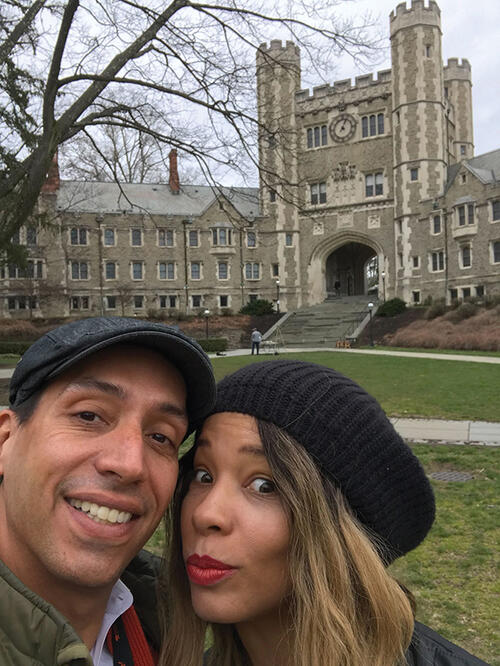
The couple’s “meet cute” story occurred during Jones’ senior year, when Feliciano was a junior. She had injured herself and was on crutches, heading toward a meeting up campus. Feliciano offered to carry her books. They did not get serious, however, until a year later, when Jones returned for her first reunion and nearly stood him up for a date. Arriving more than an hour late, Jones suggested that they walk down to Lake Carnegie, along a path where their dormitories now stand.
“I think it’s as simple as the old saying that opposites attract,” suggests Alex Doñé ’93, Feliciano’s former roommate and a longtime friend of both. “They share similar values, chiefly the bonds of family, a strong work ethic, and an ethos of paying it forward.” They married in 2002.
In the meantime, Jones pursued several paths. She was named Miss Baltimore and earned a degree at the Cardozo School of Law followed by a master’s degree in dispute resolution from Pepperdine University. While teaching cross-cultural negotiation at NYU and working as a mediator in the New York City court system, she also pursued a singing career. Her single, “Think Again,” made the Billboard Hot Dance/Club Play charts in 2011, peaking at No. 21. She has since cracked the Billboard charts eight more times.
Feliciano decided not to become an engineer, but like so many Princeton graduates of his generation went into finance instead. He was an analyst at Goldman Sachs before attending Stanford’s business school. After a brief stint at a startup that failed in the dot-com bubble, he joined Tennenbaum Capital Partners. In 2006, he co-founded Clearlake Capital, which made a fortune buying up depressed assets at low prices following the 2008 financial crash.
The couple now leads a high-flying lifestyle few can imagine. In 2023, they upgraded from the $20 million Pacific Palisades mansion they already owned to a $50 million mansion in the same neighborhood. The six-bedroom, nine-bathroom home, which overlooks the Riviera Country Club golf course, is built into a hillside, with rooms that open to the air in good weather, a 20-foot long sculpture in the atrium, and a large infinity pool. (“[I]t appears at first glance to merely be a [sic] standard and somewhat humble for the price,” Palisades News reported of the house.) In December 2023, they hosted a fundraiser for President Joe Biden. “Thank you for inviting me to your incredible home,” Biden said in his remarks. “Whoa, I hope you won’t be offended if we don’t leave.” Almost four years ago, Feliciano and a partner bought a stake in the Chelsea Football Club, which sold for about $5.7 billion. He and Jones previously looked into buying several NFL teams, including the Denver Broncos, Los Angeles Chargers, and Washington Commanders.
They formed the Kwanza Jones and José E. Feliciano Initiative in 2014 to focus their charitable giving. As Anita Ortiz ’93, another college friend and their longtime philanthropic adviser, notes, “The money is the easy part, right?” The harder question is, “How do you forge meaningful relationships with organizations and institutions?”
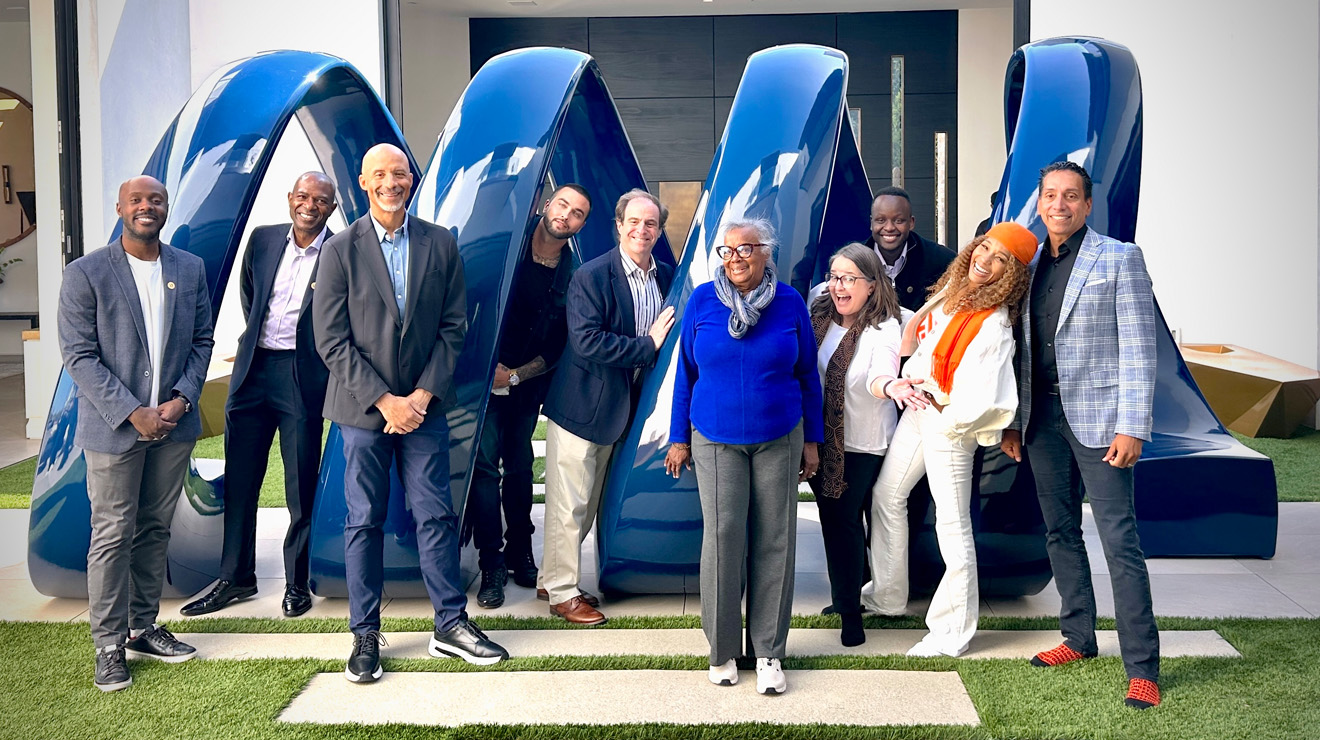
You may have a best friend. But do you have a Boost Friend™?
A Boost Friend, Jones explains, “is like one of your great, trusted friends and a trusted mentor rolled into one. Someone that’s going to help elevate and boost you, may say some things like thinking bigger, broader, helping you to be more accountable.” It’s a digital self-help and mentoring group. Those who sign up for the Kwanza Jones Boost Friends Community receive motivational messages from Jones herself, as well as access to online classes, workshops, and feedback sessions.
“Align with the ambitious,” the website exhorts. “It’s not about #GOALS, it’s about #LIFE.”
Boost Friends is one of several enterprises under the SUPERCHARGED umbrella, all of which promote the couple’s brand and are cross-pollinated with Jones’ energy and catchphrases. Other entities include Jones’ media and music company and the Jones-Feliciano charitable initiative. They are headquartered in a newly renovated building in Santa Monica full of cutting-edge video and recording equipment. Employees sit in large, open workspaces, but meeting rooms have themed names taken from Jones’ song titles and lyrics: Supercharged. Boosted. Ignite. Power Up. And of course, We Buildin’. Their strong Princeton connection is evidenced by the nearly half a dozen alumni who work for the Jones-Feliciano businesses in some capacity. Jones calls them a “teamily,” a portmanteau of “team” and “family.”
The initiative works with nonprofit and for-profit groups that align with themes of education, empowerment, entrepreneurship, and equity. Many of the couple’s biggest gifts have been to institutions with which they had a connection, such as Princeton, Cardozo School of Law, Bennett College, and the Apollo Theater. Jones now sits on the Apollo’s board, and she and Feliciano were prime sponsors of its 90th anniversary gala in 2024. They have also given money to a Puerto Rico hurricane relief fund, the Los Angeles Regional Food Bank, the Women’s Reproductive Rights Assistance Project, PFLAG (an LBGTQ+ advocacy group), and various groups providing scholarships to disadvantaged students.
Hoping to do well by doing good, they also make what they call “strategic investments” in firms that serve underrepresented groups, particularly firms providing capital for business startups. In an interview at a conference hosted by the National Association of Investment Companies last October, Feliciano said, “Access to economic capital is a human right, critical for a nation built by immigrants.”
Their $20 million gift to Princeton was bracketed by campus affinity conferences. Jones, who boasts a perfect Annual Giving record, says discussions about making a much more significant donation began at the 2017 ¡Adelante Tigres! conference celebrating Latino alumni. She and Feliciano signed their agreement two years later at the Thrive conference for Black alumni.
Their gift, Jones said in an announcement statement, “demonstrates that people of color belong in the room and sit at the table as patrons and co-creators to help the University to do the work of service to humanity.” They also wanted to make a mark on the landscape so future generations of Black and Latino students could feel fully part of the campus. “Now,” says Feliciano, “when you look at the map [of] Princeton, you see Rockefeller. You see Forbes. You see Kwanza. You see Feliciano. I think that’s important to reflect the full spectrum of excellence that not only Princeton has, but our country.”
Still, their relationship with the University has not been entirely smooth.
Early in the Venture Forward campaign, Jones says she made inquiries about an even bigger donation but never heard back. “I remember calling and sending emails and trying to get feedback, saying, ‘Hey, I’m really interested in [giving] a residential college. What’s involved for X, Y, and Z?’” she recounts. “No one got back to us. No one.” Despite the generosity of the gift they ultimately made, Jones says that, had the University courted them properly, they might have given even more. Princeton, she says, “left a lot on the table.”
Jones has also complained that after giving $1 million to Annual Giving in 2018 for her 25th reunion, she was not allowed to bring Feliciano to a meeting for major donors with Eisgruber, insinuating that this was related to the color of their skin. “We were the most obvious Black and Brown people in the Faculty Room in Nassau Hall,” she wrote in an email to the president that she also shared on her website. “And we were the only ones who were told we did not belong.” Jones wrote that the incident left her “shocked, saddened, frustrated, dismayed, and outraged.”
On the other hand, there don’t seem to be any lingering hard feelings. Jones moderated a panel discussion with Eisgruber during the president’s visit to Los Angeles in January 2024. Both Jones and Feliciano attended a dinner in Princeton last October to mark the end of the Venture Forward campaign.
On at least one occasion, Jones has weighed in on University policy. In the summer of 2020, following the murder of George Floyd, Jones wrote what she called an “open love letter” to Eisgruber and Vice President for Advancement Kevin Heaney — “open” because she also posted it on her website — denouncing what she called the racist legacy of Woodrow Wilson 1879 and calling on the University to remove his name from campus buildings. “Princeton can take away his name being associated with its physical structures,” the letter said. “In so doing, Princeton would be taking a significant step toward dismantling other structures whose time has passed ... the structures of racism.” Jones said that Eisgruber called her shortly afterward to inform her that the trustees had voted to remove Wilson’s name from the School of Public and International Affairs and a residential college.
“When you’re thinking of being taken seriously at a place like Princeton, words matter,” Jones told PAW at the time. “Actions matter equally as much, and money matters. And why money matters is Princeton, like a lot of nonprofit institutions, needs the funds.”
In fiery remarks at the dedication of Jones and Feliciano Halls, Michael Eric Dyson *93, a professor at Vanderbilt University, characterized the significance of their gift. “What you see here today is diversity at its best,” Dyson declared, calling the dormitories “a lasting monument to the beautiful creativity of equity.” That was in the spring of 2023. Given the vibe shift since then, nationally and even to a certain extent at Princeton, Dyson’s talk of diversity and equity hits the ear a little differently now.

Asked if she is able to maintain her sense of optimism in the current political climate, Jones pauses. “Some days are harder than others,” she finally replies. Those may be the most downbeat words Jones has ever uttered.
Of course, she brings it right back. “If we keep doing the things that are important to us, we can stay the course, even though all around the waters are very rough. That gives me optimism, because I know I can believe in me.” Through philanthropy, investment, and motivation, Jones insists, she and Feliciano still aim to “boost” a billion lives.
“Diversity is under attack right now,” Feliciano acknowledges. “But we are made better when we see the differences, understand where those are, and work together. Because diversity breeds innovations, breeds excellence, breeds possibilities that you would never even think of.”
Jones echoes that theme of endless possibility with a story of her own. One day when they were living in New York and just getting started, she persuaded Feliciano to leave work early. Taking along a sketchpad and some colored pencils, they spent the afternoon in Central Park, walking and dreaming.
“I ended up asking a series of questions for us to think about,” she recounts. “And it wasn’t about how much money do you want to make. It was, what’s the impact we want to make? What are some of the things we want to do? Oftentimes people leave things on the table because they’re not dreaming big enough.”
No one would ever accuse them of that.
Mark F. Bernstein ’83 is PAW’s senior writer.
Related News
With Prominent Journalists and Hoagies, the ‘Prince’ Celebrates 150 Years
A gala at the New York Historical raised roughly $400,000 for the independent student newspaper

4 Responses
David L. Evans *66
9 Months AgoAppropriate Anagram
Kwanza Jones ’93 and José E. Feliciano ’94 are truly wonderful human beings and, with their tremendous finance, also joined the many alums whose philanthropy has historically set Princeton apart with high esteem and welcoming invitation. Maybe it is more than coincidental that the 17-letter fragment, “… finance, also joined…” matches, letter for letter, the names “Jones and Feliciano.”
Sarah Gladstone ’93
9 Months AgoThe Lessons of Dreaming Big
There is a huge smile on my face as I read about Kwanza and José, the journeys they have traveled so far, and the incredible contributions they have made to make this world a better place. I am also thankful for Mark Bernstein’s honesty in reporting the issues they encountered early on when offering donations to the University, and this remarkable outcome. I am going to remember Kwanza’s mottos ... inspiring! I agree with her: We have to keep dreaming big.
Mifflin Lowe ’70
10 Months AgoStellar Couple
Wow. She’s a rocket ship! And he’s an astronaut!
Michael E. Morandi *83
10 Months AgoDonating to Princeton
While I did not offer to fund a residential college, I did make what would be considered a major gift helping to fund a new initiative, and only after the program director did some searching did the development/advancement office locate it and allocate it appropriately. Maybe what happened to Jones and me is what happens when so much money is offered to the University.