

Lights, Camera, Princeton: Why Hollywood Loves Old Nassau
From A Beautiful Mind to Transformers, campus has been home to a wide variety of productions

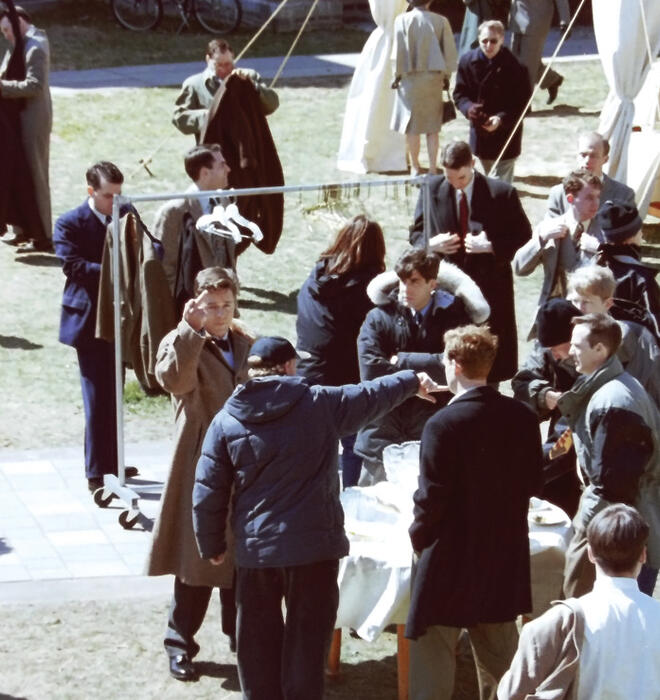
On March 27, 2001, Meredith Rugani ’02, then a junior in East Asian studies and a hobby photographer, visited her neighbor’s dorm room in 1901 Hall, bringing along her camera as well as a reporter for The Trentonian, who was on campus to cover a most unusual scene. Out the window they watched as Russell Crowe, only days removed from his Oscar win for Best Actor in Gladiator, walked through the courtyard with director Ron Howard as they prepared to shoot a scene for A Beautiful Mind, a biopic of Nobel laureate mathematician John Forbes Nash Jr. *50 based on Sylvia Nasar’s 1998 book of the same name.
“I took Crowe and Howard’s photo through the window as the two were talking,” Rugani (née Moroney) tells PAW. “Crowe looked up, saw me, and gave me the finger right as I happened to be snapping a picture.”
Rugani and Jeff Edelstein, The Trentonian reporter, ducked down. “Then my journalism instincts kicked in,” Edelstein recalls, demanding to develop Rugani’s film to see if she had captured the moment. Though Edelstein had taken his own picture with his own camera, his image only revealed Crowe’s knuckle, partially unfurled — but Rugani’s had Crowe’s finger fully (and scandalously) extended.
“When we met back up that evening, the reporter gave me the Trentonian’s standard flat photo fee and told me the photo would run on the front page the next day whether I agreed or not,” Rugani recalls.
The photo launched a tabloid frenzy. “The landline for our suite rang off the hook,” Rugani says, as reporters from around the world sought her commentary on the finger-moment, adding that “heavily embellished, progressively wilder tales of the incident spread across campus,” and that these tall tales incorrectly suggested her photograph had interrupted filming (she had not) and that she had leaned out the window (an exaggeration). Two days after the incident, The Daily Princetonian’s front page was ablaze with the headline: “A Beautiful Finger,” with Rugani’s photo, zoomed in, showing Crowe delivering the obscene gesture.
Twenty-five years after A Beautiful Mind, Lyn Pinezich, the location manager for the production, argues that Crowe, despite his incendiary reputation at the time, was actually “on his best behavior.” During a shoot in a Princeton dorm room, she says, the star started pulling out the student resident’s VHS tapes, “signing them [before] putting them back on the shelf.” According to Pinezich’s assistant location manager, Mike Kriaris, to take a break from the set, Crowe would fraternize with the Princeton town police because “he collects police badges” but otherwise mostly “kept to himself” to focus on the difficult role.
A Beautiful Mind went on to win four Academy Awards, including Best Picture, and has served as an enduring love letter to Princeton, with many of its scenes set in the Collegiate Gothic courtyards. But it’s far from the only major production to set Princeton in its sights or invoke Old Nassau to give a character an educated or privileged background.
Eric Hayes ’19, who wrote and directed the short film The Observer Effect on campus while a student, attests to the silver screen’s enduring fascination with the University. “Some of the greatest thinkers of the 20th century have all walked those halls,” Hayes says. “The ghosts in the corridors, so to speak, kind of echo that type of thinking.”
“Being so familiar with Princeton, he is a stickler for wanting things that are authentic, spectacular, and real.”
Patty Carey, location manager for director Christopher Nolan's Oppenheimer
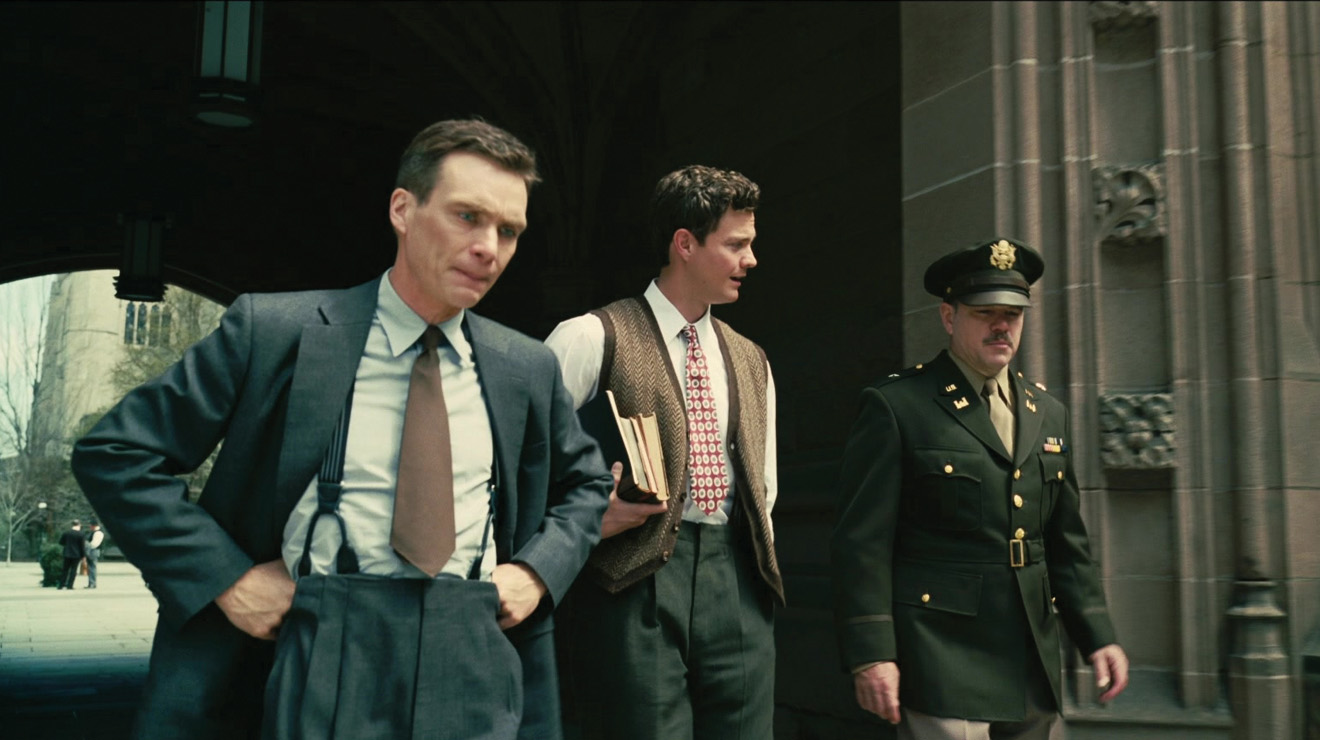
Several Hollywood films have depicted such great thinkers using Princeton landscapes, whether Richard Feynman *42 (Matthew Broderick) in Infinity or Walter Matthau’s comic take on Albert Einstein in the 1994 Meg Ryan rom-com I.Q. When it came time to shoot a handful of scenes on campus and at the Institute for Advanced Study for Oppenheimer (2023), director Christopher Nolan knew the locations he wanted to shoot, partly because he had given the Class Day speech in 2015, when he confirmed that his version of Batman attended (but dropped out of) Princeton. “[Nolan] knew what he wanted,” says Patty Carey, the location manager for the production in New Jersey and New York who had previously worked in the same capacity on A Beautiful Mind. “Being so familiar with Princeton, he is a stickler for wanting things that are authentic, spectacular, and real.”
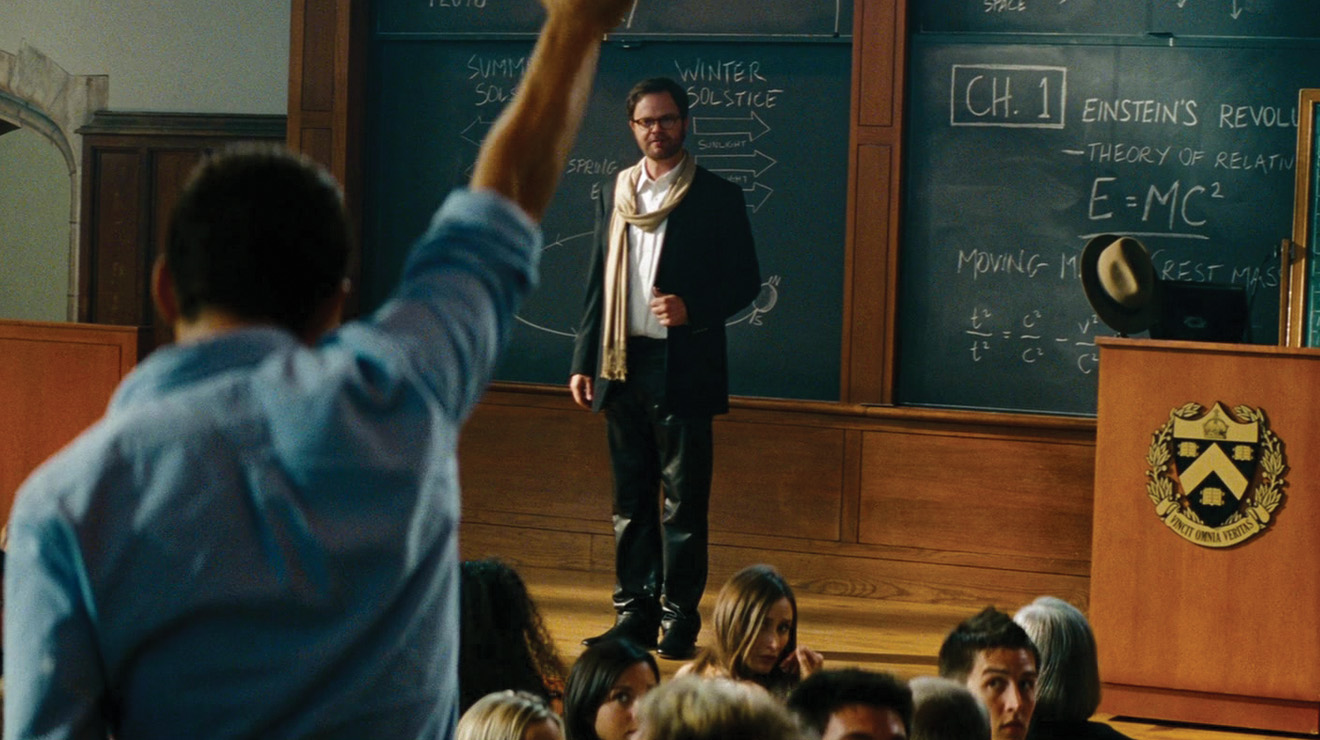
Sometimes Princeton lends credence to productions that deal with the unreal, such as the Michael Bay-directed blockbuster Transformers: Revenge of the Fallen (2009), in which Shia LaBeouf’s character goes to college and has an alien-robot-caused meltdown in McCosh 50 during a lecture. “Everywhere we went, we were looking for something that really spoke to the scale of the storyline,” says Matt Wersinger, a location manager for the project, referring to the production’s globetrotting shoots, which traversed the deserts of Jordan to the Bethlehem Steel factory in Pennsylvania. “Princeton stood out as not only a picturesque location that helped us tell the beginning of the story, but something that really fit into the franchise in a way that was really positive.”
Not all of the Princeton-set scenes in Transformers were flattering to the University, however. LaBeouf’s character hooks up with a Decepticon robot villain posing as a coed, part of a fraternity house sequence shot at the University of Pennsylvania. In another scene, the hero’s mother mistakenly buys pot brownies near the University Chapel and Firestone Library.
Despite the college hijinks depicted in Transformers, Wersinger says the shoot went splendidly. “When it’s Michael Bay calling, I think people respect the legacy of what he’s done with great action films, and they are open to a discussion of getting it done,” Wersinger says.
Other unflattering University portrayals abound. In Admission (2013), Tina Fey’s admissions official fraudulently changes her long-lost son’s application decision to grant him admission; when she’s found out, she’s forced to resign. In The Talented Mr. Ripley (1999), Matt Damon’s titular con artist starts his murderous journey by borrowing a Princeton sweater and being mistaken for an alumnus. In Risky Business (1983), Tom Cruise’s Joel Goodson impresses his Princeton interviewer by turning his family home into a brothel. And in Harold & Kumar Go to White Castle (2004), the stoner duo stops at Princeton to score marijuana on their errant quest to the eponymous burger joint, but that production didn’t need Princeton’s permission, as those scenes were shot at the University of Toronto.
So what does it take for Hollywood productions to be allowed on campus? “Requests to film movies and similar projects on the Princeton campus are considered on a case-by-case basis,” says University spokesperson Michael Hotchkiss. “Occasionally, we will consider a project if it has a direct connection to Princeton University’s history or its teaching and research mission and does not disrupt academic or research activities.”
If Princeton is choosy, the institution’s long-running intersection with Hollywood has still produced some deep, unusual cuts. In Jonathan Demme’s 1979 thriller Last Embrace, Roy Scheider plays a secret agent partnering with a predictably attractive Princeton graduate student — not to mention a scene-stealing “rabbi-detective”— to solve a series of murders. He gets in a chase through Firestone Library with a sinister classics scholar and a shootout set in the Graduate College’s Cleveland Tower, in which bullets clang off the carillon bells.
In some cases, Princeton’s campus has doubled for other sites. In James Franco’s 2014 directorial take on William Faulkner’s The Sound and the Fury, the Lake Carnegie bridge on Washington Road stood in for the Harvard location of Quentin Compson’s suicide on the Charles River in Cambridge, Massachusetts.
Occasionally, fictional Princeton institutions crop up in film and TV. Many of The Simpsons writers, being veterans of the Harvard Lampoon, frequently assign their characters Princeton pedigrees in derogatory fashion. A character named Lionel Hutz, voiced by Phil Hartman, is said to hold a degree from Princeton Law School — which of course does not exist. Meanwhile, the characters of Snake Jailbird and Cecil Terwilliger are Princeton grads; the latter’s brother Sideshow Bob is known for calling Princeton a “clown college.”
If The Simpsons often puts Princeton in its crosshairs, the long-running medical drama House M.D. celebrated the campus by taking place in the fictitious “Princeton-Plainsboro Teaching Hospital,” with Frist Campus Center forming the apparent exterior. “To me, Princeton-Plainsboro has always been an enchanted forest, where patients come to be cured of allegorical complaints,” the show’s star Hugh Laurie wrote in a 2010 companion book to the show. “Of course, any drama must obey the laws of its own universe — the characters can’t fly or travel through time — and the show achieves as much verisimilitude as it can afford with the time and money available.”
Carey credits the University’s willingness to work with the Oppenheimer and A Beautiful Mind productions. “The goal is not to disrupt campus life,” she says, “but at the same time making sure that the director was getting the shots that he wants.” She cited Eric Hamblin of University Services as a key member of the staff who interfaced with both productions. Hamblin, who retired in April after 38 years at the University, declined PAW’s request for comment.
According to Pinezich, one of the most important components of shooting A Beautiful Mind was depicting historically accurate architecture and incorporating period cars into the shots. “You park a period car in the corner of the frame, and it just sells the period,” Pinezich says. “It’s very forgiving when you’re interrupting people’s traffic flow with period cars. Everybody loves to see these old cars.”
As for photographing Crowe’s infamous gesture, Rugani says that the photo incident left a long trail in her life, serving “as a funny story for cocktail parties” and popping up in unexpected settings: Once a law firm recruiter even tested her Japanese fluency “by greeting me with a flurry of questions about Crowe in Japanese.” In the days after she took the photo, however, Rugani used her notoriety for a practical purpose: She used her not-inconsiderable photo fees to buy a new computer.
Harrison Blackman ’17 is a journalist and writer based in Los Angeles.


3 Responses
Léonard C. Berman ’89
1 Week AgoCruise’s ‘Risky Business’ Role
I was surprised to see that you missed arguably the most notable fictional Princetonian in the sidebar to “Lights, Camera, Princeton.” Who has ever had a better admissions officer interview than Joel Goodsen (Tom Cruise) had with Bill Rutherford (Richard Masur) in Risky Business (1983)? “Princeton can use a guy like Joel!”
Maria V. Arnold ’01
1 Week Ago‘Risky Business’ Admission Interview
But it did mention the Risky Business role in the “other unflattering University portrayals ...” paragraph, as it said Joel impressed the interviewer by turning his home into a brothel!
Douglas Rubin ’81
2 Weeks AgoPrincetonians on ‘Mad Men’
An addition to the fictional Princeton characters list:
“Jeffrey Graves” ’55 appears with his buddy/nemesis/customer/classmate “Paul Kinsey” in Mad Men, season 3, episode 3, “My Old Kentucky Home,” written by Dahvi Waller ’93. Was life like that for 30-something Princeton grads in the early 1960s? Or just incredible script writing?