

Phyllis and Richard Kluger ’56 Penn A Finance Thriller


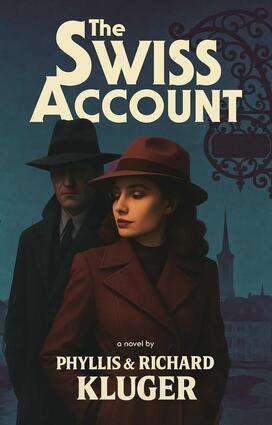
The book: Lynn and her husband Jerry are faced with a tough choice. They can keep the money Lynn’s father left for them in a Swiss bank account or report the undisclosed funds to the government. The latter would likely mean their fortune would be seized, but are they willing to risk living as tax evaders themselves? The Swiss Account (Rare Bird) explores this ethical gray zone as Lynn and Jerry struggle with this legal conundrum.
The authors:
Richard Kluger ’56 is a novelist and historian who graduated with a degree in English from Princeton. He is the author of several books including the Pulitzer-Prize-winning exposé about the tobacco industry, Ashes to Ashes.
Phyllis Kluger is a fiber artist and author who blends creativity and cultural history in her work. She has published two influential books on needlepoint patterns: A Needlepoint Gallery of Patterns from the Past and Victorian Designs for Needlepoint. She has also coauthored two other novels with Richard, Good Goods and Royal Poinciana.
Excerpt:
The Letter
The day the letter arrived from Zurich had not gone well for me at work. Rarely did I lose a listing, and Janice Darling — hard to forget a name like that — had up to that point seemed receptive to my suggestions. The Darlings were ready to sell their mostly presentable 1920s center-hall colonial on two-and-a-half acres with mature plantings and a sweet little brook gurgling through the rear yard. Nice presence, good bones, golden oak floors, plenty of light and space, but after sixty or so years the house needed some sparking up. I persuaded the owners to remodel the master bath, replace the standard butcher-block kitchen counters with granite, and repair the half-dozen rotted windowsills if they hoped to attract a top-dollar bid. I should have quit while I was ahead.
Taking the Darlings for sensible folk, I also ventured to remark — as offhandedly as I could manage — that the exterior color of their house might present a bit of a problem. The clapboards were painted blue, the trim white. The blue was very blue — cornflower blue, one of my favorite colors, as it happens. But houses sheathed in vivid hues unsettle the eye while those in a creamy off-white, a soothing taupe, or, say, a pearly gray are more subtly inviting, especially in very proper Bucks County, Pennsylvania, where we lived.
“What’s wrong with our color?” Janice asked indignantly, almost as if I had passed a racist slur. I said it wasn’t a question of right or wrong — just that some potential buyers might find the brightness a little off-putting. Blatant was the word I actually had in mind, but caution prevailed.
“Well, then let them repaint it if they don’t approve of our taste. You’ve made us shell out for enough fix-up stuff already.” Said a tad peevishly, as if I were trying to penalize her because their house would never be featured in Architectural Digest. Two days later near the end of that afternoon, Janice called in to say they had decided to go with a different listing agent — “It’s nothing personal,” she assured me, meaning they preferred someone less judgmental.
In semi-shock over my abrupt dismissal, I retreated to our back porch to sip a therapeutic glass of chardonnay, contemplate our meadow riotous with spring wildflowers, and remind myself for the umpteenth time that house-sellers are often their own worst enemies. Amid my bittersweet reverie, Jerry arrived home and joined me with a kiss and the day’s mail. I tried not to sound irritable while recounting the saga of my lost listing and the nice sales commission it would have yielded. Jerry heard me out patiently, offered a sympathetic “Not your fault,” and poured himself some wine. He’d suffered his own loss that day, he told me. “It’s bye-bye for Claire Ackerman she’s landed a tenured associate’s job at Southern Illinois. I told her it’s a big school, not much character, not fertile soil for teaching art history — lotsa farm kids who think Giotto is a board game — she’ll hate it there.” And he started sifting through the mail.
“You say that whenever any faculty member dares to abandon dear little old Channing,” I pointed out. “Just because you adore the place doesn’t mean everyone else has to.”
It was Jerry’s blind spot, so much so that over the years he had turned down a dozen job offers of a full professorship at major universities, Rutgers most recently and Indiana U. the year before that. He just preferred the charms of a snug (some might have called it smug), low-key college with a leafy campus and time-worn granite halls of wisdom. Besides, Channing appealed to the antiquarian hauteur lurking inside Jerry. Founded well over two centuries earlier, it had a seductive pedigree and intimacy that large, impersonal universities with less rigorous admission standards lacked. And serving as entrenched chairman of the school’s Department of Art and Architecture allowed Jerry to teach whatever courses he wished, tweak his on-campus schedule for his convenience, pursue his scholarly writing, and leave room to savor our life together. Only rarely did he have to deal with a thorny problem at the college, like a student caught cheating — Jerry was faculty adviser to the select committee in charge of the hallowed Channing Honor Code — or the loss of a gifted younger colleague like Claire Ackerman.
“Oh, I think she was happy enough here — only she’s too impatient to see her name up in lights,” he said. “And now she’s picked the wrong marquee.”
“Not your fault,” I consoled him with a smile, echoing his earlier words to me.
Jerry gave a grunt of agreement, then paused on reaching the final letter in the mail stack he was holding and examined its postmark. “You seem to have an admirer in Switzerland,” he said, studying the hand-addressed envelope. “Nice penmanship, too, but no return address — very mysterious.” He handed it over, eyebrows comically arching. “Could be from your continental lover — you may want to read it in private.”
“Damn — I told him never to write me here,” I said, dropping the letter onto my lap and taking another swallow of wine. “Probably some kind of international Ponzi scheme.”
“Very cool,” Jerry teased. “Come on — ’fess up. Is it Hans, Franz, or Rudolf?”
I wasn’t really in a playful mood, but Jerry was just trying to lighten me up. “Okay, you caught me,” I said and tore open the small envelope. It was a single page, quarter-folded, carrying a neatly handwritten message that read in its entirety: “My dear Mrs Hazeltine: I believe it would be greatly to your interest and advantage to speak with me. Please advise by return mail when might be a convenient time for me to phone you and at what number.” It was signed, “Yours very truly, Emil Hauser, Private Banking.” The letterhead read, in tastefully small type, “Helvetica National Bank, Paradeplatz 7, C.H. 8044, Zűrich, Switzerland.”
I handed the letter to Jerry. “The plot thickens.”
His eyes widened as he read it. “What could it be about?”
“A mistake, probably. Or some kind of scam — is that even a real bank?”
“Sounds like one. But I’m not really up on Swiss banking, to be honest.”
I studied the text. “Why didn’t Mr. Hauser just phone me? We’re listed.”
Jerry shrugged. “They do things more formally over there. He probably didn’t want to come on like gangbusters — calling you out of the blue the way a con artist might.”
“I’ll bet this was intended for you — you’re the one with all the international connections. Maybe some patron of the arts read one of your books or articles and — and wants to commission you to certify one of those masterpieces the Nazis looted and stored in Swiss bank vaults until enough time had passed and — you’ll see.”
“Nice try,” Jerry said, “but there are probably a thousand equally qualified art experts within spitting distance of the Alps. Besides, the letter was sent to you, sweetie, not me.” He sipped his wine and ruminated. “Must be something to do with Leon.”
That made more sense than my little fantasy. Leon Beckwith, my formidable father, had departed this earth six months earlier but had spent a fair amount of time in Europe as a businessman and later as a retiree with my stepmother in tow. “Conceivably,” I said, “but what in the world could that have to do with me? Daddy didn’t exactly dote on me — or weren’t you awake during the will-reading?”
“Hmmm.” Jerry impregnated the consonants with profound meaning. He had long nursed a case of raging ambivalence toward Leon, whose energetic manner and spirit of enterprise Jerry admired. But he also thought my father was crass, self-centered, dictatorial, and a poor excuse for a parent. Our two kids and I were about all Jerry and Leon ever had in common, though Jerry never quit trying to engage Leon in polite conversation that soon turned edgy because of their hopelessly clashing values. As my father’s younger child, I was still more conflicted — Leon and I never had the classic, huggy daddy-and-daughter thing going for us. My older brother Donnie had been his favorite, the golden-haired heir-apparent to the flourishing Beckwith commercial empire. But then Leon dumped Molly, our mother (who’s another gripping story I’ll save for a future epic) and went off to form a second family under the spell of the fetching and willful Alicia, my Stepmom-from-Hell, who came with her daughter Paula from her own failed first marriage. After that, I was only rarely in Leon’s company or thoughts, so far as I knew. Donnie was a different matter — appallingly so.
“‘Hmmm’ yourself,” I said. “‘Speak only good of the dead’ — or whatever the saying is.”
“Hey, no slight intended to Pops — Leon was a man of many parts,” Jerry offered, feigning neutrality. “Maybe after he retired, he became a silent partner in a multinational zircon cartel that’s being liquidated now — and his kids get to split the loot. I’d write this Swiss dude back what’s there to lose hearing him out?”
I refocused on the letter. “It seems kind of creepy — too clandestine. Why doesn’t Mr. Hauser just state his business instead of this cryptic come-on?”
“Because he doesn’t want to put it in writing — I believe Swiss bankers are famous for being hush-hush, in case you haven’t heard.” Jerry scanned the front page of the Inquirer, sitting on the table beside the chaise longue. “This wine’s fruity — have we got any olives?”
Excerpted from The Swiss Account by Phyllis and Richard Kluger. Copyright © 2026 by Phyllis and Richard Kluger. Published by Rare Bird.
Reviews:
“The Klugers pull off something rare: a literary thriller with teeth, conscience, and style. The Swiss Account is an absolute gem.” — Joseph Di Prisco, author of The Good Family Fitzgerald
“With the storytelling verve of classic Le Carré and the emotional precision of Roth or Tyler, The Swiss Account unfolds like a velvet-gloed indictment of privilege, secrecy, and legacy. This is an inheritance tale with teeth.” — Chip Jacobs, author of Arroyo





No responses yet