

Exploring Islands and Cozying Up for Winter in Estonia
Lucia Brown ’25 got to know rural Estonia during her first year on a Fulbright grant

Lucia Brown ’25 graduated from Princeton with a degree in comparative literature. She is a 2025-27 Fulbright grantee in Estonia, where she teaches English in public libraries and local schools, works on translations, and survives the winter.
On Estonian ice highways, wearing a seatbelt is forbidden and all car windows must be rolled down. That way, if the ice cracks, your odds of survival are higher. My friend’s local relative, who was driving me across the frozen Baltic Sea this February, followed neither regulation.
In the now-rare event of a frozen sea, the Estonian Transport Administration maintains official ice highways between the mainland and some of the country’s most populated islands. Residents of smaller islands, however, must manage their own unofficial ice roads. These roads are lifelines for access to groceries and medical services. Used improperly, they can also be extremely dangerous.
We drove onto the ice from a boat ramp on Saaremaa, Estonia’s largest island. Everything was gray: the sky, the surface of the ice, and the distant smudge of our destination, Abruka, a small island 4 kilometers south. Juniper branches marked the left edge of the road, and snow blew off the sea onto the windshield.
Abruka’s librarian, one of the island’s 10 year-round residents, opened her backyard summer café for a one-day winter stint. She served mulled wine and stew to guests who had walked, run, skied, and driven over the ice from across the region. We had to leave at 3 p.m. to make it back to Saaremaa before dark.
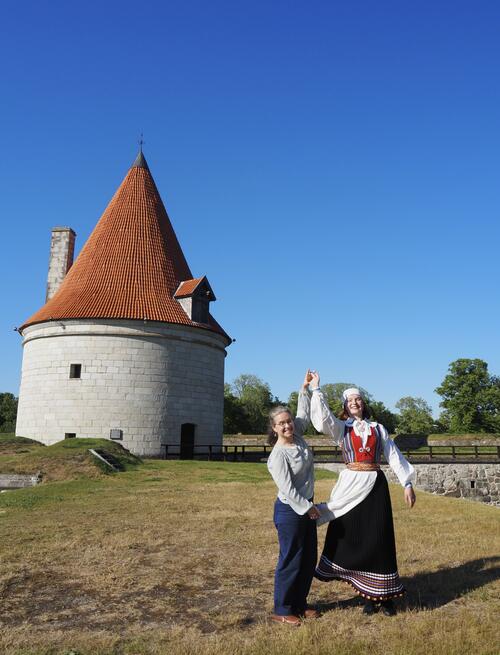
The short days governed my winter routine. My students and I watched the sun rise from the classroom windows at the vocational school, and it set before I left for home. To keep myself active in the dark afternoons, I rotated between choir, fitness classes at the town sports center, and folk dance. A coworker lent me ice skates, and I glided across a rink that locals shoveled clear on the moat of the town’s 14th-century Episcopal castle. Life was quiet, remote, and slow.
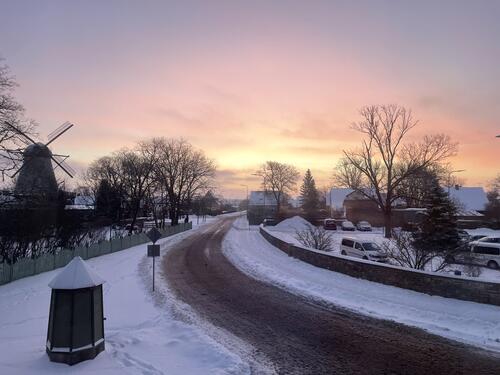
Kuressaare, with a population of 13,000, is Estonia’s westernmost town. It takes four hours by bus and ferry or 27 minutes by propeller plane to reach Kuressaare from Tallinn, the national capital. When I arrived in September for my Fulbright placement, a light jacket was already useful against the sea winds.
The best way to discover Saaremaa is by renting a car. On a weekend visit from the other Fulbrighters (stationed on the mainland), we hiked along Panga cliff, ate freshly baked Muhu rye bread, drank to youth at the Odalätsi springs, gaped at cows wading in the sea, and walked out to the lighthouse at the tip of Sõrve peninsula, where my phone connected to a Latvian cell network.
Located in Kuressaare’s castle, the Saaremaa Museum offers a strong overview of the island’s history. Occupying powers have consistently militarized Saaremaa, taking advantage of its strategic position on the Baltic Sea. Indeed, the first Soviet air raids of Berlin were carried out from bases on Saaremaa in 1941. Five years later, Soviet forces declared the island a restricted border zone, closing it off to nonresidents until 1989. Abandoned military infrastructure can still be found across the island.
Saaremaa remains rural and covered in farmland. For a unique look into Estonian farm life, explore Koguva village and the open-air Muhu Museum on the neighboring island. With my vocational school students, we explored the island’s Baltic-German manor houses and picked cranberries in Koigi bog. I also taught at a small school of 30 students next to the Kaali meteorite craters, which, at about 7,500 years old, make up one of the youngest crater fields in the world.
Each season gifted me delightful lessons in local produce. A coworker gave me a hundred or so apples and taught me to jar applesauce. Another presented me with a pumpkin so large that I baked six loaves of pumpkin bread and ate puree soup for weeks.
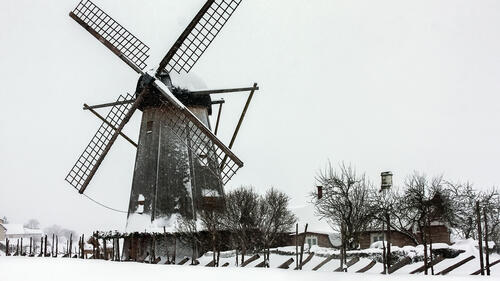
After the winter freeze, spring arrived gently. In April, storks returned to nest on top of telephone poles. On the first of May, out came patio seating at the restaurants (Saaremaa Veski, in the windmill, makes its own schnapps). Soon, lilac bushes perfumed my evening walks and sunset had slipped past 10 p.m.
Late spring brought fresh rhubarb and wild garlic. Kuressaare, empty nearly the entire time I had lived there, was covered with sunbathers holding cocktails.
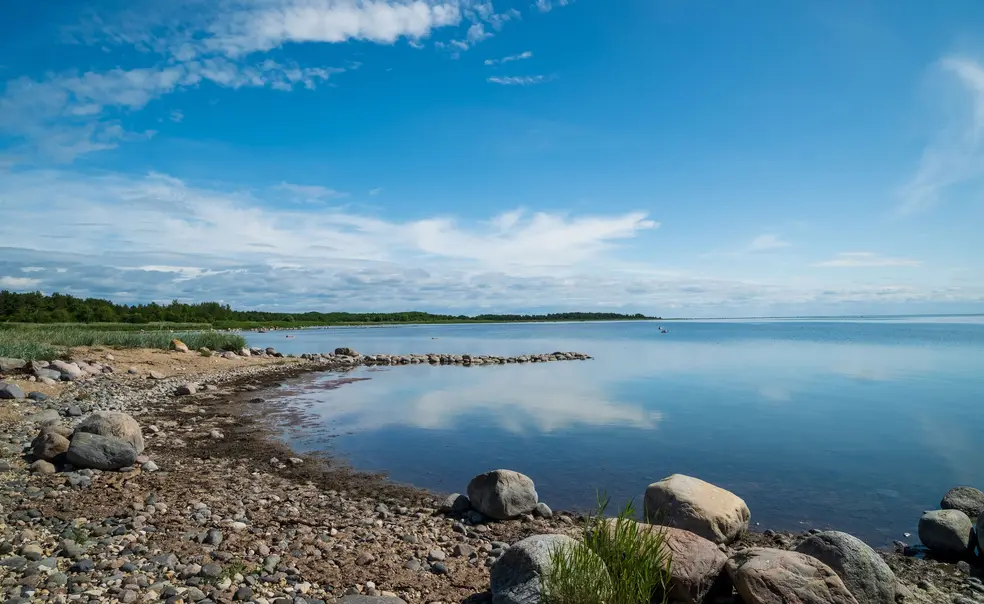
Saaremaa is best known as a summer destination. Quiet farmland stretches along the sea; tucked-away beaches and lighthouses greet the curious hiker; sunset and sunrise blend into one event.
In the long-awaited daylight, I swam off the dock by the castle, attended local professional soccer matches, and visited village cafés, like Köstrimaja, open again for the season. On a coworker’s farm, we picked dill and ate fresh strawberry ice cream made by his daughter.
The island also becomes a hub for summer festivals. The Saaremaa Peony Festival, a monthlong display of over 7,000 peony bushes, opens every June. On summer Thursdays, local folk dance groups perform free outdoor concerts in the town center. (During my last week, my group danced in front of the mayor’s office, a highlight of my time in Kuressaare.) July brings top performers to the castle courtyard for the Saaremaa Opera Festival, and the Kuressaare Maritime Festival in August celebrates the island’s seafaring culture.
I returned to Abruka by boat for Midsummer (Jaanipäev, one of the most important holidays in Estonia) across the same route we had driven four months prior. A small parade proceeded from the harbor to the Abruka museum, where visitors squared off against locals in tug-of-war and a friendly soccer match. The islanders lit a huge bonfire, and we danced barefoot for hours to a local band. At the end of the night, we rocked ourselves to sleep on the village swing (a large, usually wooden structure called a kiik). Sometime after 2 in the morning, volunteer firefighters drove around the bonfire and doused it to embers.
Estonia has over 2,000 islands, a handful of which are accessible. Vilsandi, in the eponymous national park, is a premier destination for observing migratory birds. More remote islands, like Kihnu, maintain traditions that have been inscribed in the UNESCO Intangible Cultural Heritage of Humanity. Ruhnu, Vormsi, and Piirissaar are at the top of my bucket list. Island life has something for everyone. How you arrive — by bus, ferry, plane, boat, foot, or ice highway — is up to you.
The Latest
See all


Related News

With Prominent Journalists and Hoagies, the ‘Prince’ Celebrates 150 Years
A gala at the New York Historical raised roughly $400,000 for the independent student newspaper


2 Responses
Mikk Hinnov ’66
1 Month AgoActivities and Atmosphere of Estonia
Thank you for your very fine article. I am an Estonian in our diaspora in the U.S., a World War II refugee. Since the collapse of the USSR, I have made several trips back to the land of my birth and visited most of the places and taken part in most of the activities you describe. You certainly got the facts and the atmosphere right!
Kushanava Choudhury ’00
9 Hours AgoCharming Account of Travels in Estonia
What a charming and vivid description of this magical corner of our world! Thank you for sharing the story of your intrepid northern travels with those of us who may never brave ice roads across the Baltic Sea.