

Three Books: Professor Sophie Gee on the Political History of Eating
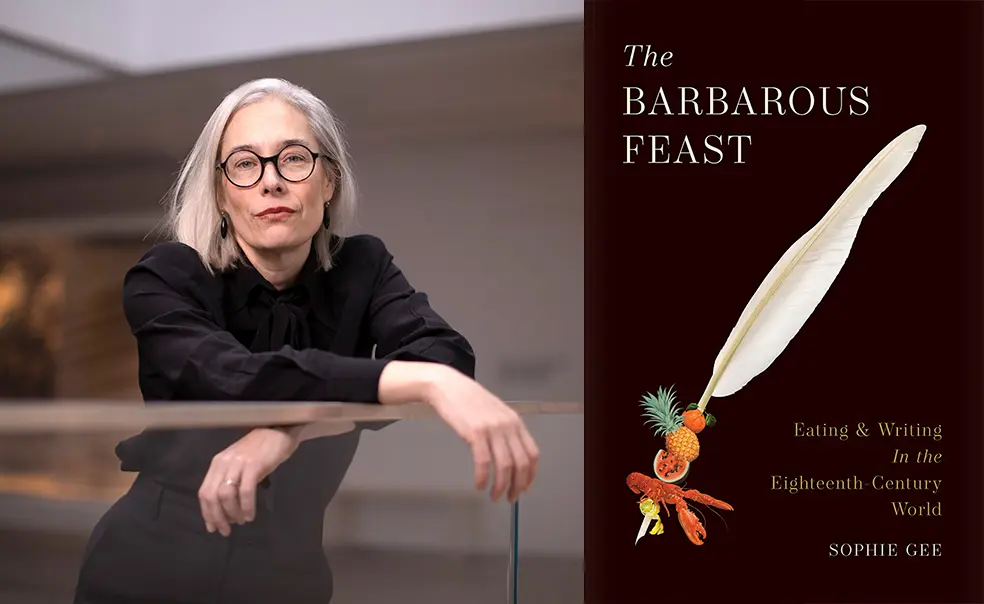

Princeton English professor Sophie Gee’s new book, The Barbarous Feast, examines how people living in the British Empire during the 18th century used both eating and writing to manage their own inner lives and to connect with other people. Food and eating, she writes, are fundamental to our sense of who we are. Here’s how she describes her work to PAW:
The 18th century is when British colonial expansion reached a peak. The trade in enslaved people was escalating rapidly and the plantation became fixed as the most profitable means of low-cost crop growth, worldwide. Mass produced goods were shipped all over the globe on maritime supply routes.
This is when global food systems emerge. In the early 18th century, every colonial setting had thriving local food economies. In Sydney, Australia, for example, the area around Sydney Harbor was lived in by First Nations people, who maintained a complex marine ecosystem that included intertidal mangroves, native oyster reefs, and many edible land species such as kangaroo. But colonizers didn’t know how to cultivate land that was so climatically different from Europe. Instead, livestock were imported into colonies for meat, European grains were mass planted or imported, and local food systems were largely erased.
What we see is the emergence of two opposed and seemingly irreconcilable models of how people eat and drink. On the one hand, local food practices that sustain families and community cultures become increasingly associated with marginalization and rebellion against dominant power structures. On the other hand, global, impersonal, mass-produced food, controlled by companies and corporations, are used to maintain plantation monocultures and the systems of labor they require.
As a literary historian, I write about how novels entered this picture as a new kind of writing that emerged within the British Empire, and offered new ways to represent inwardness, negotiating between these polarized alternatives: eating that sustains communities vs. eating that destroys them.
PAW asked Gee to suggest three more books that explore the political history of food, and she offered these:
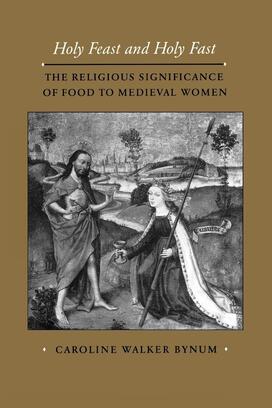
Holy Feast and Holy Fast (1987)
By Caroline Walker Bynum
Bynum’s is a truly brilliant book about how feasting and fasting, connected to the Eucharist and at the center of medieval European culture, shaped medieval women’s inner lives between 1200 and 1500. Through extreme fasting, abstention, and devotion, women established collective agency and spiritual authority in a male-dominated society.
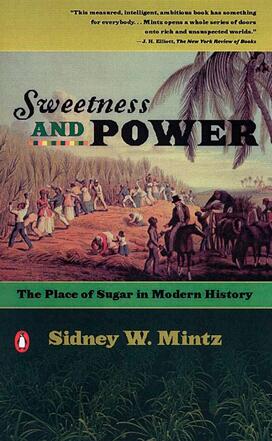
Sweetness and Power (1985)
By Sidney Mintz
In one of the first field-changing books on food studies, Mintz tells the story of how “Big Sugar” emerged by the mid-19th century: a mass-produced, cheap calorie hit for the British working classes. Mintz tracks colonial expansion, the transatlantic slave trade, and early industrial capitalism, to argue that power structures transform local foodways, diets, and human bodies.
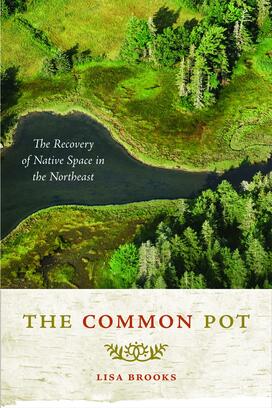
The Common Pot: The Recovery of Native Space in the Northeast (2008)
By Lisa Brooks
Brooks’ groundbreaking text shows how Native American writers in the 18th and 19th centuries protected their knowledge and culture through the concept of the “common pot,” adopted from Indigenous food practices. The common pot embodies land, community, and mutual sustenance as real conditions that allow local cultures and placemaking to survive and thrive even when there are dominating capitalist and colonial systems at work.
The Latest
See all


Related News

Kate Kaneko ’16 Turns Unused Restaurant Spaces Into Daytime Cafés
Asano is currently in two New York City restaurants, Sandro’s and The Noortwyck

Follow Angela Han ’28 and Spend a Day in China’s Snow Town
Despite the tourists, Xuěxiāng retains a distinctly northeastern character, Han writes

No responses yet