

Follow Angela Han ’28 and Spend a Day in China’s Snow Town
Despite the tourists, Xuěxiāng retains a distinctly northeastern character, Han writes
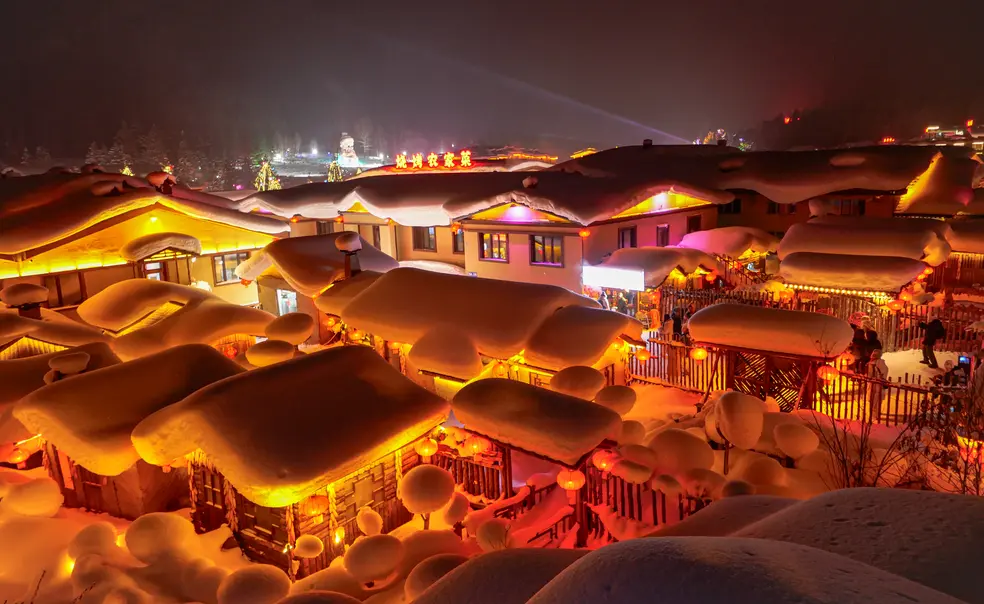

Nestled in a deep mountain valley between the Zhangguang Cai (张广才岭) and Laoye (老爷岭) mountain ranges lies Xuěxiāng (雪乡). Engulfed in a blanket of white, the village aptly known as China’s Snow Town looks as though it’s sculpted out of snow.
While its picture-perfect scenery draws millions of visitors each year, Xuěxiāng offers something equally, if not more, memorable: an opportunity to explore the food, traditions, and hospitality that make Northeast China, or Dongbei (东北) so distinctive. Despite welcoming an ever-growing number of tourists, the village retains a distinctly northeastern character.
Winter here shapes nearly every part of daily life. Sitting where cold air masses from Siberia collide with warm, moisture-heavy currents from the Sea of Japan, the region’s extraordinary snowfall is partly a product of its geography. As average winter temperatures dip below zero degrees, the snow clings to rooftops and branches, accumulating into thick, rounded formations that resemble mushrooms and clouds.
For most visitors, the drive to Xuěxiāng starts from Harbin (哈尔滨), the capital city of Heilongjiang (黑龙江) province, so that’s where I began. The drive takes approximately five hours, but the mountain route offers a few surprises. Along the Yaxue Highway (亚雪公路), certain stretches are designed to play music as cars pass over them at a specific speed. The melodies of well-known Chinese songs are produced by the grooves embedded in the road, turning an otherwise ordinary stretch of highway into a rather memorable part of the journey.
For a taste of local life before reaching the village, I suggest stopping for lunch at one of the smaller roadside restaurants. Away from larger tourist hubs, these establishments offer a more home-cooked introduction to Dongbei cuisine. More adventurous eaters might appreciate Northeast Línwā (东北林蛙), a local mountain frog prized as a regional delicacy for its nutritional density.
I arrived in Xuěxiāng by late afternoon, just in time to watch the village transform as daylight faded. Against the setting sun, warm yellow lanterns and light posts began illuminating the wooden storefronts as red decorations and neon lights added bursts of colors to the endless white. Everywhere I looked, buildings, rooftops, and trees were buried beneath the droop and rounded shape of thick layers of snow.
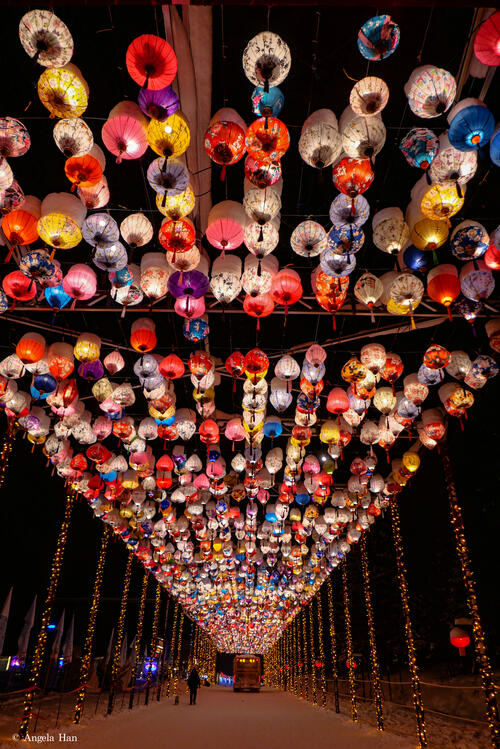
After checking into a hotel, I started to get acquainted with Xuěxiāng by walking. Xuěyùn Street (雪韵大街), the pedestrian-only main road running through the heart of the village, is lined with souvenir shops, food stalls, restaurants, and traditional wooden buildings. Walking the entire length of this main road, I found a beautiful lantern display at the very end. There was no shortage of photo opportunities along the way, and the further I wandered, the more little corners of the village revealed themselves.
Beyond this main street, a giant snowman sits not too far away and has become one of the village’s most recognizable landmarks: a towering snowman over 50-feet tall made entirely from real snow. Far from ordinary, this seasonal attraction is carefully sculpted by a team of snow artists, with the latest version taking more than 20 days to complete. Unlike a permanent statue, it is a winter-only installation with a lifespan dependent on weather conditions.
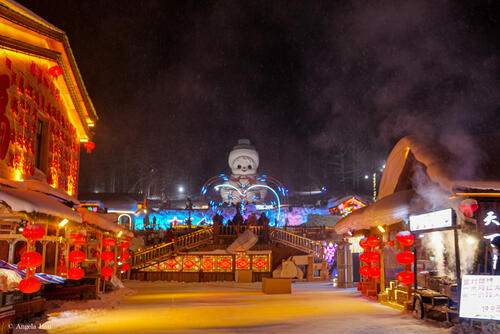
After taking plenty of photos with and of this architectural feat, I found myself itching for something more adventurous. Luckily, there were plenty of activities to choose from, including snowmobile rentals, horse-drawn sleigh rides, and snow tubing. With numerous smaller paths branching away from the main route, it was easy to spend hours wandering between attractions without following a set route. After exploring the village at ground level, I wanted to take in the scenery from a different perspective. I headed toward one of the several entrances to the wooden staircases leading up to the Bangchui Mountain Boardwalk, which is particularly rewarding to climb around dusk. From above, the noise of the village fades and there is a calm and stillness in the snow.
The village was equally, if not more, captivating after dark, when the contrast between the glowing streets and surrounding mountains became particularly striking. Even as temperatures dropped, the lively food scene gave me plenty of reasons to stay outside. Dongbei’s signature tiě guō dùn (铁锅炖) was a natural starting point, a hearty meal traditionally slow-cooked in a large iron pot, proved especially restorative after hours spent in the cold. Along Xuěyùn Street, I found stalls selling everything from fried snacks to steaming street food and sugar-coated rice cakes.
No visit would be complete without Tánghúlu (糖葫芦), hawthorn berries coated in a thin shell of hardened sugar that cracks with every bite. For something more distinctly northeastern, I always try to get a few bites of frozen pears and persimmons, which are left outdoors in the freezing temperatures before being enjoyed. The contrast between their icy exteriors and soft interiors makes for an unusual winter snack.
As the evening progressed, the village took on the quintessential energy of Dongbei nightlife. Late-night barbecue (东北烧烤) is practically a social ritual in the region, with charcoal grills roaring outside restaurants and the smell of cumin and chili powder filling
the cold air. Skewers display familiar favorites like beef, lamb, and chicken wings and more regional options like silkworm pupae and grilled slices of mántou (馒头片). I found that the atmosphere was as much a part of the experience as the food itself, with diners lingering over skewers and beer, for conversations that lasted well into the evening.
Food wasn’t the only reason to stay out: Xuěxiāng’s programming guarantees no shortages of entertainment. Starting in the early evening, Northeast Yangge (东北秧歌), a lively folk dance traditionally performed to rhythmic music, moves through the streets. At Snow Disco Square (雪乡蹦迪广场), live DJ sets at the open-air venue bring an unexpectedly modern twist to the otherwise traditional-looking village. Parties typically begin around 7:30 p.m. and end with fireworks, making it a fun stop to warm up between exploring the nighttime streets. Later in the evening, I stopped by the local venue for Èrrénzhuàn (二人转), a traditional northeastern combination of singing, dancing, storytelling, and comedy, alongside contemporary stand-up comedy.
At midnight, I watched the main lights shut off as the village gradually began to wind down. After a long day exploring Xuěxiāng, which had begun more than 300 kilometers away in Harbin, I called it a night. Unbeknownst to me at the time, there was still one more natural spectacle waiting beyond the village.
On the way out of the village the next day, I was amazed by the shùguà (树挂), also known as “tree-hanging frost” (雾凇), throughout the mountain range. This winter phenomenon leaves tree branches wrapped in white frost from end to end. The Yaxue Highway 2024 Observation Deck is a convenient stop less than 10 miles away for taking in panoramic views of this phenomenon before leaving the area.
But as the car winded down the mountain road, I found myself realizing that Xuěxiāng had given me much more than the snow covered scenery I had come to see. Beyond the seemingly fairytale-like appearance was a village with a character entirely its own, where centuries-old traditions sat comfortably alongside modern entertainment, and where the subfreezing temperatures seemed to bring people together all the more warmly. The snow may be what makes Xuěxiāng famous, but it is everything beneath it that makes the village worth visiting.
The Latest
See all


Related News
Before Orientation Change, Administrators Say They Should Have Talked to More Students
Administrators said they should have gathered more input from upperclassmen



No responses yet