

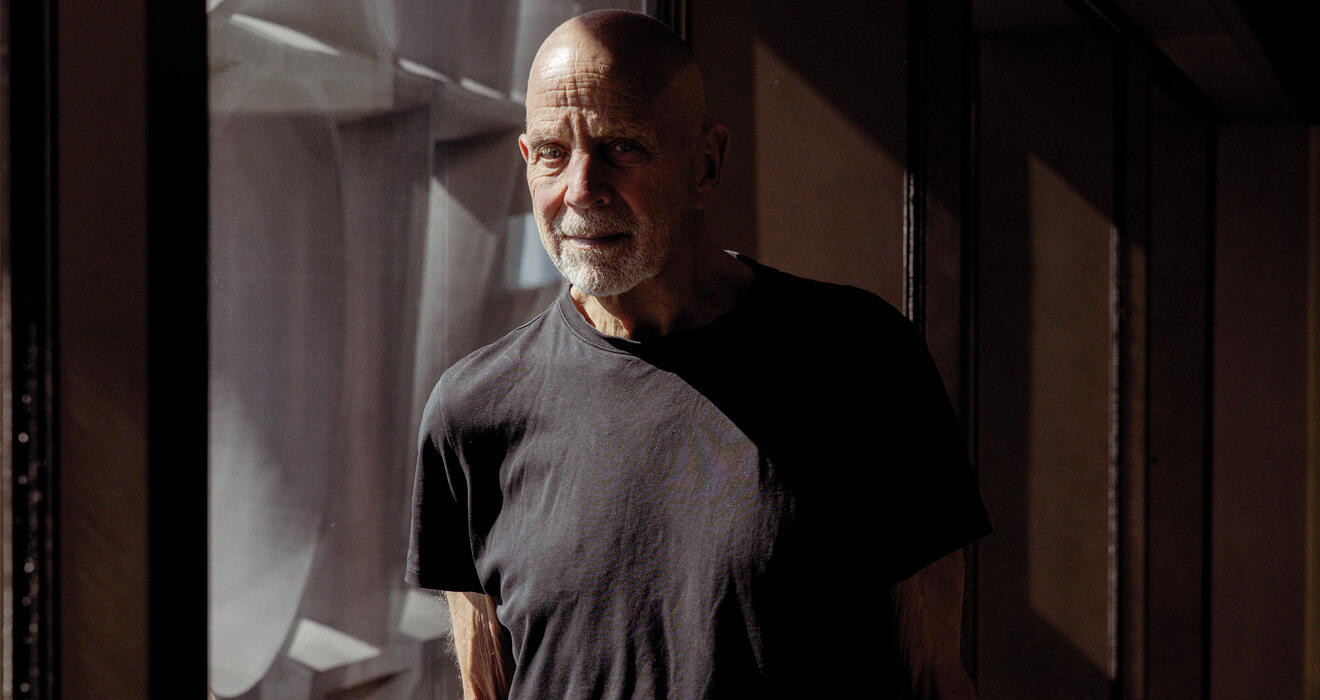

Architect Tod Williams ’65 *67 has experienced countless times the quiet miracle of roaming through a finished physical space that didn’t exist until it sprang from a doodle and a word or two scribbled on his sketchpad — but never like this. In early June, he finds himself exploring the Sky Room atop the imposing tower of the Obama Presidential Center on Chicago’s South Side. It’s near the end of another week of previews of the 19-acre campus of gardens threaded with winding paths and wetlands, and buildings that seem to emerge like bedrock from the landscape. What Williams wasn’t prepared for was the reaction of those invited inside ahead of the scheduled June 19 opening. Not just friends of Barack and Michelle Obama ’85, but schoolchildren from Nashville and regular Chicagoans of all ages, among others.
“This more than any other [project] is just a different thing because it affects so many people,” Williams tells PAW as he admires vistas of the city that are accessible for the first time. “It’s really their building. They see it as their building, not ours.”
He adds: “It’s shocking to see how many people are deeply moved by this place. Shocking, and unexpectedly moving. … I never want to be in a position where I ever say, ‘This is the project of a lifetime’ — yes, it is.”
Billie Tsien, Williams’ close collaborator for more than 40 years, feels something similar. “What pleases me, and I think also probably pleases Tod the most, is standing back and watching people come in and use the space,” she tells reporters earlier in the day. “They feel as if it belongs to them. It’s unlike anything I’ve ever experienced.”
The pair saved those initial doodles and free-associations from way back in 2015, when they were among seven finalists out of dozens of architecture firms vying for the commission. “Ennoble” and “Enable,” they scribbled on the pad, along with three rectangles around a void — a plaza. They also jotted down “Story-telling” and “Story-making.” This presidential library wouldn’t be a building, it would be a campus. A place that looked back and ahead, that celebrated and inspired, that spoke and listened.
The Obamas met with each of the finalists before picking Williams and Tsien in 2016. “They struck up a great rapport with both Obamas,” says Valerie Jarrett, former senior adviser to President Obama and now CEO of the Obama Foundation. “They got the point that the campus was to speak to the values that the Obamas have lived by.”
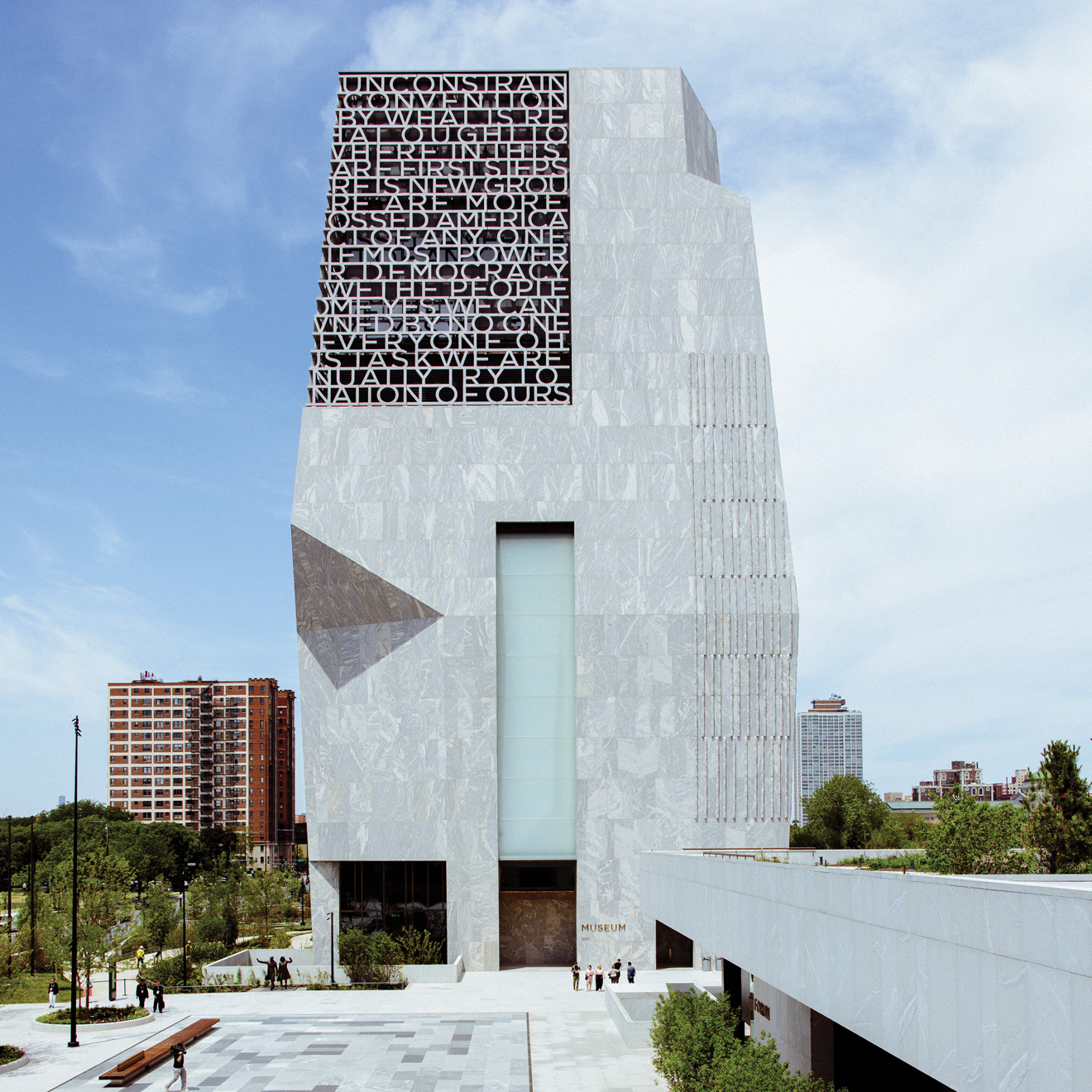
As this privately-funded, $850-million facility opens in a sometimes neglected part of town, Chicagoans can sound giddy groping for words to capture what they think of the center. It’s “going to become the new living room for the world,” says John Roberson, the city’s former COO who oversees the Obama center’s operations. “As long as you tell the history of this country, you now have to tell the story of the Obama Presidential Center on the South Side of Chicago, located at [the corner of] 60th and Stoney Island.”
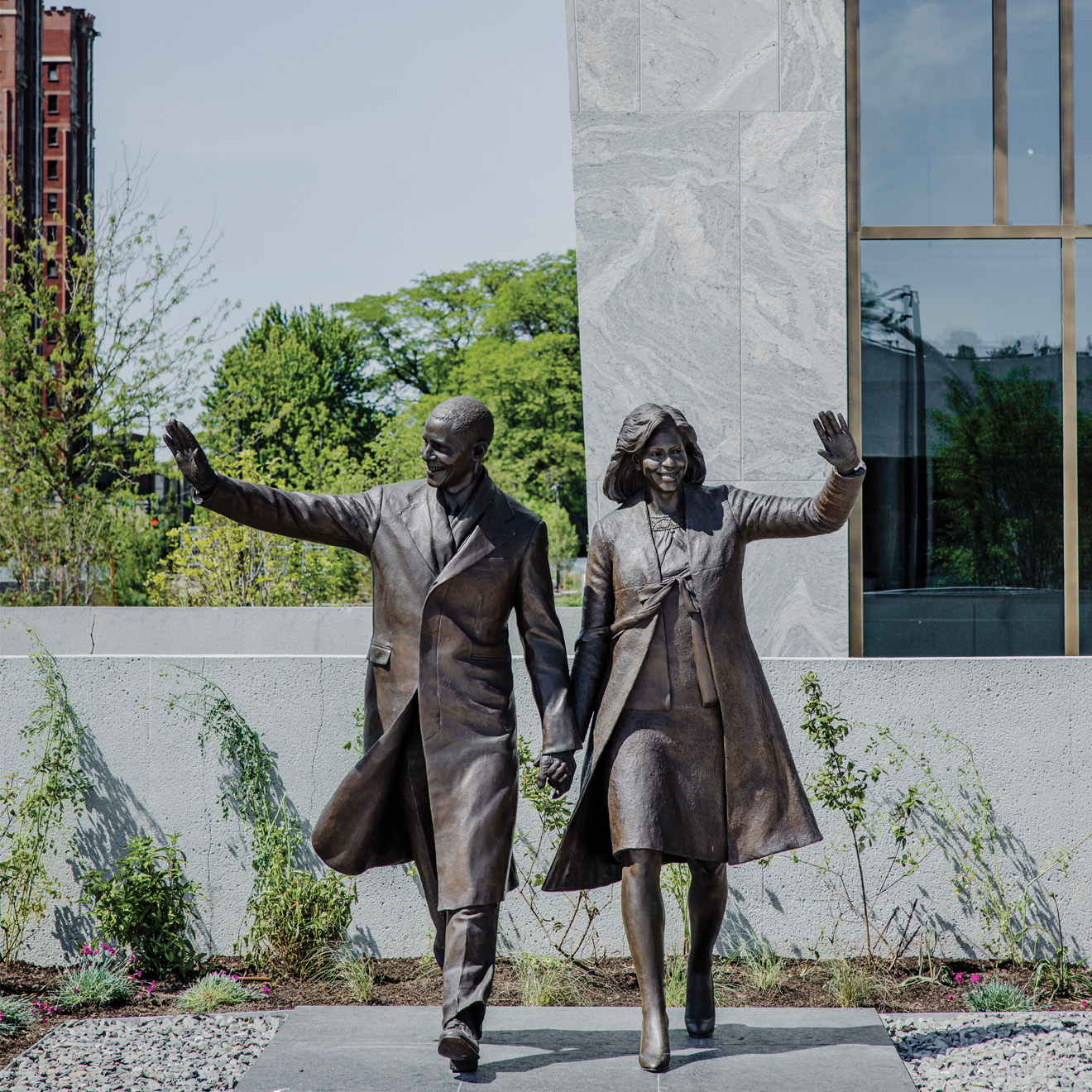
Most of the four buildings’ interiors and all of the grounds are free and open to the public, with a museum, restaurant, basketball court, classrooms, lecture hall, public library, recording studios, and barbecue grills. Just the tower’s four-floor museum section devoted to the Obama presidency requires a $15-$30 ticket for entry, while the lookout Sky Room at the top of the tower is free. If the center succeeds as the Obamas and their foundation intend, the campus will be adopted by everyone from picnickers to tourists to community organizers, anyone who might take what the Obama presidency means to them and put it to use in their own neighborhoods.
Not all reactions, however, have been appreciative. The 225-foot tower, in particular, has been called too big and blocky, earning the waggish moniker “Obamalisk.” Architecture critics for The Washington Post, The Guardian, and The New York Times published favorable, harsh, and mixed reviews, respectively. “Tod Williams Billie Tsien Architects knows how to create buildings that feel welcoming and open while also cool and contemplative, public space that pulls one out of the fray and into new forms of communion,” wrote Philip Kennicott in the Post, while Oliver Wainwright of The Guardian begged to differ: “Behold the $850M Obamalisk — or, as it sometimes feels morbidly like, the Obamausoleum.”
Much of the criticism, though, has little to do with the architecture. The Obama Foundation’s decision to place the project in Jackson Park, designed in 1871 by Frederick Law Olmsted close to Lake Michigan, and the city granting a 99-year, $10 use agreement on public land, have been controversial. There are fears the project is sparking gentrification. And it’s the first presidential library that isn’t really a library, nor will it hold printed presidential archives. Since 95% of Obama’s presidential records originated in digital form anyway, the foundation gave a grant to the National Archives to digitize the rest, which will be available anywhere, while the Archives will manage the physical papers elsewhere, according to Emily Bittner, the foundation’s vice president of communications.
Williams and Tsien wince when they hear “Obamalisk.” They didn’t originally envision such a monumental tower. It was Obama who egged them on to go larger and louder, but they unapologetically own the finished design and are taking the gibes in stride. “To say it doesn’t sting would be wrong,” Williams says. “But suddenly you realize you’re in the public eye, and the public has a right to speak. … I think it’s just better to keep my nose to thinking about the building and the problem and the person and the assignment, in which case all of this chatter goes away.”
Tsien adds, “We’ve talked about this as a 500-year building. So nicknames will come and go, but I think what remains is a building that is a marker [of a] person and time in our history.”
Williams, 83, and Tsien, 77, are more accustomed to good reviews. Their body of work includes the Barnes Foundation art museum in Philadelphia; the rebuilt David Geffen Hall and the David Rubenstein Atrium, both at Lincoln Center in New York City; the Logan Center for the Arts at the University of Chicago; and the Andlinger Center for Energy and the Environment at Princeton. In 2014, Obama presented the pair with the National Medal of Arts.
The last 14 months have been especially busy. In addition to the Obama center, two more projects have opened that, together with the Obama campus, show the range that characterizes Williams’ and Tsien’s work. Their U.S. Embassy complex in Mexico City stands as the largest State Department facility outside Washington, D.C., consolidating more than 1,500 employees under one roof, according to Ambassador Ronald Johnson. At a sprawling scale, the design calls back to the traditional courtyard style of Mexican houses, with interior patios and a large open-air courtyard lying at the center of the design.
Then there’s the humble but elegant Brooklyn Bridge Park Pavilion in New York City. It’s a bathroom stop designed with remarkable care. On a knoll beneath a curvy canopy overlooking the East River, you can order a sandwich and contemplate the bridge above and the flow of bikes, dogs, and humans on the riverside path below. “It could not have been a more important project for us,” Williams says. “This is a public building and it’s in a public place and it deserves to be honored and respected and loved.”
Civic, cultural, and educational constructions — whether a bathroom, an embassy, or a presidential library — are Williams’ and Tsien’s specialty. “We don’t do commercial work,” Williams says. “If someone asked me to do an office tower, I wouldn’t. … Usually with commercial work, the dollar is the final arbiter. I want the emotional, the spiritual to be transcendent.”
What the projects have in common — and you can also see it in the Barnes, the Andlinger Center, and other work — is a preoccupation with the structures’ relationship to the land and a heightened attention to how craft, materials, and the human experience of interior spaces drive the outward forms of the buildings. Williams calls it “designing from the inside out.”
“It’s an implicit critique of the international generic that was pretty rampant in global modernism, where you could do everything everywhere and make it all look the same, and therefore it lost its connection with the local, both in terms of materials, in terms of craft and even … a sense that somebody did it,” says Paul Lewis, a professor of architecture at Princeton. “This isn’t to say that space and form wasn’t relevant in their work, but it wasn’t foregrounded to the detriment of the tectonic materials. ... That became a really rich and provocative and, frankly, influential way of working.”
Contemplative rather than bombastic, their structures defined a quiet zone within the self-promotional din of contemporary architecture. “The seduction of their work is visible by inhabiting the buildings,” Lewis adds, “by going inside and walking around and touching things.”
The inside is what counts. For example, at Princeton, Williams compares the playful monolith of Bowen Hall to the ground-hugging, secret-garden vibe of the Andlinger Center next door. “Bowen Hall is a pretty good example of a building that sees itself as a series of materials that are arranged, I think, in a rather postmodern way,” he says. “But it’s sort of saying, ‘Look at me!’ And I’m saying, ‘Don’t look at me; be in me.’”
“The idea of getting lost and finding yourself, which is what I certainly did and am still doing. The pleasure of not knowing and finding some truth about yourself and the world by entering into the conversation you can’t even understand, or a landscape you can’t understand, and it sorts itself out.”
—Tod Williams ’65 *67 on his architectural style, specifically Princeton’s Andlinger Center for Energy and the Environment
One morning in February, Williams leads PAW on a tour of the firm’s studio on the ground floor of a building constructed more than a century ago to house artists across the street from the southern edge of Central Park in New York City. Tall and lanky, with a shaved head, he’s not hard to imagine as the former captain of the track team at Princeton who also played junior varsity and varsity football as an offensive and defensive tackle, until injuries led him to give up football. He claims he almost flunked out in his sophomore year. “One of the things that got me in trouble was the pleasure of coming to New York, and going to the Apollo Theater,” he says. “I remember seeing Little Stevie Wonder when he was like 15 years old.”
In a sense, architecture saved him. His three mentors, Peter Eisenman, Michael Graves, and Richard Meier, modernist young radicals who taught at Princeton, convinced Williams to focus on his studies. “They stirred something inside me,” Williams says.
His worktable on the broad studio floor sits alongside those of the firm’s architects, whose ranks can reach 40 depending on the number of active projects. Williams says he likes being in the middle of the action. His is the only table without a double computer monitor. He likes working on paper, and he and Tsien extoll the value of handwork — whether it’s the architect’s sketch, the stone quarry worker’s chisel strokes, or the carpenter’s joinery — while the studio also employs the latest digital design tools. “His computer turns on about once a week,” says Cleo Berliner, the studio manager. “There are pens on his desk every day, though.”
Williams leads the way to a table with more than two dozen miniature paper models of the Obama tower. The array of miniatures was the response to a request from the president. In the middle of the design process, Obama wanted to see more options for the tower. Each is subtly different. Some chunky, some svelte. None of the facades is flat; the planes are sliced and shaped and angled in different configurations.
Obama turned out to be one of those clients who tells his architects that he might have been an architect, too, if he hadn’t become, well, the president. He definitely had opinions. “He listened to us plenty, and we listened to him plenty,” Williams says.
Williams pulls out a hand-drawn sketch he made of a version of the tower. He points to slashes in black marker where Obama scribbled out some of Williams’ lines and drew in others. Another time, Obama added an appendage that, to Williams, “looked like a duck’s beak on the thing.” Williams got the president’s message. “He was just saying, you know, ‘Make it more interesting.’ It made me think, he’s very serious about this and we need to work harder.”
“It was very much a lively dialogue, so that was exciting,” Tsien says of interactions with Obama in a telephone interview with PAW. The former president has, “in terms of the larger building form, a very good eye.” Obama told the Times last October, “I’m sure there were times when I got on their nerves a little bit.”
The duck’s bill did not make it onto the tower, but the architects responded to Obama’s appraisals that earlier versions were “too quiet.” Ironically, though, the evolution of the tower inevitably prioritized making an exterior statement with the architecture, which isn’t how Williams and Tsien typically think about buildings.
“I think that was the biggest question,” Tsien says. “Can a building represent a vision? Buildings are containers for visions. Most of our buildings are containers for vision, containers like the Barnes for art,” or Andlinger for higher education and the environment, or the Brooklyn pavilion for a civic crossroads and comfort station. “We’ve not spent so much time on the container itself because, essentially, most of our buildings are fairly restrained, with an enriched experience when you are inside.” She adds, “It’s asking that a building be designed from the outside, and that’s not our normal process.”
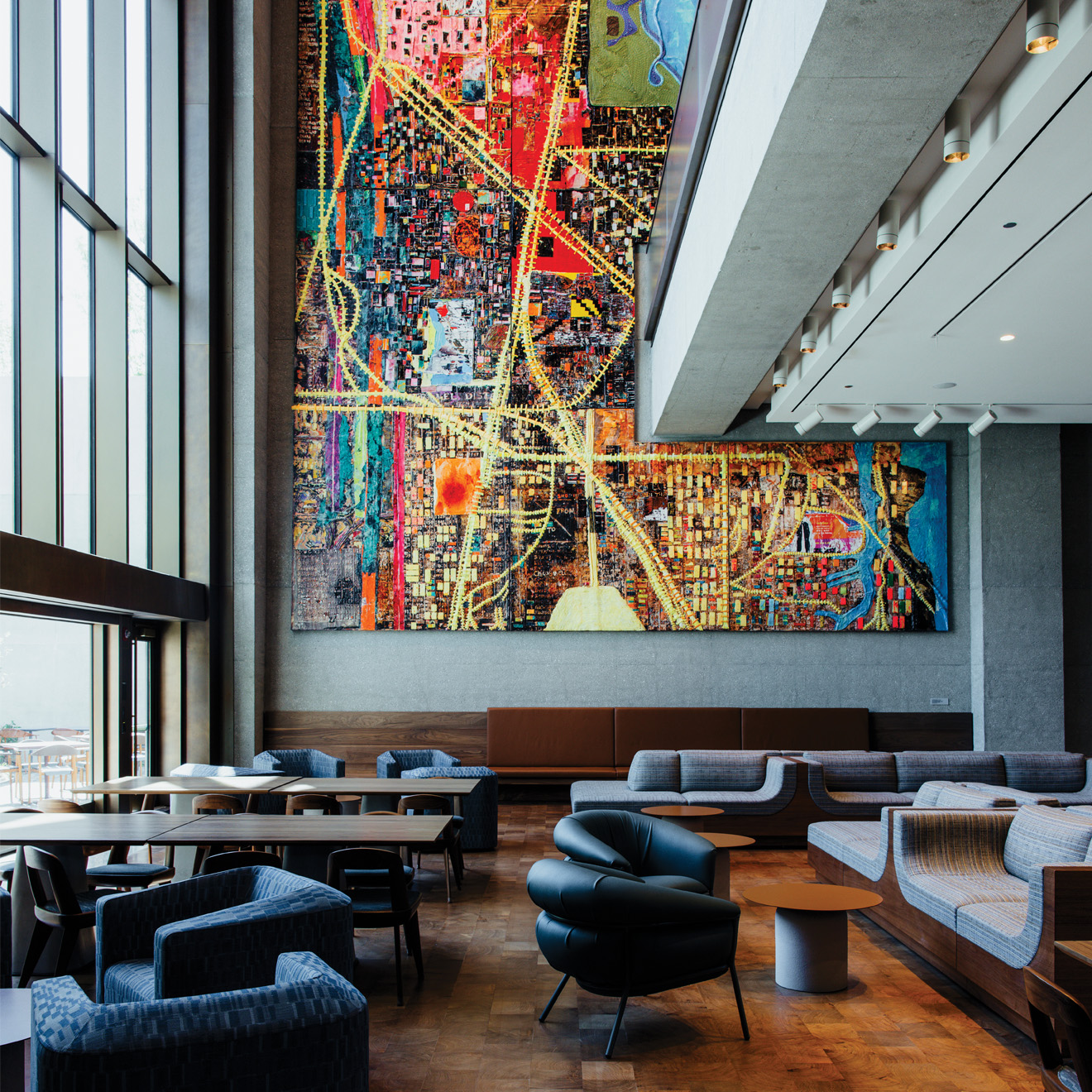
Still, they saw Obama’s point. Initial designs of the campus lacked a signature piece, sort of the way the early Princeton campus needed a Nassau Hall, Williams says. Indeed, making the museum an uplifting tower enhanced their original architectural argument that the election of America’s first Black president had “ennobled” the office. And there were practical considerations: A horizontal museum building would take up too much space.
They conceived of the tower as four cupped hands coming together and as a beacon of hope on the land. To protect museum artifacts inside, windows on most of the exterior were out of the question, so they found other ways to add texture and life to the facade. They chose granite from a New Hampshire quarry that displayed a moody “tapestry,” markings that adopt subtly different shades when wet with rain or bathed in varying intensities of sun. They made each of the tower’s four facets distinct, with unpredictable angular cuts in the granite, stained glass art screening the escalator, and a vertical light box glowing at night.
Wrapped around two sides of the top and cast in concrete are words from Obama’s 2015 speech on the 50th anniversary of the Selma-to-Montgomery Civil Rights march. Originally this linguistic screen outside the Sky Room was supposed to merely suggest the power of language without using actual words, but Obama chose to install an excerpt of the speech.
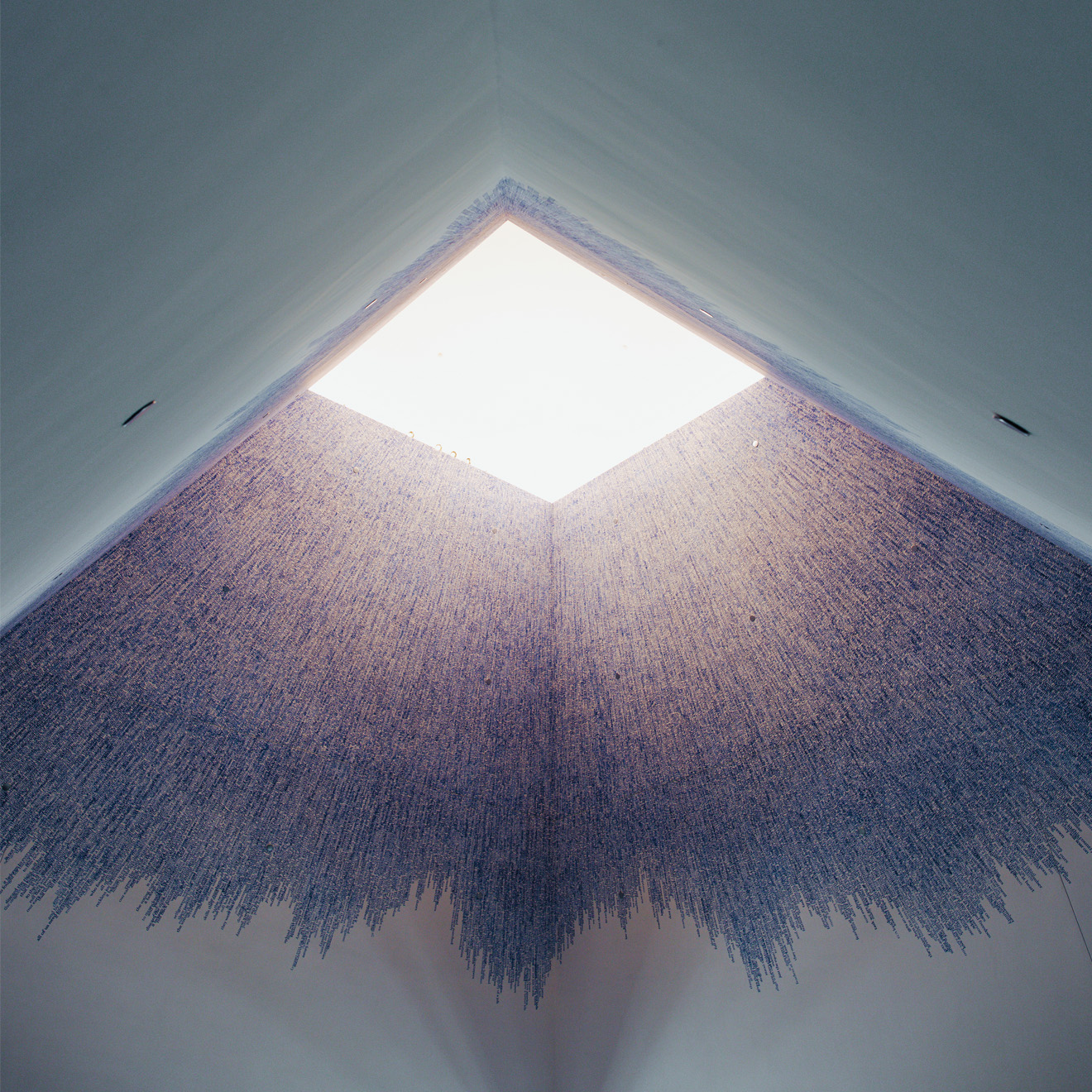
From inside the building, natural light filters through the words and glass, allowing visitors to peer between the letters. Outside, the speech can be read from the ground, but only by walking around the corner to follow the text, which frustrates some critics. Like a message aimed toward Chicago’s West and South Sides, not the corporate towers to the north, the passage begins and ends with words that might capture the stated individual and collective aspirations of the Obama presidency — and of the architecture itself: “You are America …” and “… nation of ours.”
Williams was raised in suburban Detroit and educated through high school on the legendary Cranbrook Educational Community campus in Bloomfield Hills, a place saturated with ideas of art, architecture, and design. Finnish architect Eliel Saarinen designed many of the buildings in shades of the Arts and Crafts and Art Deco movements; Charles and Ray Eames, of Eames Chair fame, left his mark; and Saarinen’s son Eero got his start there before going on to design airports and a symphony hall. As a teenager, Williams worked summers for an industrial design studio that made subway cars and jukeboxes. “I loved it, and I knew that I liked being around these people,” he says.
When he got to Princeton, Williams remembers Eisenman asking him who was his favorite architect. “Of course I said Saarinen. He told me how wrong I was.” By the time Williams reached graduate school, including a year in Cambridge, England, before completing his graduate degree back at Princeton, “it had been pounded into my head as to who the great architects were. It was very clear that Le Corbusier, particularly in his career from 1910 to ’29, was the person I should be following.”
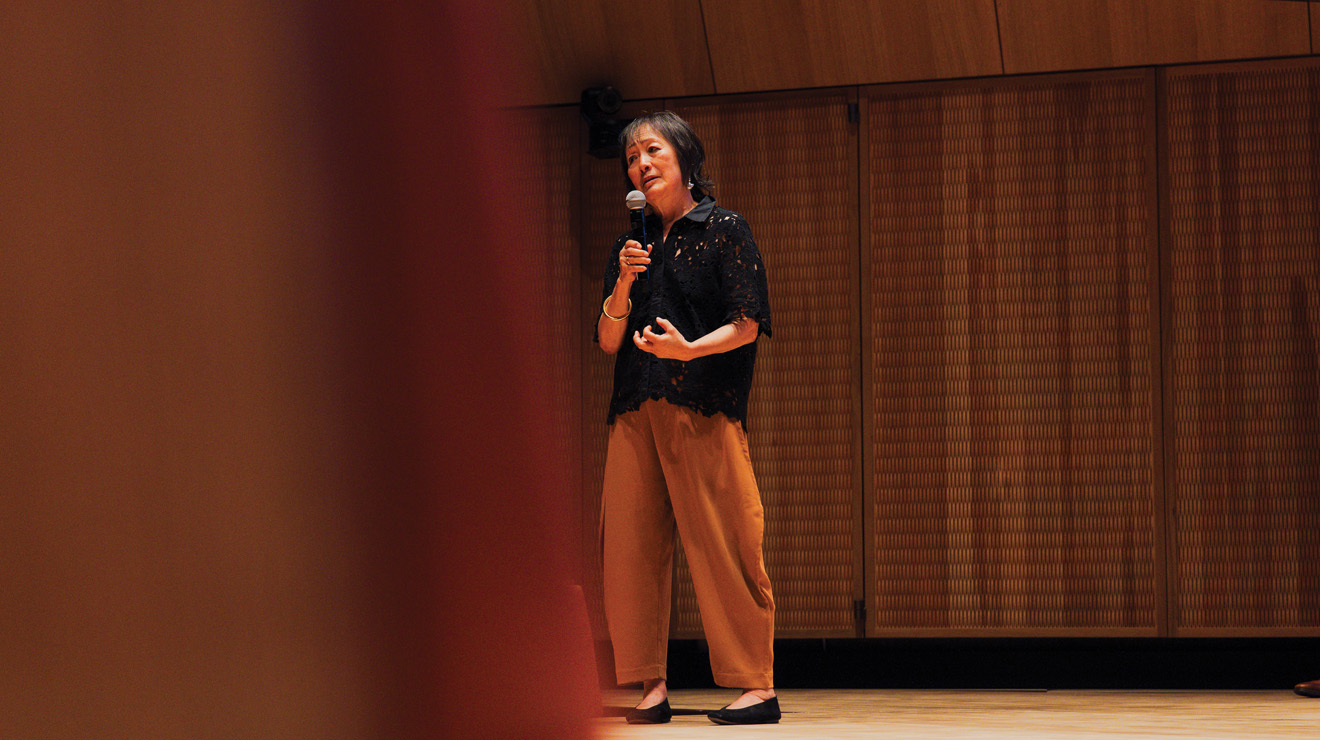
Williams got a job in Meier’s New York firm, then went out on his own. In 1977, he hired Tsien to work in his studio, and in 1986 they formed their joint architectural firm Tod Williams Billie Tsien Architects. Together they found their own architectural voice and developed a modernism that was concerned with craft and connection to the land.
In 2012, the Barnes museum in Philadelphia, like the Obama center, generated headline-making controversy beyond Williams’ and Tsien’s control. The museum’s relocation from the suburbs was fiercely opposed by some. The design had to replicate the original claustrophobic layout of galleries, but Williams and Tsien found ways to add relaxing interstitial spaces, an interior garden, and a monumental light court. The herringbone floor of the court was made of wood reclaimed from the boardwalk at Coney Island. For the walls of the Barnes, the architects chose limestone of a particular quality from the Negev Desert in Israel.
Vincent D’Antonio, senior director of operations and grounds for the Barnes, tells PAW that he’ll never forget how Williams and Tsien mingled with the construction workers and craftspeople, exchanging minute details on the transformation of design idea into constructed reality. “Folks in the construction field aren’t used to that. The architect usually walks through, writes down a list of things that they don’t like, ships it to them in a couple weeks, and everybody looks at it and runs around and fixes things. Tod and Billie want to know, ‘Why did that happen?’ Or, ‘This is the way I want it to look.’ Or, ‘Here’s a sketch of what you’re building, can you achieve this?’ ... It was really the first time on a large project like this that I saw the head of an architecture firm come out and talk to the folks building the building.”
Williams and Tsien had a plaque affixed to the Barnes with the names of every person who worked on the project. A similar “Worker Appreciation Wall” at the Obama center has nearly 4,500 names.
At Princeton, in discussions related to campus buildings, “Andlinger” has become an adjective, says Forrest Meggers, associate professor of architecture at the University’s energy and environment research center, which opened in 2016. The “Andlinger Center move” refers to how the building drops into the land, and the land drops into the building via courtyards and roof gardens. According to Meggers, campus designers will say, “Don’t build these really deep buildings that nobody can get outside, you have to do the Andlinger thing.”
“It is my favorite building on campus,” says Lewis, the architecture professor, and it “has probably the most interesting relationship to the notion of a campus. If the campus is usually seen as a lawn, and then buildings are plopped on, the Andlinger Center is fully embedded into the thickness of the campus. It goes down, it goes up, they build courtyards that bring light in. ... As a result, the building is actually quite discreet. ... It’s a building you discover by going there.”
That said, Andlinger is also notorious as a place where it’s easy to get lost, Meggers says. During a recent visit, he and PAW briefly had trouble finding each other, misunderstanding which courtyard the other was in. The three main sections of the building don’t connect on the ground floor; you have to go below ground or outside to pass from one to another. Meggers says some users of the building take the attitude of, “‘Who cares that people get lost, it is really cool.’ But the engineers are like, ‘I’m sick of people getting lost in the building, I’m a pragmatic thinker kind of person.’”
Williams is glad Andlinger has that quality: “It’s where I hope you can get lost and be delighted and find things.” It connects to a larger idea about earning an education, designing a building, living a life. “The idea of getting lost and finding yourself, which is what I certainly did and am still doing. The pleasure of not knowing and finding some truth about yourself and the world by entering into the conversation you can’t even understand, or a landscape you can’t understand, and it sorts itself out.”
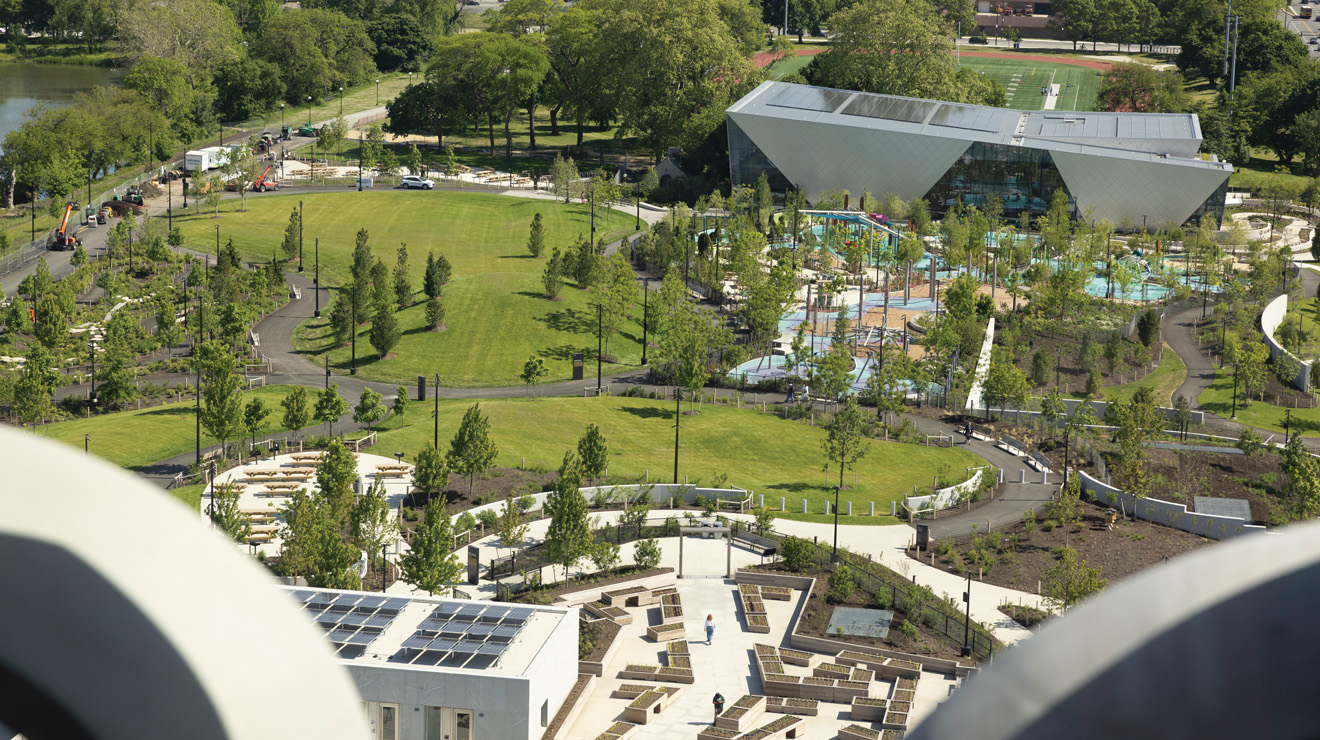
Back in Chicago, the Obama center campus feels a bit like like an expanded Andlinger Center. The curving paths lead to striking views and surprising destinations — a vegetable garden, a hill for sledding in the Chicago winter, a playground. Williams and Tsien collaborated with landscape architect Michael Van Valkenburgh, who also worked on the Andlinger Center, the Mexico Embassy, and the Brooklyn Bridge Park Pavilion. Pushing back against criticism of this intensive use of a passive Olmsted park landscape, the architects point to a net gain of 3.7 acres of green space, counting the removal of a six-lane road and a two-lane road that had cut through the park.
The three buildings designed by Williams and Tsien — the tower, the Forum for programs and gatherings, and a new branch of the Chicago Public Library — are actually one building connected underground. In aerial views of the campus, the Forum and the library are invisible because the paths and gardens have spilled over them. A fourth building — Home Court, designed by the architectural firm of Moody Nolan — contains a full-size basketball court.
The tower looms larger from a distance, muscling over a lower-scale landscape. Up close, though, it appears to shrink within its textures and moods. Step inside and there’s a zone of tranquility as one approaches the museum. Dramatic, multistory spaces and grand-scale commissioned artworks inflect the low-lit galleries with their interactive digital displays and murmur of curated music and speech. Rising four floors, the museum starts with the story of American democracy and the struggle to extend it to all Americans, leading into an account of the Obama presidency and life in the Obama White House — Michelle’s dresses? Yes — including an exact replica of the Oval Office with no gold baubles on the mantle.
Above the museum, all the way at the top, is the Sky Room, where on that early June afternoon, Williams continues to roam the spectacular lookout. He scuffs his shoe on the floor made of a different type of granite from the facade, a cloudier stone, and this choice of material pleases him all over again. So too this rippled curtain along one wall — it looks like dark fabric, but it’s smooth and hard to his touch: carved walnut. Another wall, structural and load-bearing, purposefully reveals that it’s made of unfinished, reinforced concrete, which runs all the way down to the foundation, a reminder of the building’s fundamental groundedness, as tall as it is, which may be the architectural value that Williams reveres most. “The choice of materials, they’re quite thoughtfully done,” he says. “We’re trying to always show that it’s made by a person.”
In that sense, the tower is designed from the inside out, in spite of everything. Williams crosses the floor and peers out through the giant concrete letters of Obama’s Selma speech. He catches glimpses of the gardens, grills, and playground of the campus, and the rest of the South Side lying beyond. Up here, seen from the inside out, the words of Obama’s speech — “You are America …” — appear in reverse, and Williams can imagine all those eyes gazing up in return from the outside in, the eyes of the city, the critics, the country, the world. And the future.
David Montgomery ’83 is a freelance journalist and former staff writer for The Washington Post Magazine.




4 Responses
Remy Edmunds
1 Month AgoOn the Dollar as ‘Final Arbiter’
David Montgomery’s profile of Tod Williams ’65 *67 (“Legacy Building,” July/August issue) takes the firm’s refusal of commercial work as principle and leaves it there. Williams says that in commercial work “the dollar is the final arbiter.” He is right, and that is the argument against him.
I manage capital projects for a university, which puts me on the client side of the work he prefers. A developer arrives with a lender, a pro forma, and a rent roll, and all three say no on a schedule. An institution arrives with an endowment and a legacy, and neither has ever told a president he was thinking too small. The Obama Presidential Center opened in June at roughly $850 million against an early projection near $300 million, and by Montgomery’s own account the demand for more scale came from the client, not the architects. No developer signs that change order.
I stood on the lawn in Little Rock in 2004 when Polshek’s glass bridge opened, and I have spent long afternoons in the light at the Barnes. Williams and Tsien detail stone better than nearly anyone working.
But I lived in the Loop for 14 months while that tower went up, worked in the West Loop, and never once went down to Jackson Park. Neither did most of the people I heard admiring it. Somebody’s dollar is always the final arbiter. Refusing the commercial client does not take it out of the room. It only removes the one client trained to say no.
Pat O'Connell ’74
2 Months AgoA Surprising Omission
It’s surprising that the profile of Tod Williams ’65 *67 and his work on the Andlinger Center doesn’t mention that the University filed a $10.7 million suit against Tod Williams Billie Tsien Architects related to cost overruns and delays in construction. The University said the suit was necessary to recover costs “incurred due to extensive changes and delays” caused by the architects and their sub-consultants.
Martha Mihaly Black
3 Months AgoOverview of the Obama Presidential Center
This is a nice review of the Obama Center and these architects’ body of work. I loved the idea of the worker wall! But I don’t understand why writers continue to identify the center as a library (“And it’s the first presidential library that isn’t really a library …”). Most everyone knows by now how presidential materials are handled and stored. And calling the Brooklyn Bridge Park Pavilion a “bathroom break” is, I don’t know, a little crude?
Thomas H. Wright ’62
3 Months AgoOmissions from the Profile of Tod Williams ’65 *67
It is hard to understand two omissions in the excellent article about Tod Williams ’65 *67, “The Public Architect”:
– The first listed commission in the public record for him and his partner Billie Tsien is for Feinberg Hall on the Princeton campus (1986). At the time, I was tangentially involved in such commissions at the University, and I remember well the pride and expectations of all of us then participating in this one: We were confident that we were present at an early launch stage of major architectural talent and vision.
– In the year 2000, an acclaimed entrance frontispiece and interior for the new location of the American Folk Art Museum next door to MoMA, by Tod Williams and Billie Tsien, was welcomed in New York. In 2014 MoMA shamefully destroyed that architecture as part of its expansion into the space of the folk art museum, to widespread dismay.
Editor’s note: The author is a vice president and secretary, emeritus, at the University.