


Nearly every night during this year’s run to the national championship, the members of Princeton’s men’s lacrosse team gathered for a critical intellectual exercise to weave them together and sharpen their minds.
They solved the next day’s New York Times crossword puzzle.
The Times posts a new puzzle every night at 10 p.m. Midfielder Wilder Burgin ’27, who captained this effort, would go to the Times app, download the puzzle, and project it onto his dorm room TV screen where teammates could also access it across campus. The Tigers got so good that they could knock out even the most challenging puzzles in under an hour. Easy or hard, though, they tackled the crosswords religiously throughout the season.
“Being athletes, there were a lot of Friday and Saturday nights when everyone else was going out and we had to find our own way of having fun,” says midfielder David Smythe ’26.
Crossword puzzles have been a particular Princeton strength. Have you ever struggled to finish the Times’ big Sunday puzzle? Dan Feyer ’99, a nine-time American Crossword Puzzle Tournament champion, can blaze through it in less than three and a half minutes. As the saying goes: Don’t hate the player, hate the game.
“Games are cool. ... There’s a fixed challenge. There’s a way to win, and it’s nice to have some certainty. Life is so messy. Puzzles are not.”
— Jamie Ding ’13, 31-time Jeopardy! champ
Far from hating the players, in fact, tip your hat to them. At the annual tournament in April, three alums finished in the top 25: Feyer, sixth; Stella Daily Zawistowski ’00 (until recently the top-ranked woman in the world), 13th; and Tom Weisswange ’94, 23rd. (Zawistowski constructs a monthly crossword for PAW.)
The men’s lacrosse team members, who also held trivia contests after their weekly team dinners, were a puzzle- and game-loving group. Certainly, it promoted cohesion better than their previous obsession: poker. Burgin sheepishly describes his sophomore year dorm room as “a casino of sorts” and says the games sometimes produced hard feelings, even for low stakes. Looking for something a little more unifying, they switched to the crossword. They even took their new hobby on the road, gathering each night in their hotels during the NCAA Tournament in May.
Pulling together as a group would usually help them find the right answers, providing a sense of accomplishment or occasionally, a chance to rib each other unmercifully. Smythe recalls the puzzle the night before Princeton’s quarterfinal match against Penn State. Each clue had a double meaning, and they were stumped by 65-across: “Yellow submarine?” The team had it down to “CHICKENSAND_I_ _.” Someone, whose name is being withheld to shield him from further teasing, insisted that the phrase they were looking for was “Chickens and fish” and wouldn’t let it go. But much as they would the next day against the Nittany Lions, the Tigers regrouped, found the answer — “Chicken sandwich” — and rallied to victory.
“There were a lot of things that went into that national championship run, but I’ll give the crossword some small credit in that,” Burgin says.
Princetonians of all ages seem obsessed with games and puzzles. Many play recreationally while others are champions. A few have even made some money at it. Indeed, there are more games and more competitors than can be covered in a single article. Here, though, is a sampling.
Jerry Price, senior communications adviser and historian for the athletics department, is partial to a different game on the Times website. Like thousands of Americans, he starts every morning with Wordle, in which players must guess a five-letter word in no more than six tries. Price’s strategy is often to start with a word that somehow reflects the coming day. Other times he might read a news story and use the first five-letter word he encounters. On days when a Princeton athletic team is competing, Price’s first guess is always “Tiger.”
“If I get it wrong, that’s a bad omen,” he says.
That doesn’t happen often. Price has gone as many as 200 consecutive days solving Wordle. When he spoke with PAW in late June, Price was working on a 90-day streak, but he had recently come off a four-day run of solving the puzzle on his sixth and final attempt, which he admitted had him very nervous.
In addition to the crossword and Wordle, the Times offers several other popular games such as Spelling Bee (making as many words as possible from seven letters), Connections (grouping words with common threads), and Strands (finding hidden words sharing a theme). Price does several of those, as well. An independent company, Wordle Global, offers the game every day in 91 languages.
Not only is the Times’ game site tremendously popular, with more than 10 million daily players, it has helped propel the Gray Lady to record profitability at a time when many of its journalistic rivals are struggling to survive. With a certain degree of justification, the paper has been called a puzzle and recipe company with a news division. Other news outlets and websites have also gotten into the games and puzzle space, including Apple, LinkedIn, The Washington Post, Vox Media — and PAW.

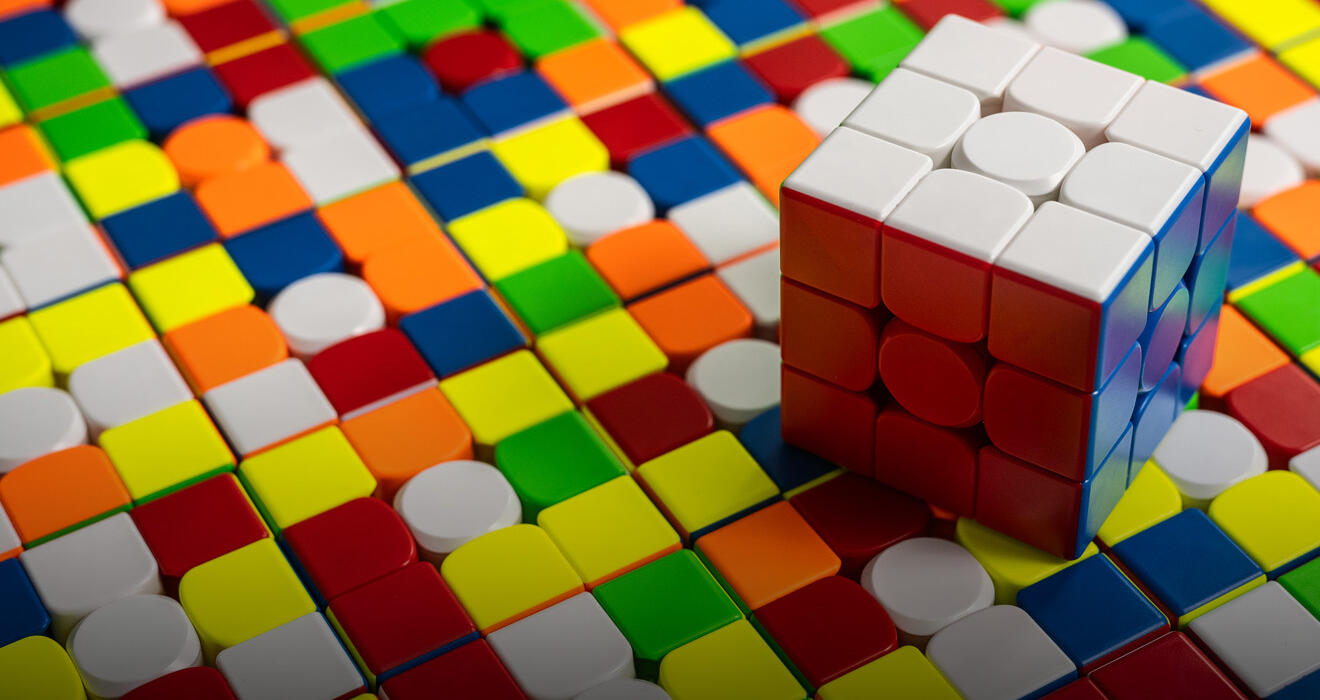
If the crossword seems a little retro, so does Rubik’s Cube. That puzzle, in which a block of squares (usually 3-by-3-by-3 but sometimes bigger) must be rearranged so that all the same colors are on the same side, became as much a part of 1980s culture as shoulder pads and Cabbage Patch Kids. It is currently enjoying a revival with the younger generation.
Not to brag, but Tigers have dominated. The Princeton Cube Club was founded in 2009 by Shotaro Makisumi ’12, who has held world records in seven speedcubing disciplines. Daniel Goodman ’22 invented a method for solving Rubik’s Cube known as CFinity, although if you move in those circles (squares?) you are more likely to know him by his nickname, DGCubes. His Rubik’s Cube-themed YouTube channel offers 475 videos and has nearly 50,000 subscribers.
As Goodman remembers it, his parents had a Rubik’s Cube lying around the house when he was little, but it seemed impossibly daunting. One day, Goodman found the instruction book, memorized it, and started solving. He got so good so fast that he began going to competitions at age 12.
Goodman’s real specialty, though, is a cousin to Rubik’s Cube known as Pyraminx. It’s another three-dimensional puzzle, in the shape of a pyramid, and the goal again is to get all the colors on the same side. Competitors are allowed 15 seconds to look at the scrambled puzzle before they attempt to solve it. In 2018, Goodman won the U.S. Pyraminx championship with an average score (across five pyramids) of 2.09 seconds. His personal record on a single pyramid is just 1.34 seconds.
“For me, cubing is such a relaxing thing,” Goodman says, although given his scores, he doesn’t seem to be relaxing for very long. “It’s super satisfying to see your times go down.”
One game often leads to another. This February, Goodman was a contestant on the TV game show Wheel of Fortune. He says he prepped for his appearance the same way he prepped for cubing competitions, by doing lots of practice rounds. The work paid off. Goodman solved the bonus round puzzle, “Giving You a Bear Hug,” which won him a total of $73,000 for the episode and a new Ford Bronco. He then gave host Ryan Seacrest a bear hug.
As an undergraduate, Goodman majored in computer science. Not surprisingly, he notes, many expert puzzle solvers have backgrounds in STEM fields. Adam Logan ’95, for example, a two-time world Scrabble champion, majored in math. Music, another field that relies heavily on pattern recognition, also produces a lot of puzzle mavens. To cite just one example, Feyer, the crossword puzzle champ, is a pianist and music director for a theater company.
Goodman, too, has followed a musical path. Five years ago, he quit his job as a software engineer to become a rapper. The artist formerly known as DGCubes now goes by a new moniker, DG the Artist. He has released three albums and several EPs, including his most recent one titled, I Quit My Day Job. Of course, he also has a rap-themed YouTube channel.
Officially retired from the gaming world, Goodman still solves cubes and pyramids, but strictly for fun. “The late 2010s was kind of my peak competitively, when I was gunning for records,” he says, looking back on his puzzling career. “Nowadays I’m just doing it for the love of the game.”
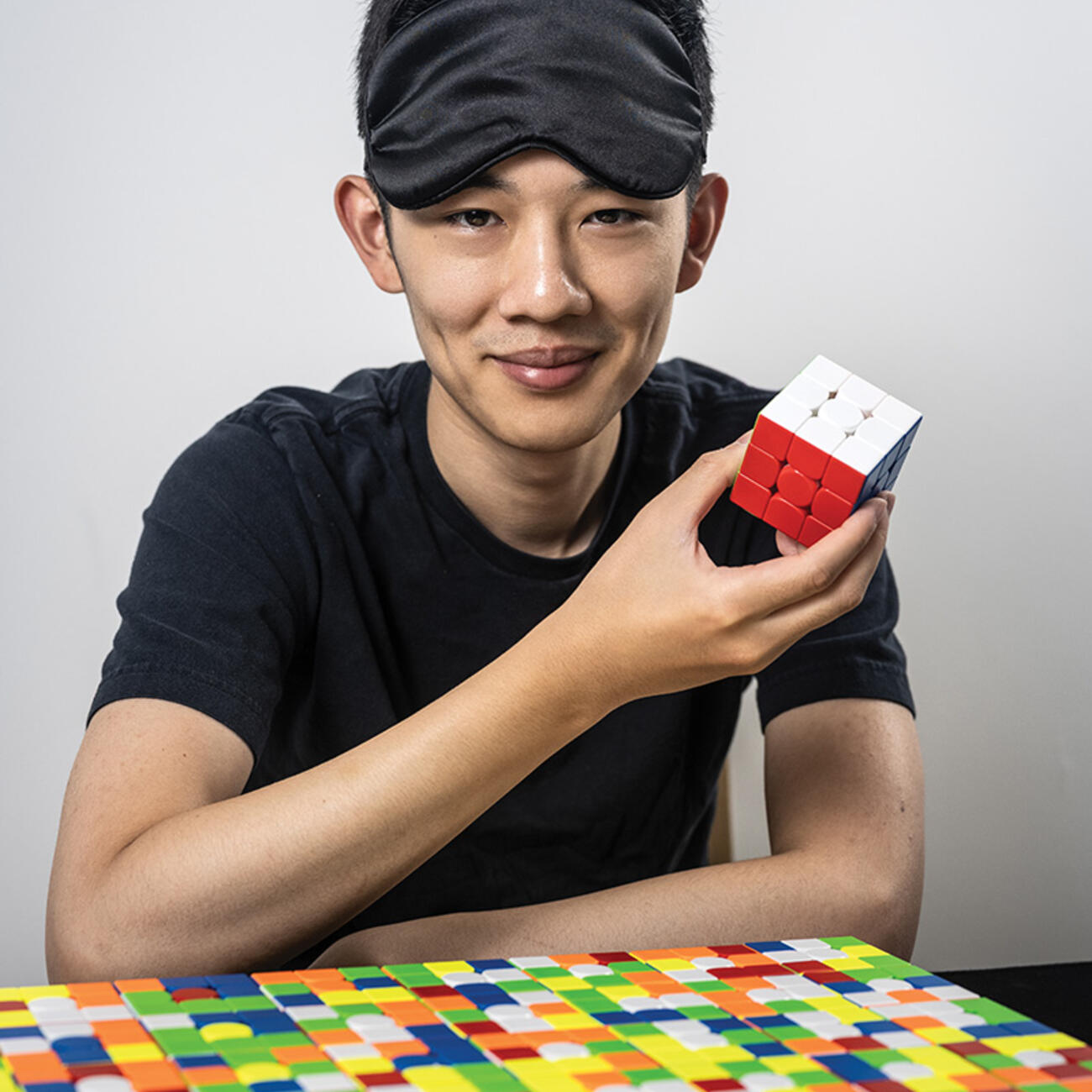
Andrew Tao ’24 is also very good at Rubik’s Cube. So good, in fact, that he can solve them blindfolded. Seriously. That’s the game.
The name of this sub-sport, multi-blind Rubik’s Cube, says it all: Contestants attempt to solve multiple cubes without looking at them. Tao has solved 60 cubes in one sitting,a feat that has helped him become the reigning world, North American, and U.S. champion.
Explaining the rules of multi-blind may make it understandable, but not much more fathomable. Contestants decide in advance how many cubes they think they can solve. Those cubes are then scrambled by hand using directions generated by a computer algorithm (there are 43 quintillion possible ways of mixing up a 3-by-3-by-3 Rubik’s Cube). After that, they are covered and placed on a table. Once they are uncovered, the contestant has one hour to study them and, after putting on a blindfold, solve them. Tao says he typically spends about 41 minutes studying and 19 minutes solving. Contestants earn a point for each cube they solve correctly and lose a point for each one they miss. At his best, Tao solved 60 of 63 cubes.
How can anyone possibly memorize so many scrambled Rubik’s Cubes? Here’s the secret: Tao doesn’t. The colored squares on every cube have the same relationship to each other, no matter how the cube is scrambled. There is only one edge piece, for example, that is blue on one side and red on the other, only one corner piece that has white, red, and green. That is what Tao focuses on, assigning each spot on the cube a letter.
The blue-red edge piece, in this case, gets the letter T. Tao will look to see where that T piece is on a scrambled cube and where it needs to go. Eventually, this produces a long string of letters that becomes the code for solving that cube. As Tao explains, the hypothetical string DGETPL means, “I need to solve piece D first, and since piece G is currently in that space, I’ll need to solve that. Once I solve G, I’ll go on to solve piece E.” And so on.
Rather than try to cram all those letters into his memory, Tao turns them into a story. Here he relies on a mnemonic trick known as method of loci, sometimes called “Roman Rooms” because it dates to antiquity. In a nutshell, he associates each of the 60-plus cubes in a competition with a physical space, such as rooms in a house, and solves them by moving mentally through that space. Let’s say DGETPL is the code for the cube in the first “room,” although the codes are usually much longer, typically around 20 letters. He will convert it into words that include those letters, something like, “Dog [DG] eats [ET] plants [PL].” When he goes to solve that cube, he will imagine a dog eating plants in that room.
“Hopefully, when I’m blindfolded,” Tao says, “I’ll go into my [mental] room and remember that story, which will be enough for me to solve it.”
For Tao, getting into the zone — the sensory deprivation zone — is important. He doesn’t just wear a blindfold during competitions; he dons special goggles that block his peripheral vision, and industrial earmuffs to eliminate sound. He also brings his own table mat, so the friction when he slides the cubes around is the same as at home.
Like Batman, Spider-Man, and other superheroes, Tao wears a mask. Like them too, he becomes completely ordinary without one. At multi-blind, Tao is currently ranked third in the world; at standard 3-by-3-by-3 Rubik’s Cube, he’s ranked 6,500th. His memory isn’t even that good, he insists. Like the rest of us, Tao regularly forgets people’s names. Several times after competitions, he has had to go back to the venue because he left his phone charger behind.
No one goes into multi-blind Rubik’s Cube to get rich. Tao says his payout for winning the world championship was just $1,000. Given that he had to travel to the event in Seattle from his home in New York and pay for his own lodging, he lost money.
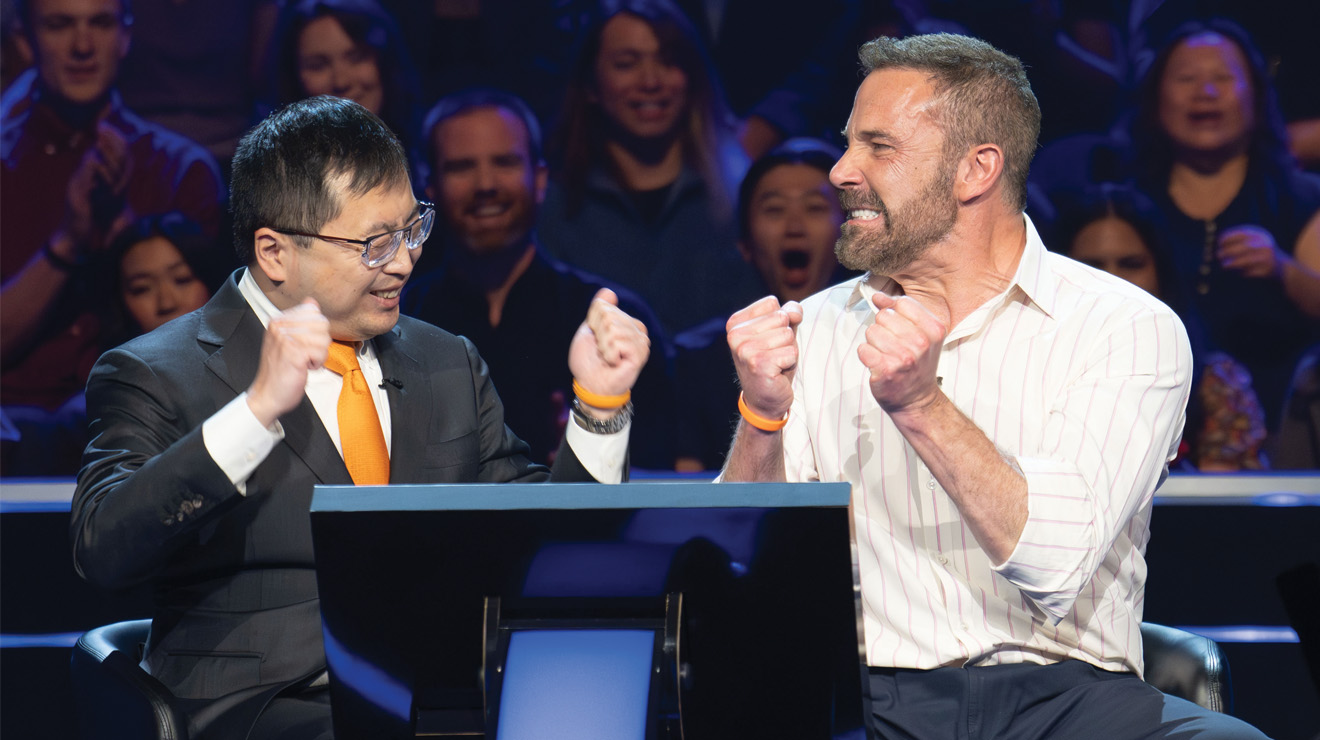
Jamie Ding ’13 has a very different story. Earlier this year, he took home $882,605 on the TV game show Jeopardy!, winning 31 consecutive games, the fifth-longest streak in the show’s 62-year history. But it took him years to get on the show at all.
Ding says he starting applying to be on the Jeopardy! teen tournament when he was still in high school and estimates that he applied to the main show nearly a dozen times before making the cut. When Ding finally was selected, he had to pay his way to Los Angeles for the initial taping, along with his hotel. The show only pays expenses for returning champions.
Ding is not the first Princetonian to appear on Jeopardy! or to do well on it. Dave Madden ’03 won 19 consecutive games in 2005. Terry O’Shea ’16 won the Jeopardy! College Championship in 2014, the first Ivy Leaguer to do so.
One might say that Ding was born for this. He competed in spelling and geography bees as early as elementary school. At Princeton, he was on the Quiz Bowl team while majoring in molecular biology. A resident of Lawrence, he is also a Quizzo shark, now competing regularly on Tuesday nights at the Ivy Inn.
Success breeds success. This summer, Ding’s long run on Jeopardy! got him on another TV game show, Who Wants to Be a Millionaire?, which is produced by the same company. Again wearing something orange, his trademark, Ding and his partner, actor Ben Affleck, won the million-dollar prize for Affleck’s charity, the Eastern Congo Initiative. A New Jersey civil servant now entering his third year at Seton Hall Law School, Ding has spent his Jeopardy! winnings conservatively, buying extra years on his state pension as well as an orange and black watch.
“Games are cool,” he says. “There’s a fixed challenge. There’s a way to win, and it’s nice to have some certainty. Life is so messy. Puzzles are not.”
If Princetonians like playing games, they also like learning about them. More than 100 undergraduates have enrolled in a new course this semester, From Ur to Catan: Board Games in the Near East and Beyond (NES217), taught by associate professor Daniel Sheffield. The course traces the history of backgammon, chess, and other board games from ancient times to the present day. A game known as Ur was popular in Mesopotamia nearly 4,000 years ago, Sheffield says. Archaeologists have found Ur puzzle pieces at numerous excavation sites, along with cuneiform tablets explaining the rules.
As Sheffield — who is also the reigning Near Eastern studies departmental backgammon champion — explores in his course, the games people play tell us something about the society in which they live.
“I think there is a tremendous desire right now to experience what it means to be human,” he says. “That is ultimately what board games are doing. If they illustrate anything about us, it’s that fundamental need to be with other people, to have a shared experience, and maybe to unplug from the constant bombardment of the world.”
More ambitious types might hope they can do even more. Given our culture’s relentless drive for self-improvement, could puzzles and games be restorative as well as recreational? By sharpening our brains, can they also stave off cognitive decline or even extend our lives?
Princeton neuroscience professor Sam Wang says no and, alas, numerous studies back him up. Wang, too, admits to being a Wordle and Connections fanatic, but he cautions that those who play games or puzzles in hopes of finding a neurological fountain of youth may be disappointed.
“I am not under any illusions that these games improve anything other than my ability to do the games themselves,” he says. “Any promises that they have general effects for cognitive preservation are snake oil. However, if they bring people pleasure, then who would get in the way of that?”
In other words, don’t get obsessive. Do them like Burgin does, to connect with friends, or even just for fun. Puzzlers may be perfectionists, they may be super smart, but even they have limits. Take Zawistowski. Although she lives in New York, she gave up doing Wordle on the New York Times app when it started to become a burden.
“I realized, why am I getting stressed out or angry over whether I have a streak?” she says. “This is silly.” So she cut back.
For now, she only plays Wordle in German.
Mark F. Bernstein ’83 is PAW’s senior writer.



No responses yet