

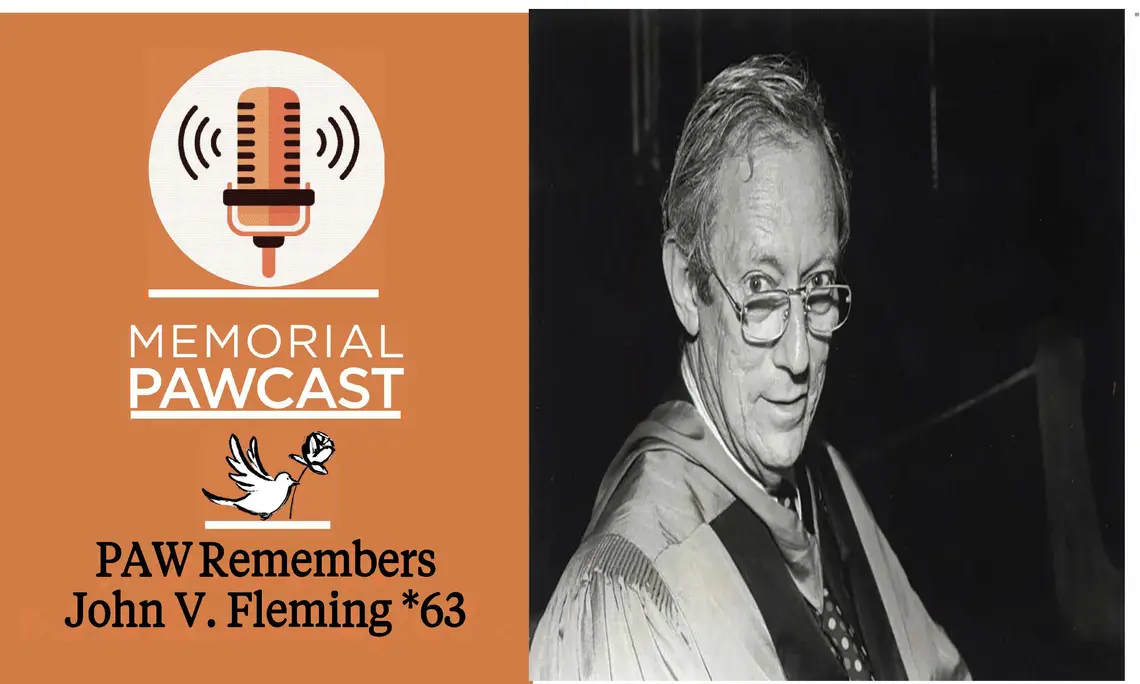
Remembering John V. Fleming *63
‘When I was a student, some professors, when they were speaking, had what I called to myself, the music. The way that they spoke, the way that they reasoned. Professor Fleming had the music, that’s why I enjoyed him so much as a teacher, and that’s why I’m happy to have taken a class with him and grieve his loss,’ says Elyse Graham ’07

Published Oct. 26, 2026
Welcome to the PAW Memorials podcast, where we celebrate the lives of a Princeton University community member. For this episode, PAW Memorials editor Nicholas DeVito sat down with Elyse Graham ’07 to discuss John V. Fleming *63, a 1963 Princeton graduate alumnus in medieval studies. He joined the Princeton faculty in 1965 and transferred to emeritus status in 2006.
During his 40 years at Princeton, he was an admired member of the University community. He received the President’s Award for Distinguished Teaching, the Howard T. Behrman Award for Distinguished Achievement in the Humanities, and the Phi Beta Kappa teaching award.
Listen on Apple Podcasts • Spotify • Soundcloud
TRANSCRIPT
Priest: As for me, I know that my redeemer lives, and that at the last he will stand upon the earth, after my awakening, he will raise me up, and in my body I shall see God. I myself shall see him, my eyes behold him. He is my friend, and not a stranger.
Nicholas DeVito: Hello, today I’m talking with Elyse Graham from the great Class of 2007, and we’re talking about John V. Fleming from the Class of 1963. He was a graduate alumni from the Class of 1963. Hello, Elyse. How are you today?
Elyse Graham: Hello, I’m doing great, how are you?
ND: I’m well, thank you. So, Professor Fleming, he was a professor, he was first off a graduate alum at Princeton, and then he was a professor of medieval scholar for quite a while at Princeton, and-
EG: 40 years.
ND: 40 years. And so, Elyse was fortunate enough to have him, she actually was in his last class that he taught at Princeton, is that correct?
EG: That’s correct.
ND: So, we’re going to talk a little bit about Professor Fleming and about his last class, and how he was as a professor. So, Elyse, where do you think we should begin on Professor Fleming?
EG: Gosh. Well, I’d like to start with something that he commented in one of his last blog posts, which is that, he says, “One sign that a writer has attained truly classical status is the assignment to him or her of an adjective that describes their character.” Chaucerian body, Shakespearean majesty, Miltonic grandeur, Woolfian subtlety, whatever. And when I read that, it got me thinking about what’s the Fleming-esque, right?
ND: Right.
EG: Assuming that one of the things students study most closely is their professors, what is the Fleming-esque manner in teaching? And I would suggest that the Fleming-esque is to be like a worldly abbot, abstemious and knowing.
ND: Yeah, I think that’s great.
EG: He was a stern medieval-looking figure, but he had this wonderful wit, this wonderful sense of humor. And that’s something that I remember, especially from the last seminar that he taught, which was about the classical tradition and how it was incorporated into medieval literature. So, his sense of humor, here are a couple of his lines.
ND: Please.
EG: Let’s see. He says, “Petrarch, who had one foot in the Renaissance and the other on a banana peel, blew on some embers and started the enlightenment.” He had a way of summarizing history like that. On book jacket covers, he says, “You never read on a book jacket cover, this is another hackneyed retreading of a well-worn theme. Charitable reader, please do not think there’s anything new in this book.” Let’s see. He likes to explain things to us as though we were just born yesterday, “So all the world’s a stage, that’s Shakespeare, famous English author.” His advice for reading middle English aloud was, “Just pretend the great vowel shift never happened. Forget the great vowel shift, ignore the great vowel shift, there was no great vowel shift. It wasn’t so great anyway.” Let’s see. Of course, he’s describing Helen of Troy and he asks us, “Do you know what a millihelen is?” It’s a unit of measurement. “A millihelen is the amount of beauty needed to launch one ship. Helen of Troy has 1000 millihelens, that’s how beautiful she is.” Let’s see.
ND: No, it’s great that he’s taking such... Medieval literature, it’s not easy to get through, but he can put it into simple ways for 18, 20-year-old students to pick up and not be afraid to work through it.
EG: He certainly was very much... I mean, you could think of this as the Commedia, right? You have a guide, Virgil, who’s taking you through this confusing space, and he knew every step of the territory. It’s a bit like, was it James McPherson, the Civil War historian?
ND: The Civil War historian, yes.
EG: And the thing that the students said about him was that if you took him to Gettysburg and blindfolded him, that he would know within a few steps where he was. And Professor Fleming, it very much felt the same way with medieval literature, that he knew the territory so well. He says, “The Middle Ages was a lot like the University of Pennsylvania, broken up into a lot of little Dutchies, deans fighting each other. Princeton, that’s the Holy Roman Empire.” He was very learned, I think he grew up in strained economic circumstances in Denver, Colorado, went to Princeton as a graduate student, I think after being a... You can correct me on this, Rhodes scholar. I think that’s correct. Went to Princeton as a graduate student, went away to the University of Wisconsin-Madison, because that’s what Ivy League schools did when they had a very promising student, they would send you away into the woods to prove yourself, and then bring you back.
ND: Right.
EG: So, that’s what he did. They brought him back after two years, he had proven himself in the wilderness of not Princeton. And he had this real love of language, which was shown partly in the way that he had retained the language of every place he had been in his life. I can give you an example, which is that in the same breath, he would say of one of the typical body scenes in medieval literature, “She was clothed in nothing, save what nature provided. Venus sent a cloud to cover their Congress.” And then a minute later he said, “Well, my Socratic method has gone all to hell to tell you the truth.”
ND: Yeah, he just-
EG: He...
ND: Go ahead.
EG: Yeah. Oh, some other things that I wanted to mention. One was... Look, that era in Princeton, it was the last time before people brought laptops into the classroom. We had laptops, but they needed to be connected, there was no Wi-Fi. So, it was just the language of the professor, there were no slides, there were no laptop, it was just the speech, just the language. There are a lot of details about that time that I think are going to melt and get lost in the night of history. One of them is, for instance, that you wouldn’t look down at your phone while you were seeing whether you had time left in this meeting. Instead, what the professors would do is they would flip their watch around so that the face of the watch was on their wrist, which allowed them to much more elegantly glance down at their watch without making it look like they were looking at their wristwatch.
ND: Right.
EG: While they were lecturing, they would take the watch off and lay it on the table so that they could see what the watch said. Anyway, Professor Fleming, he knew Robert Fagels, of course, and according to one of my other professors, when the two were both still active professors at the university, they used to stand on the steps to the Princeton Chapel and talk to each other in Latin, so that the orange key tours could hear them. They liked to show off in that way.
ND: Right.
EG: Professor Fleming said that he planned to write a book with Bob Fagels, and it would be titled, Homer in the Realms of Gold, but they never did get around to writing it. He also mentioned-
ND: Do you think they never wrote the book or they never...
EG: That’s a good question-
ND: Or they never had it... Shopped it around, I should say.
EG: I don’t know. Having met both of them and knowing a little bit about what they did, I think I know what the book would be about, which would be the history of the language used for translation, and then changing ideas of translation itself, that is translation very... In the Middle Ages, and I’m getting this from that course, was more about transformation, and later on in our time, it’s more about fidelity. So, we have all of these fights over the actual meaning of the first line of Homer’s Odyssey and that sort of thing. So, it’s possible that they worked on the book and it never wound up anywhere.
I also know from one of his colleagues that Professor Fleming worked on and off on a novel, but I don’t think he ever shopped that around either. That was about... Hold on a second, I did look it up. OK, I’m going to mispronounce this name. François-André Philidor, who was an 18th century French chess master. It was a historical novel about this guy.
ND: Oh OK.
EG: I would’ve loved to read it, because... Well, I think that all novels written by professors, even if they’re not set on campus, are campus novels. And it’s true, there are ideas of... I would’ve liked to see his take.
ND: I mean, I think most books are, there’s a little bit of your history in every book, right? Whether... If it’s fiction, I think you draw from yourself and your experiences no matter what I think the author says. That would’ve been an interesting book to read.
EG: Professor Fleming... It would’ve been an interesting book to read. He mentions once in the class that he thinks Cole Porter is the second-greatest poet in the history of English literature, and he’s just leaving the first spot blank in case he’s forgotten someone.
ND: Wow.
EG: Mm-hmm.
ND: OK.
EG: But he has wonderful ways of talking about the uses that authors make of each other. He says Augustine was reading Virgil in a brilliantly abusive way. He treated Virgil as history when he wanted to, and as fiction when he wanted to. He talked sometimes about, because of course this was his, he called it the class of destiny, it’s a sports metaphor of some kind. Like the team of destiny. I don’t know a lot about sports. But he talked about things that he remembered from his time at Princeton. And once in the 19... Must’ve been the early 1970s, there was a mob surrounding a building, probably having something to do with opinions about the Vietnam War. And a dean came out and said, “Let’s be reasonable here, let’s sit down and reason together.” And then a student said in a really snide voice, “Don’t you know you can’t reason with a mob?”
ND: Right. Yeah. So, the protests were, I believe, 1970, 1971. So, he was here for that too, yeah.
EG: Fleming, he mentioned that he knew that the war was, for all intents and purposes, over when he saw a student carrying a sign that said, “Even Princeton,” as in even Princeton opposes the war. He knew that the appetite was completely gone. Yeah, the way he makes language... Another time he says, “Who for lovers can prescribe? He’s just got to stick the beans up his nose,” which is saying the same thing twice, but one way is a very elevated, almost French way, and another way is a very American way. And he delighted in having one foot. He was also someone, like Chaucer, who had a foot in two different traditions. So, hold on a second, another one... I won’t just be reading one-liners, I’ll be talking about other things too.
ND: OK.
EG: But... Here we are. All right. He talks about French poetry of Chaucer’s time, he says, “See what the French can get away with simply by being in French? The English version sounds so dorky.” The English version was like, “Darling, come over here,” or something like that.
ND: Right.
EG: The French version sounds amazing. He would send us all over the place, because again, this is before the internet really made a difference in learning and teaching. So, he would send us all over the place to get copies of texts. And there was a guy called Mr. Bickford, I don’t know Mr. Bickford’s first name because he just called him Mr. Bickford. I think he liked the name Mr. Bickford.
ND: Yeah, right.
EG: Once Mr. Bickford was late, and he says, “I sent Mr. Bickford all the way to the University of Pennsylvania to get a very rare book we don’t even have. A very, very rare one in Italian, and asked him to translate it, and then I sort of blew him off. And so, I was going to abase myself. But if he’s going to be late, I’ll be damned if I’m going to abase myself.” Next class, he assigns me something to make copies of, which is Robert Hollander’s Boccaccio’s Two Venuses. And Mr. Bickford reminded him that I had already done an assignment for him, which was to translate a French paper on the idea of contemptus mundi in medieval schools. So, Professor Fleming assigned the Hollander to Mr. Bickford instead, had just gone to Philly the week before, and he said, “Well, he’s embarrassed me, and what would embarrass me would shame a hog to death.”
And then the next day, Mr. Bickford wasn’t there, so he said to me, “Where’s Mr. Bickford? Your protector, your defender. Well, he isn’t here to defend you this time.” My point is he had a lot of fun, and I do think, I don’t know, there was an Abbott-like quality to him. You know what I mean?
ND: Yeah, definitely.
EG: He was worldly, but also abstemious.
ND: Right. To be a professor, especially, you have to keep the students engaged, and that’s what he was doing with his language, it sounds like.
EG: Yes. Yeah, very much so.
ND: With what he was teaching and using the language of everything. Yeah.
EG: So, it wasn’t just one-liners, of course.
ND: Right.
EG: I’m giving you all of this, by the way, for the benefit of listeners. I took notes during my time as an undergrad that were effectively transcriptions. I did it for... I can’t hear that well, this was just an easier way for me to consume the class material, but I have very, very good notes of all of our class meetings. So, this class was on... How do I put this? On the act of originality, as it appears in medieval texts that are reconfiguring classic texts. He was very interested in the relationship between the classical and the medieval. And also on the fact that we have a lot of classical literature because it was preserved by medieval monks. That is, these people who were trained in contemptus mundi, contempt of the world, are the people who are responsible for our having Ovid or these other very worldly texts.
And they found all of these ways to explain to themselves why they were preserving the classical tradition, why they were making the Ovide Moralisé, the moralized Ovid, which is a copy of Ovid, but it also says, by the way, this is an allegory for the church and Christ, or other appropriately religious things. And Fleming’s take, as far as I can tell, is that they had this infrastructure of learning, this trellis of learning, and what do I want to say, interpretation, exegesis, that allowed them to preserve these texts and justify it to themselves. But actually, they just loved Ovid. It’s as simple as that. It was a very human... It was just a love of these older texts, combined with the need to have that exegesis in order to preserve them and to study them as carefully as they wanted to. So, yeah, the idea of influence for him, he said this over and over in the class, that at least in the Middle Ages, it wasn’t the anxiety of influence, it was the generosity of influence, the excitement of influence, the abundance of influence.
To be influenced by someone isn’t just to try to live up to what they’re doing or to cast aspersions on them so that you can rise superior. Instead, influence is always a very crafty and problematic thing. When you notice influence for Fleming, it’s not when you stop thinking, it’s when you start thinking.
ND: I like that. Yeah.
EG: [inaudible 00:17:47].
ND: Elyse, you’re a professor like he was.
EG: Yes.
ND: Is there any part of him that you use when you teach? Is there anything... I know you’re not teaching medieval languages stories.
EG: I’m not teaching medieval language and literature, no. But I ripped off Fleming in all sorts of ways in the way that I teach. I’m not an Abbott-like person myself, but his sense of humor was his own, but the idea of bringing humor into a class, I guess you could say. There’s one particular joke that he gave, and it was just a throwaway for him. He was talking about Dean Root. Dean Root, an earlier professor in this very strong tradition of terrifying Princetonian Chaucerians. So, there’s Dean Root and then there’s D.W. Robertson, whom he always referred to as, “The great D.W. Robertson,” the same way that you would say Palace Athena, or John V. Fleming, John Victor Fleming. No, I’m sorry, John Vincent Fleming. I think he mentioned that he included the V because it was obligatory for a medievalist to have a middle initial. That was something that you did, like a [inaudible 00:19:14].
You know what I mean? It was just something you had to do. But anyway, he’s talking about Dean Root, and he mentions that Dean Root had taught a mandatory class on the history of language, and he called it Roots Roots. And then Professor Fleming gazed gravely into the distance and said, “And that was the last vague shadow of humor that ever crossed the career of Dean Root.” When I tell you that I have spent my entire life since then chasing the feel of that specific joke. You don’t understand, that joke is the horizon for me, and I am always trying to approach it.
ND: I love that. That’s great. Like you were saying, when you took his class, there were no computers, there were no smartphones, he had your attention.
EG: That’s right. Oh, no, no.
ND: And you do not have that today.
EG: And he had to hold our attention.
ND: Yeah. If you lose a student’s attention today, there’s three different things they could look at.
EG: Playing Tetris, they’re on Reddit, they’re reading fan fiction, they have a million other things to do.
ND: Right, yeah.
EG: Yeah, it’s a very different world as far as teaching is concerned. Even in my early years of teaching at Stony Brook, which is the school I teach at, we didn’t have slides. I would stand at the podium and read from the proverbial yellowing notes. Except that I was just starting out, so they weren’t yellowing yet. I thought they would be someday. But then, now-
ND: They’ll get there.
EG: ... there have to be slides. The kids have to be looking at something. You know what I mean? They have their laptops out, they’re doing all kinds of things. Well, it is different.
ND: It’s different. Yeah.
EG: I’m glad that I was able to take those notes and to preserve something of what that world was like. And I’m not prepared to say that this is worse, you know what I mean?
ND: Correct, yeah.
EG: You can’t take a class on the transformations of tradition over time and come away thinking that something that never changes is dead, right?
ND: Right.
EG: So, this is different.
ND: It’s different, yeah. It’s not better, not worse, it’s different. And that’s... Yeah.
EG: He talked about... But there are still things that have to remain... He talked about the way that you would learn, you would study in the Middle Ages, and he said the trivium... The quadrivium was what you studied in university. The trivium was, he said, “It was the three roads by which you came to all learning. Grammar, knowing how to read, rhetoric, knowing how to put language together, logic, knowing how to test for truth statements.” I don’t think it’s controversial that those are three things that all students, the same today, as when I was a student, as in the Middle Ages, have to learn those three things before they can come to other learning. So, those are still things that... It’s the basics, it’s the basics.
ND: Right. It’s just a different way of delivering them.
EG: Different way of delivering it, different way of bringing it together. But it was beautiful the way that he did what he did. This is going to sound very pretentious, but you have to bear in mind that all undergraduates are very pretentious, all right? F. Scott Fitzgerald and James Joyce were obsessed with the idea that undergraduates are pretentious. When I was a student, some professors, when they were speaking, had what I called to myself, the music. The way that they spoke, the way that they reasoned. It was utterly their own, but also in conversation with their subject in a way that felt musical. Professor Fleming had the music, that’s why I enjoyed him so much as a teacher, and that’s why I’m happy to have taken a class with him and grieve his loss.
After I left Princeton, I never heard the music again. It’s something that was very specific to my time as an undergraduate. Maybe that’s just part of what being an undergraduate is, but also it’s a song that you carry with you for the rest of your life. That’s why we’re all such dedicated alums.
ND: Yeah. Elyse, that’s beautiful, of you describing Professor Fleming, I think that’s a great place to end it.
EG: OK.
ND: Yeah. He had the music. I love it.
EG: The music.
ND: Yes. Elyse, thank you for your time and talking about Professor Fleming, I really appreciate it.
EG: Thank you.
ND: The PAW Memorials Podcast is produced by Nicholas DeVito and Princeton Alumni Weekly. If you enjoyed this episode, please subscribe. You can find us on Apple Podcasts, Spotify, and SoundCloud. You can read transcripts of every episode at PAW.princeton.edu.
Paw in print
October 2026
Holding on to Jewish life; Katy Anderson Keating ’08’s career in wine; Hollywood loves Princeton.
No responses yet