

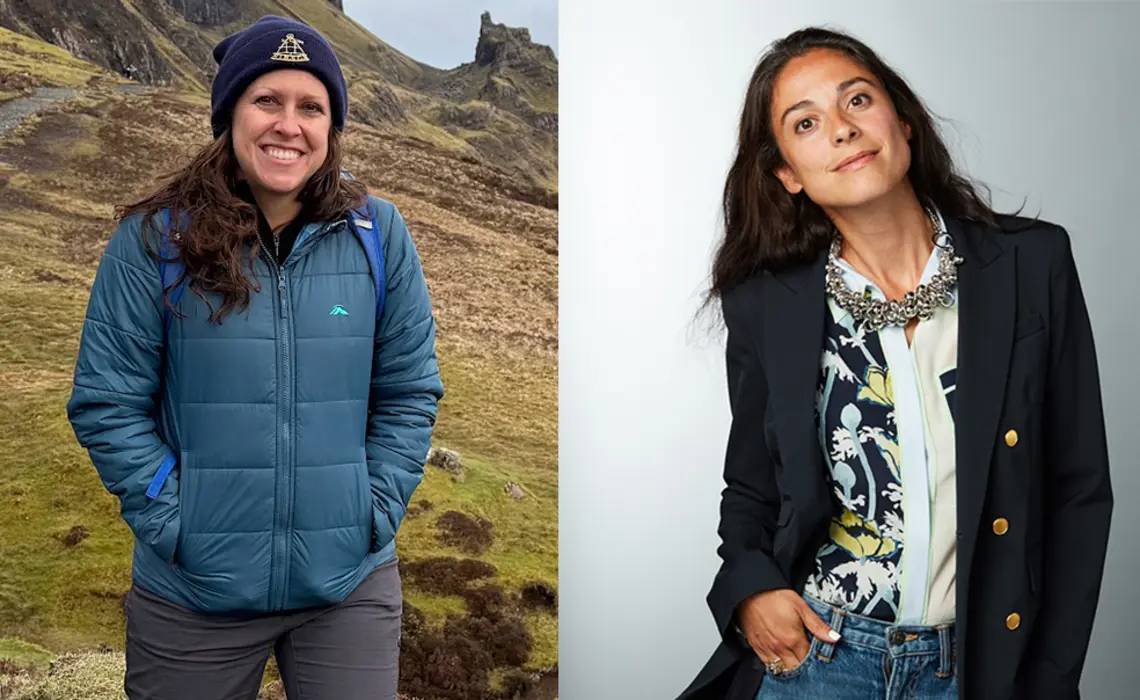
Alumni Travel Journalist-Adventurers Tell You Where to Go
Travel journalist Laura Dannen Redman ’03 and Jacqui Gifford ’02, editor-in-chief of Travel + Leisure, discuss trends in travel for 2026
This is the Princeton Alumni Weekly’s PAWcast, where we talk with Princetonians about what’s happening on campus and beyond.
Today we bring you a conversation from PAW’s Tiger Travels section, between travel journalist Laura Dannen Redman from the Class of 2003 and Jacqui Gifford ’02, who is currently editor in chief of the gold standard magazine for jetsetters, Travel + Leisure. They say travel journalism is a field in flux, but the lure of adventure will never die. If you’ve ever wanted to go gorilla trekking, or visit Disneyland Paris, or if you’ve wondered whether seeing cherry blossoms bloom in Kyoto is worth the trip — this is the conversation for you.
Listen on Apple Podcasts • Spotify • Soundcloud
TRANSCRIPT:
Laura Dannen Redman ’03: Hi everyone. This is Laura Dannen Redman. I am Class of ’03, a proud Princeton alum. I was a poli sci major, and now I am a travel journalist and I have been for about the last 15 years. I’m here today with another amazing travel journalist alum, Jacqui Gifford. Hi, Jacqui.
Jacqui Neiss Gifford ’02: Hi, Laura, it’s so good to see you.
LDR: You too.
JNG: So my maiden name, by the way, is Neiss, so when I graduated from Princeton in ’02, everybody knew me as Jacqui Neiss. And then I married another Princeton alum, Robert Gifford, Class of ’01, and took his last name. And I was an English major, he was a history major, and here we are today, in travel media, just like you.
LDR: That’s awesome. I also married a Princeton alum, Greg Redman, ’07. Should we go by our maiden names on this?
JNG: Sure, why not? Go for it.
LDR: Dannen and Neiss. Jacqui is the editor-in-chief of Travel + Leisure. How long have you been there, Jacqui?
JNG: I have been at Travel + Leisure for, it’ll be 13 years in June. And then I took over as EIC in November of 2018, so let’s do some quick math. It’s a little over seven years now. I have been in media for basically my whole working career. I started two weeks after graduating in ’02. It was an interesting time to start because first of all, 9/11 had just happened. The job market was really interesting for people trying to graduate then. Things had shifted, we had had the tech crash of 2000, right? So, I knew that I didn’t want to do finance and I fell into media because of a Princeton professor, Daniel Mendelsohn [*94], who was my classics professor. He looked at me and said, “What do you want to do, Jacqui?” And I was like, “Oh, I don’t know. Magazines seemed kind of fun, but I’m not really sure, I’m an English major.”
And he had a friend who worked at Conde Nast and my résumé got passed over to Conde Nast HR and I ended up getting a job at Vanity Fair and starting work there two weeks after graduating from college. So I have been in media ever since. And magazines, as you know, have greatly shifted since then. Media is constantly evolving. But that period of time, I would see as has seen the most change, I’d say from when I started to now, compared if you had started, I would say from the ’80s to the ’90s or something like that. But yeah, I didn’t ever go to college and say, “I want to be a journalist.” That was never my path, it just sort of happened.
LDR: I mean, what a path, though. That’s incredible that you got that start at Vanity Fair. And Travel + Leisure, if you’re not travel media junkies like we are, is the biggest travel magazine in the world. How many international editions are there now?
JNG: We’re now up to eight and they’re constantly growing. We have really, through the expansion of the brand in the past few years, we’ve opened editions in places I didn’t even think were possible, whether it was Italy, Central Asia. We just signed a deal in Turkey. We had had an edition there years ago and it went away and now we’re coming back. And so I think that it’s really fascinating to see the power of the name of Travel + Leisure and how it really impacts.
And all the different editions, for example, the one in Central Asia, they’re based in Uzbekistan, they have more of a design culture and it’s like a coffee-table-style magazine. It’s quite big, the paper’s big. It’s bigger than ours, even here in the U.S. We have such a huge circulation so it’s a different business model. But I’m really proud of all the work we’ve done to get to that place. And it wouldn’t have happened without a lot of people here just really being Travel + Leisure evangelicals, if you were.
LDR: I mean, it is terrific to hear because I feel like 20 years in, most of the talk of travel media is kind of doom and gloom, or media these days is doom and gloom.
I was someone who wanted to be a journalist, but I didn’t figure that out until junior year of college. I wanted to be a lawyer, and then I realized lawyers had to argue in court and write a lot of really stiff briefs, sorry to all the lawyers out there. So I started taking a lot of humanities seminars at school. And apparently, there’s now a journalism program, a proper journalism program, which is awesome. And I wish I could go back.
JNG: Which we didn’t have.
LDR: No.
JNG: We didn’t have that back then. I think it’s a weird time in journalism, that’s for sure. But I am optimistic that people still want to enter the field. I think that the biggest challenge is that people don’t know, and I still say this about my time at Princeton, I didn’t really quite know what the path was to get there. And I don’t think that anybody’s really clearly answered that. We’ve seen an erosion in local journalism, right? That avenue has narrowed. But then you look at things like Substack and social media, and it is a journalism in its form, it’s just not the same as it was then. And those things are still open to people, whether they’re interested or not. I think that it’s just, some of the traditional paths aren’t the same. And that’s the hardest part, is sort of figuring out your place in this new ecosystem.
And I’m seeing over the past few years, and really since coming out of the pandemic, too, there’s still more room for voice and great storytelling. It’s just sort of there’s a clear divide between the brands that are really successful. I’m talking about The New York Times, and I would put Travel + Leisure in that same field in terms of its relevance and for travel and relevance. And also it is a profitable brand. That’s something that’s important that a lot of creative people don’t think about behind the scenes. The economics of journalism have shifted radically.
And when we think about subscriptions and how people used to think nothing of paying for subscriptions years ago for a magazine, it’s very hard to get them to pay for digital content, so that has really shifted. But then you look at Substack and people are paying for Substack, and that is journalism. It’s just very, very different than when I started, which, when I started, the internet was in its infancy, and that’s even crazy to say but it’s true. Putting a story up online was such a big deal. And now you think about how many stories we put up for Travel + Leisure every week and it’s a completely different ballgame.
LDR: How many do you put up a day right now?
JNG: Oh my gosh, that’s a good question. I mean, it really varies, but you’re looking at anywhere. It depends on the time, but for something like World’s Best, our big franchise, that’s like a tent pole of the brand of when we go live digitally, we have 102, 110 articles that go live in one day. Then some weeks you could produce 20 pieces of content, you could produce 30, you could produce 40. It depends on what is actually happening also in the news cycle. We won an award, which is really interesting, for some of the coverage we did at the beginning of the year that was tied around the LA wildfires and how hotels were helping out. One of our staffers out in LA took the reins and said, “Let’s see what hotels are offering in terms of discounts.”
And gosh, that’s a story nobody wanted to report on or thought we’d be reporting on, but we did. And it was constantly being updated just to say, “OK, now you can get a discount. This hotel’s offering a discount for people who are displaced.” So it’s evolving. And then we have the magazine, which is 11 times a year. And that’s unheard of today, too, because magazines have reduced frequency over time. Again, the economics of journalism have shifted, but we’re still producing 11 books a year, which is huge.
LDR: That’s huge. I know, I was at AFAR magazine for five years, an independent travel magazine, and we had to go down in size, but now there’s four issues and they’re almost like a luxury good, right?
JNG: Yeah.
LDR: You want it to be the kind of thing that people leave on their coffee table for a while. I feel like there should be a class on the economics of journalism and maybe you should teach it.
JNG: Maybe that’s what I do. Maybe that’s my next career act. I could. I mean, that’s sort of the way of the world, right?
LDR: Right.
JNG: And it’s hard. Listen, I think that anybody who’s still in this game, you have to be open to meeting readers, meeting audience members, meeting followers where they are. And I would’ve never predicted a platform like Instagram would completely change the way that we consume travel content when I started. But gosh, I’m on Instagram, I love it. And I’m open to those things. And if you’re not open to those things, I think it’s a hard, as a brand, I think there’s always going to be another disruptor. And then how do you pivot and think about where your brand fits within that framework?
LDR: Do you feel like as a new journalist, a budding journalist coming in, would you recommend being a generalist, someone who can do social media well and write well and do video well, or I mean, do them all? Or should they come in with a specialty? Should they say, “I am an amazing writer and I want to be known for my words?”
JNG: That’s a really smart question. I’m going to answer it just because of what I think that I do and how I’ve found success, but I don’t think that’s the only, I think being a generalist is a really strong asset. I think knowing, and this is sort of part of what I found at Princeton in particular, is the freedom to take courses and understand a little bit of everything, and that can kind of shape your worldview. So I think that that applies to journalism, too. Now, I’d say there are some people who have found great success by having a niche and owning that niche. And I just, if I’m looking big picture at the way it’s going, I think being nimble is probably the most important thing.
And being able to say, “OK, I know how to do this, but if in five years it’s going to change, maybe.” Here’s a good example. You look at the rise of influencers. I, again, would have never predicted, and I’ve always loved writing, I would have never predicted that that would be a way for me to express my writing in a new way and also marry it with a picture that felt; photography is something that I’ve enjoyed. I’m not a professional photographer by any means, but I have to know how to take a good photo. But when I started, did I think that was possible? No.
LDR: Great.
JNG: So I say generalist, but you could argue the other side very easily.
LDR: You could. Although I think I would say that, too. I think some of the best advice I got right out of school was, there is no path to being a journalist because journalism is about curiosity and wanting to learn more about the world. And each step you take, each trip you take, each, I don’t know, hat you wear helps inform your worldview. And your worldview is what you bring to your writing, to the way you analyze people, places, and things, and try to communicate that fairly and colorfully, right? I kind of took that to heart. My path was all over the place. I was newspapers, magazines, politics reporting, arts and entertainment editing for five years in Seattle. I lived in Singapore and I was editing Timeout Singapore there for a year. And I’ve since been in travel media for, gosh, I want to say at least 15 years now, maybe 12 to 15. We lose track, right?
JNG: Yes.
LDR: I’m currently at Robb Report, which is a magazine, I call it the magazine for billionaires who love to travel and who love nice things. But I am a freelancer, so I went freelance two years ago after being on staff since the beginning of my career, journalism school and then staff. And that is a hard gig to have right out of the gate. And I think I’ve gotten lucky that in having built a network and built some experience over time, that I can do it now. And it allows me to pick the places I want to cover, pick the stories I want to cover and—
JNG: Which is great.
LDR: Work with great people like you at the same time as people at Robb Report or AFAR or Conde Nast Traveler, some of the bigger names in travel media. But some of the fun things about travel media is we are constantly talking about where we’re going, where we want to go. And I feel like you and I could talk shop about journalism all day. I want to give people listening, a little bit of like the sweet stuff about where we recommend you go next year. I know Travel + Leisure just published its 50 Best Places to Travel in 2026. I was wondering, of that list, that’s a big list and it’s beautiful, congrats.
JNG: Thank you.
LDR: What are some, a handful of places that caught your eye on that list, be it classic or kind of off the beaten path?
JNG: I’ll start with some of the classic, and next year obviously, is the 250th anniversary of the U.S. and America 250 is going to be big. And I had really started thinking about this earlier in 2025 and how we were going to cover it and how it was going to play out throughout 2025, teeing it up and then into 2026. So we published our list, we always published it at the end of the previous year and say, “Here’s where you’re going to go in the new year.” And so I think we went with a lot of great domestic destinations, whether it was Naples, Florida, Colonial Williamsburg, Philadelphia, Salt Lake City, all these really fun places, knowing that a few things: One, the 250th was happening. Two, domestic travel is still hugely popular with our readers. Europe and the U.S. are their first places they want to go.
And there is a lot of innovation happening right now in the U.S. And I think particularly in the culinary space, there’s always a new hotel opening and that is a big draw for our audience. So I would say some of those places, they lean classic in that they’re closer to home. I like to always make sure there are some affordable options for people so they don’t feel like they have to fly halfway around the world to try something exciting and new.
Colonial Williamsburg is someplace that’s been on my list, too. I’ve never been. And they’re doing readings of the Declaration of Independence and there’s a boutique hotel in there that’s really cute. And I’m from Philadelphia, they’ve got the Calder Gardens, they’ve got some incredible museums. I just visited the Museum of the American Revolution with my son and husband earlier this year. That isn’t new, but they’re always innovating with programming.
And when I was there, they did this incredible flag exhibit. It was showcasing old regimental or different state flags that, some of them had never been seen before. One was found in the attic of someone’s home, truly. And you unveil these things and they’re works of art. It was on the ground floor of the museum and it was stunning. So I think that there’s a way that we can approach, and we took Bobby, my son, to the Betsy Ross House, which is something I did as a kid. So I think there’s ways that we can make travel feel like it doesn’t have to be such a chore. It can be educational, but close to home.
And then when I think about the list, which is all editor-written and staff-vetted, there are some far-flung places on there because we want to continue the mission of T+L, which is to really get out and see new places, new things.
Brazil was our destination of the year. Actually, that’s another big story we work on, so it is also on the where to go list. And Brazil, to me, is super exciting. We did a story with Anita, who is Brazil’s biggest pop star. She just moved home to Rio. We did a cover shoot with her at the Fasano in Rio. And really from the beaches to the major cities like São Paulo and Rio to the Amazon, there’s so much there that people can explore.
And then I wrote about the Okavango Delta of Botswana, which we visited in April (2025). There’s a whole host of new lodges opening in and around the Moremi game reserve, or they’ve just opened or renovated, that are really kind of elevating the design.
Travelers are getting ever more demanding. We could debate and talk about that all day long. And as someone who writes for Robb Report and Travel + Leisure’s audience, a lot of them are affluent travelers. Most of them are, and they expect a lot out of the hotel. And I was in Botswana, I couldn’t believe some of the amenities that people have built in these very remote places. So something to think about in terms of where people are going. They’re traveling for food, Taipei is on our list. Taipei has some of the best food scenes, they just opened a Capella hotel there. Brazil, I mentioned. Iceland, so many great places. People are traveling for the celestial events and sort of stargazing, and that’s a big trend so we have that on the list. I think there’s a lot that you can find there that really appeals to whatever passion point you’re looking for.
LDR: What are the passions you travel for? I know I love seeing your whole family out there on the road, I aspire to that. We have two kids who are eight and six, and they love to travel, but I can’t take them on everything.
JNG: It’s hard.
LDR: Yeah.
JNG: Yeah, you can’t. No. I would say my personal interests vary, but I usually do like, and it’s not necessarily my 10-year-old son’s cup of tea, but we went to Egypt last year, and a historical trip really does inspire me just because I like to learn sort of the evolution of time and sort of civilizations. And that to me feels like it’s reassuring in a way that we’re still standing and that we’re still here. When we’re in Egypt, looking at the pyramids and you’re like, “OK, that’s still around.” I would say I love beach trips just to chill out, that’s important. Believe it or not, I love a theme park. I love Walt Disney World. We’re going again in March.
LDR: Are you a Disneyland or Disney World?
JNG: Disney World, Disney World. And actually, I love Tokyo Disneyland too, because I grew up in Japan, and I really enjoyed going. It’s so accessible on the train. And by the way, for those who, prices have gone up in Orlando and Tokyo, believe it or not, you can still get a relative deal on a ticket. Same at Disneyland Paris.
LDR: That’s a good tip.
JNG: Yeah. Oh, yeah. Disneyland Paris is a fraction of the price of; now granted, it doesn’t have all the amenities that Orlando has, but I love a good theme park. And you’ve got a short shelf life with kids when they still believe some of that stuff, so I think it’s important to take advantage of it. I love cruising. I love to take a cruise, a river cruise. We did a cruise on the Danube, which was incredible, and saw some of the major cities and sites and castles and wineries. So honestly, Laura, there’s so many things that I think; I just never want to say that I only like one style of travel.
LDR: Sure.
JNG: That’s my main thing.
LDR: Well, I’m sure in part in your role, it benefits you to be kind of an omnivore and to know what’s out there and what’s new or what’s classic.
JNG: Totally.
LDR: I’ve been leaning into adventure travel in the last few years. I think in part because subconsciously I’m like, “I don’t know how much longer I could do this.”
JNG: It’s true.
LDR: I am thankful that my body can handle the glacier hikes I’m doing in British Columbia and Iceland and Antarctica, and that I can manage to get away once or twice a year somewhere far-flung. The Pantanal in Brazil was a place that I loved in the last few years. They have this amazing jaguar population and Blue Macau. So if you love wildlife, where can you go in the world to see some of those beautiful things?
JNG: Yeah. I would say another tip, it’s interesting having done Egypt, and I’ve done it a couple times, but this last time, it’s a fairly rigorous trip in terms of the walking and the sights and the monuments. And I think a lot of people wait to do it when they’re older because it’s one of those, you need the time. And I agree with you, I don’t know if you should wait that much because it’s a fairly rigorous trip. And there are ways. Trust me, I’ve seen people do gorilla trekking. We did gorilla trekking and they were in their 80’s and they did it.
But I’ve also seen people who are younger and not as in good shape, but I think that there is a point when you realize, “My body can only handle this amount of stress, work, whatever, exercise.” Is there a time to do the Galapagos? That’s another one that we’ve done relatively recently, and it’s pretty adventurous. So I would recommend for people who are sort of contemplating retirement or multi-generational trips, to not wait to do some of the more strenuous stuff.
LDR: That’s a really good tip. I think people do push the far-flung trip out as a once in a lifetime trip, which makes sense. I mean, you have to spend money for it.
JNG: Totally.
LDR: And it’s a big deal, you have to plan it a year out, right? But don’t wait too long.
JNG: Don’t wait too long, no.
LDR: Is there somewhere you are desperate to go next year or in the next few years?
JNG: Desperate to go, interesting. That’s a good question. I’ve never done Antarctica. I do want to see it. I’ve never done Peru, that’s on my list. I’ve never been to, let’s see, there’s so many places. I would love to go back to China. I went when I was younger and admittedly, China in the early ’90s was not a major tourism destination. But we were living in Japan and my mom and I went to Hong Kong, which was still technically under British control then. So then we went up to Beijing and then we did Xi’An and saw the terracotta warriors.
I was pretty young and I remember the warriors. And China is just a completely different in terms of the infrastructure and all of that, I would really love to go and see it. And other places I think that I’m; because I’ve traveled quite a bit, I still haven’t done Tanzania, I still haven’t done Mongolia. Some of those more far-flung. Australia, still haven’t been to Australia.
LDR: You have to go.
JNG: I have to go, I know. As much as I’ve traveled, there’s still some places I’m like, “Oh wow, I’ve never been to X.” And that’s the exciting part of the job, I think.
LDR: We’re going to run out of time soon, so I wanted to talk to you about Japan quickly. I know as someone who grew up there and there’s been such a boom in travel there in the last few years, especially with the yen dipping a little, but some people say too, it’s become overwhelmed, it’s become congested. A country can’t become congested, it’s usually a few main hubs. But I was wondering what you think if someone’s like, “Should I go to Japan to see the cherry blossoms?” Someone poses you that question.
JNG: I have lots of thoughts about this as having lived there twice, born there, just been back in March. I find it fascinating that the interest level in Japan is at an all-time high, because when I lived there, it was not on Americans’ list of places to go. It was considered; and by the way, behind me is our cover of Osaka. What I think is happening right now, there’s a few things, and this is more granular maybe than some people might want it, but I’ll tell you why it’s expensive.
LDR: Let’s do it.
JNG: There’s a shortage of guides right now in Tokyo or just in Japan in general, because remember, they were closed for quite some time during COVID. A lot of people left the hospitality industry and found other work because there weren’t many tourists. So there’s been a sea change in hospitality there like there was here. They’re just a little bit further behind, perhaps, where we were in the U.S. A lot of people want their Japan trip planned soup to nuts for them because they think it’s confusing.
LDR: It’s hard.
JNG: It’s hard. But with a shortage of guides and a shortage of people who are in hospitality, and it’s getting better, it just has gotten more expensive to plan those sort of soup-to-nuts trips. Now, I, having lived in Tokyo twice and just been in March (2025), there’s so many great hotels there. I think if you just want to go to Tokyo, fine. I think you can plan the trip. And again, you’re right. For now, we benefit from that. And having lived there years ago, I can tell you it is a relative bargain. Planning things throughout Japan is just a little bit more time-consuming and a little bit more complex. In Kyoto, which I also visited in March, there is an over-tourism problem there, but it’s so hard to unpack because part of it is the cultural sensitivities of the Japanese and sort of how they travel.
And everything from when you make a reservation at 8:00 p.m. — you have to show up at 7:58 for your dinner reservation, they don’t like people being late, it’s considered highly rude — to not being loud in bars and restaurants, which is something that a lot of people who are just traveling just don’t consider. So there’s all these. Truly, there’s just so many people on the ground and cherry blossom season is probably not going to be; you’re going to pay a lot to be there. I think the answer is a complex one, but I think people should absolutely still go.
I just think they need to go and sort of understand some of those cultural nuances. And this is where having a guide or a great tour operator does help. One way to do it, I think that’s fascinating, is by a cruise ship because they stop at all these great ports. You don’t have to worry about sort of; you come back to the ship, you have a home base, the guiding is included with the cruise. And there are more and more interesting itineraries in Japan that I think that’s kind of a nice workaround if you can’t get the land accommodations that you want.
LDR: That’s a really great suggestion. What is the starting point for that as an American traveler?
JNG: A lot of them, I believe it leaves out of Yokohama. So you fly into Tokyo, I believe most of them. And then some of them start; it can take many forms and you can leave from South Korea and then go over. But I think it’s a good exercise and it’s a good way to consider it. And some of them can be quite in depth, but I love Japan. I highly recommend going and it’s just a matter of managing expectations. Also, people want to travel in the summer sometimes, it is ungodly hot in the summer. I’m going to tell you that right now. Having lived there, it’s worse than New York City.
LDR: All right, that’s an excellent tip. Last few minutes, rapid fire. What are some trends you’re seeing in ’26?
JNG: We have seen this massive interest in solo travel, and that’s something I think that particularly female solo travel, I think that people feel this certain sort of, “I’m not going to wait anymore. I want to do this trip, I don’t need to go with someone else or get permission to travel.” And particularly with women, they could actually have a partner, but they also feel more emboldened to go on their own, so that’s something that I’ve noticed over the past few years. I think the rise of all-inclusives and the word “value” and all-inclusives just getting more sophisticated and the product is better, people are, even in the luxury travel or affluent travel space, they’re still looking for value and they want to make sure that what they’re paying is living up to everything, whether it’s service, food.
That’s why cruise is actually quite popular right now because you get on board the ship, your meals, your gratuities, a lot of it is already included in the fare. I think the other thing, and it’s a stressor, is that air travel continues to have its challenges and people are more, whatever people are paying premium, business class fares, those are often now the first things that sell out on a flight. Whereas years ago they weren’t and people were used to getting upgrades if they had frequent flyer status. That doesn’t happen as much anymore.
I have Delta Diamond and United 1K and I have maybe gotten upgraded twice this year and that was a rarity. So I think the way that we fly and the way that we look at those loyalty programs, that is completely changing. People are looking more at the premium credit card space like Sapphire Reserve, Amex Platinum, and thinking about how those credits work for them, whether it’s Uber, whether it’s, now you can do a StubHub credit on Chase Sapphire Reserve. The programs are leaning more toward experiential than the traditional point system.
LDR: I think I’m also seeing, are you seeing this as well, that hotel prices are staying pretty high and I don’t think they’re going anywhere? I think—
JNG: No, it’s an interesting question because coming back from a trade show where we talked about this at length. Labor costs have risen, everything has gone up. So they’re dealing with labor costs, they’re dealing with food prices, they’re dealing with on the back of the house. At the same time, the consumer during the pandemic, said, “I’ll pay whatever to go to Italy. I don’t care.” And I think the challenge now is the two need to meet in the middle and figure out what the new norm is. And I don’t have an answer for that. It’s a global challenge, but there are some markets where it’s been more pronounced. I would say Europe, even here in the U.S.
LDR: New York, especially.
JNG: New York is definitely more expensive than it ever was, and it always was an expensive destination to travel to, but now it’s; so I think that that’s why I talked about value, is that I think people are going to keep going back to that idea and finding value that works for them. And maybe they don’t spend on the crazy expensive suite that they did three years ago because it just doesn’t make sense anymore.
LDR: Well, I hope that everyone feels inspired by what Jacqui is saying and if you’re looking for inspiration, again, go to Travel + Leisure, online, social media. We’re on all the platforms, look us up. I’m happy to answer questions about the industry, as I’m sure Jacqui is as well. It might take a little while to get back.
JNG: Thanks, Laura.
LDR: Thanks, Jackie. Bye.
PAWcast is an interview podcast produced by the Princeton Alumni Weekly. If you enjoyed this episode, please subscribe. You can find us on Apple Podcasts, Spotify, and SoundCloud. You can listen and read transcripts of every episode at paw.princeton.edu. The music in this podcast is licensed from Universal Production Music.
Paw in print
October 2026
Holding on to Jewish life; Katy Anderson Keating ’08’s career in wine; Hollywood loves Princeton.
No responses yet