

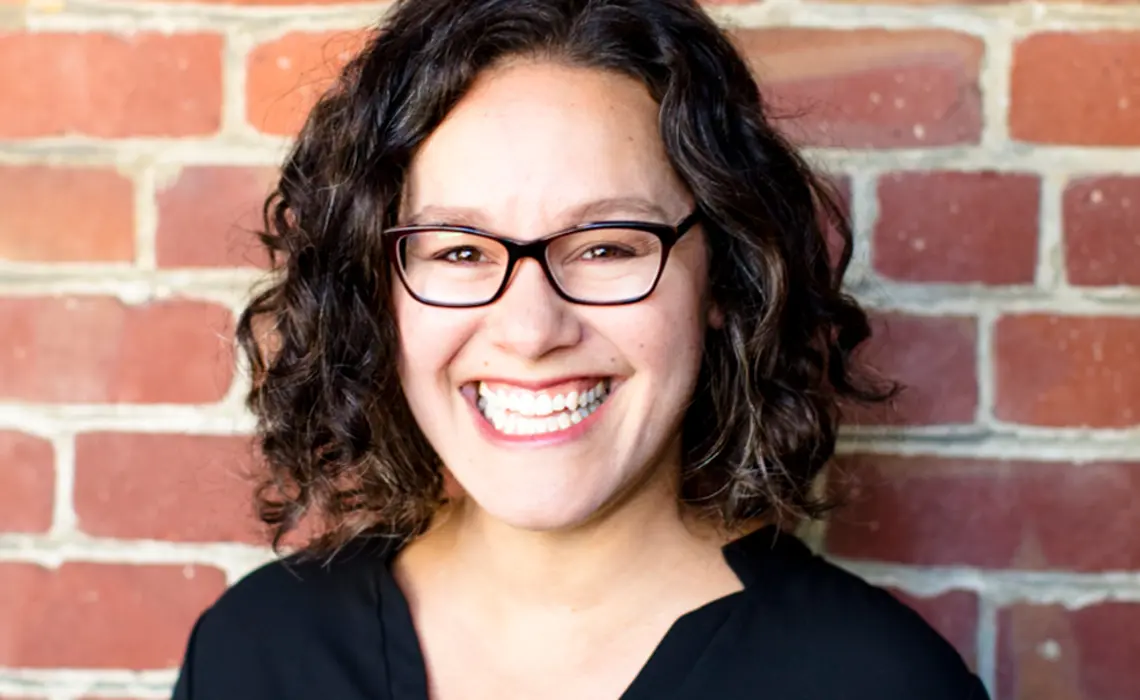
Culinary Podcaster Maggie Hoffman ’04 Knows What’s for Dinner
‘I wanted to make it very real in our discussion of how sometimes cooking is hard and sometimes also cooking can make life feel less hard’

Published Feb. 26, 2026
Listen on Apple Podcasts • Spotify • Soundcloud
TRANSCRIPT:
This is the Princeton Alumni Weekly’s PAWcast, where we talk with Princetonians about what’s happening on campus and beyond.
Today, I’m speaking with Maggie Hoffman from the Class of 2004, who has built a podcast and an online presence around that age-old question, which some of us love and some of us hate: What’s for dinner?
Previously, Maggie was managing editor of Serious Eats and digital director of the recipe website Epicurious, and she published two books of cocktail recipes. Now, she’s applying what she learned at her own venture, titled The Dinner Plan. Patrons of her podcastand Substack get recipes, cookbook recommendations, and other tips. Like how to recover from kitchen burnout. She agreed to come on the PAWcast to discuss her journey and help us all figure out what to put on the table tonight.
Liz Daugherty: So Maggie, thank you so much for coming on the PAWcast. I’m very hopeful that this conversation is going to help me with my cooking conundrums, which are many and varied. But let’s start. Tell me how you arrived here at what you’re doing now. Where did it all begin?
Maggie Hoffman ’04: Sure. Well, so at Princeton, I was a history major and I always, always took fiction classes and I always took a creative writing class, like a poetry workshop. So I think learning to write in all those different modes was really important and learning. And writing a thesis is really good practice for writing a book. You learn that you just do it one page at a time.
LD: We’ve learned that lesson many times at PAW. All the Princetonians think they can write a book and they can write a book because they’ve done it before.
MH: We’ve done before. Yeah. I do think all of those things came together. And in fact, it was one of those history professors who set me up for my first job, which was in book publishing. I think a lot of people come out of college, want to do something related to writing. And in those days got into book publishing, maybe not so much anymore. So I had an unpaid internship at my poetry professor’s publisher, which was right on Union Square in New York. So walking through the farmer’s market every day, that’s really the life.
And it turned out that I really needed that unpaid internship to turn into a real job. And I took the first job which was available, which was not a very exciting set of tasks. I was managing the back-list and the paper orders on the production side of publishing. And it was not really the creative endeavor I was looking for. And so I started a food blog, which in part was just to show my mom across the country what I was cooking. I knew that I needed to write and I needed to be doing something a little more creative. And eventually, while I was still doing this desk job, pitched myself as a writer to Serious Eats, which was a new on the scene food website that was really growing at the time. And I looked at what they had and was like, “What do they need? Where is the white space here?” And what they didn’t have was anyone writing about drinks.
There was a cocktail columnist, but they didn’t have a whole section. They didn’t have wine and beer and other things. So I said to them, “Well, I’m from Oregon. You should hire me to write about beer.” And that was enough in those days. Eventually I convinced them to hire me full time and I came on as an editor and really got to be there in moments when we were developing what the food internet was going to be like.
So I was there for a number of years and we launched a whole drink section of the site. And I learned so much about food and about editing and about what worked on the internet. And many years later, I guess I was there from 2010 to 2016 and ultimately was running the site. And when I was ready to switch to a freelance situation, I happened to be out for drinks with an editor from Random House, from Ten Speed Press, and she was complaining about how long it takes to put a book together. You have an idea and two years later it becomes a book.
And I said, “Yeah. Well, but the internet actually in those days, especially, a lot of what people are looking at isn’t what’s brand new. A lot of what people are looking at is this back catalog.” And she was like, “Like what?” And I said, “Well, for example, we have this story that I did that was like everything you can make with a single bottle of spirits and a trip to the grocery store.” And she turned to me and said, “That’s a book.”
So I left Serious Eats. I wrote a couple cocktail books for Ten Speed Press, I was reviewing bars for the San Francisco Chronicle and really going down this path of really focusing on cocktails. But the second book that I wrote was really about entertaining and I was having a lot of dinner parties and thinking a lot about what it means to host and why we cook and why we host. And my second book was about, it’s called Batch Cocktails, it’s about making drinks for a group in advance, so that when your friends come over, you can pay attention to them and you can spend time together and you’re not knocking over the jigger and you’re not spilling the simple syrup. You’re all set and you’re just pouring it and you are focusing on spending time together. And that was really what I was thinking about in those days.
And I went on book tour and wound up, I was living on the West Coast at the time and I went on book tour and wound up back in New York City and was like, “Oh, man. I want to come back.” And so at that point I also really wanted to come back to editing and I missed working with a group and thinking about food really. I had gone down this path of mostly focusing on drinks. So I ended up applying for this job at Epicurious, ended up getting hired as senior editor and then was digital director at Epicurious for Conde Nast. I was there from 2019 to 2023, thinking full time about cookbooks and cooking and why we cook and how to cook better.
While I was there, I wrote a story about burnout and it really resonated with people. I wrote this story about just losing your love of cooking and feeling overwhelmed. So many people wrote to me and said like, “Yeah, I’m right there.” And you have to think about what’s for dinner day after day after day. And it just stayed in my head from that moment that this is something that so many people have in common. After I left Conde, I noticed that there were new cookbooks about burnout on the market. Margaret Eby wrote this wonderful book about really cooking through, if you’re experiencing depression or just really can’t face the day. She wrote this wonderful book, and Meera Sodha wrote a beautiful book called Dinner that’s about how she found her way back to the kitchen after a rough time. And I was like, “Wow, this is really a common experience that a lot of people are having.”
So I knew I wanted to do a podcast. I knew that I’d loved being on other people’s shows. I had been on the Bon Appetit podcast a little bit and I had always performed. I did improv growing up and I was in an a cappella group at Princeton and so I knew I wanted to be doing something creative. I didn’t want to be sitting in meetings all day and I wanted to do something about cookbooks. And I was like, “OK, what I want to know is if we talk to cookbook authors, what inspires them? What do they actually cook? How do they actually think about the week as a whole, or not?”
Meal planning is the thing that some people do and it’s not really for everyone and there’s a messy middle. And so I wanted to offer solutions and so many ideas and maybe it’s like an ingredient that gets you excited or maybe it’s a dish that we talk through. But I also wanted to make it very real in our discussion of how sometimes cooking is hard and sometimes also cooking can make life feel less hard.
LD: Have you experienced this burnout for yourself, I ask in our post-pandemic world?
MH: I mean, in so many different waves. When I wrote that story, it was the days of the fall of 2020, where I was juggling, trying to do a full-time job in half the hours and my husband the same and we were juggling childcare at the same time and remote school. I don’t know if people are fully recovered from that. If you had young children or you were the caregiver of an elder during that time, I don’t think we’re recovered from that. And I think people are working so hard these days. I think so many people are experiencing burnout at work and that translates into not being able to think, not being able to come up with an idea.
Sometimes the answer to that is repeats. Sometimes the answer is to build yourself a structure. I know that my family likes to eat turkey burgers and there is nothing wrong with having turkey burgers every Monday.
LD: I like that. How about chicken nuggets every night? Is that OK? Give me permission, Maggie.
MH: You have all the permission you need. I mean, I also think that for those of us who like to cook, that can feel like a loss to just feel like the kitchen is a place of stress. And so a lot of people I talk to, I had Hetty Lui McKinnon on the show and she was saying, I want to push back against this idea that everything has to be a 30-minute meal. Cooking can be a beautiful part of your day. So can you set up a situation where you give yourself an hour and maybe it’s on a Sunday, you give yourself an hour and get to do it in a way that feels good?
LD: Do you have, this is right on the subject of a topic that my boss brought up and I was like, yes. Do you have any tips for cooking for a whole household of picky eaters? He was describing it the same way that I’ve described it, which is a Venn diagram of everyone’s preferences and limitations. Got any tips that you can give us?
MH: I mean, I think the Venn diagram is the perfect description and the answer to these things is modular meals where people are building their own. So if you’re doing, and this is also a great way to have some things prepped. Maybe you’re going to prep a grain, maybe it’s farro, maybe it’s quinoa, maybe it’s rice. You are going to prep a protein or maybe two, maybe there’s a plant-based protein and a non-plant-based protein. You’re going to have the option of cheese, you’re going to have the option of vegetables, you’re going to have cooked vegetables. My kid likes crunchy vegetables, rather than cooked vegetables.
You’re not forcing anyone to put anything in their bowl. There’s a spicy sauce for the adults, but maybe one person doesn’t like a spicy sauce, that’s allowed. So I think there are a lot of meals that can go that way. It could be tacos, it could be a chicken nugget salad. It could be sandwich night. How many nights in the week? It could be that you do a stir fry and rice and a protein that’s separate and people are mixing and matching.
LD: That is a really good idea. That is a really good idea.
MH: Salad bowls, any salad bowl. People are making burger bowls these days. I don’t know. There are a lot of things where it can be modular in that way. Make your own sushi rolls, anything that could be a little DIY. Then also there’s a thing of people feeling some ownership. And I think with kids especially, the feeling of them being in control of their own plate is very valuable.
LD: That is very smart. I’m going to totally use that idea. I love it. Who taught you how to cook or did you teach yourself? Where did it come from, this interest in food and mixology?
MH: I’ve always been interested in food. My mother was a fabulous cook and I grew up in Oregon where things really taste like something, produce really tastes like something there. And she would get Gourmet magazine and I would sit and read it and watch her cooking. I was just thinking about this because I was writing a story about it. In high school, we had some school project, where you had to cook food from a different country, so I started experimenting and learning. And then somewhere along the line in high school, my mother broke her leg and so she wasn’t standing without crutches and I learned a little bit.
Then I didn’t cook that much in college except I had one friend who was at 2D, the vegetarian co-op, and that’s what it’s called. And so I would sometimes go there and cook. And that’s so fun because it’s really a pirate ship and you’re cooking for, it’s 20 people or whatever it is and using whatever there is on hand. But so then I just jumped into it after college and especially getting to walk through a farmer’s market three days a week is pretty inspiring.
LD: So who are you cooking for when you’re at home and what do you have in your kitchen? I’m picturing the library of cookbooks that you have on your Substack. What does it look like? What does your household look like in your kitchen?
MH: Well, I have a lot of cookbooks, about 500 and a big collection of vintage food magazines as well. So my walls seem a little precariously full of cookbooks, but I love them. And I do turn to them when I’m, Saturday morning and I’m thinking about what my plan is, I will go and read a cookbook and try to keep a list of things I’ve been wanting to try. I cook for myself and my husband. My kid eats some of those things, but not all of them. And we really try to keep our dinner table just really happy and a good time to be together and not fight about food.
I really realized, I mean, this is part of the whole thing. If I was going to be a professional in the food world, however many years ago that started, that I needed my cooking to be a creative place. And I needed to be able to follow what I was craving. Of course, that’s going to work differently for different people, but I do think that if you have to do this every day, which you more or less do. You can get takeout, you can get meal kits. Those are all valid choices. But if you’re going to cook, if you’re going to be a person who cooks at least some of the time, you’ve got to follow what you’re craving. And for me, that just felt so important to move out of a stage of feeling really rushed all the time and into a stage of, I really love this.
And something I ask my guests every week, I talk to a cookbook author every week and I ask some different questions, but one of the things I really like to know is, how do you set yourself up to be happy in the kitchen? And people have really different answers. Some people like to listen to a podcast. I used to like to listen to a podcast. Now I edit every podcast three times and I can’t stand to have voices in my head anymore. So you hear more music or a history podcast, something different, but different.
I interviewed Melissa Clark from The New York Times and she said that she is happiest in the kitchen. Her husband comes in and sits in the kitchen and reads to her while she cooks, which sounds wild to me.
LD: Oh, that’s so romantic.
MH: It’s very sweet. Maybe it’s music that you need or maybe you want your whole family there, or maybe you close the door and it’s your private time. But taking a minute to, you’re going to do this. It’s something you’re going to do, to think about what would make it feel good is really important.
LD: I like to phone a friend when I’m cooking.
MH: Totally.
LD: Mm-hmm. And I tend to get people who ... I call people across the country like, “Hey, are you doing nothing? I’m making meatballs.” You have gone out on your own with this Substack and podcast. I was curious about this because it’s a model that I’ve actually seen journalists do. I’ve seen sports journalists do it and even news journalists do it, just creating your own ecosystem. How has that been for you and what has the response been?
MH: I think it’s so exciting. And it’s funny, when I was leaving Conde Nast, I said to my husband, “What I’m really going to miss is the strategy part of it.” When I was at Epicurious, we were launching an app and thinking about the future and thinking about all this different strategy. And then I realized like, of course, launching a small media business is absolutely going to be strategy. And there’s actually a whole world of food people on Substack, different people writing to different niches. And I have a group of friends who do sometimes meet and talk strategy and that’s so fun.
Do I think it’s going to last forever? Possibly not, but something that’s wonderful about Substack and other newsletters is for the most part they are not search driven. For the most part, you’re signing up to connect with one person or many people who you trust and like and want to follow. And so it feels very intimate.
So the way that it works is I do this show. Every week I interview a different cookbook author. Usually they have a book coming out that week and then in the newsletter you get a recipe from that person. So you get a little preview of this book that is just on the market. Cookbooks come out on Tuesdays, maybe all books come out on Tuesdays. There’s this cycle that you are able to get a little look at this book the day before it comes out or the week it comes out.
And people reach out to me and say, “This has really helped me.” Or, “I made this thing.” It feels very intimate in a way that like, I’ve written thousands of articles about food on the internet and very few people wrote me with the exception of really two articles in my whole career. One, which was this burnout story. And people are getting real access to individual, I don’t love the word creator, but individual people that they trust. Some of them I think have been following me in this 17 years or whatever it is that I’ve been writing about food and they tell me what they’re making for dinner and I tell them what I’m making for dinner and we all help each other.
LD: That’s like the creation of a community, right?
MH: Yeah. I’m not a photographer, so to me it has felt like a much better place for me than like Instagram is. I’m not making videos of myself, though I probably should, but Substack is really a place for words and I’ve been able to create some tools that are helpful for people. So I have this list of every cookbook, every single guest on the show has recommended. So it’s this massive list. And another thing I’ve done is just a list that’s ideas, 99 ideas for what to make for dinner. And you could cut them on strips and put them in a hat and draw something out, or you could play pin the tail on the dinner. Or just read through them and find something that’s appealing.
Sometimes the thinking about what’s for dinner is so much harder than the cooking. And so if you can just look and be like, oh, yeah. I could do that little cycle, where you make a pot of beans and the second night you put some of them into tacos and the third night you put some of them into pasta and you just solved the week.
LD: From all of those people and all those cookbooks that you’ve been taking a look at, are there any nuggets that stand out that you can share with us? Anything that surprised you or that you would be like, “Oh, if there’s like three things that I would totally recommend you take a look at, these are them.” Not to make you play favorites, but I’m asking you to play favorites. You know what I mean?
MH: For different reasons, and I get to talk to such a wide range of people, it’s truly, to design a whole career around having piles and piles of cookbooks everywhere is really the dream. I will say one of the books I cook from most is Julia Turshen’s latest, What Goes With What. It has these charts and everything is very flexible and recipes are truly easy and she is a pro. She’s been around forever. They’re very well-tested. So if you’re just looking for like, “Maggie, I need a book that has really easy recipes that are going to be delicious,”I would start there.
In terms of books that floored me, there’s a woman named Rosie Kellett, who is based in London, who had a book out last summer (In For Dinner) about living communally in London, in a flat in London. And I talked to her and it’s just like such a different experience. Here is the setup. There were 10 of them or whatever, and each person cooked dinner once a week. Can you imagine only having to think about what’s for dinner once a week?
LD: Oh, my God, that would be amazing.
MH: And she would really look forward to it because here was her chance to impress her housemates and make something great. And they were on a very strict budget and really saved money by doing this. And maybe you can’t give up your life and move into a communal loft with your friends, but maybe there’s some version of that, that you could establish with your community. Maybe it’s that everybody has soup together every Friday. Maybe you switch off. One of the things about dinner is that we feel compelled to do it in isolation and we don’t have to do that.
LD: That is a really good tip. Embrace the potluck.
MH: Totally.
LD: Embrace the potluck. Yeah. I love that.
MH: Just take turns and have people over, even if your house isn’t clean and it doesn’t have to be formal, it’s about not feeling so isolated and food really helps with that. And if you wait for your house to be perfect, you’re never going to see those people.
LD: I love that. And people never really care as much about the cleanliness of your house as you do. I’m not sure they totally notice.
MH: Exactly. They’re just glad to be fed.
LD: Yes. I’m pretty sure Nora Ephron said that. You and Nora Ephron. I love it. Well, we’ve gone through a lot of my questions. Is there anything else that you want to talk about or anything that you think that you’d like to impart on these alumni listeners?
MH: Something that we do is at the end of every show, I have people call in and leave a voice memo with what they actually have in their fridge or their freezer or their pantry. And so if you call in and do this, one of these cookbook author guests will come up with a custom dinner idea for you. So if you want to do that, all the instructions are on the newsletter. The newsletter is free. It’s the thedinnerplan.substack.com and it has the instructions so you can call. I always need more of those.
LD: Oh, I love that. And we’ll link to all of these things and your books and the books that you mentioned will all be in the transcription that we’re going to post at paw.princeton.edu with links to all of Maggie’s stuff. Thank you so much for taking the time for this, Maggie.
MH: I really enjoyed it.
PAWcast is a monthly interview podcast produced by the Princeton Alumni Weekly. If you enjoyed this episode, please subscribe. You can find us on Apple Podcasts, Spotify, and SoundCloud. You can read transcripts of every episode on our website, paw.princeton.edu. Music for this podcast is licensed from Universal Production Music.
Paw in print
October 2026
Holding on to Jewish life; Katy Anderson Keating ’08’s career in wine; Hollywood loves Princeton.
No responses yet