
How to Get Your Book Published
‘Is there energy in your life for obsession? Because if you’re going to write a book, you better be obsessed’

Published June 16, 2026
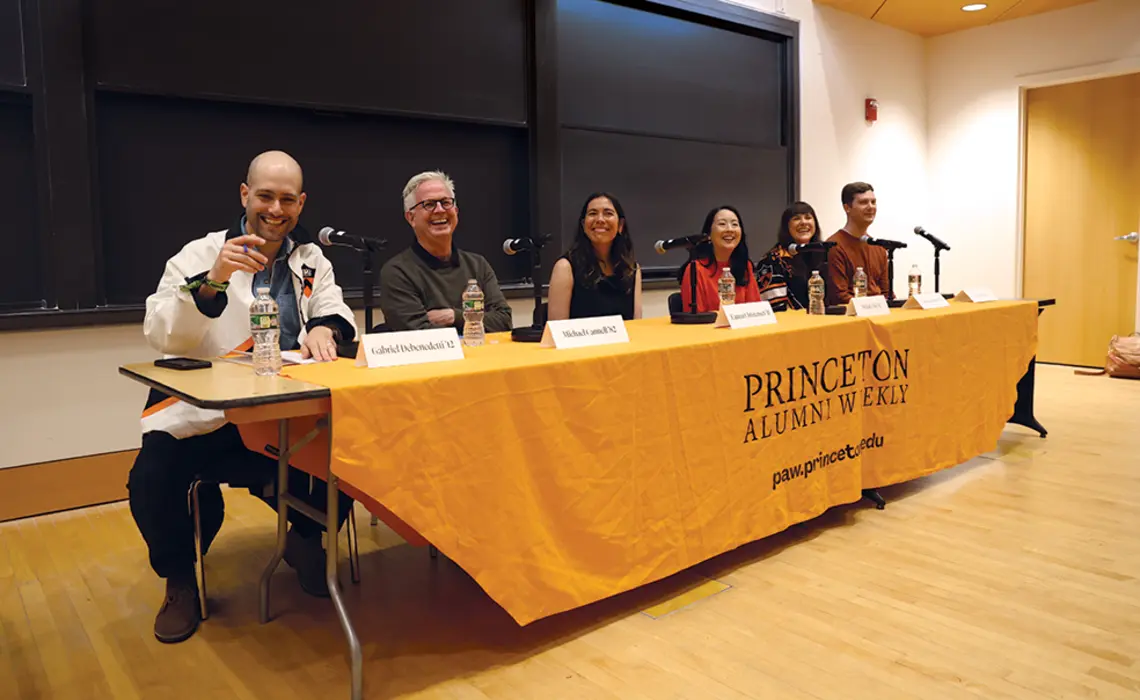
Have you always dreamed of publishing a book? At this year’s Reunions, PAW convened a panel of terrific alumni authors and industry insiders to give advice on how to write your book and get it into the hands of readers. We recorded the conversation and now it’s available for you to listen wherever you get your podcasts.
Listen on Apple Podcasts • Spotify • Soundcloud
TRANSCRIPT:
This is the Princeton Alumni Weekly’s PAWcast, where we talk with Princetonians about what’s happening on campus and beyond.
For this episode we’re pleased to bring you a recording of PAW’s 2026 Reunions panel, titled How to Make Your Book a Reality. We gathered a terrific group of authors and publishing industry insiders, all alumni, of course, to share their experiences and tips on how you — yes, you — can get the book you’ve always wanted to write into the hands of readers. Visit PAW’s website for a transcript, including hyperlinks to all the books mentioned.
Peter Barzilai: All right. Good morning, everybody. Thank you for being here for our panel on how to get your book published. I’m Peter Barzilai. I’m the editor of Princeton Alumni Weekly, the sponsor of this event, and I’m going to hand it over to Gabe who is going to be our moderator.
Gabe Debenetti ’12: Hi everybody. Good morning. Thanks for braving the rain to be here. I think more people are going to be filing in throughout, but we’ll try to keep this as focused as we can. Welcome to How to Make Your Book a Reality, this year’s edition of the annual Princeton Alumni Weekly panel. I am Gabe Debenedetti, Class of 2012. It’s great to be here moderating.
I am a political journalist and the author of The Long Alliance: The Imperfect Union of Joe Biden and Barack Obama, which came out a few years ago when the world looked a little bit different than it does now. And I am a proud member of the PAW Board, so that’s what brings me here today. I’m joined by a fantastic panel of alumni authors and book publishing professionals. And so hopefully this morning we can have some real talk about what it takes to get a book published and what that world looks like these days, and I’m sure they will all tell you all about their great books. So we’ll talk for a while, and then let’s open the floor for questions. So please be thinking of your questions, and then we’ll pass around some mics.
With all that out of the way, I will introduce our panelists briefly. Starting right here. Michael Cannell, Class of 1982—
Speaker 1: Yay. (laughter)
GB: — get some more enthusiasm than “yay” — is the author of five nonfiction books, most recently Blood in the Badge: The Mafia, Two Killer Cops, and a Scandal that Shocked the Nation, great title, which came out in January and was nominated for an Edgar Award for mystery nonfiction. Previously, Michael worked as an editor at The New York Times, and his writing has appeared in publications, including The New Yorker, Time, Sports Illustrated, and so on.
Lauren Christensen, Class of 2011, is celebrating her 15th. Congrats. Lauren is a senior editor at The New York Times Book Reviewand a former Vanity Fair editor, and her memoir, Firstborn, came out last March.
Melody Chu, Class of 2001, is here celebrating her 25th. There we go. An attorney, Melody practiced in Hong Kong in Beijing but now lives in Cleveland. And she self-published her debut novel, Mathey Girls last May, and was subsequently named one of Cleveland Magazine’s most interesting people of 2026. She’s the only most interesting Cleveland person in this room, I’ll bet.
MChu: Totally not true. I’m happy to talk more if anyone has questions.
GD: Cassandra James, Class of 2023. Cassandra won the Toni Morrison Award for the novel that she wrote as her senior thesis just a few years ago. Let’s not dwell on how recent that was. And last February, she published her debut young adult fantasy novel, Capitana. And the sequel, Libertad, is due out next month.
And finally, Alex Ulyett, also Class of 2011, happy 15th, he’ll give us the view from deep inside the publishing world itself. Alex started his career as a children’s book editor, then spent some time at McKinsey and Audible, and now he is a director on the global strategy team at Penguin Random House, which you all have heard of.
Let’s start with a somewhat fun one before we get into the nitty gritty. We can just go down the line, but what kind of books do you all most like to read these days? And what’s one you’ve read semi-recently that you would recommend to the crowd?
MCannell: Starting with me?
GD: Yeah.
MCannell: Well, here’s what’s weird and complicated for me is that I really have only written nonfiction and never have had any interest in writing fiction until recently, but I really almost exclusively read fiction. And so partially, I think that’s because when I write nonfiction, I’m trying to write in a genre that’s known as narrative nonfiction, which means that you try to write nonfiction as if it were fiction, borrowing novelistic techniques. And I shudder at how pretentious that sounds.
GD: Welcome back to Princeton.
MCannell: Yeah. Right. Right. It’s a safe space for pretentious talk, isn’t it?
GD: Look at that orange.
MCannell: Oh yeah, exactly. But to answer your question about who I, I really admire the Irish, I guess Irish-American writer, Colm Tóibín. I just think he’s working on such a high plane. And for those who are interested in these things, he teaches an MFA program at Columbia, I think.
GD: Has taught courses here as well.
MCannell: I didn’t know that.
LC: He taught me here.
MCannell: Me too.
GD: He taught you here. OK.
MCannell: Me too. Yeah.
GD: So now you can shoot him down. But some of his, I don’t know, lectures, some of his talks about the technique of fiction are available on YouTube, and to me they’re worth watching.
LC: I too mostly find myself reading fiction, although in my job, I really do have to read a little bit of everything. I guess most recently the thing that is standing out in my memory and maybe some people in this room have read it is Tayari Jones’s new novel, Kin. I think it’s exceptional. I think it’s just a breeze to read, but that does not, I mean, it’s extremely deep and rich. She also wrote An American Marriage. Yeah, I mostly find myself reading general and just really deep storytelling yarns.
MChu: I also recently read Kin, and it is really actually amazing. I think it is a good mix of very easy to read but also very deep storytelling, and it’s not superficial at all, but it flows. The prose just flows. I really like reading novels of all kinds. I lean literary even though my writing maybe is not as literary as I like to read. And the novel I can recommend that I actually finished as audiobook on the way here was How High We Go In The Dark by Sequoia Nagamatsu. And all of my Princeton friends who are here to support me, I’ve just been telling each of them in turn about how they should read it. It is a literary sci-fi, a connected group of stories about a dystopic kind of future, but you don’t realize until the very end how it all links together, and it’s really amazing.
CJ: I’m going to echo the last two people that I also read a lot of novels and fiction, but I try to read a little bit of everything. And one thing that I’ve been really loving recently in publishing as a trend is genre blending. I love to see genre blending going on, especially with speculative genres. So I’m going to highlight Bochica, which is written by another Colombian-American author and it’s a speculative novel that blends horror with historical fiction and it’s set in this very creepy house in the mountains of Colombia. And I literally read it in the perfect day. It was like rainy and stormy in Florida, and I devoured the entire thing in a couple hours. So highly recommend.
AU: I also read a lot of fiction.
GD: You all should buy nonfiction books at least, please.
LC: Gabe’s book is great.
GD: Buy one of them. I can think of one you should buy.
AU: We’ll get to that. Yes. I generally read as physical books fiction and then I listen to some nonfiction, and that’s the way my brain works for I can’t really listen to fiction and I prefer listening to nonfiction. A recent book that really surprised me is called Land by Maggie O’Farrell who wrote Hamnet, and it’s historical. It also spans about 2,000 years. There’s touches of magic but it’s not magic and it really; I had no idea where it was going and I just loved the ride and really; It’s set in Ireland largely in the 1800s about a family at its core.
GD: Great. All right. Now we can dig in a little bit. I’ll start with a question for the authors and Alex, we’ll come back to you in a second. But you all can use this question as book promotion if you want, but let’s start by telling us a little bit about your most recent books. And then why don’t you talk a little bit about how the idea came to be and really, importantly, I think for this room, what your first steps were once you knew you wanted to write it.
MCannell: My most recent book is called Blood in the Badge. It’s the true story of two decorated, high ranking New York City detectives who were secretly on the mafia payroll and they were feeding the mafia all sorts of sensitive police information, FBI information. And most importantly, who in the mafia ranks was a rat who was informing on them. And then these two detectives would facilitate the murder of those rats. They were involved in more than a dozen murders. I don’t know how, I had written, my previous book was about the mafia in the ‘40s, so I just somehow stumbled onto this. It had been written about before some, and my publisher was not sure about doing it for that reason, but I convinced him that given that a little time had passed, that it would be a more complete and a book would have some resonance.
And I was bullshitting him when I said that, but it turned out to be true. It’s this funny way, like after 10 years maybe things pass from current events into history and they take on a different quality. And I would say just not to go on and on about it, but the crucial thing in this book was to get the people in the story to talk about it. And generally they had never, both on the mafia side and the police side, they had never talked about it, but 10 years later they were willing to, and then it all came out and I couldn’t even get them to shut up actually.
LC: So I guess as an author on this panel, I am having a bit of imposter syndrome. I don’t really consider myself an author. I did publish a book. It just didn’t really come out. I don’t know that it was the usual process, but I’ll overview briefly. So my memoir, Firstborn, was about the story of my first pregnancy, which ended halfway through for medical reasons. This was something that just happened. I didn’t even really know I was writing a book when I started writing it. I just was writing. I had time off of work. And I guess because of what I do and my interests as a reader, it did feel like the most natural thing for me to do, and also because of my work, I did have access to agents, and yeah, that whole world.
I will say that I guess I predominantly consider myself a critic and an editor, and going through the publishing process, which we can talk about, has really given me new insight into the work that I do, not all positive. These are real people who write these books, it turns out. But yeah, so my first step, I guess, was just putting it all on paper, and then I found an agent and sold it to a publisher.
GD: And we’ll talk about the process.
LC: Yes.
MChu: It’s funny that you mentioned imposter syndrome because I, out of this group, am the only one who is not in the traditional publishing space. So I self-published Mathey Girls and I only have the one. So that is my most recent book. I was a lawyer for almost 20 years and I had put aside whatever creative writing impulses I had from childhood while I was being an international finance lawyer and having three children. And then in 2018, I had my third child, my son, and I almost died. And that experience made me reprioritize what I really wanted to do as a mother, as a human being, and as a creative. And I really started looking back into creative writing. In 2021, I quit my job with my big law firm and I wrote a novel, which is not Mathey Girls, and it wasn’t great, but I learned a lot from writing it.
And I think first steps, if you want to write a novel is to actually just try to write a novel. If you do it, you’ll know if you love it, you know if you can do it. And that’s what I found. And while I was trying to get an agent for my first novel, I started writing Mathey Girls, and I, from the beginning, just had so much love and confidence in this novel. It is an ode to friendship, and I have to shout out my Mathey Girl friends who are not represented truly in the book, but as an archetype for the kind of support that the friends you make when you’re 20, by the time you’re 40, if tragedy hits, how they can coalesce and support you.
CJ: So my debut novel is Capitana. It just came out in 2025, and then the sequel, Libertad, is coming out next month, or was it this month? Next month, which is really exciting. And it’s about a girl who attends an academy for pirate hunters. And I describe it as Pirates of the Caribbean meet Zorro. It’s very swashbuckling action and adventure, like classic ’90s adventure movie kind of vibes. And I actually wrote it while I was here at Princeton. I was a sophomore, and I won the Dale Summer Award if anybody’s familiar with that. Yeah, got a couple head nods. So I won the Dale Summer Award, and the world had shut down, it was COVID, so we were all sitting at home and home for me is Florida. I was like, well, what can I write about in Florida? And I’ve always been a history nut, and I was like, “All right, let’s do some digging into the Spanish history in Florida.” And everywhere I turned, I hit pirates.
So I was like, well, it seems inevitable to write a pirate story, and I’m bored, so let’s do it. And I wrote the first draft of Capitana sitting at home in the pandemic, and when I came back to Princeton, I brought it to my absolute favorite creative writing professor, Professor Yiyun Li, and I brought it to her and I was like, “Does this have any legs?” And she was like, “Actually, it does.” And that was the genesis of Capitana that later became the book that snowballed into an agent and a deal with HarperCollins and the whole nine.
GD: Why don’t we go this way now because I don’t want to just have this go down the line the same way all of our time, but let’s talk about the process briefly. What for you all was the hardest part of getting some idea from your brain into pages that people could actually hold and read?
CJ: So this was actually really funny. I’m a research nut, that’s what I do. And for me, it was the immersive research process that unlocked it. And that sounds very academic when I put it that way. And part of it was academic. I went to a lot of archives at a lot of libraries and a lot of museums and talked to a lot of very important people about Spanish history and pirate history, including two people that actually worked on the Atocha wreck that Mel Fisher resurrected off the coast of Key West, which is like one of the biggest wreck stories in Florida history. So I did do the academic side, but the more fun side, which is what I like to talk about, is the experiential side, which was I learned to sail and learned to fight with a rapier. And those experiences really unlocked the story for me and it turned it from a project; because I had been writing novels since I was 10 years old.
I’ve written a novel a year since I was 10. And I was precocious and maybe a little bit weird, but I have been writing forever, but I think something about that process and experiencing the book just made it so much a part of me that I just couldn’t let it go. I was like, this has to be the one. It has to be. And then I think getting, like I was saying before, getting that OK from Professor Li and that she saw something in it seconded the feeling that I was feeling in my early process of writing that I wasn’t crazy. There was something different about this book and there was something that resonated with people. And as I even went through the editing and drafting process all the way up till when I sold it to my agent and then to Harper, that initial spark stayed with me and continues to stay with me. It’s my favorite part of talking about Capitana.
MChu: I wish I learned how to fight with a rapier as part of my story for Mathey Girls. I think the hardest part for me was not necessarily putting my words into the computer, typing it, actually writing the novel. It was probably the 20 year law career that I had that prevented me from actually creative writing. And I definitely realized when I started writing my first novel that there is absolutely no way I could have done that while I was working full time as a lawyer or even part time as a lawyer with three kids. And so I think giving myself the permission and the space to just quit my job, take some time, and I’m very, very grateful for my husband. We talked about a three-year hiatus, which hopefully I can extend forever. It’s been five years so far. So it’s basically carving out that space for myself, which took an act of I want to do this, and I need to make some changes in my life to make it happen, and I’m so glad I did.
LC: I think the hardest part for me was actually the publicity part. I was very fortunate. Like I said, the writing was the writing and I actually, I don’t totally remember that process. It was very immediate and intense. But then I was very lucky to find an agent who, I mean, he’s like a therapist to me. I mean, he really held my hand through the process. And I can talk a little more about that. I find that really important in a relationship with an author, I guess particularly if you’re writing something personal. But all to say, I found that relationship incredibly fulfilling. I felt very then later taken care of and respected by my editors at Penguin Press. So all that process being edited, I love being edited, I found that to be very enriching. What was difficult was the publicity, was getting prepared.
I mean, I guess it’s my whole job, I know. I know that world and feeling like part of my soul was just offered up as a popularity contest or a business proposition when I venture to say that my editors at Penguin Press did not buy this memoir to make money, which is very fortunate for me, but it still becomes a game. And knowing that so well from the other side was very daunting. So yeah, it was personal struggle at the end, but the process of actually getting it edited and putting it on paper was very fulfilling.
MCannell: I’m a little bit surprised that people haven’t said that taking things out in the editing process was the most difficult part. There’s an expression, kill your darlings, which means the things that you’ve fallen in love with in your manuscript are often the things that really need to go. And once you’ve completed a book and it’s in the editorial process, you’ve lived with it for years and so it’s like hardened in concrete in your mind. And it seems unthinkable to take it out. If you’re writing nonfiction, I’m just curious to know how many people, just raise your hand, how many people here would write a nonfiction book versus; so a lot of people. So if you write, just to start with the basics, if you’re writing nonfiction, you write a proposal for your agent and publisher, right? I think that’s generally true. Fiction, you would write the entire manuscript before you submit it. In nonfiction, you write a proposal, which is typically like 40, 45, 50 pages.
And there’s a certain technique to writing that. It’s its own weird art form and you have to nail it really. And the good thing is that when you’ve worked it all out, then writing the book, I’m not going to say is easy, it’s never easy, but you have your roadmap. But getting there, that part, I think, is hard. You got to figure out, you really, really got to figure out what the book is and the structure of the book.
GD: And a good agent and a good editor will help you do that if you’re lucky enough to have that in the early stages. Just briefly, if anyone has a good story about this or good memories of how do you; this is probably helpful for some people in the audience. How did you find an agent?
MCannell: My sister was an agent, but she wasn’t my agent because that would be weird, but she had friends who were agents. So I just fell into it and I was lucky. But this is a big deal, finding the agent, right? That’s the big, I mean, it’s like the big enchilada is finding the agent. And I mean, I don’t really have any experience with this, but I’ve never. It used to be that agents would, you could just send in your material and they would read it, and I’m guessing probably their assistant, the agent’s assistant usually read it and it would be vetted, but everybody is so strapped now, I don’t even know if their agents have assistants. So I think it was always tough and I think it’s tougher now.
CJ: So I had a both traditional and untraditional story at the same time. So like I was saying earlier, so I wrote Capitana during my sophomore year and edited it through my junior year. So by the time I hit my senior year, I was ready to query and I went to a bunch of agents over about four months over the course of the summer and was querying and querying and querying. Word to the wise, do not query over the summer. Everyone is on vacation. I didn’t know that. So I was submitting and wondering why I wasn’t getting anything back. And I got to the fall and was having a bit of an existential crisis of maybe this novel isn’t the one, maybe I heard the wrong thing, maybe the signals were all wrong. And a friend of mine, who is now also a published author, turned me on to a Twitter pitch competition called Latinx Pitch for Latin storytellers.
And I was like, a Twitter pitch? No one is ever going to see my book on Twitter. I have like two followers on Twitter. And she was like, “Go for it.” So I was sitting in the Mathey dining hall and I had my phone literally sitting next to me, and I remember I was eating tacos and my phone started levitating. It was buzzing like crazy. And I looked down and I’m like, “Are these real people?” So I go and I look, and they are in fact real people at very real agencies. And I ended up sending out a bunch of full requests, which is basically when you send out the full manuscript to an agent, and within 24 hours my now agent read the book and signed me. And then I walked outside of Mathey Hall and there was an ice cream truck that was fortuitously timed and I celebrated. I celebrated with an ice cream.
MChu: So I don’t have an agent because I self-published the book. I did try to get an agent and go the traditional publishing path, and I don’t know if you’re planning to do the nuts and bolts, but basically you try to get an agent. If the agent you get an established relationship, they will then try to sell the book to a publishing house. So it’s a very two step process, and it’s the diamond in the rough if you get the agent, and then the jackpot if you then get a publishing deal. And about after a year of querying, which is when you reach out to agents and hope that they like your book, I think I queried over a hundred agents and I had about 20 full requests and I had a lot of feedback that was like, “It’s great, it’s beautifully written. I don’t know how I can sell it.”
And at the same time, I saw a few author friends who got agents and then their books didn’t sell to publishing houses. And this whole experience from the time you start querying to when your book, if you get a publishing deal, is in a bookshop can be four or five years or more, whereas with self-publishing, it can be a month later if you have everything set up or the next day. And so yes, at some point I made the decision that I was going to go the self-publishing route instead, so no agent for me.
LC: So I found my agent through my day job, and I guess it was somewhat easier. I did not have to query, which we can talk about if you guys want to know more about what querying entails, that’s probably a Cassandra question. But so once I found this agent who I’d been working with, that’s not to say that this was the first; we had actually been working together. He had seen a bunch of other things that I had written because he was wondering if because I was a writer and editor, if I happened to have a project. So a lot of agents will just play a long game because they get 15% of what you sell your book for, so it behooves them to make relationships early and then hopefully work with you over your career. So I was very unsure about why this man was talking to me in the beginning, and he was like, “Are you working on anything?” And so I sent him some stuff that was admittedly horrible and not; some of it was maybe fiction, some of it was essays, it was just not good.
And then when this life event happened and I had it all written out, I actually showed it to my husband first and he was like, “You should send it to Bill.” And then that’s where the book started. I will also say this isn’t quite exactly what you’re asking, but I will say that this two-tiered process that Melody was talking about, I think the first tier, for me at least, is in my experience editing publishers, there’s so much less actual editing happening overall at publishing houses. And so in my experience, that puts much more of an onus on the agent, which I think goes back to what I was saying about making sure that’s the kind of relationship you want. I’m not saying everyone needs to have an agent who’s like their therapist. Some people want more of a business relationship. That’s fine, but just make sure it’s the relationship that you are really comfortable with.
Some things will happen with your editor, whatever it is, you don’t like the cover, you don’t like this edit. And the agent, his or her entire job is to be your first port of call. I would feel awkward about saying, “Oh, I don’t like what you’ve done here.” I would talk to my agent, he would deal with it. And that was end of story. And so I guess I would just say, I mean, of course you’ll be tempted to just go with the first agent who comes to you, and maybe that is what you have to do in this increasingly difficult publishing landscape, but I will say if you have the ability to choose or wait for the right person, I think it can really, really make or break the book and your career.
GD: That’s right. We’ve talked around this a lot and I think everyone here understands that the publishing world has changed a lot even in the last few years, but really over the last two or three decades, but it can often feel like a real black box. So Alex, can you talk to us a little bit? Can you open the box, but really just talk to us about your journey in the publishing world and what are you working on now? How should we think about what someone like you does?
AU: OK. So I began my career as an editor and you talking about them as a therapist, I mean, you were talking more about your agent as a therapist, but I think writing is such a personal; and whether it’s something more memoir or fiction or whatnot, it becomes a very personal relationship and like to your point around the timeframe, I would acquire a book and it would come out three years later sometimes. We would sometimes spend a year editing and then it goes into copy editing and getting a cover and getting a marketing plan and getting publicity and going out with the sales team and they’re getting numbers from Barnes & Noble and indie reps selling across small bookstores across the country, sub rights teams selling to foreign publishers. There’s just so many pieces along the way and we can dive into any of that later on depending on what’s of interest.
I then worked at Audible, so I can also speak to audio if that’s of interest, where my role was working with the publishers on there. I was not in the audio production part, but rather, which is most of Audible’s business is selling the books from Penguin and HarperCollins, etc. So working on the deals with publishers there. Now I’m back at Penguin Random House. I work on the global strategy team. So for that, PRH is the largest publisher, we operate 10 global businesses. So part of that is organizing and collaborating among the global businesses and especially when there are publications coming out from multiple businesses and how that is organized together, but also how they may stay unique. I’m sure you’ve seen books in other countries with completely different covers, maybe even different titles. So there’s a level of coordination, but for what also makes sense. And something that’s in the US, someone in the UK may say, “That cover, that treatment’s not going to work at all here.”
PRH also has grown through acquiring smaller publishers. Sourcebooks does a lot of commercial fiction, Hay House is a more self-help publisher. We recently acquired Wonderbly, which does personalized books. So one of the things I work on is helping those businesses grow within the PRH ecosystem. I don’t know if that answered the question at all, but—
GD: That’s a good answer.
AU: —that’s a bit about what I’ve been doing. Anything you’re more interested in—
GD: No, I think that’s all great. I think why don’t we talk about; I’m curious for your take on this and also Lauren’s take on this in particular. Let’s take the last 10 years in particular. What kinds of books do you think publishers are interested in now or readers are interested in now that they weren’t? And what’s fallen by the wayside? What do you think people in this room should be looking for now and moving forward?
AU: I mean, this has been going on the whole time I’ve been involved in publishing, but the challenge of discoverability and the, quote, unquote, midlist. And I think publishers, obviously they have different expectations based on what they’re paying for a book and you may have; I found it interesting you said, Lauren, that they weren’t necessarily interested in making money by—
LC: We didn’t.
AU: But I think there’s a variety of types of books that the major publishers publish. I think what’s becoming, in recent year to two years, there’s been a nonfiction is becoming increasingly challenging and that’s something we’re trying to understand. There’s a lot of theories about what that could be and are people getting information that they would otherwise see from nonfiction in other sources. Now certain types of nonfiction, there seems to be a very clear thesis on that. Travel books are in deep decline, and that’s not that surprising given that I’m currently planning a trip to Japan with some friends from Princeton and one of them used ChatGPT to start the itinerary. So there are certain types of prescriptive books that are seeing more challenge. I think there was a time when, for fiction, landing one of the big book clubs, Oprah’s Book Club, GMA, Jenna, was more of a surefire way towards success, and even that is a bit more of a mixed bag nowadays.
I think of one recent book that PRH published maybe a month ago of just an example where everything lined up is the book Yesteryear by Caro Claire Burke, and I think that is an example of where the stars aligned where it was on this topic that was buzzy and trending of trad wives plus a media savvy author plus a propulsive plot and a twist. And that’s an example that the sales week over week are growing and growing, which is not usually the way. However, you can take media-savvy author, you could take plot with a twist, you could take trending thing and it could completely not work. So there’s no formula in that way.
LC: I mean, I think it’s like, why does a tweet go viral? I think it’s random at the end of the day. That said, I guess I will just talk from a publicity standpoint because I don’t have a hand in actually acquiring and publishing the books. I mean, you ask over the last decade, that’s exactly how long I’ve been at the Times. And I will say that when I got there, the New York Times Book Review was still a print-first operation, which meant that our workflow was solely based around the weekly print edition and then we just put things online as an afterthought. They looked like Word documents online. And that was 2017, that was not that long ago.
So in the last 10 years, our operations have shifted just as critics and as a newspaper or just as an insert to the newspaper. And I think that both reflects and frankly influences the book-publishing world itself. I think we, the media, I guess, are being increasingly encouraged to meet readers where they are. I’m not saying that is not an admirable worthy goal, but I am saying that it does influence the kinds of coverage that you’re going to read. I think it means that you’re going to see a lot more of thing; it’s algorithmic. You’re going to see a lot more things on the front table at Barnes & Noble that you are already interested in versus things that you were not so likely to find.
Yeah. I think speaking of Yesteryear, I did edit that review. I think a book like that, not every book like that is going to be a hit, but it does make sense because it’s a very elevator pitch kind of book. I think conceits work really well. Maybe it’s tied to the nonfiction book proposal. It’s like, just tell me what this book is about. I don’t even necessarily need to see the whole thing to then decide whether it’s worth my reading it. So that does reward a certain kind of book, whether it’s genre fiction or literary fiction. It’s just, OK, if you can say really quickly, “This is about this,” as opposed to, “Well, it’s a searching, coming of age, slippery slice of life.” No one wants to buy that even if the book itself might be totally brilliant. I do think there are some really serious readers of the book review and of books, and I think they’re looking for really interesting things. I think it is just becoming increasingly difficult to reach them.
AU: One thing that made that triggered for me is from a retail environment, we talk about over the past five years, a real shift from a push mentality to a pull mentality with our major retail partners. And there was a time when I started where there’d be a book that PRH would say like, “This is going to be like a big book.” And Barnes & Noble would be like, “Great, sign us up for 20,000 copies.” They don’t do that anymore. They’ll say, “That’s nice. We’ll take 4,000 copies, and then if it sells, we’ll order more.” So there’s a lot more of being responsive and I think that shift from push versus pull is one of the big changes over the last five or 10 years.
GD: I want to get to audience questions in a second. So let’s just do one quick question that you all can answer as quickly as you’d like to. If you’re talking to someone in this room who is interested in publishing a book of any kind of their own, what’s one thing that you would say they should do in the next 30 days? No pressure.
MCannell: I mean, I don’t think this is really answering the question, but I think you should be, I think you should think about whether you’re willing to be obsessed. Is there room in your life? Is there energy in your life for obsession? Because if you’re going to write a book, you better be obsessed. You better be willing to really, really dig deep and be obsessed. I don’t think anybody should write a book unless they’re willing to do that.
LC: Have they written the book yet? No, they haven’t written the book.
GD: Up to you.
LC: OK. I guess either way.
GD: Have you written the book yet, people?
LC: So I guess make time to write the book, but on top of that, I think in addition to being obsessed, I think vulnerable, just be ready that this is going to; whatever it is, even if it’s nonfiction, even if it’s a biography of somebody else or novel that you think is not based on you, but whatever, it’s going to be a very personal product at the end of the day. So just be ready to hear; because people are going to say crazy things and they have unlimited outlets to say really insane stuff about your work, about you, and that’s part of putting it out there. That’s part of why it’s not, you don’t want it to just be a Word document. You want other people to read it. There will be some great stuff. There will be some really insane stuff that people will say. So I guess just be ready for what it means to put your entire self out there.
MChu: Assuming you’ve already written the book, so I’m not going to say that. I would say it’s very important to find people who can support you.
LC: The readers. Yeah.
MChu: Yeah. So it’s not necessarily your friends and family who are going to be the people who are going to help you the most in your writing journey. I would definitely recommend trying to find writer groups locally or Zoom. I feel like my writing groups, both of which are on Zoom, have really, really helped me. And that’s, I think whether you are doing it traditionally or self-publishing, just because writers will read your writing in a different way than readers will, and you can get a lot of helpful feedback that way, but also you can share some of this insane vulnerability and pressure of all of this stuff with them. And so I think writing itself is such a solitary thing. You spend so many hours by yourself with a notebook or with a laptop. And so to have people who can really commiserate with that process but also love it was really important.
CJ: I’m going to give an answer that’s maybe leaning a little bit more practical because I’m coming from a YA, very commercial, very fast moving space and I would say get very specific about who your audience is. And what I mean by that is I came into this industry thinking, oh, my audience is teenagers or my audience is teenagers who write fantasy. And in the publishing landscape that we live in now, that is not specific enough. It’s not nearly specific enough.
And I think one of the great learning lessons that I’ve acquired over the last three years in the industry and working on Capitana was to get so specific with what my audience was that I could convey that by saying, “I’m targeting this towards parents who want their children to read classic fantasy adventure stories.” That’s a very small group of people, but it makes it so much more helpful to know who you’re targeting and how to reach them because then you can take actual action steps on social media or through events or through indie bookstores or through Barnes & Noble to be able to find that audience. So get specific about who your readers are.
AU: I was originally going to say find your people, so I’ll just second that. I think anyone that I edited, they had their writer’s group, they had a journey before and that’s just invaluable. Going along with your point, Cassandra, I think reading very current new things in the type of book that you’re writing, so beyond how you speak about who the audience is, especially if you’re approaching querying stage, being able to refer to specific and recent books that share that same reader... I mean, this was a while ago, but as we know when I was editing middle grade and young adult, if anything came in being like, “This is for readers of Harry Potter or Perks of Being a Wallflower,” that’s useless, but being really specific of a recent title that is for that audience will help you see what’s working in the marketplace and then also help an agent, an editor think about how they’re positioning that book down the line.
LC: Can I add something?
AU: Sure.
LC: Maybe just make somewhat of a specific financial plan. I think we haven’t really touched on that, that once your agent sells the book to a publisher, you get an advance. Sorry, I’m not sick. You get an advance, and that can be, I mean, the numbers range wildly. They can be often five or $10,000. They can be hundreds of thousands of dollars. It’s very exceptional and newsworthy when someone gets a million dollars. But this is now, and then if you go the traditional publishing route, like Alex said, you’re looking at three years to live off of between five and $100,000, let’s call it. So there are some really serious financial considerations to take into account when you are deciding that this is going to be a professional route you take.
GD: Yeah. And unless you have a super smash hit, the idea of planning for royalties or anything beyond your advance is not real—
LC: Royalties is when you earn back the amount of your advance. So if you get $50,000, if they sell enough copies, if Harper makes back 50,000, then you get royalties based on, yeah.
GD: We don’t have unlimited time, so let’s open for some very specific audience questions. Right here.
Speaker 2: I just wanted to pivot off of what Alex and Cassandra said. Do you think younger writers are better mentally or philosophically equipped to pivot to meet trends in the marketplace? Because I’m on the Mystery Writers of America board and I’m on the Bouchercon board, and we tried to give Mike an Edgar, but it didn’t quite work out, but a lot of our, and Thriller Fest and a lot of our members are gray. And I was talking to Lee Child who writes the Reacher books and he says that fantasy, nonfiction, literary fiction are the barnacles on our bloody boat, which is a very old fashioned notion. Do you think that younger writers are better able to pivot to these new trends like romance-fantasy and stuff like that rather than us writing our old detective novels?
CJ: It’s a very good question. I would answer it in two ways in that I think the audience for books like Thrillers like a Jack Reacher or like a Michael Crichton, the books like that, I don’t see those going away. I think there is going to be an audience for that kind of fiction. I mean, I just read Wild Dark Shore. I don’t know if anybody is familiar. Yeah. It’s like a speculative thriller. It’s really interesting, and it’s sold really well. And that’s a very upmarket literary speculative novel that I guarantee somebody read that and was like, “This is not going anywhere.” So there’s still an audience for those kinds of voices that seem a little bit more upmarket or maybe a little bit more traditional. I don’t know if that’s the right word. At the same time, I would say that I think the markets for romantasy and for this kind of new YA that’s very much evolving as we speak, I think younger writers are able to keep up with these things faster because they generate not with publishers or with bookstores, they generate on social media.
And what Alex was talking about, about being so reactive, part of that is because BookTok practically drives the boat now with a lot of those genres, and because young writers exist in those spaces and young readers exist in those spaces and they’re the ones driving the conversation, we’re up to date on those conversations because we’re watching them all the time and consuming them all the time. So by the time something hits the shelf, we’ve known about it for nine months. So I think partially it’s just a media consumption thing that’s driving that trend. So I would say in that way, I think young writers are probably better equipped to deal with that specific side of the industry. But I also don’t think it’s going to mean that the other voices go away either. I hope that answers your question.
Speaker 3: Thank you so much for this panel. I wanted to ask Alex a question. I was at the American AWP conference, American Writers and Writing Programs Conference in Baltimore. And one of the things that I heard was that the traditional, the big five publishing houses were increasingly being bought by private equity, and that they were less willing to take chances on debut authors, and that debut authors, the figure was 3%. If you are a debut author, only 3% of the books that are getting published these days are debut authors and the rest are the Michael Crichtons and the others where there’s this stream of income. And not to expect, I think somebody said editors, you don’t expect a lot of editors, it’s really more the agent who’s in the role of doing the editing.
And so I’m just wondering, you’re a strategy person. If you could put yourself in our shoes, our strategy when it comes to targeting agents to get into the big five versus the indie presses, the university academic presses, I mean, there’s just all kinds of presses out there. And I’m a limited resource. I’m trying to figure out how do I allocate my time in terms of maybe finding an agent may not even lead to a publication and then I’m back where I started. Thank you.
AU: So in terms of, yes, if you’re pursuing that agent, you’re looking for an agent, which I think like I’d be curious to your reflection on agent versus not agent, but if we’re taking that as the first aim, I think I always recommend people looking, going back to reading books that are similar for the audience that you’re reading, looking who their agents are, literally going to the bookstore, looking at that area, pulling out the acknowledgements, it’s basically always the first person they thank. And I think from there, it’s about finding someone who rather than, “Oh, I’m going to submit to Simon & Schuster,” or that’s the one owned by private equity at the moment and I don’t work there so I can’t really speak, but from the outside, looks like a lot’s going on, but finding someone who sees your book or what you’re trying to do in the way that you do.
So I had a friend who queried a number of agents and got one who basically was like, “Yes, I’m ready to sell your book.” And then some others who were like, “I love your writing and I worry about how this book will sell and the things that I’m seeing that you’re great at are X, Y, and Z.” And she ultimately said no to the agent who was going to represent and sell the book and went with an agent who basically told her to start over, but because they had that aligned vision. So my advice I guess within that is finding someone who you feel can represent you, and then figuring out where in the whole publishing ecosystem is the best fit, they’ll be the best person equipped to help you get there.
Speaker 4: Hi, I have some experience that might be of interest to people in the room because I’m not only a recently published author. I picked up my books two days ago, so very recent. And I was not in a position because of the subject matter to really appeal to a mainstream agent. And so I ended up going self-publishing route, and one of the comments was, know who your audience is. I had a very clear audience from the beginning, which the name of the book is, it’s basically A History of Princeton Basketball.
And so I know that there are lots of people who have a passionate interest in that, but people in Minnesota don’t, and people who do other things don’t. So I knew who my audience was and one of the benefits of being self-published is you get to write your book and nobody is taking you on a tangent away from it. So this weekend has been interesting because every reunion’s former Princeton basketball players come back, and you get a chance to get real life reaction to your book, and did it do what you hoped it would?
And without his knowing this, I will ask my friend Brian, not ask Brian, but Brian, who was a great player at Princeton, one of the best ever yesterday saw the book for the first time, wanted to buy a copy. Late last night, he called me up and said, “Hey, can I get three more?” This morning he came by and got... So it resonates with that audience. The question is, and I guess another question for everybody is, are you doing this because you’ve got a story you want to get out or are you doing this because you want this to be your living? And for my case, at my age, and so forth, it was to get a story out, but is there an avenue once I’ve got a book and it’s resonated with its initial audience, is there a way to explore, what’s the best way to explore how to perhaps broaden the interest in it?
LC: I will say that there are freelance publicists more and more. People are going the route of just hiring their own publicity, sometimes even if they do have a publisher. Publicity staffs are strapped also. So there are people who you can pay to get your book into my hands or the hands of just traditional media who can then say, “Oh, this book about Princeton basketball is fantastic.” So that is a possibility. It costs money. I have no idea how much, but that is a possibility.
MCannell: I know how much. I mean, it’s expensive. That’s my answer. It’s expensive.
Speaker 5: Order of magnitude?
MCannell: I spent $12,000 on a publicist. And that’s exactly as Lauren said, I think it’s harder to rely on the publisher’s publicist, not because they’re incompetent or not because they don’t want to do a good job, but just they’re really strapped and overworked and it’s hard to; then the job is more complicated than it used to be. And so I just made the decision that I was going to bring somebody else in and did it. I mean, I know that I got a lot of benefits out of it. My book was excerpted in People magazine, which was meaningful for sales, but it’s just hard to. I think it’s hard to know if it’s worth it or not.
Speaker 6: There you go.
Speaker 7: Thank you. Excellent panel. I am one of the lawyers who uncovered the Live Nation Ticketmaster corruption scandal in ticketing. And I am in the case, and I am arguing in the federal circuit, but several people have come to me and told me to tell this story, OK? I am not a writer of novels. I am not a writer of nonfiction, but what I’m interested in is whether or not there are resources in any of the publishing houses who could align me with a writer for this story. Now I did get the interest of Rob Reiner, and, of course, that didn’t work out, but I am trying to get to Aaron Sorkin or somebody else to help me, but it would be very helpful for me to get somebody, I mean, considering the Secret of Secrets, which was a similar type of case because I happened to have invented all the patents for overlay ticketing, but regardless, I want to tell this story, and I am not the person to tell it to the public. I know that for sure. So I’m trying to figure out how to get that person.
Is it to go to a talent agency, have them package me with somebody else? Or is it to go to a publishing house and have them assign someone to work with me? Because I think this is a very important story to tell. This is a 15-year story of corruption in the federal courts nationwide. And I will tell you that I did go to college with Arthur Sulzberger. So basically I do have some contacts, but I am not the writer of this story. And I also want to know if I should publish an excerpt or a series in the Atlantic or any of these places in order to get the story heard first. Anyway, that’s my question, is how to—
GD: It’s an important story. One answer is that if you look up similar kinds of books or projects, often there is a ghostwriter or a writer attached to it that you can either find on the cover of the book or in the acknowledgements. [inaudible]
GD: That’s true. But the answer is an agent will be able to set you up with that kind of person. It’s a thriving industry, the person who latches onto a story like this to write it. And the quickest way is to have an agent set you up. So I would email some agents, but also if there are writers that you admire, just email them because a lot of; speaking as a nonfiction writer who’s written a book and always looking for the next one.
LC: You could hire Gabe.
GD: I’m flattered. How do we turn off his mic? Is there a murder in this?
Speaker 8: There can be.
GD: But direct outreach to people that you admire or to agents, people are going to want to tell the story. As you said, it’s a big one.
Speaker 9: So several of you talked about how difficult it was to be a first time author. A lot of Major League Baseball MVPs started in D-level baseball and worked their way up. Is it more important to get published by a small publisher and then go to a bigger publisher for a second book because you’ve already been published or not?
LC: I think this goes back to what the gentleman in blue said that it depends on your goal. If your goal is to make a lot of money, that is a different thing. Then if it’s not, my opinion is find the editor who you really connect with. Make it the best book you care about. I think if you’re chasing trends and you try to write something that is meeting the moment, well, you’re going to be a little late on that moment three years later when it comes out. And even if you do meet the moment and someone doesn’t like it, you’re going to be like, “I didn’t even want to write this book. I just wrote this because I was chasing a trend.” I think you write the book you want to write and you work with the editor who’s going to work with you toward that goal.
I think that’s your best shot. I do see it just from an industry perspective all the time, no name authors, small presses, they get really popular, or they’re just good, they just prove themselves to be excellent. And then unfortunately for the small excellent publishers, they often get stolen away by the bigger budget, big five publishers. So yes, I mean, I think go with the house that you feel most aligned with.
GD: I think we have time for a few more quick ones.
Speaker 10: Oh, hi. Thank you so much for this panel. I know that we spoke a little bit about the importance of maybe having a savvy potential author. I’m wondering about the importance of personal branding and even personal audience building when you’re thinking about being a debut author, especially in the nonfiction space. I do speak on college campuses and high schools on this topic and so I’m really passionate about it and I know it resonates, but I also have friends who have great books of their own, but I think their process was very fast because they had a lot of followers on Instagram and TikTok or whatever when you think about sellability of a book. So I’m wondering how important is it to build up your personal credentials and personal branding and followers before pitching to an agent or is that something that you can continue to build as you’re going through that process, understanding it takes time?
MChu: I can start with my perspective. So I started with nothing. I created an author social media account when I decided I was going to self-publish the book. So it was really [inaudible]. I had no followers or anything like that. I have heard anecdotally agents say that you don’t need, for fiction, you don’t need a social media following. It can help, but you don’t need it because that’s not how they tend to sell fiction. I hope someone can correct me if I’m wrong. Whereas with nonfiction, you do need something of a, if you’re an expert in something, that really helps. I do think that for a self-published author and if anyone is considering self-publishing, marketing and yelling into the void, it takes up so much time, so much more than I would have ever expected. And I really enjoy talking with people about it, but I am not the kind of person who likes selling myself generally.
I think after Mathey Girls came out, I realized that if I don’t talk about Mathey Girls, no one will talk about Mathey Girls. And so I really had to get out there and be willing to shout and post and comment in different groups on different platforms. And then hopefully the idea is that word of mouth will then help spread. And that’s absolutely what happened with Mathey Girls. I started with nothing. I am a no one, but now it is at the place where it was chosen for the PAW Book Club in the fall, the first time they’ve chosen a self-published book. So these things are possible, but it is a lot of work. And so if you are thinking of self-publishing, I think that is something you should take into account because there are so many books published every day. So to get yours actually in the hands of readers, it’s a lot of work.
CJ: I can add a thought too on the social media side specifically. I have a lot of thoughts on this, but I’ll keep it very short. I had absolutely no social media at all when I sold Capitana, literally did not exist. I wish I had a platform. I had to make up the ground on that fast, but I learned how to do it. So it’s a learnable skill. I basically taught myself from YouTube videos and TikTok videos, and taught myself how to build a personal brand. And to your point on the author side, I know the publishing folks can speak to this too, but on the author side, you literally get a one sheet on your personal brand when your publicist gives you their plan. So it’s really important, especially like in the YA and kid lit space that’s moving really fast. It’s really important to have an understanding of who you are as a creative and how to reach the people that you’re trying to reach.
And the last thing I was going to say on that was I know a lot of people think they’re turned off by it because they feel like, “Oh, that’s so commodified. It makes me feel like a product.” And I prefer to think about it in a storytelling way. I’m telling a story. My brand as an author is telling a story, and I’m trying to figure out how to package that in such a way that I can reach exactly who I’m trying to reach with that story. I think if we look at it that way, it becomes less intimidating and more exciting, to Melody’s point of like trying to make it exciting so that when you’re on social media every day marketing your books, it’s not a royal pain to deal with. So basically to summarize, I would say it’s extremely important. Understanding who you are as a creative is really important, but don’t make it a chore. It doesn’t have to be.
GD: And just to add to that briefly. Well, first I was surprised that when I asked what everyone should do in the next 30 days, that no one said, open a BookTok account, or make sure your Instagram is dialed in, or open a Substack. Because you hear that all the time. Very often when you’re putting a nonfiction book out there, editors, publishing houses will very explicitly ask you for what your numbers are in social media and what your reach is, and they will make decisions based on what your audience is because the assumption is some percentage of that audience will buy the book. So if you want to be brass tacks about it’s really important. That’s just how it works these days. And I wasn’t good at that, but...
MCannell: I’d just add one thing and that is I have a friend who’s a nonfiction writer who’s; she’s really done a great job of promoting her book. And just I’m just trying to think of how to say this. It’s like her book promotion online, it comes organically out of her social media presence. It isn’t like she’s just there to promote the book. It sounds like you already probably have a following, so that’s the best way I can put it, is it should come organically out of whatever conversation you’re having with followers anyway.
GD: I think we have time for a few more. You already have a mic.
Speaker 9: I’m interested in following up on what Lauren brought up in terms of crazy feedback. So I think like with Good Reads and BookTok and everything, you can probably go online and see all sorts of things being said. So would love to hear about anything unexpected, surprising, and saying that maybe changed your perspective on your own work or your process as an author moving forward.
LC: So much. OK. How do I start this? So this does also go back to why you’re writing this book. I do not consider myself a career author. I don’t plan on writing another book. So selling it was fortunately not a consideration. That said, I obviously wanted like positive feedback. I cared about getting good reviews. I haven’t checked Goodreads in a while, but I did. There was a period when I was checking a lot, and I mean, especially I made my own bed, I have to sleep in it. I wrote a memoir. I wrote about a very personal experience, so I realized that I was going to have to have somewhat tough skin. People on Goodreads, I think they feel like they have anonymity, which is probably just across social media. But to just say very hurtful, mean things about you as a person, the criticism, “Oh, this is not well written.” I can take that. No problem. But they didn’t like me as a person.
I think that is fair. I think that’s actually, I had to come to the realization that that is why I put this out there is for people to have their own thoughts about it. When you put art into the world, I’m not even saying it’s art that I made, but just generally when you put art into the world, you can’t control what people think about it.
How has that affected my work? As a critic, am I a little bit kinder to the writer who I obviously don’t know who’s writing the book that I’m reviewing? I’m not sure actually. I think that it has made me respect... I don’t think that it’s actually the most respectful thing to do as a critic to pull punches necessarily. I mean, if I’m reviewing a debut author and I really don’t like it, I’ll probably just not review it, but I think you meet the writer of the book where they are, and I think, yeah. I don’t know. I still do what I do. I’m still a critic, but yeah, it definitely has made me rethink just what is the purpose of criticism? What is the purpose of putting things out there for people to read? Yeah. I don’t know if that’s answered your question. Sorry.
MChu: I just want to say, if you do go through the query process, most likely you will face so much rejection, but it really thickens your skin. So I think authors who have survived the query process, whether they got an agent or not, it actually makes you much stronger to when you get the people who say, “I don’t like it,” or, “I didn’t jive with them,” or whatever. And I do think as an author, you realize your book is going to be interpreted by every reader differently and that reader is bringing all of their biases and baggage to the experience of the book, and you can’t take it personally. I don’t know that I would be brave enough to do a memoir for that very reason because readers don’t necessarily think about what the author is feeling when they write their reviews. And you want them to have honest reviews. That’s still very important.
GD: All right. We have time for one more question, I think. Let’s go to this side of the room because we haven’t done that much. Maybe just right here in the front.
Speaker 11: Yeah. Thank you. So when it comes to the process of writing a book, say you have it written out, but you know absolutely nobody in the writing industry, you’re not really that involved in writer groups or it’s just not a process that you’ve had the opportunity to connect with other people and get involved with that. Say you want to go the traditional route or the self-publishing route, what is a good way to network, put yourself out there, not just in social media, but being able to meet other people in the writing industry face-to-face in that way?
CJ: I actually just did it so I can talk about it. So I didn’t know this existed until I became an author, but there are so many events all around the country and a lot of them are free to get into. So I just attended as an author, I went to the Tucson Festival of Books, which was free to attend. I’m going to the Pittsburgh Festival of Books next weekend, which is also free to attend. There’s one in Boston, there’s one in the Bronx, there’s Imaginarium in DC. There’s actually so many I could probably talk about like five minutes with all the lists. If you literally just go into Google and look up book festival near me, it’ll come up. You will meet the most rabidly crazed readers you’ve ever met in your life. It’s really fun. A lot of editors, a lot of agents attend, and also a lot of big name authors. So you can meet them, get your book signed.
And usually at events that are a little bit less lower pressure like Tucson where it’s like outdoors and people just mill around. I had a full-blown conversation with one of my favorite authors of all time. I almost fainted, but I did have a conversation with her. It was amazing. So I would say that that’s a really easy resource. The second one, your local bookstores. Wildly underrated. Indies host amazing authors all the time. Barnes & Noble does too. So if that’s closer to you, that’s totally fine. But if you just go onto their events page, if you just look up the bookstore and then go onto their events page, just look at who they’ve got coming into town. And if it fits into a genre that you’re interested in writing, stay after and talk to them, because most of the time we as writers get sent to far flung cities all over the country and all over the world, and we want to talk to you.
We’re real people and we’re very excited to talk to you. So if you hang around and ask a writer questions about their story, about how they got published, they’re more than happy to chat about that with you. And I’ve found at least that most authors, especially in YA, we’re very no gatekeeping in this house kind of people. So you can ask us very nitty-gritty questions and we will answer. So that’s what I would say.
LC: We also haven’t talked about MFA programs at all, but yeah, I guess if anyone wants to chat about that, if we’re interested in possibly going that route, you can find me.
GD: Yeah. Well, I think that some of us will try and hang out for a little bit to answer some questions. We’re formally out of time. Thank you all for coming. PAW will be publishing this as a podcast, so keep an eye out for that and yeah, come ask us questions, reach out. Thank you all. Enjoy Reunions.
PAWcast is a monthly interview podcast produced by the Princeton Alumni Weekly. If you enjoyed this episode, please subscribe. You can find us on Apple Podcasts, Spotify, and SoundCloud. You can read transcripts of every episode on our website, paw.princeton.edu. Music for this podcast is licensed from Universal Production Music.
Paw in print
October 2026
Holding on to Jewish life; Katy Anderson Keating ’08’s career in wine; Hollywood loves Princeton.
No responses yet