

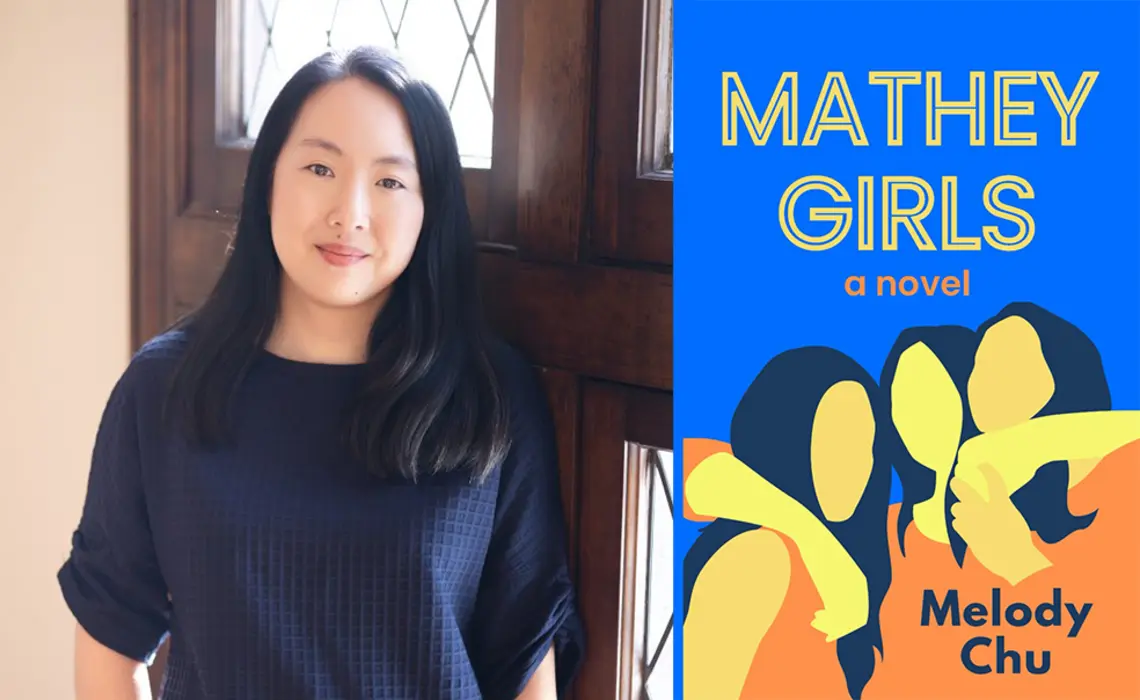
With ‘Mathey Girls,’ Melody Chu ’01 Reminds Us to Treasure Friendships
‘I purposely went in wanting to thank my friends and look at how valuable old friendships can be as we get older and as we hit things like tragedy’

Published Sept. 22, 2026
When Melody Chu ’01 nearly died giving birth to her third child, it made a few things in her life crystal clear. One was how much she wanted to write. She put pen to paper, and three years later she gave up her day job to write Mathey Girls, a novel exploring that near-fatal moment as well as some themes that may be familiar to Princetonians, like imposter syndrome and college friends who stick by each other — no matter what.
Listen on Apple Podcasts • Spotify • Soundcloud
Transcript:
I’m Liz Daugherty and this is the Princeton Alumni Weekly’s Book Club podcast, where Princeton alumni and friends read a book together.
Today, I have the privilege of speaking with our current book club author, Melody Chu of the Class of 2001. Melody studied economics at Princeton and followed it up with Harvard Law School, but after a near death experience during pregnancy, she left her corporate law job to write.
The book she produced is Mathey Girls, a novel whose plot draws from Melody’s pregnancy scare as well as other parts of her personal life, including her heritage as the daughter of Chinese immigrants from Taiwan and her experiences as a Princeton student and alumna. Other themes may ring familiar to alumni, like the imposter syndrome that haunts the protagonist, Esther, and the friendships forged at Mathey Hall — friends who stick by and support each other and the families they’ve built no matter what.
Melody, thank you so much for joining me today and for being a part of the PAW Book Club.
MC: Thank you so much for having me. It’s such an honor. I’m super excited to talk.
LD: So let’s start with a question from Judy Lee, who’s a Princeton parent. She writes, “I really appreciated the portrayal of different kinds of Chinese families. Can you share more about your upbringing and how you are raising your own family?”
MC: Sure. I mean, I think anyone who has kind of a similar background knows how complicated it can be. The history of Taiwan in terms of its relation to China and as its own right can be very complicated, so when people come over from Taiwan and raise their kids here, there’s a lot of uncertainties of how they’re going to do that, especially with my parents who immigrated from Taiwan in the 1960s. And they were in Ohio and they really didn’t understand how easy it is for kids to assimilate and become Americanized. So for my older siblings, they actually forced them to speak English at home. And so by the time I was born — I’m the youngest — we were just basically an English-speaking family. And even though we knew Chinese people through, say, church, we weren’t really actively involved in a greater Chinese community, I think especially because Cleveland, just where we were living, there weren’t that many Chinese people.
So I grew up not speaking Chinese and not feeling super connected to my Chinese culture, and it was actually when I got to Princeton that I started studying Mandarin. And Princeton’s Mandarin program is really excellent. So I had Perry Link as my professor when I was a freshman, Chinese 101, and I just fell in love with the language and the study of the language. And I went to Princeton in Beijing the summer after my freshman year where I spent two months doing very intense immersive Mandarin study, and that’s when I kind of really fell in love with the language.
So that was such a pivotal experience for me that, before I actually started studying Chinese, I wanted to be a writer. So I went into Princeton thinking, “I’m going to be a writer, I’m going to study literature.” I pivoted hard to my Chinese culture. And so I ended up going to law school. Then I went to Hong Kong where I worked for five years, I was in China for five years. I married a Taiwanese Canadian man, and we had my first daughter when we were in Beijing. And I think that’s, again, when my priorities had to change again.
So even though I was very much enjoying my time in Asia, I felt at that point my Mandarin was fluent, I felt very comfortable there, I didn’t think it was the best place to raise a kid. And so I did the thing that I never thought I would do, which is to move back to Cleveland, Ohio, and establish myself there. And so it has been a cultural kind of very round-the-world journey, and I still feel like I’m learning.
I now have three children. Unfortunately, they don’t speak Chinese because my native tongue is not Mandarin. So because I didn’t grow up with Chinese as our home dialogue, when my kids were little, I tried speaking to them in Chinese and I actually had a really hard time because the Chinese I had learned was college level, being a lawyer, very professional Chinese. And so the language thing was kind of an issue. Like, I couldn’t be a mom in Chinese. So while I send my kids to weekly Chinese school and now my older ones take Chinese in school, it’s not something that we have at home. So that’s probably a very, very complicated answer to that question, but I feel like people who are children of immigrants from Taiwan, probably it sounds very familiar, and I’ve heard that from a lot of readers.
LD: Oh, that’s so interesting. OK, so Judy also asked, she says, “I love the relationships in the group. Do you think students can realistically form these new and enduring bonds these days given the social media introductions kids often have before they meet in person?”
MC: That’s a really great question. I think if I am correct, I believe Princeton still does the randomized, or the University sets the roommates for freshman year, and I think that makes a big difference. And so I would say yes, because I can see how if you self-select your roommates, you might be able to be in more of a bubble from the time you start. But if you are just placed with somebody who the University thinks you might be a good fit for, you really have to start from scratch with somebody and you really have to get to know someone really well that’s not necessarily who you might have chosen for your comfort zone.
And I do think nowadays people are understanding the limitations of social media and understanding the reasons why it’s so addictive and somebody else is making money off of your eyeballs, basically, the time you’re putting in with it, and so people are searching for more authentic connections. And given that my oldest is now in high school and going to go to college soon, I do like to tell myself that yes, it is still possible to form these kinds of relationships.
And I think, personally, and I think this is reflected in Mathey Girls, when you’re in college, especially if you’re going away from home for college, this is the time where you really start to figure out who you are. It’s the first time you’re away from your parents, away from that environment that you’re so comfortable with and everyone is so comfortable with you, you get a chance to really test the limits of who you like and what you like and what you can do and what you can’t do. And so, for me, it’s such a fertile time in terms of creating friendships, and I’m so grateful for the friendships that I created at my time in Princeton because we all were getting to know ourselves and each other at the same time, and we all grew into adulthood together. And I think that’s why, even now, 20, 25 years later, we’re still so close.
LD: I was going to ask, do you have your own group of friends like the Mathey girls? You sort of thank them, I noticed, in the acknowledgements at the end. And did you make those friendships through your roommates and who you were placed with?
MC: Yeah. So I do actually have a WhatsApp chat group called “Mathey.” Not everybody in that chat group was in Mathey College, but a good number of us were and a good number of us, while we weren’t necessarily roommates, we were kind of in the same RA group. And so, yes, that part is absolutely true.
So when I was writing the novel, I wanted it to be about a couple of things. One is I wanted to explore the idea of imposter syndrome, and another is I wanted to write kind of an ode to friendship because Mathey Girls is actually the second novel that I’ve written. The first one is shelved away, never to be seen. But I purposely went in kind of wanting to thank my friends and look at how valuable old friendships can be as we get older and as we hit things like tragedy.
So yes, the title Mathey Girls came to me very, very early on, which is, I think, kind of unusual for both my first book and the book I’m working on now. I have a really hard time with titles. But for this one, when I started writing it, once I decided it was going to be Princeton, that I was going to use a real university, Mathey Girls was just it. So now I think we call ourselves, jokingly, Mathey Girls, but before it was just “Mathey,” like the “Mathey” WhatsApp chat.
LD: So you have to tell the story, because I have to hear it, we have to hear it, we have to know, of what happened with your pregnancy. And you said it prompted you to write this book. So what happened and why did it turn you towards writing?
MC: OK. You have to think about the long view, because when I got to college, I was already very comfortable with writing short stories and poetry, and it was very much a part of my identity. And then, again, I kind of pivoted to the Asia stuff. And once that pivot happened, all the way until 2018, writing really wasn’t a part of my life. I was an avid reader and I loved books, but I never really felt like I had the bandwidth, especially with three kids, to actually write and be a lawyer.
So what happened was, so my third child, my son Ben, basically I was totally fine all the way through the pregnancy, actually, it was when I was in the hospital being induced that I had what’s called an amniotic fluid embolism. And it’s a pretty rare condition. I think it’s like 1 in 10,000 mothers giving birth, it hits, but it’s mostly fatal. So the majority of the time the mother dies. And oftentimes the only way they can confirm that it was an embolism is because after the mother dies, they go into the blood and do tests and stuff like that. So it’s a very scary, scary thing.
Unfortunately, there’s nothing at this point we know that we can do to prevent it, and then once it happens, your body as a mother stops clotting blood. So if you can imagine when you are giving birth, there’s always going to be a certain amount of blood loss, but mother’s bodies have evolved or are programmed to kind of stop it, to shut it down. When you have an amniotic embolism, for reasons unknown that doctors don’t really understand, you don’t. So basically on the operating table, I basically just kept bleeding and bleeding, and apologies for people who don’t really want to hear this much information, but I had 44 units of blood product transfused on the operating table, which if you know anything about blood product, I think a normal person might have 12 units of blood in them. So I had basically four people’s worth of blood that I just kept bleeding out and they kept transfusing me, so I was very, very fortunate to survive.
And it was one of those things where I woke up in the ICU and as I was recovering in the hospital, so many doctors were a little bit traumatized themselves because it was so close and they kept telling me, “You’re so lucky. You’re so lucky that you survived. Anything could have gone wrong.” They couldn’t believe that I made it through. And so in that time in the hospital, I was trying to process the fact that I almost died. At that point, my son Ben was in the NICU because the birth also was bad for him. And I had gone into it thinking, “This is my third child. What can go wrong? This is going to be great.” Even right before everything started going wrong, my husband and I were joking about how this was going to be so easy and what am I going to do with maternity leave? And so I really, really, really had no awareness that this was a possibility. And so I was basically very much in shock and I found that there was a very primitive kind of instinctual desire to write again.
So as I was in the hospital, as I was trying to get my mind around what had happened while physically my body was kind of destroyed, I felt like the only possible way that I could channel whatever I was feeling out would be through writing. And so that was kind of my eureka moment where I realized that there was something missing and there was something I needed, but I had a tool that I could go back to.
And it took a while for me to recover, it took a while for Ben to get OK, and he’s totally fine now, and it wasn’t until actually three years later when I quit my job and really was like, “I’m going to try to write novels and see how that happens.” And it wasn’t until maybe two years after that, after I had written my first novel, that I think I felt comfortable enough to actually use the amniotic embolism as something in fiction. So I think it took quite a lot for me, both as a human being going through that trauma, but also as a writer to get enough distance where I could really tackle that.
LD: This is exactly what happened with Claire. So you had Claire have the same thing with the embolism, only she dies and it’s her friends whose story you’re following. Was it cathartic to write it when you finally got to the point where you could write it down, or was it laborious? What did it feel like?
MC: It’s interesting. When I wrote it, I had already written my own personal pieces in bits and chunks, but just not in a novel form. And it’s actually a conversation that I had with one of my Princeton friends, my Mathey friends, where she said, “I don’t know what the group would’ve done if you had died because it would’ve just been so shocking and so devastating to the group. And would the group implode? How could the group go on?” And I think that really kind of stuck to me.
And so 3 years later, I guess I had gotten enough distance. I wouldn’t say it was cathartic for me to write about it because I think I actually already needed to be a little bit over it. I needed to be a little bit farther from it before I could treat it like something that is something I can edit and something I can share with other people and make it the premise of a book.
But yes, basically what happened in Mathey Girls is that Claire passes away from an amniotic embolism, and a lot of the details in the book about that experience are true. So my son Ben was in a cooling blanket for 3 days where he was basically put into hibernation after his birth. My husband was a resident at the time at University Hospitals. He tried to run in when I coded and they had to push him out of the OR saying, “No, you can’t be in here.” I mean, there was a lot, but I think I definitely needed to have a couple of years in between for me to actually write about it in an objective kind of way.
LD: Wow. When you did leave your job after, 3 years later to write, how did the people in your world react to that? Did you get, “Oh, you can’t do that. You can’t leave this career. You’re successful, you work so hard”? Or was it more like, “You brave soul, I wish I could do that”?
MC: I have to say, I feel like I got a lot more positive feedback and support, maybe because the people who know me know that I wasn’t really ever super into being a lawyer. I was working part time before that, but it was very, very stressful part time, and I think while I was good at my job, it was also kind of destroying me in a way. And so I think people knew that this wasn’t my end goal, was to always be a lawyer.
I actually didn’t know myself if I was going to be able to write a novel because just because when you’re in high school, you really like short stories and poetry does not mean that 20 years later you’re going to be able to actually produce a novel. So I treated it more as, “We’re going to see if this can happen because this is what I would like to do.” My husband had been in medical school and residency and fellowship for a long time, but he was finally an attending, so he had his kind of set job, so financially I could take a step back, and I’m really grateful that he was supportive of me doing this experiment.
When we originally talked about me trying to write full time, he said, “What do you need? How long do you think this experiment will last?” And I said, “Well, you can give me 3 years. In 3 years, I’m going to try to write three books and then we’ll see what happens.” And the timeline definitely did not go that fast, but 5 years later, I do have one book, Mathey Girls, that’s been published, and it’s been well received, so I’m very proud of how far I’ve come.
And I think a lot of my friends who are moms actually really do appreciate the fact that I did it and I was able to get it done. And hopefully it inspires some people also who might be feeling a little bit stuck. Because it is scary, especially when you have this kind of very pedigreed education and the expectations are that you’re going to live up to your pedigreed education. And so, at some point, if you want to step away, it becomes kind of a shock to certain people. But I think the people who knew me well knew that I wasn’t really ever on the very normal path because I did the whole go to Asia thing and then, yeah, so I was supported.
LD: I was wondering where the imposter syndrome came from, because it’s a big part of the book. You don’t always realize it until you’re getting towards the end. You go, “Oh, wait a minute. I see what was happening with Esther.” You mentioned it earlier, was that where you felt imposter syndrome, when you were stepping away and it was like, “OK, can I do this? Can I be a writer?” Or was it something that you experienced earlier, back at Princeton? Where’d that come from?
MC: Yeah. I think I used to always say that I don’t actually relate to Esther at all because professionally, I never viewed myself with that kind of imposter syndrome. I had a very weird kind of career path, and so I never felt like I was living up to a standard route and expectations.
But I think when I was thinking about friendship and how women’s lives change over time, I have a number of friends who I think really do struggle with imposter syndrome and do struggle with the fact that they’re expected to be a certain thing and achieve a certain thing, and maybe they’re disappointed in themselves that they haven’t. And that, to me, is heartbreaking because career isn’t everything, for sure, and you can be an amazing person with a lot of value to society without becoming a consultant at McKinsey and making a lot of money by the time you’re 40.
So I think, for me, it was more like I was trying to get into that mindset because I was interested in it and curious about it, and I wanted to explore what it would be like and how we could try to bring someone through it to confront it and go through it. And then I think, yes, I do have imposter syndrome as a writer for sure. I don’t know that there’s any writer who doesn’t have any imposter syndrome, but I think for a self-published author, it is especially prominent because we don’t have any, or very, very few, external markers of success. So I don’t have an agent, I don’t have a publishing house. I’m kind of doing it all on my own and pushing it out on my own, so I have to have a lot of faith in the book and in myself as an author in order to take it forward.
But definitely at times you wonder, “Am I really doing this? Are people actually reading this?” Which is actually one reason I’m so grateful that the PAW Book Club has looked at Mathey Girls, because this wasn’t something that I even thought was potentially possible because it’s a self-published book. So I’m so, so happy that people are finding it.
LD: I’m really glad to hear that. I wanted to ask you about the self-publishing as well because that was something else that we were talking about. Why did you decide to self-publish and how did it go? I was wondering if you had to do a lot of self-promotion, if you had to go on BookTok and do all these things.
MC: I really wish that I knew how to do TikTok and BookTok. I have not touched that app. So maybe if I did, I would be super bestseller, but probably not. I originally wanted to get an agent and go the traditional publishing route for Mathey Girls. And I tried. I’m not sure how familiar the listeners to this podcast are with that process, but basically an agent is like a gatekeeper to any kind of big publisher if you want to have your books in bookstores. And so I tried to get an agent. It’s very difficult because you have to find somebody who just absolutely falls in love with your story and thinks they can sell it and wants to put in the work to sell it because an agent doesn’t get paid until you get a book deal. So an agent generally would not take on a book unless they really thought that it could be successful.
So I spent about a year querying agents, and the response that I got from them, from a lot of agents, was that the book was well-written, but either it was too quiet or they didn’t think they could sell it. And I think at some point I realized that I could keep doing this for a very long time, some people would spend years and years querying the same book and then eventually maybe get an agent, but I really just felt like the book was where I wanted it to be and I wanted it to be out in the world. The last thing I wanted was to get an agent and then have a publishing company not buy it and then you just put the book away forever, and I didn’t want that to happen.
So originally I did not want to do self-publishing because I didn’t think that I would want to promote or have any of the skills to actually get it done. But I think once I decided I was going to self-publish, in a very Princeton way, then I taught myself all the things I needed to do. So I ended up designing the cover by myself and formatting the book by myself and publishing it by myself and yes, promoting it by myself.
And I have a publicist friend named Mara. She was in a writing group with me and she was just a friend and writing partner, but she loved the book and she has a background in PR, so we have now become this duo. She helps me think how I should promote it because I am not naturally a promoter, and I think a lot of writers are not naturally self-promoters. So she definitely pushes me to go harder and think outside the box. I honestly published Mathey Girlsthinking, “I’m going to produce this thing that I’m proud of and nobody will read it, and then I’ll write the next novel and at least I have a thing I’m proud of.” And that was kind of my only goal. Since then, I have done a lot of work to promote it, but I think, I know it’s because I believe in the book. And reader feedback from the book tells me that they do appreciate it and it is worth it, and I want it to get to as many hands as possible.
LD: So Susan Salberg, who’s the parent of an alum, said, “Your book emphasizes how one single gesture of kindness and caring can change a person’s life. Have you experienced this in your own life?”
MC: I think that that is absolutely true, that one gesture of kindness and caring can make a huge difference. And I think I am lucky enough where I would say that I have been blessed with a lot of different people being kind to me or people supporting me as I’ve gone through my journey. And so it’s really hard to pinpoint it to one that I would say changed my life in one way or the other.
But I do appreciate that Susan found that meaningful in the book because I don’t think that I necessarily went in with the goal of, “I want a reader to really appreciate how kindness matters,” but it totally does. And I think one thing that’s really great about being an author, being a writer, being an artist is you start to open yourself up to nice things happening. Do you know what I mean?
It’s kind of like when I was a very stressed out lawyer mom in my own little bubble of anxiety and trying to make things work and just survive, I don’t think I really let myself be open to, necessarily, the kindness of strangers or the goodwill of strangers. But I think since Mathey Girls has come out, I’ve really met a lot of amazing people, had a lot of amazing opportunities just because, mentally and emotionally, I was putting myself out there. And so I do think that is something that’s probably very important for people who are used to having a lot of control or wanting a lot of control in their lives. There’s actually quite a lot of good energy in the universe and people who are willing to engage with you, especially when it comes to art, and so I would say definitely be open to that.
LD: Oh, I love that. All right. So Nina Arcott, she’s a double alum. She’s an undergraduate Class of ’20 and a graduate Class of *22. She writes, “Thank you for writing this book. Can you chat a bit about how you wrote the sibling relationships in the book? I found that siblings can be a great source of connection since they understand your challenges with immigrant parents and relatives.”
MC: Absolutely. So I think when I first thought of the book, I did not think of the sibling part playing a key part at all, and I really just wanted to look at the friendship aspect and I wanted to look at the imposter syndrome aspect, which doesn’t necessarily need any siblings for the story to work or exist. And then as I was writing it, I think I started to bring a lot more of my own personal experience into it without really trying to.
So something I don’t talk a lot about publicly, but it’s definitely out there, is that I actually had a brother who passed away when I was 11 and he was 20. And so I did not go into Mathey Girls meaning to write about that, actually, but I started to write about it, I think, because I was processing the idea of a child who lost their mother, and then it made me realize that there was actually kind of stuff I needed to unpack myself about me losing my brother. And so I ended up having that kind of parallel loss in Esther’s life.
And the stuff about her brother in the novel, the source of her imposter syndrome is kind of when her brother went to Princeton and she basically used his death as a means to get into Princeton, this is kind of revealed somewhere in the middle and she feels very guilty about that. So since then she’s been like, “I can’t live up to what my brother was and I’ve just been kind of pretending it and faking it.” None of that is true. So that is wholly fictitious. But the idea of having this kind of residual grief and trauma from her older brother passing away was definitely something that I was dealing with when I was writing it.
And then I wanted to bring in her little brother in the book, Didi. I don’t have any younger siblings, but I think it made me feel like Esther was a more complete person because I could give a little bit more color into how she related to her family. Yeah, so that’s why. But I have to say, I feel like I didn’t emphasize the sibling thing enough, and so this next book that I’ve written and I’m trying to shop around actually is about siblings. That’s the big theme because I do think that there’s a lot to explore there.
LD: Oh, very good. I was going to ask you, what is your next book about? What can you tell us?
MC: So my next book has, unfortunately, no references to Princeton, so hopefully people aren’t too disappointed.
LD: Aw, man.
MC: But I think one nice thing which hopefully people who read Mathey Girls will appreciate is that the next book is actually much more funny and lighthearted. I think after writing Mathey Girls and talking about it a lot, it definitely deals with much, much heavier themes. And it’s hard for some people to get into a book like that, especially when the sadness comes at the beginning. And so I, for myself, wanted to write something a little bit easier to read, kind of a little bit more like, “Let’s just enjoy ourselves with this one.”
And so it is about a woman who moves back to Cleveland to be with her parents, but then her parents then move back to Taiwan because they don’t want to be in Cleveland. And so she’s kind of lost. And she has a younger sister who’s a famous musician who specializes in a Swedish instrument called the nyckelharpa, she has a brother who’s also younger, but not as much younger, who’s kind of off the grid doing tech startup work, and she has this plan to basically bring all her family together for Thanksgiving. So hopefully that sounds exciting to people. I’m very excited about it. It’s actually written and I’m in the process of trying to get an agent for it now. So hopefully either soon I will have news of an agent or I will end up self-publishing it and getting it to readers one way or the other.
LD: I was curious whether you’re going to go the self-publishing route again or whether you were going to try for an agent this time.
MC: I think it’s really nice to know that I have the kind of ecosystem for self-publishing. I’m very comfortable with it now, so I definitely know that that is an option. I think there are still a lot of biases against self-published work. And in terms of getting distribution, wider distribution to bookstores and libraries, it is definitely a drawback to be a self-published author. So I think I’m trying to get an agent, but at the same time, I don’t have all of my hopes pinned on getting an agent because I think, ultimately, the important thing is that readers read the book. So it’ll be great if it goes to traditional publishing route and I get a book deal and all that, but that’s not my main goal, actually.
LD: Well, since you self-published once, you know you can do it.
MC: Yes, absolutely.
LD: We had, Allison Sullivan who’s PAW’s publishing director, who’s a PAWS staff member, she was curious: She said she listened to Mathey Girls as an audiobook and was interested in learning more about that process, particularly since it was self-published. What was involved in producing the audiobook and finding the right narrator and recording and releasing it?
MC: Right. Well, thank you for listening to the audiobook. So like everything else I did with Mathey Girls, the audiobook was very much a DIY project. I had mentioned to you before we started recording that I’m not a huge fan of my voice, and so when Mathey Girls came out, a lot of people asked if I would record an audiobook and I always said, “No, I can’t possibly fathom. Nobody wants to hear this.”
At some point, I think I realized that there were a lot of readers who primarily listened to audiobooks. So if I wanted to get Mathey Girls into their ears, it had to happen. And there are a number of different ways you can do this, but often it involves hiring a narrator who is expensive. But for me, I was more worried that I would need to find a narrator who could speak Mandarin and who could do the book justice. And I feel like, as a self-pub author, I didn’t know that I had the resources to find that person and pay that person.
So I was telling this to my cousin, Betty, explaining this dilemma. I was like, “I don’t know where I’m going to find this person or if it’s going to be like $5,000 or whatever.” And Betty said, “Oh, I’ve always wanted to try to narrate an audiobook.” And I said, “You’re joking.” And she said, “No, but I thought you have to take classes or be certified or something.”
What happened was is that Betty had studied voice. She has a lovely voice, actually, it’s for singing and she loves listening to audiobooks, whereas I have only started listening to them. So she’s much, much more familiar with how they work. And so I said, “Do you want to give it a try?” And she very gratefully said yes.
So the narrator is Betty Chu, that is actually my cousin. She recorded it in her closet with free audio software, so apologies if it’s a little bit rough on the edges, but we did work very, very hard. We did a very painstaking DIY process where she would record a chapter, send it to me, I would listen to it, I would give her the notes, she would fix it. And after we did all 30 something chapters, she actually rerecorded the whole first six chapters again because by that time she felt like she was a lot more comfortable with doing it. So yes, I hope that people enjoy the audiobook. It may not sound like the most polished and professional recording, but I think she did a great job.
LD: What do you hope people take away from reading or listening to Mathey Girls?
MC: I think the primary message that I always wanted to focus on was just the value of friendship and I think the idea that friendship doesn’t have to be something where you are seeing that person all the time or that you’re really in their daily lives at all times, but basically that that kind of bond is to not let go of that kind of bond from two decades ago or try to reconnect with that person that you kind of lost contact with two decades ago.
I was really, really touched with how my various friend groups, my Princeton friend group, my law school friend group, how they came together when I almost passed away when I was having Ben. In fact, it was my law school group who basically, one month in, they just showed up on my doorstep. They all decided separately to do a surprise trip. They arranged it with my husband. They didn’t want to freak me out, so they booked a hotel so I wouldn’t have to worry about anything. And they literally... The doorbell rang and my husband sent me a text saying, “I think FedEx is sending a package, so you have to go pick it up.” And so I opened the door and they were there. And I think all of us, it wasn’t just me, all of us in that group really appreciated that time together and reconnecting because we hadn’t really all been together in the same room for many years. And so since then, we now try to meet up very regularly, definitely for Reunions and off reunion trips.
My Mathey friends and I, we have been trying to see each other at least once a year forever, and so we’ve been tight, but it is the same thing where we don’t talk every day. We have a chat group and we input when we have something interesting to say or we have questions, but our lives kind of all run their separate ways. But at the same time, I know that if I need them, that those are the people who really know me so well. They know me better than a lot of people even in my family know me because they know the 20-year-old me and they’ve charted the 20-year-old me all the way to the 40-something-year-old me that I am today.
LD: Well, I think you just inspired me to phone a friend, so thank you.
MC: Yes, absolutely.
LD: Thank you for that.
MC: I hope so.
LD: Oh, that’s wonderful. This goes through all my questions. Is there anything else that you want to mention or anything else you’d like to say before we wrap it up here?
MC: So I can just say thank you so much for everyone who has read the book. I really, really appreciate it. I really feel like nowadays to ask someone to spend hours of their life in one particular thing, it’s so much of an ask because of the way everything, information is given to us. Like, we don’t really pay attention to one particular thing for that long, and if it is, it’s probably a very bingeable Netflix series that is visually stunning. So to take a book and to spend however many hours you spend with it and really devote yourself to it and invest yourself into it is such a gift. And I’m truly, truly grateful for that.
I do have one request, which is that if you read Mathey Girls, please, please, please help spread the word. So that could be rating it online, writing a review, or just telling your friends or requesting it from your library. I think for a self-published author, it is absolutely, absolutely critical to get word of mouth going. And that’s basically the only reason why Mathey Girls has got to where it is, is that people read it and they liked it and they shared it with their friends. And so I definitely appreciate, first, you reading, and then if you share the word, it means a lot.
LD: Well, this has been wonderful, Melody. Thank you so much for taking the time for this.
MC: Thank you, Liz. I really had fun.
PAWcast is a monthly interview podcast produced by the Princeton Alumni Weekly. If you enjoyed this episode, please subscribe. You can find us on Apple Podcasts, Spotify, and SoundCloud. You can read transcripts of every episode on our website, paw.princeton.edu. Music for this podcast is licensed from Universal Production Music.
Paw in print
October 2026
Holding on to Jewish life; Katy Anderson Keating ’08’s career in wine; Hollywood loves Princeton.
1 Response
Carlyn Kenny Casey ’93
8 Hours AgoLooking Forward to Reading ‘Mathey Girls’
Thanks for this interview! I will definitely read the book and share a review.
My interest was piqued because I just self-published a comedic women’s fiction novella, Unemployable, but Ms. Chu’s interview wound up even more interesting to me because I have two close connections who’ve lost someone during childbirth due to amniotic embolisms — in the first case, both mother and child died; in the second, the mom died and child survived. In these modern times, crazy that this occurs.
Additionally, I just this morning listened to a writer’s podcast about imposter syndrome, which I’ve realized since self-publishing is something from which I suffer! As a Princeton first-year, I wrote a paper about “fear of success,” and I do think the two are closely related.
I look forward to seeing how Ms. Chu weaves both of these into her work — congratulations!