
PAWcast: Valedictorian Daniel Yu ’26 Seeks a Life In Pursuit of Justice
‘I think my recognition speaks less to me as somehow exceptional or special and more to the tireless, patient, endlessly generous work of everyone in my department and in my community’

Published May 13, 2026
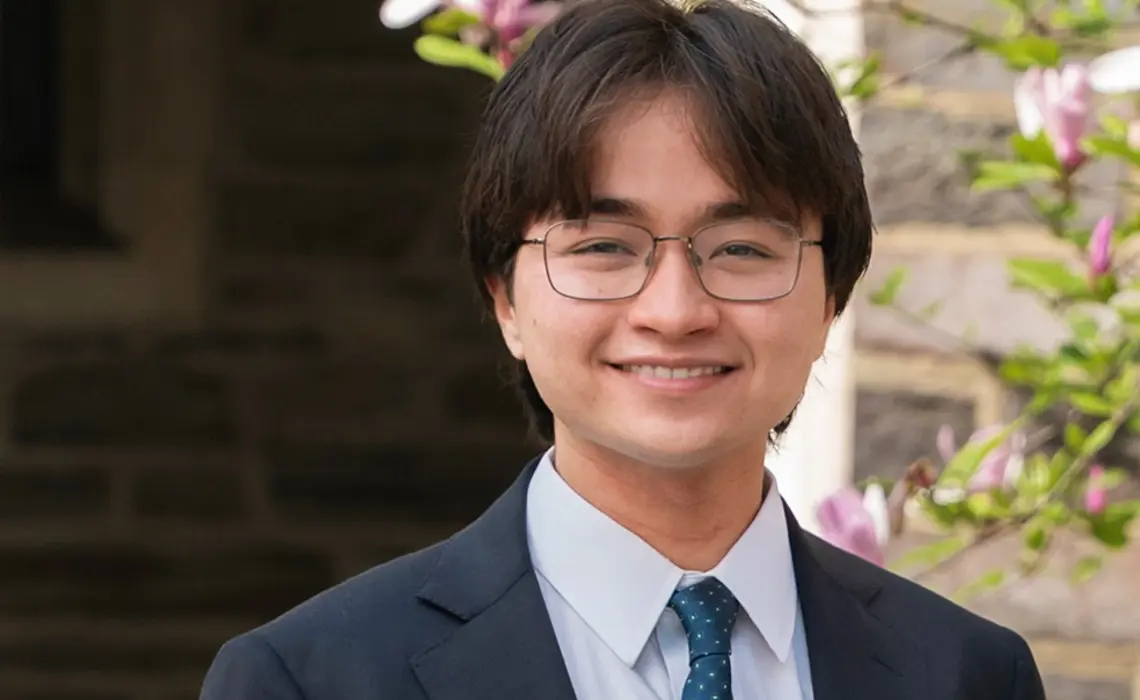
As an African American studies major who researched anti-trans violence for his senior thesis, Daniel Yu ’26 has had a front-row seat to issues of justice in our current political moment. On this episode of the PAWcast, he discusses what it was like writing about a “hyper-contemporary” topic changing in real time and why he’d like to use his valedictory address to challenge his class to ask themselves: “What is the vision for the world that we are trying to enact through our work?”
Listen on Apple Podcasts • Spotify • Soundcloud
TRANSCRIPT
I’m Liz Daugherty, and this is the Princeton Alumni Weekly’s PAWcast, where we talk with Princetonians about what’s happening on campus and beyond.
Today I have the pleasure of speaking with Daniel Yu, valedictorian for Princeton’s Class of 2026. Daniel is an African American Studies major with minors in English and gender and sexuality studies who has big plans: Next year he’ll begin studying in the U.K. as a Marshall Scholar, working toward a master’s degree in race and gender studies at SOAS University of London with the eventual goal of a public-facing career that contributes to global debates on LGBTQ+ justice.
In a University statement, assistant professor Marcus Lee praised Daniel as “an exceptionally talented, diligent and enterprising student” who pays attention to the real-world stakes of academic research. Daniel’s work, Lee said, “will continue to enlarge our understanding of the human condition.”
Daniel, thank you so much for taking the time to come on the PAWcast.
DY: Of course. I’m so excited to be here.
LD: How does it feel to be a valedictorian? They choose it with a faculty vote, right? They just kind of pick you and like bam, there you are. What was that like?
DY: Yeah, my understanding is it’s a faculty vote that I was totally unaware of. So I was completely surprised. The way I found out is I got an email from Dean Gordin that said, “I have some exciting news, come to my office.” He did clarify that it was happy news, which I really appreciate, otherwise it’s not great to be called into the dean’s office. But he told me and I think I literally said like, “Wait, what?” And he was like, “Are you really surprised?” And I was like, “I’m genuinely shocked.” And so it’s kind of been a whirlwind from there.
LD: Cool. So tell me a little bit about your path to Princeton. Where are you from and what got you interested in your areas of study?
DY: So I’m originally from New York City and so not too far from here. I actually took a gap year in between high school and college, which was really formative for me. It was kind of this opportunity after these many years of academics to think about what kind of impact I wanted to have to be doing work in my local community. I was kind of doing a variety of things. I was working a bit. I was doing like a sort of urban studies program for a semester. I was taking some classes and writing some poetry, which is something that I like to do in my free time. And I was also just like exploring the city and getting a better sense for this place that I had called home for so many years, but hadn’t necessarily seen every nook and cranny of. And something that was really meaningful to me is I ended up getting really involved with the protesting against the mega jail that they’re building in Chinatown.
So they’re proposing this like enormous jail to replace Rikers Island, one of several borough-based jails, and this would be the tallest jail in North America. And so being at those protests, like being able to spend time around the organizers, interviewing them, writing about the jail was really formative for me when I came to Princeton of like, “OK, I want to be doing community-focused work and I want to be thinking about these big questions about race and gender and power.” Because I had just spent a whole year immersing myself in these kinds of community debates and community struggles that I don’t necessarily think I got a full taste of while I was in high school or when I was growing up in the city.
LD: Oh, that’s really interesting. Just out of curiosity, because I feel like people may be curious about this. Did you get into Princeton before or after the gap year?
DY: Before the gap year.
LD: Oh, and they let you defer while you worked on—
DY: Yeah.
LD: Oh, that’s really cool.
DY: Very generously. I originally wanted to do the Bridge Year Program. I knew I wanted to take a gap year. I felt like it was like a real privilege that I wanted to take advantage to be able to sort of take time and think about like, “OK, why am I going to this college? How do I use my time for good?” And I felt very lucky to be able to defer. I was also very sad because they did end up canceling the Bridge Year Program my year and so this was all kind of cobbled together at the last minute, but I ended up being really grateful for it. I think it also taught me how to — I was living at home because I was in New York, but I was also like figuring out how to set my own schedule, live by myself in a way that, or take care of myself in a way that most of the time in high school, most folks don’t have to really think about until they get to college. So it was a nice sort of transition area for me.
LD: Nice. So I wanted to ask about your thesis. I’ve got the title here. It’s Purity Politics: Race, Racism and (Anti-) Blackness in an era of Anti-Trans Violence. Can you tell me about it and what you found?
DY: Yeah, absolutely. So my thesis is super timely. The word I use in the thesis is “hyper contemporary” because people always ask me like, “What time period are you thinking about?” And I’m like, “right now.” Even over the course of writing this, starting in September or late August, just the amount of sort of anti-trans, anti-LGBTQ+ material that is coming out is enormous. Right? We have new laws, new sort of forms of political discourse. There are all these growing threats to queer and trans people in the United States. And so part of what my thesis was looking at is, OK, we have this crisis of political violence, legislative violence against trans communities in the U.S. Where is this coming from and how do we situate this within these broader traditions of social movements and social injustice?
Traditionally the answer that we give is to say, “OK, we had these sort of gains of in marriage equality, maybe in gender equality in general. We had this sort of mainstream recognition of transgender identity.” But then the question that I’m taking up is, is there something else on the other side of that? So obviously we can think of this movement as a backlash to those gains, but my research suggests that if we really take a look at some of the legislative and political language that these movements are using, they’re also talking about race. They’re talking about fears of white fragility, the great replacement fear, the idea that this particular white social order is losing control of the nation and the social, and spaces that we are in every single day.
I think that part of what my thesis was, which ended up being this kind of wide-ranging exploration of both these culture artifacts — I was writing in one chapter about like anti-trans parenting books — and also these sort of more formal political discourses. So I was writing about the designation of the transgender terrorist, which is very popular now that the FBI has started to take up and thinking about those things in sort of complementary relationship of like, “What are we saying in both politics and culture and how does that tell us something about race or about racism or racial identity in America?”
LD: How did you go about researching that? Did you have to spend a lot of time on the dark web? Where were you doing your research?
DY: Yeah. I mean, I think part of the sort of difficult part is you don’t have to be super into the dark web. You don’t have to get into the dark corners of the internet or of these movements anymore. A lot of them are very mainstream, which is something that actually did surprise me in my work. For instance, if we’re talking about the “transgender terrorists,” this is sort of like a conspiracy theory that starts to emerge of transgender people are more likely to commit acts of terror or political violence.
And that like starts in the mid 2021, 2022 we sort of see inklings of that and then all of a sudden in 2025, 2026, we have major officials in the federal government who are saying like, “No, this is real and we need to act on this threat.” And so I guess part of my work was about tracing those lineages and saying like, “Look, I say hyper-contemporary for a reason. I really mean in the last five or six years, the quality of these discourses have really changed and they’ve proliferated and been legitimized in ways that we could never have conceived of a couple years ago.”
LD: And just to be clear, when we’re talking about that kind of violence, does this have any basis in reality or this is just a fear that people have?
DY: Absolutely not. I mean, it’s almost comical the extent to which the sort of statistics are inflated. I think people commonly cite 50% of school shootings are committed by transgender people, which is nowhere near the case. In fact, I believe trans people are far more likely to be victims of these sort of violent killings than vice versa. But I mean, something that we’re seeing is that they’re sort of lumping people who maybe have no affiliation with transgender identity under this category in order to skew the numbers a little bit. And so that’s also part of my exploration, is the actual official FBI designation that they’ve taken up or are in the process of taking up is transgender-ideology-inspired terrorism or violent extremism. And so the claim there is it’s not even necessarily about you identifying as transgender or you being gay or queer or whatever. It really is if we can draw a line from you to any non-normative person in your life, we’re going to blame that influence.
LD: Oh goodness. That’s really interesting. We were wondering, speaking of hyper-contemporary, you’re researching all of this at a pretty interesting moment for the whole country. We were wondering how, in these fields, you might be looking at the federal cuts that the Trump administration has made to research funding. What do you think about all that that’s been going on over the past couple of years and has it impacted your plans for research at all?
DY: Yeah. I mean, I think it’s hard to not see the impacts on the intellectual communities I’m in. Obviously there have been cuts across the board, but I think the places that might feel it most intensely, aside from maybe specific scientific studies that require these time bounded investments, I think is going to be the disciplines that are most precarious in the university already. And I don’t just mean by the university at Princeton. African American studies is a relatively new discipline. Gender and sexuality studies at Princeton, for instance, is not even a major, right? It’s just a minor. AAS was not a department here until 2015 I think. And so naturally I think the kind of threats to budgets fall more heavily if not in baseline numbers if there are these cuts across the board.
But I think in terms of strategic planning, thinking about the future of a department, if you don’t have that sort of institutional capital built up over many, many years. And so I think that’s definitely something that I think about. I think it’s something I think about with my own career path. I think luckily African American studies at Princeton seems like they’ve been able to continue doing really good work. I have not known anyone who has been personally affected at the department level and I really appreciate how careful and cautious they’ve been with budgeting. It’s clear to me that the department is sort of recognizing the scale of the threat and is responding adequately.
But I really think we’re on the verge of losing a generation of critical studies scholarship. It’s pretty clear when we say like, “Oh, there are these losses in climate science,” things that are really, really important that we can articulate that are sort of obvious. But then you think about, well, how much funding can the humanities really need? We’re talking about disciplines where these programs have existed for a handful of years, they’re not recruiting that many people because they’re not enormous like equivalent graduate degrees. And so even just the cutting off of some humanities Ph.D.s at other colleges, the consolidation of various humanity specialties into one department, all of these things just make this increasingly precarious in a job market that was already so difficult.
So I really think as someone who has been lucky enough to have my work sort of recognized in the institutional level and to not, both being at Princeton and being in my department, to not be directly impacted by it, I really think about how much knowledge production will be lost, how much incredible, brilliant, important scholarship will be lost for those generations of students to come. And I think about that on the undergraduate level, I also just think about that on the graduate level at Princeton and elsewhere of these cuts are, in some ways they’re doing exactly what I think the federal government intended, which is to make these sites of scholarship and sites of knowledge production politically toxic. And I really grieve for the folks who will not be able to continue doing their work or who might decide this isn’t for them because there’s already so little in opportunity.
LD: It sounds like you, if everything goes well, you’re planning to take the scholarship you’re working on all the way, right? You’ve got plans for multiple master’s degrees and I think a doctorate eventually?
DY: We’ll see.
LD: You’ve got a lot of years there. So what’s your thinking on how you want to do all this going forward? Is there a change in the field or in the world that you want to see someday?
DY: So I think the first thing you said, yeah, I’ll be in the U.K. the next two years, which is really exciting. I also feel really lucky to be doing, to have this opportunity, to have this opportunity to do scholarships somewhere where there are vastly different politics in the U.K. I don’t think it’s all straightforwardly better or even less politically controversial to be doing the kind of work that I’m doing, but also there aren’t those threats to higher ed on the scale that there are in the U.S. and so I think I’m excited to be in that environment. I think in particular, the first degree I’m doing is based in London at SOAS and so I’m excited to be able to — I’m from New York City — involve myself in the local scene and just explore London. I’m a huge transit nerd so I love to learn about like, “Oh, this is how this system works.” And of experience like, “Oh, how do these systems affect people in their day-to-day?”
And so I’m really excited about that and I think that that is part of also why I’m excited for the opportunity to the second part of your question is to be able to give myself the opportunity to think about what’s in store for the future, for my future, for a lot of people’s futures and to think about what do I really want out of my graduate education. And I think that the two years, maybe something I’m thinking about is, how are my decisions, or how are they not, inflected by the present moment? I think when I declared African American studies, we lived in a very different America. Not to say that there wasn’t a state of crisis, but there wasn’t the state of crisis that we’re experiencing right now.
And I think something I have thought about is I think I thought straightforwardly I would want to pursue a career in scholarship and I think now I’m thinking more about what would it mean to do, for instance, to go to law school, to work as a public defender, work more directly with communities who are impacted, to work in organizing in a sustained way. And so I think, I haven’t made any decisions — that’s what the next two years are for — but I’m excited for the opportunity to think about these different ways to make change and to really think about like, “OK, which one resonates with me? What do I feel like my time is best spent on?”
LD: Can I just point out that’s the first time I’ve ever heard someone say, “I’m so excited to go to London because of the Tube.”
DY: I mean, I think I’ll change my mind in the summer probably. I’ve heard that it gets very hot down there.
LD: I thought it was cute for what it’s worth. I thought the Tube was cute compared to the New York subway, which is lovely in different ways.
DY: I appreciate the encouragement because that is something that I’m thinking about is it’s not as extensive as the New York options, but I’m excited to see how it works differently.
LD: It’s still a city that you can get around, you know what I mean? Which is the great thing about New York too.
So can you give us, you have to give a graduation speech, that’s part of the whole valedictorian deal. Can you tell us anything about what you’re planning to address or what you want to talk about with this opportunity?
DY: Yeah, no, it’s something I’m definitely thinking about. Definitely still in the drafting process, but I mean, I think to touch on what the major themes I want to communicate, I want to take this very rare and special opportunity to both create the space for gratitude — I think it’s really important, gratitude to all of the people who make our work possible and who have made our trajectories possible as the class of 2026 — but also to think about what obligations do we have to other people, to our communities, to our world beyond ourselves or beyond this place.
I think when I think about the kind of questions I want to grapple with in my speech, I think something I’ve learned in my time in African American studies, in my time in gender and sexuality studies, and in my time just in the last five years after graduating high school is, there is no outside of politics, there is no outside of ethics, right? We’re all making these decisions all the time and I think something that as this sort of Ivy League very sort of prestigious degree confers on us is this additional responsibility to think about the impact that we’re going to have on the world.
And I don’t think that means that everyone has to be deeply invested in the work of social change all the time, but something I want to kind of I guess challenge my class to think about and challenge myself to think about with them is, to what end are we doing this? To what end do we grind problem sets or go to med school, go to law school, do finance, become teachers? What is the vision for the world that we are trying to enact through our work? Because in my mind that’s really how change happens and I think that’s something that has been very important for me in Black studies.
I just had my senior thesis defense and the first question that my adviser asked was like, “OK, you gave us this sort of theory of politics. Tell me what that looks like in people’s everyday actions. What does that look like in the sort of ordinary politics of just ordinary people’s lives?” And I think something that I really want to share and I want to ask people to think about is how we make these sorts of decisions, these ethics-based values decisions even when we think we’re opting out of them. Because there is, especially if you have a Princeton degree, if you have the pedigree of the institution behind you, really no outside of those questions, there’s no way to avoid them. And I think now it’s sort of more clear than ever at a moment where these sort of ostensibly apolitical disciplines are being threatened at a moment where the global financial precarity that we’ve maybe seen for a long time elsewhere is starting to lap at our shores, we really have to think about why we do the work we do and not just what work we’re doing.
LD: Is there any advice you would give to incoming freshmen who are about to start at Princeton or just at the very beginning of the journey that you are just about to conclude?
DY: I always find that funny because I’m like, “Oh my gosh, I still need advice myself.” I think what I would say is to hold fast to the things that got you here and I don’t just mean the sort of intellectual commitment or interests or dedication or drive, but also just the people and the communities that have made your first maybe 18 years, maybe more, special. And I think something that has been really important for me is to think back to both my family and my community, but also to those experiences I was talking about in the beginning of our conversation. Thinking about the folks who I was in community with at those protests or thinking about these incredible high school teachers and mentors I had, thinking about these people in my family who have given so much for me to be here and really using that as a compass to guide me.
I think something Princeton is really good at is throwing a lot at you. There’s always something to be doing and it’s, how do you cut through that noise? And I think that’s a skill I’m still learning. I don’t know that I’ll learn it before I leave here, but I think one way to think about that is where do those commitments lead me? Where do those experiences lead me? And also just to take this opportunity for all it’s worth and whatever that looks like for you. For me, one of those things was like doing a major that I don’t know I could have done that anywhere else. I think part of it was the reason why I could get a Black studies degree is because like I was here and so I had the backing of the institution all these other ways. Maybe that doesn’t look like that for everyone or even most people, maybe it looks like something else, but with those commitments in hand, with those community members and those values in hand, what do you do with that? And I think whatever that risk looks like, like I would encourage a freshman to take it.
LD: This has been so lovely. Is there anything else you want to add or talk about?
DY: I think if there’s just one thing I could add, I think my selection as a valedictorian, I feel very honored and very humbled by it. It’s also been I think very difficult. There’s been a decent amount of public backlash, even just like on the internet from folks who have a lot of things to say about Black studies or me and Black studies and those sorts of things. And I guess if there’s one thing I would hope for would be that this is a beginning and not an ending for the institutional recognition of work in my department.
I think my recognition speaks less to me as somehow exceptional or special and more to the just tireless, patient, endlessly generous work of everyone in my department and in my community. And so when I think about why I’m here having this conversation, why I’ll be up there on graduation, I think about those people who continue to give up so much of their time and resources and energy for me and for my peers every single day. And I feel very lucky to be in community with those people, both faculty, staff, and also just the other majors who are endlessly brilliant and kind and thoughtful.
LD: Well, this has been so nice. Thank you for taking the time. I always love it when doing this podcast lets me sit with a deep thinker and I feel like that’s exactly what this has been. So thank you so much for your time. I really appreciate it and good luck.
DY: Thank you for having me and thank you for the encouragement about the Tube because now I just need a positive voice in terms of my transit options when I get there.
LD: You’re going to love it. You’re going to love it.
PAWcast is a monthly interview podcast produced by the Princeton Alumni Weekly. If you enjoyed this episode, please subscribe. You can find us on Apple Podcasts, Spotify, and SoundCloud. You can read transcripts of every episode on our website, paw.princeton.edu. Music for this podcast is licensed from Universal Production Music.
Paw in print
October 2026
Holding on to Jewish life; Katy Anderson Keating ’08’s career in wine; Hollywood loves Princeton.
No responses yet