

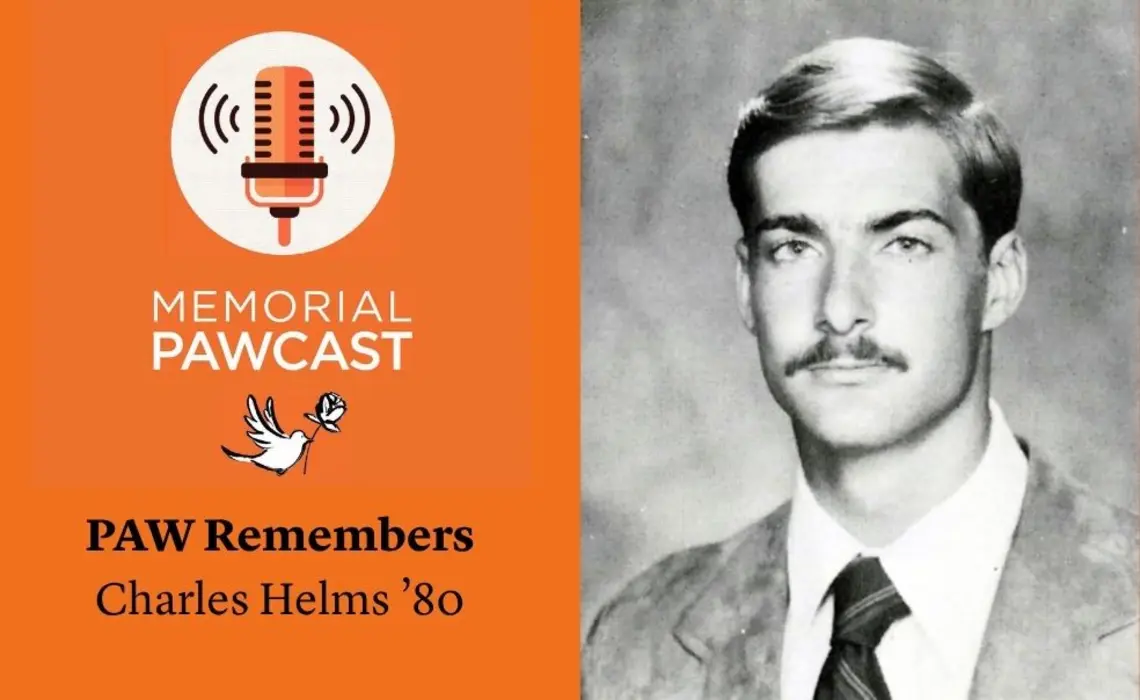
Remembering Charles Helms ’80
‘Chuck is the kind of person you are lucky enough to meet once in your life,’ says Doug Eberhart ’80

Published April 1, 2026
Welcome to the PAW Memorials podcast, where we celebrate the lives of alumni. For this episode, PAW Memorials editor Nicholas DeVito sat down with Doug Eberhart ’80 to discuss Charles Helms ’80. Chuck was a lawyer, teacher, and had a deep faith in his family and Catholicism.
Listen on Apple Podcasts •Spotify •Soundcloud
Links discussed on podcast:
Crisis Magazine: "The Ghost of Oxford: What Do Cicero, Cucumber Liqueur, and Catholicism Have in Common?" https://crisismagazine.com/vault/the-ghost-of-oxford-what-do-cicero-cucumber-liqueur-and-catholicism-have-in-common
Funeral Mass: https://www.youtube.com/watch?v=2oiblplFArg
TRANSCRIPT
Nicholas DeVito: Hello, I’m Nicholas DeVito, Memorials editor for Princeton Alumni Weekly. Today I’m here with Doug Eberhart from the great Class of 1980, and we’re going to talk about his good friend Charles Helms from the great Class of 1980. Doug, if you can introduce yourself and tell us about the first time you met Chuck.
Doug Eberhart ’80: Thank you, Nicholas. Yes, Doug Eberhart, Class of ’80. Now, there was a Doug Eberhart in the Class of ’85, so just want to ... I’m the original. OK.
ND: That’s right.
DE: Well, I met Chuck almost 50 years ago now, in the fall of 1976. We were randomly assigned to be roommates in Cuyler Hall with a third fellow by the name of John M. Williams. I arrived first and Chuck showed up second, and then John came in.
Our situation was a great room with a little room attached to it. I’ve heard a rumor later that that was intended for the servant to live in, but I don’t know if I can confirm that, but we took our three beds and we stacked them up in the little room. And since I was from Colorado, I was at the highest elevation about a foot away from the ceiling. And I don’t remember who was who in between.
Yeah. So then we had the great room for our desks and couches and that sort of thing. So that was a great freshman year, and we also met all kinds of people and all sorts of different things. Now, Chuck was there to study liberal arts, and I was there to study engineering.
So we had absolutely no classes in common, and we had no activities in common, other than maybe we could eat at the dining hall. He was a great guy. You could tell from the moment he walked in, so polite, very, very intelligent, very athletic. We’ll talk about his fencing, which was really a great attribute that he had there.
That was our first year. In our second year, we swapped out and had another roommate whose name was John Packman. Now, John was a liberal arts guy, and he shared with me the following story, which I only found out about recently. I’d like to quote John. He said, “When you go off to a school like Princeton, you know you’re going to meet some people who are extraordinary in terms of intellect and fitness, larger than life people who give the Ivy League its reputation. A few months into our semester, I realized that Chuck was that guy."
So he had met Chuck as a freshman somewhere in class, a blistering intellect, fantastically fit, and extremely accomplished in both academics and athletics. Even at that early time, he was unmistakably the real deal and he proved that repeatedly throughout his life. So absolutely solid, solid, solid guy. I don’t know what they do to select roommates if there was a questionnaire back then or it’s all random, but I lucked out.
At his funeral last year, his son Nathan said that his father was the type of man you’d be lucky to meet once in your life. And that’s who I got for my freshman roommate.
ND: That’s amazing. Go ahead.
DE: You go. That was it.
ND: Yeah. From Chuck’s memorial and you shared with me some writings, it just seemed that everyone kind of felt that way about him, that he just was someone smart, athletic, kind, and just an outstanding human. And this is one of the reasons I wanted to meet with you to discuss him today. You mentioned fencing. So he came in, did he start fencing freshman year?
DE: He did. And I guess there’s a little background there. He attended a place called St. Mark’s School of Texas, which was a non-sectarian private boys school in Dallas. And there’s a big story there because his fencing coach at that school was a man named Daniel Navot who was a bonafide big time war hero for the French in World War II.
He won seven medals. He got the highest award you could get there for Valor. So this fencing coach was a huge, huge influence in Chuck’s life and also obviously extremely talented, and absolutely a top fencing coach. So Chuck came to Princeton with this training and he was immediately going for the fencing team and he was very successful. You start out, I guess, as JV or you’re on the squad and you learn and you train and you watch the other fellows do their thing. But wasn’t very long at all before he was on the team competing as one of their lead guys.
I wanted to say that in fencing, there are three different types of weapons. One’s called, what a sabre and I know there’s something else, foil?
ND: The foil and the epee.
DE: Epee. So Chuck was an epeeist. This requires strength, endurance, cunning, lightning fast reflexes. I may have told you the story ahead here. He would have me stand in the room sometimes with this metal mask over my head and hold out an epee, and he would come at me slashing, slash, slash, slash. I don’t know what good he got out of that, but it was very memorable for me.
ND: That’s great.
DE: So when he wasn’t in the room, he was out to the fencing team, I would say most of the time.
ND: OK.
DE: Oh, and so that was all just background really. He would go to meets all the time. I know he told me that he had his sights aimed very high and there’s no reason why not to. Hoping for All American or Olympics or this is how high he was aiming. He was All Ivy and All East and I guess All American by his junior year.
His coach was Stan Saja and Chuck personally had a record of 3113 in the Ivy League. The great focus was his fencing team and the people there were like family to him, I think including the coach. And he would often mention a couple of people. I remember Luke Zorick was a name and Dave Nocenti. I might recognize other names if somebody read them to me, but this was a huge focus for him there. And again, he came from a fantastic background and there’s still more to talk about with this French war hero later on.
ND: Yeah. Isn’t he... He wrote a book, correct?
DE: No. The man lived to the age of 99, but one of Chuck’s classmates from St. Mark’s School, a year head of Chuck, I believe. His name is Robert Zorn. And later in life, Chuck and Robert Zorn got together for a reunion with a coach in 2016, and they decided they should work on a book about the man.
ND: Right.
DE: So that should be coming out in the year 2028. Mr. Zorn sent me a draft of his book, and I’ve been reviewing it this week.
ND: Oh, nice.
DE: He keeps teasing a big reveal later on. And I’m sorry, I haven’t finished the book to tell you. Well, I wouldn’t tell you anyway.
ND: No, we got to wait until the book comes out.
DE: If you’ve ever seen the movie The Princess Bride.
ND: Yes.
DE: You know that one? OK. So it’s Peter Falk, I think the grandfather, and he’s telling the story to a grandson, and then they go to the story. Well, that seems to be the format of this book.
ND: OK.
DE: It’s Robert Zorn under another name talking to his grandson and telling him the story of Daniel Novell, the French war hero.
ND: Right. Oh, that sounds great.
DE: Yeah, I’m blessed I got to meet Mr. Zorn at the funeral last year. And I mean, Chuck had told me about the book and I kept... Every last couple of years, I said, “How’s the book? How’s the book?” And so it will come out and now I can actually see it myself, but I won’t spoil it for you.
ND: All right. And speaking of Chuck, Chuck did a lot of writing. You mentioned the article about Oxford. Do you want to talk a little-
DE: Oh my goodness, I sure do. After Princeton, Chuck got married in 1983 in Dallas, and I was at his wedding with a bunch of other Princeton alums, including some of those fencers. But then a year later in ’84, he went to Oxford. What I found out about Oxford is that it’s a group of 40 different, so called colleges. OK? So it’s not enough to say you went to Oxford. Which college did you go to?
Let’s see. I know which one it is because I wrote it down somewhere here, but... OK. His son went to Oriel. He went to Worcester College, Worcester College. And the history on that is it started as a Benedictine Monastery in 1217 or something. And later it became a college on its own, 1714, about 30 years before Princeton opened up. But anyway, he was there in 1984 for his PhD for several years.
And I found some writings of Chuck in an online journal or blog or something called Crisis, which when they started, it was called Catholicism in Crisis, but they shortened it to Crisis. And the subtitle on that, it’s a Journal of Lay Catholic Opinion. So Chuck had at least four articles I found in Crisis online. And his memoirs of Oxford are just must read. Absolutely fantastic. 1989 article, it’s called "The Ghost of Oxford: What Do Cicero, Cucumber, Liqueur, and Catholicism" have in common.
I think you can tell that Chuck was a witty guy, as well as being absolutely brilliant. And in seven pages, he describes his time at Oxford and how amazing it was. And he just is so erudite and all this ... You have to read this article. So it’s on Crisis 1989, The Ghost of Oxford. So I’ll send you a link for that.
ND: And we’ll link it on the transcript here. Speaking of, Chuck, Chuck had deep faith in Catholicism. Did he come to Princeton with that? Did he find that at Princeton or that started from younger?
DE: I would say he absolutely brought it with him to Princeton. He, again, such a reverent and a solid guy. So when we were rooming with John Packman in sophomore year, John and I and a friend named Jennifer, we would go to the radio station and we would do a kiddie story hour, the children’s hour. Chuck, of course, was at Mass where any sensible person would be. So I felt a little guilty about doing the radio... I mean, why was it scheduled right then on Sunday morning, but that’s when it was, and that’s what I did.
Chuck did invite me to an Easter vigil one time. That’s a late night and a rather long service. And that was the first Catholic service that I ever attended. It was very kind of him to invite me. It wasn’t something I had on my radar, but a couple of years later I did Mary a Catholic woman and a dozen years after that I converted to Catholicism. This has always been central, central to his life.
Everything he did was going to be for his faith and true to his God and his faith. So his son eulogizing him called him the model of a Christian Knight. He was a gentleman. He was strong. He was strong for his faith.
He was in something called the Thomas Moore Society in Dallas, which is from the diocese of Dallas. And from that position, some people there who ... Chuck became an attorney, by the way. He went to law school and became an attorney. So that society was for attorneys, and it was to help them focus their ethics and their practice to be in conformance with Catholic principles and so forth. From that, in 2014, I think somebody else decided there were organizations like this around the country, maybe 60 of them, and somebody there in Dallas said, “Hey, we should get together and create a national umbrella,” which they did, called the Catholic Bar Association. And just a couple of years before Chuck’s death, he was actually elected to be the president of the Catholic Bar Association, which is a national organization. So this shows you how involved he was and how respected he was and how capable and competent and intelligent he was to be elected to that spot.
He didn’t get to serve, however, because then he had a cancer diagnosis, so he had to back away from that.
ND: Right. Yeah, no, you see that throughout his life, is that it was to serve, with Catholicism as a lawyer, his family, his friends, that was a big part of it.
DE: Well, I have in my notes here, a couple of other Princetonians who went to that Worcester College at Oxford, include Bill Bradley, who was a basketball star, he became a US Senator and ran for president and Al Gore beat him out for the nomination. Two others who went to that same college were Elena Kagan, who’s on the Supreme Court now, and also a gal named Ellie Kemper, who’s a gal on The Office, which is a very popular TV show in its day. So that’s the kind of people... There’s some special people that went to the Worcester College, and Chuck.
ND: Yeah. And you mentioned Chuck’s son. Can you talk a little bit about Chuck’s family?
DE: Thank you. Yes, indeed. He married Rachel Andry in 1983, was kind enough to have me there as a groomsman. Rachel came from a family of architects, prominent architects in the Dallas area, and Chuck showed me some of the buildings that they did. She was involved in more smaller scale, not university big buildings and stuff like that. So they had five children who were all brought up attending Catholic schools and so forth. The oldest son was Nathan.
He also later on went to Oxford and also got a Ph.D. there. I mentioned it was the Oriel College, so not Worcester. He is brilliant, like his father. He gave the eulogy at the Mass in November. And by the way, I just found that online on YouTube. If you Google Charles Helms Funeral Mass, you can see an absolutely brilliant eulogy by his son, Nathan. If you do that, skip 15 minutes of people being seated and then it’s before the official religious service.
All his sons and his daughter, they’re just wonderful people. They came to visit us in Colorado. Chuck kept me up to date on everybody. Two sons are in construction management. The daughter met a husband in Australia. Chuck and Rachel went to Australia a couple years ago to visit them and see grandchildren and so forth. So it’s just an absolutely fantastic family that he raised. And it was great to see them all again in November and they were so kind remembering me there.
ND: Yeah. And there was a story you had sent me, if you’d like to tell it here about there was a football bet and the loser had to grow a mustache.
DE: OK. I guess I have two stories from Princeton that would be fun. Indeed, January ’78 was the Super Bowl. I was from Colorado, so I was a Denver Orange Crush Broncos fan, and he was a tried and true Dallas Cowboys fan. So we did make a bet. And the wager was that if Denver lost, I would have to grow a mustache. And I don’t know how I negotiated this, but if Dallas lost, he would have to grow a mustache and a beard.
Now, the game was not really close, I guess, not as close as the 27 to 10 Dallas victory. So actually, for five weeks, tried to grow a mustache. It was pretty pathetic. It got onto my university dining ID card. That’s the only photo that I know of it. And then he let me off the hook. Chuck did, for some reason, out of solidarity, grow the mustache and the beard anyway, although he didn’t have to.
He looked really, really good in it. So, we have some photos of him looking really sharp that way.
ND: Well, his Nassau Herald photo, he has a mustache in it.
DE: Right. His Freshman Herald, he didn’t have it and Nassau Herald he had it. Could I tell the Don Quixote story because that really-
ND: Yes.
DE: So Chuck majored in comparative literature and I typed some papers for him. He did one or more papers about Don Quixote, the novel written in 1605. Chuck, of course, read it in Spanish. Chuck was fluent in Spanish and then was writing about it in English and I typed papers for him. So I typed a very long one for him. I don’t think it was his thesis because we weren’t roommates of seniors just for the three years before that. This must have been a prior paper. But at the end of it, I had spare time after typing his paper and I typed a fake parody page one that was just... When he was going to read this, he would see that I was going completely off the rails.
And if he saw that on page one, he must have thought that the whole 20 pages were total crazy. So that was a fun prank he enjoyed. He didn’t kill me or anything. And a couple years later, I pulled the same prank on my wife in medical school on the medical paper. So that was fun. So Don Quixote was huge to him, getting back to kind of the Christian Knight. He had this famous Picasso print of Don Quixote and Sancho Panza by Picasso. It’s just a ink line sketch. It’s very famous. And he had that in his room and that’s a picture he always had with him, I think, for 50 years. That was a big inspiration to him, the Christian Knight.
ND: That’s great. Is there anything else we should know about Chuck?
DE: Oh, let’s see, what else? What else?
ND: Is there any-
DE: Yes, yes, indeed. In his later years, besides being an attorney, he then kind of turned to teaching classes and coaching fencing at the University of Dallas. And the classes that he taught were theology.
And the last time I visited him, he had come down with a cancer diagnosis. This was colon cancer, and I really think he would want everybody to know that they should get screened for that. That’s kind of a gift he can pass on to everybody, is to watch out for that.
I did attend one of the classes that he taught, the last time that I saw him actually was when he taught his theology class at the University of Dallas, and then he took me to the airport. That’s the last time I saw him.
ND: OK.
DE: I guess there’s one more thing that I learned at the funeral from his son’s eulogy. He mentioned that Chuck had been in Iraq. The whole family went to Iraq in 2012 and volunteered, kind of a mission trip at something called the d-Mor Mattai Monastery. And so they were setting up a school for the kids over there in the heat of Iraq in 2012.
So this is the whole family, by the way, all four sons and the daughter and Rachel. So this is the type of people that they were in every way. And so I did wanted to add that story.
ND: Yeah, no, that’s important. That’s great. And then is there any part of Chuck that lives on in you?
DE: Well, of course, I’m eternally indebted for his inspiration that I became Catholic myself. I’ve learned so much since then, and it’s just been totally life changing for me. And I give him credit for planting that seed in my spiritual life. Again, his son in the glorious, glorious eulogy that you can see online, he said, “Chuck’s the kind of person you’re lucky to meet once in your life.” Oh, he’ll always live on in my memory, 50 years of friendship. I forgot to say that in between our final two years at Princeton, he came out to Colorado and he was determined to climb Mount Princeton with me.
So we went up there. It was in the summertime, and Mount Princeton’s 14,204 feet up there. We got to the trail head and we started on up there, but he didn’t have the right shoes, for one thing.
And we didn’t have a good map. And as we’re getting close to the top, a horrible sleet storm came down and we really weren’t dressed for nasty, nasty, wet, cold weather. It was summertime. So we didn’t make it to the top, but we gave it the good try. And that’s another thing that I’ll always remember.
ND: That’s great.
DE: Just a gentleman, just a fantastic person. Again, you’d be lucky to meet somebody like that once in your life. As Jason called him, what, a weapons-grade intellect and he absolutely was. Absolutely. Sometimes he would be telling me, we’d discuss various different things and he’s quoting St. Augustine and Plato and these folks. And I’m saying, “Yeah, OK. Yes, that must be correct.” That’s out of my pay grade, I’m just an engineer, right?
ND: Right, right. That’s great.
DE: Yeah.
ND: Well, Doug, I think we’ll leave it there. That’s a great way to end it. I really do appreciate you taking the time to talk about your friend Chuck. He just sounds like such an amazing guy.
DE: Absolutely. He was. Thank you so much for the opportunity to tell about him.
ND: Thank you.
DE: Take care.
ND: The PAW Memorials podcast is produced by Nicholas DeVito and Princeton Alumni Weekly. If you enjoyed this episode, please subscribe. You can find us on Apple Podcasts, Spotify, and SoundCloud. You can read transcripts of every episode at paw.princeton.edu. Music for this podcast is licensed from Universal Production Music.
Paw in print
October 2026
Holding on to Jewish life; Katy Anderson Keating ’08’s career in wine; Hollywood loves Princeton.
1 Response
Jennifer Daly Maienza ’80
5 Months AgoA Friend, Teammate, and Class Act
Thank you, Doug, for sharing all of those wonderful memories about Chuck! He was, indeed, an amazing man. I was not only a friend but on the fencing team with him. He was the very model of a gentle leader. I feel very lucky to have known him. (I remember that he never made us feel guilty about doing the kiddie radio show on Sunday mornings — a class act.)