

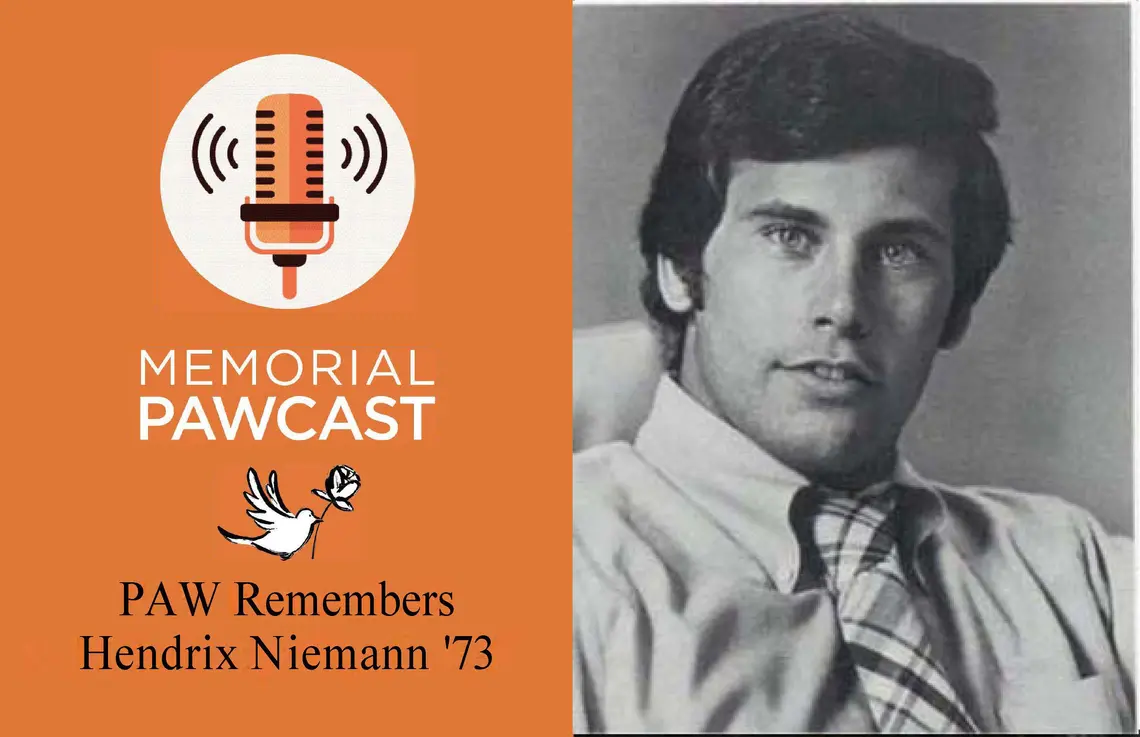
Remembering Hendrix Niemann ’73
‘A relationship with Drix, even in business, it was personal. You couldn’t be with him ... and not treat it as a friendship that you either wanted to develop or that you cherished and wanted to continue,’ says Rob Mancuso ’73

Published Dec. 9, 2025
Welcome to the PAW Memorials podcast, where we celebrate the lives of alumni. For this episode, PAW Memorials editor Nicholas DeVito sat down with Rob Mancuso ’73 and Mike Mims ’71 to discuss Hendrix “Drix” Niemann ’73. Drix was active in Business Today at Princeton and co-founded New Jersey Monthly Magazine.
Listen on Apple Podcasts •Spotify •Soundcloud
TRANSCRIPT
Nicholas DeVito: Hello, I’m Nicholas DeVito, class notes and memorials editor for Princeton Alumni Weekly. Today I’m with Rob Mancuso and Mike Mims, and we are going to talk about Drix Niemann from the great Class of ’73. Rob, if you could introduce yourself.
Rob Mancuso:Yeah, as you said, the great Class of ’73. And I live in Chicago. I’m a retired automobile dealer, and I spend my time now doing some consulting and some writing for the industry publications and trying a little harder to stay in touch with my old friends from Princeton.
ND: All right. And we also have Mike Mims from the great Class of 1971. Mike.
Mike Mims: Exactly. And I now live in Leland, North Carolina. Having lived in Connecticut for about 40 years, moved here four years ago. Still involved in publishing, just like I got started at Princeton, 1968.
ND: So when you were at Princeton, you started with Drix and Rob with Business Today?
MM: Well, actually I’m two years removed from their class. Business Today started in ’67 and ’68 with John Pearl and Steve Forbes and five others of us meeting in the basement down at Lori Love to get the thing started. And then met, well would’ve met Drix, Chris, Ed, and you, Rob, probably in ’69 when you were coming in as freshmen at a Business Today recruitment party. And that’s where we would’ve gotten to know each other.
RM: I think that’s where it started. I think that’s right. It was a real exciting time, and as you and I have talked about, it was an exciting time to even think about writing and producing and distributing a pro-business publication to colleges on the East Coast, because the business world was not held in the highest esteem at that point. You guys built the foundation for it. That was some heavy lifting.
MM: We were definitely swimming against the current at that time.
RM: But you all had that thought. You all had that focus. And it’s proven even today to be valuable because as we talked about, Business Today still exists. Correct?
MM: It does.
ND: That’s amazing.
MM: And they have an international conference. I mean, they’re just doing amazing things there.
ND: Wow.
MM: And to meet them and find out how active they are and how far it’s gone, it’s truly gratifying to find out that we started, Rob, has meant so much to so many people later on.
RM: Well, I was blown away by you and Steve and Jonathan, and then I met Drix at the same time, and Chris. It was a side of the world that I hadn’t been exposed to with the publishing side, and I never really understood what went into it. And it allowed me to learn a whole lot. And I naively expressed my interest in joining the organization and it provided I think some of the best memories of Princeton that I can recall. And of course, Drix and Chris were part of that because we were roommates. So a lot of people, I know you did Mike just, you just ate, slept, and breathed the publication.
MM: Almost too much.
RM: Yeah.
MM: I think my parents felt that I was a little too much into Business Today and not enough into college.
RM: Well, that’s why it was a good fit for Drix, I think, because the joke we all had about Drix was this guy never sleeps. He was always working; he was always doing something. And whether he was up studying or whether he was at the Business Today offices or whether he was even back then starting to ... And who knows if it’s even possible but starting back then to envision New Jersey Monthly coming to fruition someday between he and Chris. But it was really something to watch. And rubbing shoulders with people in the business like yourself, I mean, that’s just been one of my fondest memories.
MM: Well, that’s gratifying to hear that today, all these years later. Drix was, I think known as Mr. Energy and you’re not going to meet many people like him from that standpoint. And he also had a lot of interests. So, if something got his interest, then he was willing to jump into it and pursue it farther than most of us might just because he was, I think, determined to find out how things worked and what made them go.
RM: Well, that’s a good way to say it. I mean, he threw himself into everything. And if you were to meet Drix, you would remember him because he made an impression. And maybe, I don’t know if one led to the other, if it’s causation or correlation, but he was also involved in Triangle Club, so he was highly emotive. It was never a casual discussion about anything because he was full on a 1000%.
His facial expressions, his laugh. I mean the way he ... I’ve enjoyed over the course of my life, people like Drix that when you’re talking to them, they make it clear the way they’re looking at you, that you are the only person in the room and you are the only person who’s getting their attention. They’re not looking left and right to see if there’s a better deal down the road somewhere. And Drix was one of those, and that’s very rare. It’s still, especially today, it’s very rare. But that always struck me about him, and it was one of those things that attracted people to him, I believe.
MM: He was definitely charismatic that way. And I think that people appreciated being appreciated.
RM: That’s a very good way to say it.
MM: They found that a good experience.
ND: And when his memorial came across my desk, that radiated too. And that was why I was like, “OK, I need to learn more about this man,” because it just seems that everyone he came into contact with, he left a good impression, and he made them feel better. And that’s what we want in the world today.
RM: Well, my son is a private pilot, not a commercial pilot, but he always jokes, “How do you know if there’s a pilot in the room?” The answer of course is, “He will tell you.” With Drix, he didn’t have to say it, but you just knew he was in the room.
ND: OK.
RM: He was pleasantly over the top, most of the time. Right? Is that a good way to say it, Mike? Kind of-
MM: Yeah, because he was actually most of the time very likeable. And so, he had managed to corral the best of that impetus.
RM: Well, and he had the synergistic relationship with another one of my classmates and one of our group that we’re talking about today, Chris Leach, who’s also unfortunately passed away. And they would act as a team almost trying to control each other and direct each other. I mean, that was a comedy routine, just all on its own.
MM: Well, they had been roommates for a couple of years at Choate, I think
RM: That’s correct.
MM: So, they knew each other quite well,
RM: Very well.
MM: And they sort of arrived as a package.
RM: They came in and went out as a package, didn’t they?
MM: And they carried that package all the way through college and right into New Jersey Monthly years later.
RM: Unbelievable. What a relationship. And they were both quick to speak the truth to one another. That was something that I always got a kick out of. There was no trying to withhold emotions or thoughts. They were pretty brutal on each other, but that’s, I think, what made them good together.
MM: Well, I think they trusted each other, and they knew that each other had the other person’s best interest at heart. And there was never anything mean about it. It was just, you need to know the truth.
RM: Yes.
MM: They could be pretty honest.
RM: They could be. And I think about Drix, and I say over the top, this is a quick example of how Drix was over the top. We were, I think it was probably freshman year, sophomore year maybe. And we were in our dorm, we were in Dodd at the time, and we were commiserating over the fact that at the time there were, what, Mike? 30 women and close to 3,000 male students at the University, and it was always tough to get women to come to school and all that.
Drix goes, “Well, I’ve got an idea. Why don’t we go out and go to some nearby schools?” I think there was a teacher’s college maybe in New Jersey, teacher’s college or something, “and let’s go put up a flyer in all the dorms saying there’s a party and just put your room number on it, our room number.” And I said, “Yeah, let’s do that. Who’s going to come? Like anybody or two or three people?” So we did this, and I see Drix looking out the window about 7:00 or 8:00 that Friday night, and he goes, “Oh my God.” And I said, “What?” We look out, there’s two buses. And he goes, “We’re going to need more beer.”
MM: Maybe they thought they’d gotten a formal invitation to Dillon Gym.
RM: And it wasn’t a problem for the overflow to be absorbed into the rest of the dormitory. But that was a typical Drix approach to something. Let’s bring 200 people out here, 200 girls instead of two or three.
MM: Let’s reverse that ratio.
RM: Yeah, that’s right. That’s exactly right. But that’s the kind of guy that he always was. And he was the guy that if you said, “What do you think about doing this? What do you think about this road trip,” or whatever, boom, in, let’s go. Let’s do it. So really unusual that way.
ND: That’s great.
MM: Well, we need people like that.
RM: Oh yes, yes. They’re precious few.
ND: Yes, I can agree with that. So you guys went from Business Today and then he started New Jersey Monthly with Chris Leach?
RM: Mike, you know more about that than I do.
MM: After I graduated, I moved south to Dallas and then Atlanta, and about four years after my graduation, they were contacting me to say that they had this idea for a publication that would be a magazine similar to Texas Monthly, only for New Jersey called New Jersey Monthly. And it was a crazy idea because New Jersey didn’t think too well of itself at that time. Saturday Night Live was beating on the state regularly, every weekend.
But they sensed correctly, I think, and even divined, that there was a lot of pent-up enthusiasm for the state that wasn’t being recognized. And if they were to put together a publication that would capitalize on that and pulled that good feeling together, that we could actually have a magazine. So, they went out and I mean, by the time they called me and asked me to move north to become the ad director, they had already found limited sponsors among seven newspaper companies in New Jersey.
And they had found a dozen advertisers who would all advertise every issue for the first year. And they were ready to roll with the subscription campaign to find those first subscribers. I mean, they were just really doing it and had thought of literally everything and were putting together a great staff. So first issue was there in fall of ’76, and they had pulled it all together.
RM: Unbelievable.
ND: That’s impressive.
MM: And they were doing it at age 24 and 25, convincing people to put hundreds of thousands of dollars, which was real money at that time into starting this publication.
ND: Yeah, I mean, that’s unheard of. And especially at the time, the country itself was going ... It wasn’t the greatest time to be spending money. And so for them to build up that capital and do that at the time, that’s quite impressive.
MM: Well, I think they were smart to have gone to a group of investors who were already in the print business themselves being in newspapers, and they were on board with creating something that could speak to New Jersey and have people within the state feel proud about where they lived. And so a publication was born. That first subscription effort pulled like an all-time record, 8.5% response to a direct mailing.
ND: Wow.
RM: Oh, my gosh.
MM: Which most publishers would’ve given their eye teeth for that kind of response.
ND: Right.
RM: Sure, sure.
MM: And those people stuck and stayed with it. I mean, it was a great base for the magazine to have for the next several years.
RM: Well, if you had a relationship with Drix, even if it was in business, I think it was personal. Because you couldn’t be with him and engage with him and not treat it as a friendship that you either wanted to develop or that you cherished and wanted to continue.
MM: Sure. That’s absolutely true. And one of the things that he did so well was that when we would’ve our managers meetings, we would’ve almost, not just seven or eight managers, but maybe 15 people in the room because he wanted people to learn about other aspects of the publication.
He wanted them to know circulation, he wanted them to know editorial, he wanted them to know the business side. So, in a sense, he was already the first guy to break down the silos and let people understand what other people in the business were doing so they could work more productively together. So, we made great strides those first four years. Really did.
ND: Do you think that that management process was something innate or something maybe that because he saw from Business Today, you guys are all working in the same room, so you kind of know what’s going on, and so he just brought that along?
MM: That’s certainly possible, Nick, because one of the things we always did at Business Today is because we were trying to find businesses to advertise in the publication, we were sending all of us out on these missionary trips around the country for two or three weeks at a time in order to call on businesses in various parts of the country and get them on board with what we were doing.
And then we would all come back and share that with each other and analyze how we’d done and figure out how we could do it better the next time. So, I think there was a kind of process of analysis going on that was just kind of built into us from early days. Maybe you sense some of that, Rob?
RM: Well, he had a compass. I mean, I think whatever environment he got into, he just automatically found the most efficient route. And it was just fun for me to watch him and like I mentioned earlier, his relationship with Chris, because I think they worked off each other a lot too. But I just always found, and Mike, I just found the publishing business fascinating. I didn’t know anything about it. And so just my peripheral involvement, but watching Drix and watching the way he interacted with you and Steve and Jonathan, it was absolutely fascinating to me.
I was just thinking the other day about this in anticipation of this conversation that the kind of guy he is, he was a rugby player, but he also played some soccer now and then. So, I mentioned to him, I said, “I think I want to be on the soccer team.” And he goes, “Oh, so you were a soccer player in high school?” And I go, “No, no, I’ve actually never played soccer.” He goes, “Well, that’s really not how this works.” I said, “What were you talking about? I pay the tuition. I can’t get on the soccer team?” And he says, “No.” He said, “That’s not how this works.”
So, he knew the coach, and I don’t know, I think he just said something to the coach, and he said, “Just go see the coach,” and I went to see the coach and the coach said, “So I understand you want to play soccer.” And I said, “Yeah, it looks like fun.” And he goes, “Well, we’re looking for a little more than that. I mean, you don’t have to be on the team to kick a ball on the grass.” And I said, “Yeah, but the uniforms are so cool and everything.” So he goes, “Yeah, OK.” I mean, it says a lot about Princeton too, OK? The coach goes, “OK.” He said, “I may super glue your butt to the bench, but you’re technically on the team.” OK?
So, I said to Drix, I said, “Well, I’m on the team now.” He goes, “Well, you can’t be on the team.” And I said, “Yeah.” And he said, “Well, there’s some stuff you’ve got to know because you’re going to get your butt kicked out there.” So, he talked to me a lot about certain positions and just some athletic things and all this, and he kind of nursed me through it. And I think one game; I actually got in to play for maybe 30 seconds over the course of the season. And the first guy I told was Drix. I said, “Hey, by the way, they’re playing me now.” It was parents weekend and I had said to the coach, I said, “Biggest favor in the world. I know you’ll never play me again. If it’s me running out to the goalie to ask him what he wants on his pizza for dinner, send me out on the pitch. OK?”
MM: My folks are here.
RM: “My folks are here. I need your help.” But Drix was instrumental in that. I never forget that, he helped me out, and that’s the kind of thing he would do. Instead of saying, “Rob, you’re crazy. You can’t play soccer. Those guys are all-state players that some of them are recruiting, so you can’t do that.” He said, “Oh yeah, well, we’ll figure it out.” Then he did it. It was awesome.
MM: Well, I think you must have inspired him because at New Jersey Monthly, he at some point decided that first spring that we were all softball team material. And so, he showed up with a clipboard at the office one day and said, “OK, what position would you like to play?”
RM: Oh, my gosh. Yeah.
MM: Inside of about 45 minutes, he had a softball team going.
RM: Oh, my gosh.
MM: He was getting us out there on Thursday afternoons.
RM: Oh, my gosh. Well, he taught me something that had never in my entire life up to that point, occurred to me to be a thing. But I think it was about spring of, probably spring of freshman year, and Mike, you may recall, we all wore topsiders. That was part of the standard issue outfit, right?
MM: Yeah.
RM: So I’m walking down the sidewalk and these things, the leather’s pulling away from the sole, and the sole is half eating through. And I go, “I got to get rid of these things.” And Drix goes, “Get rid of them? No, they’re perfect.” I said, “For what?” And he said, “No, no. See, you got to get them to that level. And then you get the white adhesive tape, the medical tape, and you put it around the front of them, that holds it all together.” He said, “Those are the coolest things in the world. The coolest things I’ve ever seen.” And I said, “So that’s a thing around here?” He goes, “Oh, it’s a big thing.”
MM: The more beat up, the better.
RM: And he showed me how to do that. I wore them home one time, and my parents went, “Is this what you look like when you’re walking around campus?”
MM: Just doing the family proud, right?
RM: Exactly. Yeah, exactly. I’ll mention too that the DNA he had for theater was passed on to his son, JJ.
ND: Yes.
RM: I had heard of JJ, I had never met JJ. I heard that he was quite an accomplished actor and musical, he’d sing and he’d dance. And I heard that he played the role of Michael J. Fox and the Broadway production of Back to the Future, the musical production.
MM: Correct.
RM: And about four or five months ago, Judi called and said, “JJ’s going to be in Chicago. He’s the lead in Catch Me If You Can,” which you may know from that book and the movie. Leo DiCaprio was in it where the guy was a charlatan, a con man. And I thought, how do you do a musical about that? But I guess that’s the great thing about musicals. You could do a musical about anything if it’s done well.
And so we went, and I had never met JJ, and this kid just absolutely tore it up. He was absolutely fantastic. After the show, there were people lined up to see him and begging for his autograph. And I was telling my wife when we were watching him doing the show, I said, “Every angle, I could see Drix.” He would turn a certain way and I’d go, “It’s Drix up there.” I mean, he looked so much like his father.
ND: Wow.
RM: And toward the end of the show, there are some lines that even I remember from the movie version where the detective that is finally arresting Frank Abagnale, who’s the con man that JJ’s playing says, he says, “No matter what you do, you can’t bring your father back.” And I thought, “Oh, JJ’s saying these words,” a month or two ago. So, after the show, I said, “JJ, tough lines at the end of that.” And he says, “Yeah,” he said, “near panic attack every performance when I get to those lines.” Tough.
ND: Yeah, that’s tough.
RM: But it’s in his DNA to be an actor like that.
ND: Yeah.
MM: Well, you mentioned Judi. Judi was Drix’s wife for all these years since Princeton, and I think she served as a centering compass for him. And the two of them have four wonderful children. And the same energy that Drix has devoted to everything else, and Judi, to her painting wonderful watercolors, they poured into their kids. So, you’re seeing that in JJ, but whether it’s Wesley, Corey, or Dale, they all have it, and they are just the most amazing family. And you can just see that pouring itself through and through.
RM: Well, it doesn’t happen on its own, as we all know. Right?
ND: Yeah. Right.
MM: And by the way, speaking of his organizing sports, when he got to North Carolina and found out that North Carolina didn’t have women’s lacrosse, he set about organizing that.
RM: Oh, my gosh.
MM: And lacrosse is now a recognized sport in this state because Drix got that going, starting 15 or 16 years ago when his kids were younger and he wanted them to be able to play. So, he’s touched a lot of people. He really has.
ND: Yeah. He sees what could be, and he knows how to act and make it happen. And along the way, he is an enroller. He’s bringing people along, which is, it’s a unique ability.
RM: And he is very, very smart. And as my wife kids me routinely, she said, “Every time you talk about people at Princeton, you go, ’Well, that guy was really smart.’” And she said, “Was everybody really smart?” And I go, “Yes.” I said, “They were smart and smarter and smart-est, but it was always an interesting group.” And Drix was one of the smart-est because he left a mark. I mean, that’s all we can hope to do, as they say, right?
MM: Yep.
ND: Right.
RM: He left something behind.
MM: I think there are a lot of people in the Wilmington area and in North Carolina, whether they’re involved in stage or musicals or lacrosse, have been touched by him and will always remember him for what they brought to their lives.
RM: Wow.
ND: Yeah.
MM: Quite remarkable.
ND: Yeah, he just sounds like he was such a remarkable man. Is there anything we’re leaving out? I mean, I’m sure there’s a ton of stuff, but any final thoughts about Drix?
RM: The only thing I’ll say in parting was the shock of hearing that he was gone because I had been with him and spent ... You know how Reunions, you kind of latch onto a couple that you haven’t seen, and well, what time are you guys, after the P-rade, where are you going? OK, we’ll go too.” And “What time are you coming to dinner? Oh, we’ll meet you over at the Arch and we’ll walk.”
We spent the entirety of Reunions with Drix and Judi and traded some photos and all that. I know it’s been a couple of years, but coming off that, to hear that he was just gone was just such a shock. And the right thing to do is what we’re doing right now. Nick, what you’re doing, and they have Mike here who knows so much about the genesis of the person that Drix became. And whatever I might be able to add, I think is the best way to honor him. And he deserves it. He really deserves it.
ND: Yeah.
MM: I’ll tell you something very telling. Maybe it speaks to his optimism and his belief that there will always be a tomorrow. Even after Drix was in intensive care in Greensboro and fighting for his life, he wanted Judi to phone Amy and myself and let us know that we were going to have dinner together as soon as he was out. And he didn’t want us to think that he had forgotten that we had a date planned.
RM: No. Oh, boy.
MM: And I felt myself saying, “No, no, I appreciate that but save your energy to save yourself.”
ND: Right.
MM: But it was so touching that even at that moment, he could be thinking of the people around him and wanting Judi to communicate to them that there was going to be a tomorrow. So, I think what you’re experiencing, Rob, and what I experienced was that that tomorrow didn’t come, and it was a shock because he was such a vibrant, lively person for all the time that we knew him.
RM: He was bigger than life, and the best way to honor him is to keep him in our memories and keep talking about him.
ND: That’s right. As long as you talk about somebody, they’re still with us. And I’m glad that we were able to do this and keep him with us.
RM: Me as well.
ND: I want to thank you both for today and thank you for doing this. I appreciate it.
MM: Well, thanks for having invited us to participate in this. It’s a real pleasure.
RM: It’s an honor to be involved. Thank you.
ND: Thanks.
ND: The PAW Memorials podcast is produced by Nicholas DeVito and Princeton Alumni Weekly. If you enjoyed this episode, please subscribe. You can find us on Apple Podcasts, Spotify, and SoundCloud. You can read transcripts of every episode at paw.princeton.edu. Music for this podcast is licensed from Universal Production Music.
Paw in print
October 2026
Holding on to Jewish life; Katy Anderson Keating ’08’s career in wine; Hollywood loves Princeton.
1 Response
Nela Niemann
10 Months AgoThanks for This Tribute
Thank you for the beautiful tribute to my brother Drix. He touched the lives and hearts of everyone he encountered, from the guys who fixed his old car to the young people he coached for decades to the people who meant the most to him — his family. No one ever forgot meeting Drix. I appreciated listening to stories from the perspective of his Princeton years. When I was 16, my parents allowed me to stay with Drix during parties weekend, which was an eye opener, but that’s a story for another time 😊. Thank you again.