

Microbes for the Masses
Rob Knight *01 is building the tools to transform health care through microbiome science

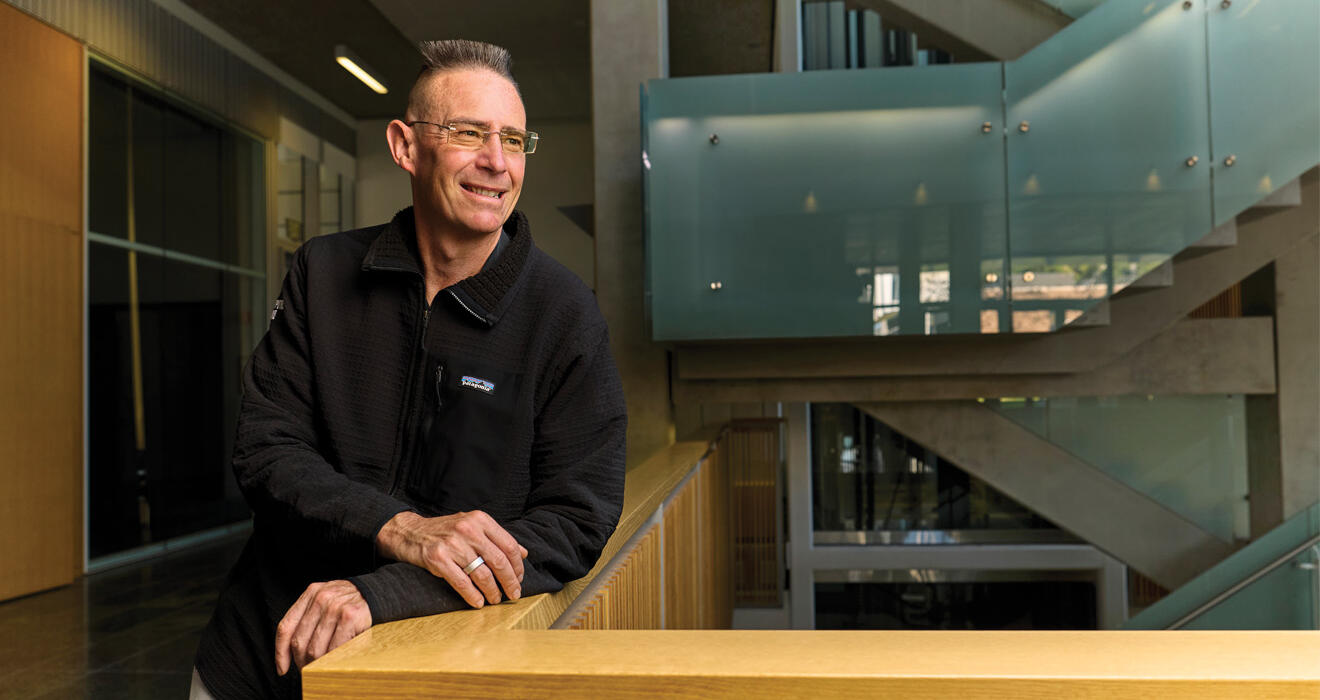
Rob Knight *01, director of the Center for Microbiome Innovation at the University of California San Diego, is on his way to a meeting but first needs to change his continuous glucose monitor (CGM). The device sticks unobtrusively to the back of his arm and pumps a stream of data about his blood sugar, moment to moment, to his phone. He rips off the old patch, positions the new one, syncs it to his phone, and keeps moving.
On the walk through campus under crystalline blue skies and cotton ball clouds, with a hint of a sea breeze, Knight explains in his typical lightning-fast speech how his interest in wearable health devices relates to the subject of his research: the microbiome.
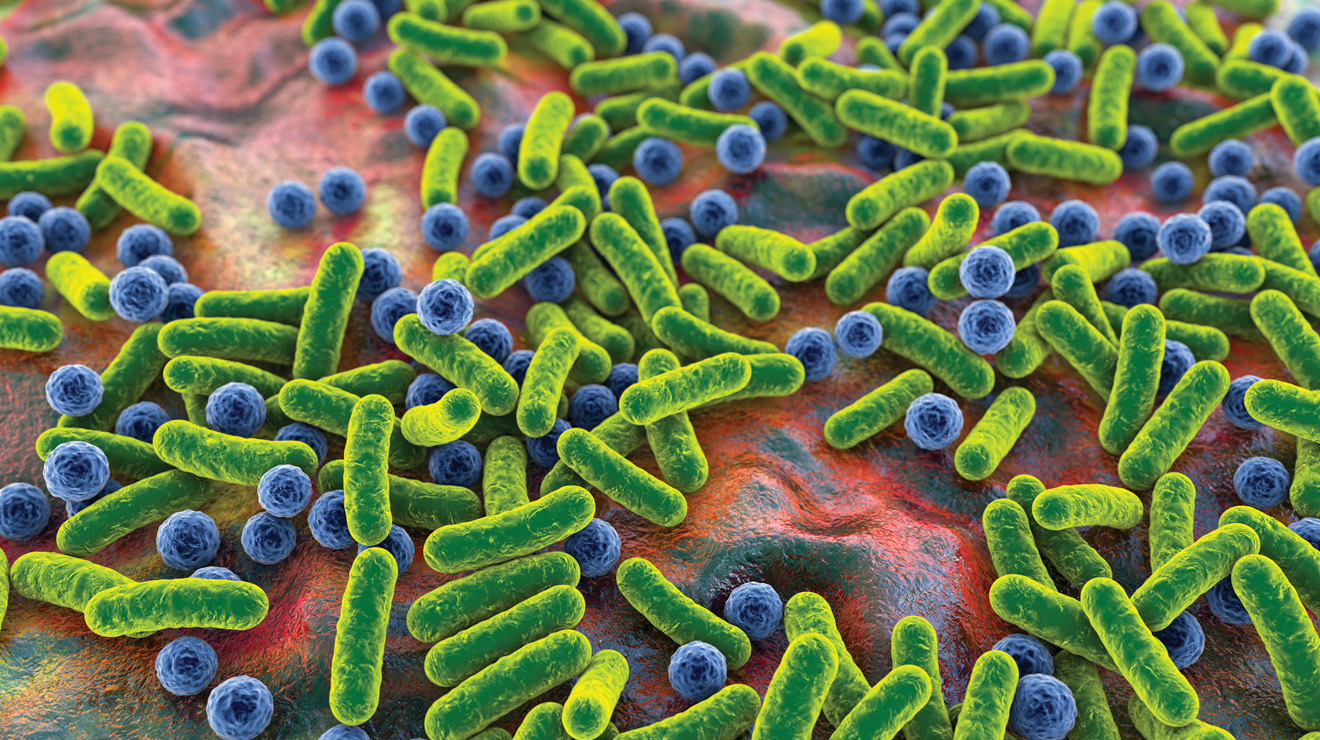
The microbiome is the term for all the microscopic life that’s inside of us, on us, on our pets, in our homes, our backyards, and even in outer space. And more than showing us that, yes, microbes are everywhere, research has started to show us how much they matter. We know that the microbiome is a factor in immunity, brain health, and cardiovascular disease, and beyond our bodies, it shapes the yields of crops and even oil wells. Knight has played an outsize role in all of this, having developed the primary tools that the global community uses to study these invisible and pervasive life-forms.
And now, he says he dreams of a day when “based on what we know about your microbiome and other people’s microbiomes, we can say, ‘This is your risk of developing things,’” like cardiovascular disease, for example. “We could give people actionable information, perhaps integrated with wearables.” And that’s why Knight wants to learn about wearables, not because of any medical condition of his own but because, he says, “I want to make sure I’ve tried it before I ask others to.”
CGMs work because when people change their behavior — for instance, stop eating bananas — they see an immediate result. “What if you knew there was something you could do that would reshape the influence of your microbiome on your blood glucose, your immune system, and your stress?” Knight asks. While he admits that this “sounds pretty out there,” the 49-year-old is used to scientific bushwhacking. When he launched the American Gut Project in 2012, which has now collected and analyzed the stool of 30,000 participants, he says, “No one thought we should be asking the participants about many of the things we had on the questionnaire, like sleep for example. No one had any idea that the microbiome was linked to sleep, and our data showed some of the earliest links.”
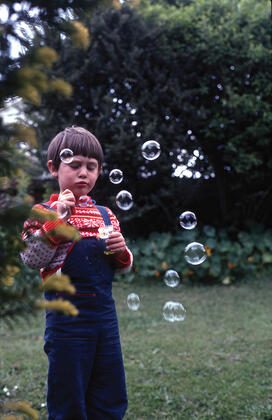
He “spent a lot of time running around with a butterfly net” at the nearby state park, while also marveling over the computers at the NIH. “He became very enthusiastic about our early model Macintosh.”
— John Knight
Knight has been defying expectations since he was a child growing up in New Zealand. By 5, he was reading at an adult level and using the scientific names of all the specimens in his seashell collection. When he was 7, Knight’s father, John, says, an education officer came to visit the classroom and Knight explained the difference between metamorphic, igneous, and sedimentary rocks. “The officer was shocked by his knowledge,” his mother, Allison, says with a laugh. “Sometimes it was hard for him,” she continues. “Some of the teachers were turned off when he would correct them.”
The family moved to Bethesda, Maryland, for 2½ years starting when Knight was 9 so that his immunologist parents could take on research positions at the National Institutes of Health. Though Knight was drafted into a gifted and talented summer school, “he announced that he didn’t want to spend the summer shut up in a classroom,” Knight’s father says. Instead, Knight says he “spent a lot of time running around with a butterfly net” at the nearby state park, while also marveling over the computers at the NIH. “He became very enthusiastic about our early model Macintosh,” John Knight says.
In Knight’s second year studying biochemistry at the University of Otago in New Zealand, he approached his father with a research idea: to genetically engineer an invasive possum ravaging New Zealand to produce only males and thus wipe out the species. Knight’s father thought the idea superior to the possum poisons he was working on and arranged a visit to Princeton to meet with Lee Silver, an expert in this form of genetic engineering. Silver encouraged Knight to stay and work on the idea for his Ph.D. “I said, ‘We can’t possibly pay for that,’ and Silver said, ‘Don’t worry, we have scholarships for someone with his talent,’” John Knight says.
Silver transitioned his research to policy and ethics, and Knight found a spot in the lab of Laura Landweber ’89 in the ecology and evolutionary biology department. Here, Knight met Steve Freeland, without whom, Knight says, “I would not have taken my research into a computational direction.” Freeland, a postdoctoral fellow, and Knight, a new graduate student, were tackling the origin of the genetic code — the set of rules that determine how the information in DNA and RNA is translated — from different angles. “I was computational. He was laboratory,” says Freeland, who is now interim dean and vice provost of undergraduate academic affairs at the University of Maryland, Baltimore County. While Freeland saw the code as a result of evolutionary adaptations, he says Knight was coming at it by looking at the molecules and what they could do and not do. “Intellectually, we could have been enemies,” Freeland says, but instead they developed a deep friendship, bound by their workaholic tendencies. “Meeting Rob was like meeting a mind that was propped up and walked around by a body,” Freeland says. “Our only social life would be to go to an eating club for a beer every now and then,” he says.
“I watched how [Steve] coded,” says Knight. “It made me appreciate the nuts and bolts of designing algorithms that work, and that work for the end user.” Eventually, Knight shifted his graduate work in a computational direction, which was not the obvious move at the time. In fact, a few years before, a professor at the University of Otago told Knight there were no applications for computers in biology. “You have to understand,” says Freeland, “this was 1999, one year before everyone was freaked out about Y2K. The internet was new.” Landweber, now a professor of biochemistry and molecular biophysics at Columbia University, says, “Knight was the first bioinformatician in my group,” referring to the field, bioinformatics, that took off in the early 2000s as scientists completed the Human Genome Project and genomic data collections grew exponentially. “It was the whole notion that you could do biology on a computer,” she adds.
Freeland taught Knight coding languages and how to develop user interfaces; Knight built a computational model that was able to explain why different organisms used different sequences of DNA to encode the same sequences of amino acids, the building blocks of proteins. “Around this time I noticed he had a photographic memory,” says Freeland, who says Knight and some friends in a Dungeons & Dragons group had memorized “every piece of Lord of the Rings lore.”
Knight went on to win the United States Council of Graduate Schools award for the best Ph.D. in the life sciences in 2001 for his dissertation, “The Origin and Evolution of the Genetic Code.” At graduation, Henry Horn, former professor of ecology and evolutionary biology at Princeton, wore a computer motherboard on his graduation cap as a tribute to Knight. “Princeton was an incredible turning point in his career,” Knight’s mother says.
Knight traveled to Boulder to continue his study of the genetic code as a postdoctoral fellow in the lab of University of Colorado biologist Michael Yarus. Yarus, now an emeritus professor of molecular, cellular, and development biology at Colorado, recalls the “unmatched joy” he had in conversations with Knight. “I never talked to anyone like Rob. He’s funny, has great jokes, is a dynamo,” says Yarus. In the lab, Knight created software that essentially established a shortcut to determining RNA structure. “I’ve never met a person who was more ambitious,” says Yarus. Yet, adds Freeland, “behind that terrifying intellect, he is one of the kindest people.”
By 2004, the university had hired Knight as a professor with research programs spanning chemistry, biochemistry, and computer science. Knight’s first graduate student, Cathy Lozupone, had been working with Knight since Princeton, where she had been a research assistant in Landweber’s lab, and like Knight, caught the bioinformatics bug. Her master’s degree work in soil fungal populations sparked her interest in the microbiome and led her to a research rotation in the lab of Norm Pace, who was studying communities of naturally occurring microorganisms. “Rob’s a computer jock,” says Pace, who is now, like Yarus, an emeritus professor at Colorado. “He came along and did what needed to be done.” Which was to make software that could uncover characteristics of microbes and the relationships between them more effectively than imaginable. The software, called UniFrac, “solved an important problem,” says Knight, “because before then, you’d scrape five microbial communities off of rocks, and say each pair was different, and then what? We needed statistical techniques to integrate the communities. … What happened then was that sequencing technologies completely transformed what we could do in terms of data collection.” Knight and Lozupone published the paper on UniFrac in 2005 in Applied and Environmental Microbiology; since then, it has been cited nearly 10,000 times, which is in the upper stratosphere for citations for a single scientific paper.
“The microbiome went from this baby field to a major player in so many diseases and health issues. Now, we’re at the point where we know a lot, but we don’t know what to tell people to do.”
— Cathy Lozupone, University of Colorado associate professor
The term microbiome first appeared in a scientific publication in 1952, but most in the field agree that microbiome research began in earnest around 2005, right when Knight shifted his lab’s focus. “Rob was in the right place at the right time, with the right algorithm,” says Lozupone. By the mid-2000s, sequencing technology was generating heaps of data and computation had gone from the fringe to a core part of the biological science infrastructure. “Rob was smart enough to see that these things were converging. That frontier thinking is a direct thread to everything he’s doing now,” says Freeland.
With the release of UniFrac, microbiome studies proliferated, with Knight leading or collaborating on many of them. An incredible set of studies showed that lean and obese mice had distinct microbiomes, and further, transplanting the fecal microbiome from an obese versus lean human into a mouse resulted in a fatter mouse. Another set of studies showed that families living together shared microbiomes with each other, and even their dogs, and that upon moving, a new home’s microbial community was rapidly taken over by the microbes of the occupants. In 2010, Knight co-founded the Earth Microbiome Project, with the goal of mapping microbial communities worldwide by swabbing for microbes in oceans, soils, forests, mountains, and animal habitats, including the Komodo dragon enclosure at the Denver Zoo. Sampling was often not straightforward. “We only needed a swab’s worth of saliva,” says Knight, who had to hold a plastic tube under a Komodo dragon’s jaw, “and ended up with overflowing drool.”
While Knight and his lab continued to improve UniFrac, they also created QIIME (pronounced “chime”), which stands for Quantitative Insights Into Microbial Ecology. QIIME allows users to create evolutionary trees, plots, and other compelling visuals to get at the stories the massive datasets of microbial sequences can tell. “QIIME, still in ongoing development, was one of the earliest and best of the sequence-processing pipelines,” writes Pace.
QIIME opened the door to extensive collaborations for Knight — with more than 1,200 papers, “he has the most extensive publication list I’ve seen for a mid-career scientist,” says Pace. “I like Rob a lot, but he bothers a lot of people. He can be pushy. But I interpret that as interest.” Knight is widely cited. As of February, his Google scholar H-index is 265, which means that 265 of his papers have been cited at least 265 times. “That kind of H-index is almost unheard of, especially for someone so young,” says Martin Blaser, a physician and microbiologist at Rutgers University who has been collaborating with Knight for 20 years.
“His tools and methods are our battle horses,” says Maria Gloria Dominguez-Bello, a microbiologist at Rutgers and president of a microbe preservation nonprofit called The Microbiota Vault, of which Knight is vice president. By the time Knight gave a TED talk in 2014, entitled “How our microbes make us who we are,” the studies made possible by Knight’s tools had pinpointed the massive role the microbiome plays in nearly every aspect of human health. Of the genes at work in our bodies, at least 99% are not human, but instead belong to our microbiome. “The microbiome went from this baby field to a major player in so many diseases and health issues,” says Lozupone, including inflammatory bowel disease, anxiety, drug metabolism, autism spectrum disorders and susceptibility to allergies. “Now, we’re at the point where we know a lot, but we don’t know what to tell people to do.”
Enter Knight’s next crusade: giving people the tools to improve their lives.
On a Tuesday morning in September, Knight sits in his office at the Israni Biomedical Research Facility on the UCSD campus, about to join a call with the World Microbiome Partnership, a global institution established in 2023 to foster collaborations and standardize data collection and analysis. Knight’s computational genius is not obvious when he logs onto the call, which is on Zoom, and mumbles, “What do you mean, meeting passcode?”
His partner on the call immediately congratulates him on his Cell paper, published that day, describing the latest tool Knight is excited about: long-read DNA sequencing. All DNA sequencing involves reading and then assembling small pieces of DNA, akin to assembling a jigsaw puzzle. Long-read sequencing increases the size of these pieces — in some cases by a hundred times — and as a result, “Instead of this little blue thing which you don’t know is sky or sea or someone’s shirt, you have this huge chunk and it’s extremely obvious what it is,” says Knight.
This solves a key problem, Knight explains. If you are trying to figure out which microorganisms are in a sample, but there’s a lot of DNA from the host, it can be very hard and slow to get reliable answers using short-read sequencing — those tiny blue pieces — which breaks DNA into tiny fragments. “I think a lot of the problems that are plaguing many different fields, from biothreat detection to ecology to clinical questions, will go away with the long-read approach,” he says.
Knight is driven by an optimistic fervor for the day when rapid readouts of microbiome information can tell an individual what they should eat, what medicines are effective, or even how to avoid Alzheimer’s. “The American Gut Project showed us that on population level it’s more important to eat a lot of different kinds of plants, rather than say, a huge salad that’s just spinach,” says Knight. “But we want to take it down to the level of the individual.” Knight is pushing on developing wearables because of the immediate feedback. “If you have to collect a microbiome sample and then send it up to a lab and then a month later you get your results, it’s too slow. Ideally, you would have some kind of sensor that is looking at something that might help people come to these personalized microbiome conclusions.”
Knight points out that most health studies have been blinded, which means that a person in the study does not know if they are in a control group or what kind of treatment they are getting. “The idea is that you don’t want to influence people’s behavior while they’re in the study, but I think that’s leaving almost everything on the table because for people who use CGMs, at least anecdotally, what they love is that you can finally see what impact food and behaviors have on your blood glucose.” What’s exciting, he says, is the notion of designing a study that can capture people’s changes in behavior. “That way, you are empowering them to use the data,” he says. →
And to get data that is both fast and precise, the whole pipeline has to be fast and precise, from collecting the sample to producing the final report. Knight’s goal? Get it done within 24 hours. Perfecting the pipeline is the focus of a weekly lab meeting, which I attend. Knight assures the students that nothing confidential will appear in this article, then he whispers that since everything is open source, there’s nothing confidential to reveal.
Making sure the tools are available to anyone who wants to use them is as important to Knight as making them. “He calls it the ‘democratization of science,’” says Lozupone, and this practice has enabled smaller labs to do more significant work. It’s also pragmatic in a funding landscape that has become uncertain. “We make the technology available to everyone, so anyone lucky enough to get funding can pursue the research,” Knight says.
Knight is no stranger to the funding roller coaster. After years of preparation, including training astronauts in sample collection at a full-scale mock-up of the International Space Station at Johnson Space Center, Knight’s group published work showing a dearth of microbial diversity on the actual International Space Station. “The ISS is an extreme example of environments that are being kept too clean, and the health of the occupants could be improved by reintroducing microbes from other sources. The question is, what is the minimum assemblage of species and systems that you can take with you to promote a healthy microbiome in space?” Unfortunately, funding for the project has ceased.
Funding for more traditional studies that look at the effects of nutrition on the microbiome is bleak — “first, a place like an avocado growers’ association can’t give $1.5 million, and second, the study will be perceived as biased by that industry association,” he says. Yet, nutrition studies have a heroic past — “we cured goiter and scurvy.” With a wearable, each person effectively conducts their own long-term clinical trial, able to see what kinds of foods or behaviors affect molecules that the wearable might sense and that possibly act as a proxy for their microbiome.
As for what the wearable sensor could look for, Knight points to the work of his colleague Pieter Dorrestein, a professor in UCSD’s school of pharmacy and pharmaceutical sciences who works on identifying the kinds of molecules that microbes produce during the course of their metabolisms. Knight asks, “There are hundreds of molecules that can be sensed on these platforms, but the question is, are they useful or not?” Dorrestein says he believes if anyone can figure this out, it is Knight. “He is really good at uncovering hidden data patterns and he has this magic power to know computationally what to do to find that hidden data. And he brings together different disciplines — math, microbiology, chemistry — to make connections I could not make.”
Knight has succeeded with a version of this already, in oil wells instead of humans. His work identified which microbes residing in oil wells were indicative of strong oil flow — “the companies using this were able to reduce unproductive fracking by 90%,” says Knight, who founded a startup, Biota, of which the core data science platform was sold to Novozymes, and then the oil and gas IP later sold to BP.
Potential for new, rich collaborations drew Knight to UCSD in 2015. A position in pediatrics was appealing in cultivating his interest in how the microbiome shapes health from infancy. “When he arrived, he hosted an evening with all the pediatricians in the area,” says Gabriel Haddad, the chair of the pediatrics department, “to talk about the idea that some germs are beneficial to a child’s immune system, and how too many antibiotics can cause harm.”
Knight is the founding director of UCSD’s Center for Microbiome Innovation, where more than 140 UCSD faculty members and about a dozen companies, such as Nestlé and Danone, work on “real-world problems that are intellectually interesting that you might not necessarily come up with in an academic department,” Knight says.
Stuart Sandin *02, a professor down the road from UCSD at the Scripps Institution for Oceanography who, like Knight, got his Ph.D. in ecology and evolutionary biology, says “when you leave Princeton you go, oh, of course you go across departments! Rob and I both collaborate more than some of our colleagues, and that comes from having been at Princeton.”
Knight’s collaborations seem to multiply as quickly as the microbes he studies, and when asked when he has time to think, he says wryly, “off schedule.” But later, he describes how he prioritizes the tools, above all else. “We develop some core technologies and then look for application areas that are going to be interesting. The tools can uncover new kinds of microbes or microbial communities, or they can open up a new area we didn’t know the microbiome was involved in until recently, like the gut-brain axis,” he explains.
The microbiome will only become more central as scientists grapple with questions around human health and the environment. As Yarus says, “Knight was, and is, crucial to the development of the idea of the microbiome, and its contribution to biology. He will be remembered for that.”
Susan Reslewic Keatley ’99 majored in chemistry and is now a writer and host of the podcast Science Fare.
Related News
Janice Lee ’09 Worked to Renovate One of Hollywood’s Best-Kept Secrets
An engineer by training, Lee has been deputy project manager on the renovation of Hollywood Burbank Airport

2 Responses
Ken McCarthy ’81
6 Months AgoThe Influence of Pioneering Immunologist Ilya Mechnikov
I enjoyed the account of Rob Knight *01 and his work studying the microbiome. There’s a back story people interested in the topic may not be aware of. Ilya Mechnikov (German spelling: Élie Metchnikoff) shared the 1908 Nobel Prize in Medicine and Physiology with Paul Ehrlich, for their separate contributions to the field of immunology. Ehrlich believed in medical “magic bullets” and even is credited with coining the term. He, along with the German dye and chemical industry, gave us our modern pharmaceutical model.
Mechnikov was the first to describe phagocytosis, the process by which immune cells engulf and destroy pathogens. He was also the first scientist to write a popular book on the subject of the influence of the gut on health. It’s called The Prolongation of Life: Optimistic Studies and was published in 1908. One of the informants for the article commenting on the current state of microbiome studies stated “... we’re at a point where we know a lot, but we don’t know what to tell people to do.” Mechnikov had no such problem. He advised people on the health benefits of consuming yogurt. People who aren’t satisfied with just marveling at the research studies piling up might do well to acquaint themselves with the virtues of traditionally fermented foods. “Modern” diets are lacking in them. In addition to providing the fundamental insight that unlocked our understanding of immune system mechanics and writing about the influence of the gut on health, Mechnikov had a lifelong interest in promoting health throughout the lifespan and helped pioneer the scientific study of aging.
Princeton Alumni Weekly
7 Months AgoFor the Record
Henry S. Horn was mistakenly identified as a Princeton alumnus in an earlier version of this article.