

Dung Beetles Do ‘the Job That Is Necessary’
Princeton researcher Finote Gijsman *25 studies crucial links between the insects and elephants in a new paper
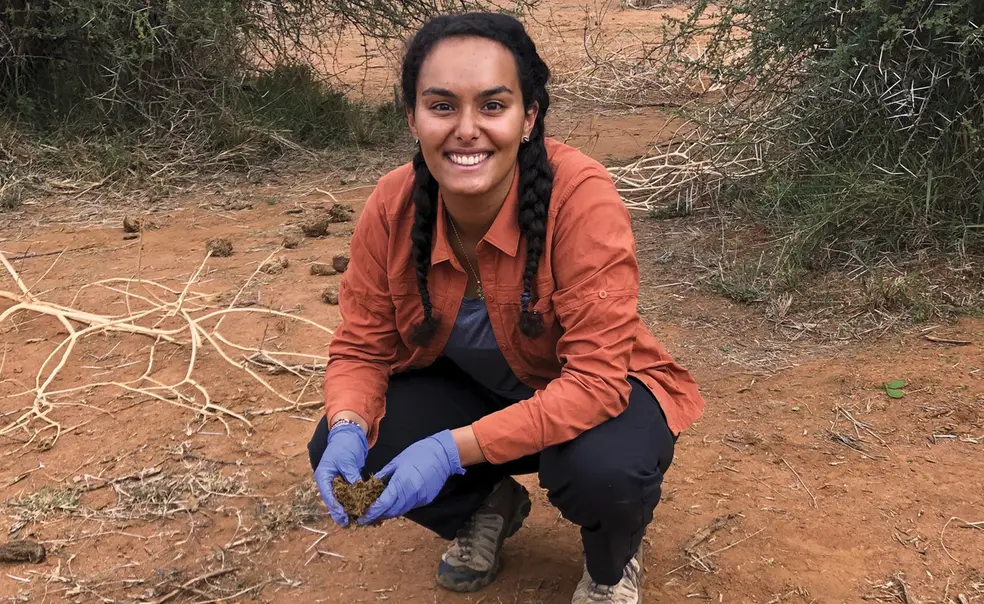

On the savanna in central Kenya, conservation stories usually start with elephants. They tower over the landscape, reshaping vegetation and drawing tourists’ cameras. But for Finote Gijsman *25, the most revealing creatures are the ones working underfoot: dung beetles. “They’re just such underrated heroes,” she says. “They’re doing the job that is necessary but nobody acknowledges.”
In her doctoral work at Princeton, Gijsman followed these beetles to understand relationships between diverse creatures across the ecosystem. “The big message that I personally take away from the paper is the fact that everything is connected,” she says. “If you affect one thing, it’s going to have ripple effects on other things.”
Her research, conducted at the Mpala Research Centre in Laikipia, Kenya, of which Princeton is a managing partner, shows in stark detail how the loss of elephants — long described as a keystone species — cascades down to dung beetles and the crucial ecosystem services they provide, including nutrient cycling and soil aeration. In the process, she has transformed a childhood fascination with small, overlooked creatures into a scientific lens on some of conservation’s biggest questions.
In ecology, the idea of a keystone species — an organism whose influence on its ecosystem is disproportionately large relative to its abundance — is often illustrated with the story of sea otters and sea urchins along the Pacific coast of the U.S. But Gijsman says the term has not always been rigorously quantified. She wanted to understand the impact of losing elephants on the ecosystem, to create a rigorous measure of their influence on the environment.
Elephants shape African savannas in obvious ways like knocking down trees, opening up grasslands, and redistributing nutrients as they move. But they also have an impact under the ground: Their waste structures the lives of insects like dung beetles, which bury dung, recycle nutrients, and help maintain soil health.
By comparing areas with and without elephants, and tracing how beetle communities changed over time, Gijsman demonstrated that elephant loss triggers a measurable cascade. Altered dung availability leads to shifts in beetle species and behavior, which in turn affects the entire ecosystem. The research was published in the journal Science in May.
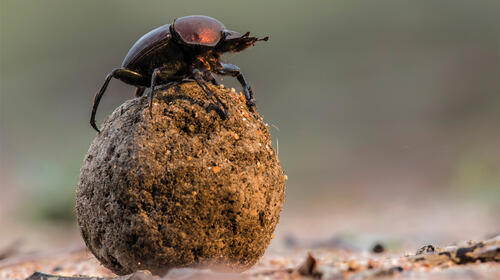
Growing up in Kenya as the daughter of scientists, Gijsman did not see herself following their path. “To be honest, I kind of rejected science for a long time,” she says, “just because it was my parents’ thing.”
Still, she spent much of her childhood outdoors. Chameleons were her first love. She remembers racing around the garden to catch them and bring them home — much to the dismay of neighbors, who often viewed the animals with superstition.
Biology at school gradually pulled her in. It was always her favorite subject, and insects held special appeal. Little by little, she followed the science track that eventually led her to Princeton’s Department of Ecology and Evolutionary Biology and to the lab of professor Robert Pringle.
When she joined Pringle’s group in 2020, in the early months of the COVID-19 pandemic, Gijsman had a background in studying insects and expected to spend graduate school analyzing the interactions of ants and acacia trees in Kenya. Instead, the enforced slowdown led her to start reading about dung beetles — and realize that the lab she was joining had a long history of studying large herbivores and their dung.
“Dung beetles are the natural merging point,” she says. “It was a serendipitous moment where everything lined up.”
Her project also built on a dung beetle survey started more than 20 years earlier at Mpala, documenting which beetle species were present and what they ate. That ongoing data offered a rare opportunity to measure change.
Another strand of her work dug even deeper, into the guts of beetles. Because dung beetles feed on the feces of many different mammals, their digestive tracts contain a DNA archive of the animals that share the area. “They feed on basically everything, so they’re just surveying the entire landscape,” she says. “We detected almost every single mammal species at Mpala in their gut content.”
That makes dung beetles unconventional but powerful tools for biodiversity monitoring — tiny, shiny sentinels that record with their bodies which mammals are present, even when those mammals are elusive to human observers.
Throughout the project, Gijsman’s Kenyan background gave her an important kind of expertise that does not appear in methods sections: cultural fluency. Navigating permits, coordinating logistics, and building relationships with local institutions all required nuanced understanding of how to approach people and processes, she says.
Since finishing her doctorate, Gijsman has moved to Sweden, where she is currently a postdoctoral researcher at Lund University. She is drawn to work at the interface of science, policy, and global partnerships — an echo of the many connections she had to cultivate to make her Kenya research possible. Back in the savanna, the dung beetles keep working. For Gijsman, they are a metaphor as much as a research subject. Protecting elephants, her work shows, means protecting those unsung heroes, too, along with the intricate web of life they sustain underground.
The Latest
See all


Related News


Ann Noguer ’05 Moved to Argentina and Opened a Travel Company
‘It’s nearly impossible to plan out all the steps of your life looking forward,’ Noguer says

No responses yet