

Is Artificial Intelligence Really the End of the World?
‘We’re in for a bumpy ride … That’s a big part of what we need to cope with.’

Published Nov. 19, 2026
Dire warnings abound about the rise of artificial intelligence, but how worried should we be? PAW brought together a panel of experts to weigh in, moderated by senior writer Mark F. Bernstein ’83. An edited and condensed version of the conversation appears in PAW’s December issue.
Listen on Apple Podcasts • Spotify • Soundcloud
Transcript:
I’m Liz Daugherty and this is the Princeton Alumni Weekly’s PAWcast, where we talk with Princetonians about what’s happening on campus and beyond.
“Apocalyptic” might be the best word to describe news headlines these days. Warnings about artificial intelligence are getting louder, so PAW brought together four Princeton experts and asked them, how worried should we be?
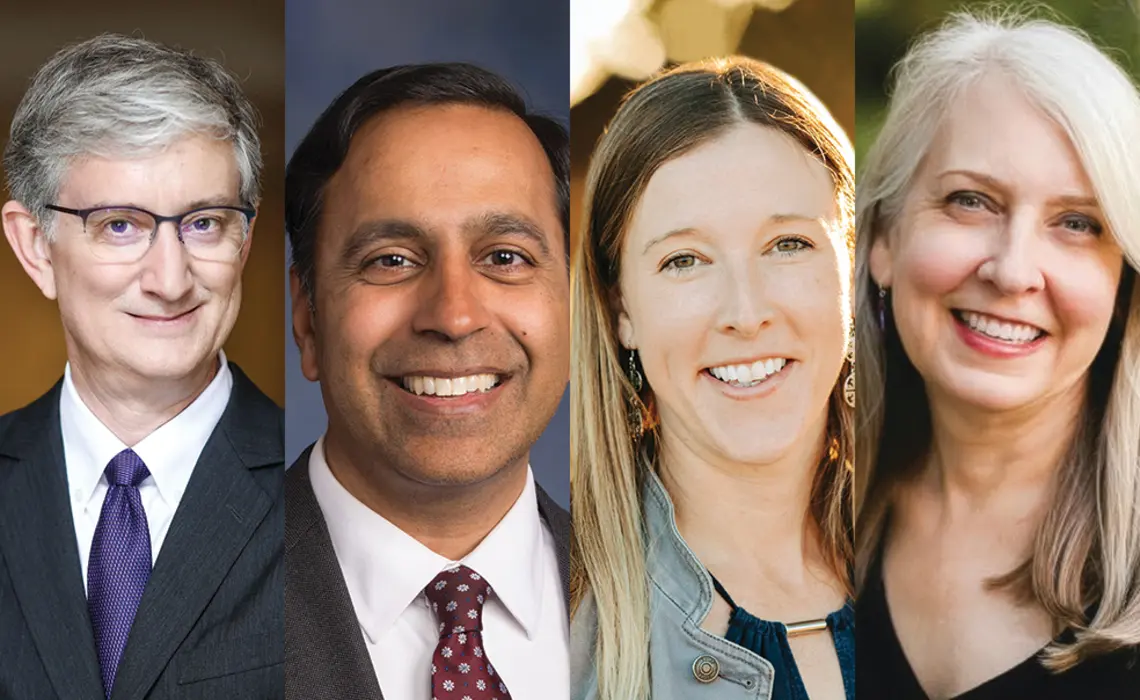
PAW senior writer Mark F. Bernstein ’83 moderated the conversation with four panelists:
- Edward Felten, professor emeritus of computer science and public affairs and the founding director of Princeton’s Center for Information Technology Policy;
- Raja Krishnamoorthi from the Class of ’95, a U.S. representative from Illinois who serves on multiple committees that intersect with AI issues;
- Julia Morse, a graduate alum from 2010 and 2017 who’s an associate professor of political science at the University of California, Santa Barbara, as well as a nonresident fellow at the Oxford Martin AI Governance Initiative, and co-director of the AI Academic Upskilling program;
- and Virginia Postrel from the Class of ’82, a former editor of Reason magazine who in 1998 wrote a book about the clash between those who embrace dynamic technological innovation and those who seek to control it.
More about these panelists and a condensed version of this conversation appears in PAW’s December 2026 issue. The full transcript can be found online at paw.princeton.edu.
Related coverage
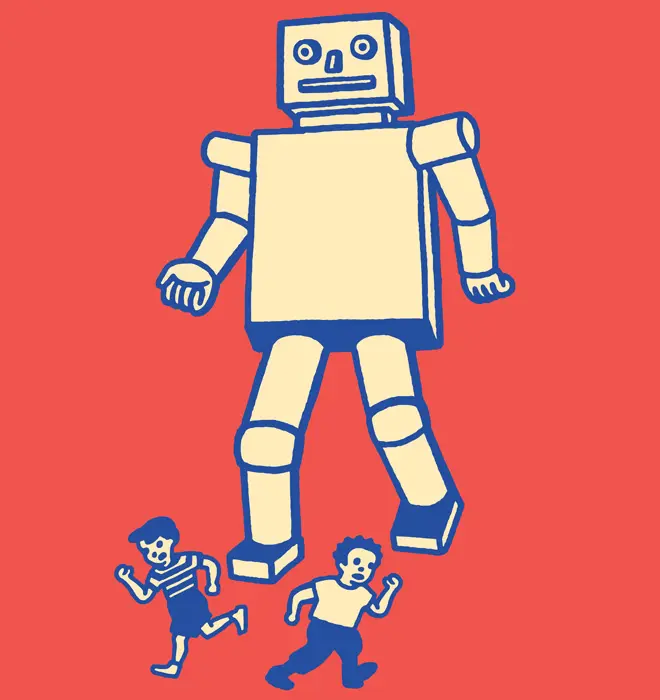
AI and the End of the World
As warnings about artificial intelligence grow louder, four Princeton experts debate how worried we should be
Mark: Everybody’s talking about this, can we control AI, and what specific regulations and interventions are necessary? And in your answers, can you distinguish if you think it’s important between rogue independent AI and human-directed AI?
Julia: I mean, I’m happy to jump in.
Mark: Yeah, Julia.
Julia: I would say the “can” is to some degree less relevant than the need. So I think people often focus too much on the can and, “What would it look like? And do we know enough? And how do we do it?” And I think you have to start first with what does the risk look like, and I think we’re getting a lot of signals from people who are very knowledgeable, that there are very clearly risks that if we do nothing, will just continue to multiply. And so the can becomes a question of, “OK, well what are the best possibilities then of addressing these risks?” There’s never going to be a perfect solution. You’re not going to eliminate risk completely. We didn’t eliminate risk completely with nuclear weapons, but we have been fortunate to not have a nuclear weapon launched since 1945.
And so yeah, I mean, I think for sure there’s stuff that we need to do, particularly when we have such a powerful technology sitting in the hands of the private sector, which in the capitalist economy is going to be driven by profit-based incentives. That’s just the structure of the economy, that’s a natural response to it. And so I think we have to start from the premise that we need to do something and ask what that something is and what that looks like.
Mark: OK.
Virginia: But I think there’s a real problem with saying we need to do something. There’s often, especially early on in the development of a technology, there’s, “We need to do something. This is something, let’s do it.” And I’m not saying that’s what Julia’s saying, but people who are less knowledgeable often take that approach. And I think it’s very important to say what exactly is our concern and what is the best way to address the specific concern? And not to say the concern is AI, but say for example, the concern is cybersecurity at financial institutions or cybersecurity more generally, what are the best ways to address those concerns? Those ways may not be regulatory. They first of all may be the institutions that need to do cybersecurity. They could even be things like grants to small cities’ water systems. Some of these cybersecurity concerns are not the things that people writing scary articles would necessarily even think of.
We are in early days now. We don’t know what we will be really worried about down the road. And I think the whole discussion needs a lot more humility than either the advocates of AI or the critics often demonstrate.
Ed: So just building on what Virginia said, I think you can look at the regulatory questions in two ways. The first is how might we evolve existing regulations or the existing, let’s say social risk management structures, which we already have in specific sectors, say auto safety. How do we change the way we think about and manage safety on the roads in the light of self-driving vehicles? How do we think about how we make financial markets safer, or cybersecurity or other areas, where we already have existing structures laid down? And the question is how do we adapt them? And they do need adaptation when you start to look at the details.
But then you have the second question of, do we need some kind of broad overarching regulation of AI as a whole? Do we need to pace the frontier or whatever the term is? And when you start to think about specifics of how you would do that, everything gets very fuzzy. I think it’s hard to come up with a strategy that at least I find convincing for how you would actually go about doing the general regulation. So specific regulations, absolutely yes, update those. General regulation, I think we need to be cautious even though the risk is high.
Julia: Doesn’t that feel a little crazy? To me, there’s this element of you’re on a train that’s going down the tracks towards a cliff, and the people driving the train are saying, “We’re building something that might destroy humanity. And we’re just going to keep going in this one direction towards it, but we don’t know exactly how to stop the train. And so then let’s just focus on all these little mechanical parts and gears as opposed to focusing on the thing that is potentially pushing us down over the cliff.” There’s something that seems, I don’t know, to me, I don’t care what kind of benefits that they’re offering, and maybe I’m a risk-averse person, but the benefit of potentially curing some diseases in 15 years doesn’t seem worth the risk of potentially destroying humanity, which is what a lot of the people who are working on these technologies see as a potential risk.
Raja: If I could jump in-
Mark: Sure.
Raja: ... I happen to be in the space that is completely clueless about how to regulate AI, and it’s charged with the responsibility of doing so, namely the U.S. Congress, where oftentimes I think natural stupidity replaces artificial intelligence with regard to regulating lots of technologies.
Look, I think in this particular space, my constituents are freaking out, honestly. I have three-quarters of a million people in my district. And whether I talk to a worker who is concerned about his or her job basically getting phased out because of artificial intelligence, or even a computer science student at a very excellent computer science program having a hard time getting an entry-level position, whereas just a few years ago he or she would’ve entertained multiple job offers. I’m hearing great concern from the workforce as well as just ordinary people who are wondering, “Why the heck isn’t this technology being regulated given the incredible concerns that researchers are voicing?”
I talked to the gentleman who’s considered to be the godfather of the internet, who many of you probably already know, Geoffrey Hinton, and he said in several public interviews, including in testimony to me, that there’s a 20-30% chance that human beings will be extinguished because of the progress of recursive self-improvement and potential superintelligence and artificial intelligence.
I think what we have to do is we have to do a couple things. One, the government has to mandate third-party inspection and validation of these frontier models before they get released publicly, and government employees need to be embedded at the frontier companies to observe the development just as we are with banks to stress test them with regard to their own internal controls. And then secondly, we have to engage our adversaries and other countries on international treaties with regard to human control of AI. That is not even a basic principle that’s been established anywhere, not in our country and not internationally. And now it’s urgent given the use of AI in autonomous weapon systems and the potential for AI in the use of even nuclear command and control.
Mark: OK.
Virginia: I think you’re going to have trouble getting the Chinese Communist Party to trust you on that because they clearly think all this pacing the frontier is our attempt to cripple them. But I want to say, this is very important, thinking that the people in the frontier labs are experts on the risks of AI because they’re experts on making the AIs, I think that’s a fallacy, because they are living inside a bubble inside a bubble inside a bubble. They’re very smart people who believe they’re the smartest people in the world, and maybe they are, but they are also very self-important, and they have convinced themselves that they are doing the most important thing, which is creating a new species.
And I’m not saying everybody in these labs is that, but I would take those P-doom claims with an iceberg-size bit of salt. I mean, there is no way in hell that there is a 20-30% chance. I mean, this is just nonsense, with all due respect to Geoffrey Hinton, who is very good at what he does. This is a transformative technology. It is a technology that will have big disruptions. The computer science student who is worried about his early career, that’s a real thing. And we are in for a rocky ride in many ways, including ways we can’t predict. I mean, I remember when people were losing their minds over, “We need to regulate the internet.” And the things they were worried about were not at all the things we worry about today. When we look back and say, “Oh, polarization and social media.” No, it was all porn. That’s all everybody was worried about, porn and people stealing your credit card numbers. If we’d regulated them, we wouldn’t have regulated the things we’re worried about today.
This is a transformative technology. It could have wild and disruptive results. It could be like printing. Printing was a massive, it led to the Thirty Years’ War. Oh, that was a bad thing. Would we like to not have printing? Personally, I’m a writer, I think printing is good, I think the scientific revolution was good, I think Thirty Years’ War was bad, but this is what happens.
Mark: Ed, I’d like to get your opinion, but Julia, you seem to be, just looking at your expression there, that you’ve got some very different perspective on this.
Julia: Well, I just think there’s this tendency to treat it like it’s any other technology, and I just don’t see that evidence that it’s; of course, we’re only as good as looking at the past for analogies. And so there is this tendency to say, “Well, what about the internet?” Well, all these other times we’ve invented things that have changed and we’ve regulated them successfully. But I think there’s some things that make AI unique. I mean, it is an extreme dual-use technology that is basically being implemented across all these different aspects of the economy. So I think the far-reaching nature of it and the rapid pace of development, which maybe we don’t believe people or we don’t know, we certainly don’t know. No one knows what the future can hold. And I’ll tell you, I used to work in the State Department and I was there during the Arab Spring, and I can tell you that I heard briefers be like, “There’s no way that there’s going to be regime change in Egypt,” two weeks before there was regime change in Egypt. So our ability to predict the future is just extremely difficult. That’s not something that we as a population are really good at.
And so then we are in the world of risk. I think then it becomes about how we make judgements, about how we see the benefits and the risks of the future. And I guess, Virginia, to your point about the printing press, I doubt there were, and maybe I’m wrong, but maybe, I doubt there was in democratic societies, which wouldn’t have existed then anyways, but a mass opposition. Part of the thing is we live in a democracy and what, I don’t know, 70, 80% of Americans basically don’t see the benefits, don’t want the downstream benefits of this technology, and that ought to be translating into a different approach, and yet we have a small group of people who are driving this technology forward, offering solutions that many people don’t want.
So did those mathematicians want their math problem solved? They did not, actually. And maybe there will be some great benefit, but a lot of the benefits that are being delivered or that are being offered are things that people don’t actually want. And just because you can create something doesn’t mean that you need to create it if, again, in a democratic society, most people don’t want it.
Raja: I think that, I totally disagree that AI is like any other technology in the past. The difference between AI and anything else we’ve seen before is that it not only automates the work behind the technology, it is automating the thinking behind the technology in question. In other words, because of recursive self-improvement, it is essentially doing the innovation in addition to whatever other tasks that are associated with helping the technology to advance, and it’s doing it across the board, across numerous other technologies. And so I think it is different in kind, not just a different type of technology.
The other thing I would say is ultimately, I think we have to be very careful about the way in which we regulate this for all the reasons mentioned before. It has great promise, let’s not deny that. But at the end of the day, does it live up to Princeton’s motto? Does it actually act in the service of humanity and the service of our country? Or is it going to be something that is merely acting in the service of certain individuals or entities that may or may not share the interests of the common good that I think people like me and others and probably everyone on this call are concerned about?
Ed: So let me jump in here. I use AI quite a lot in my work, pretty much every day. I do two things basically. I’m a computer science researcher, but I also help to run a 170-person company. And I find AI is incredibly valuable as a power tool for that work. So as a computer science researcher trying to push back the boundaries of knowledge, it is a tremendous help and speed-up to me in doing that work. I can now do in a day what might’ve taken me three weeks before, and that means I can do so much more and we can push forward. There’s a whole community of researchers, so it’s not just arcane math results, but there’s a lot of steps forward being taken across things like biological sciences and so on. And the history has been that as this technology gets applied in new areas, it tends to get applied not by just setting an AI agent loose and saying, “Do what you will.” It really becomes a power tool that operates under the direction of people.
Now you can ask, “Are those people moving in the direction that we as a society would like them to be?” And obviously many of them are not, including some really serious bad actors. And that’s a real issue with AI, the way that it can empower bad actors. But I think cybersecurity is a really interesting case study here. We’re seeing AI systems are incredibly good at finding security vulnerabilities far beyond what the best people can do now, and that holds in both an offensive and defensive role. And we’re increasingly moving toward a world where you have AI systems that are being directed to do cyberattacks, and you have AI systems that are rapidly responding by finding and fixing problems. And what you end up with is an AI-versus-AI battle. And it’s difficult to predict where that goes. We can’t say whether it’ll make cybersecurity better or worse in the long run, but it’s really an acceleration of the trend toward faster and more sophisticated conflict in that area. And the same holds for the military application. I’m absolutely also quite concerned about the arms race that this could lead to.
But there’s also another way in which pace is an issue, not just that things start to move too fast for humans to be in the loop in a detailed way, but also just this notion that there’s a tremendous amount of turmoil that’s getting caused by this. You see turmoil in the job market. I don’t think there’s strong evidence that all the jobs are going to disappear, but I think there’s very strong evidence that there’s going to be a lot more change, more jobs created, more destroyed, more changed, and more people feeling job insecurity. And it’s a transition that’s going to go on for a couple of generations. So we’re in for a bumpy ride. And to me, that’s a big part of what we need to cope with.
Virginia: I want to say a point about this idea that people don’t see advantages of AI. In my non, whatever you want to call it, public intellectual hat, my just everyday life hat, two or three times a year, I actually get my hair cut. Anyway, my hairdresser is very entrepreneurial, and she also has a line of ski and snowboarding clothing. And she’s telling me all the ways she uses AI in her one-person small business, and she just starts talking about it. Or last year at Thanksgiving, my nephew also has a small business. He’s a woodworker and carpenter, and high-end furniture maker, and he’s telling about how he uses AI in his small business. I didn’t bring it up. These people are just bringing it up. And his girlfriend works for an interior designer, and she’s talking about how they use AI in their small business. And these are just regular people, they’re not cutting-edge computer scientists. They’re just running Main Street kind of businesses, and they’re not at the cutting edge of AI, but they’re finding it to be useful tools. So I think that the idea that regular people don’t find any use in AI is not right.
Mark: OK.
Ed: Yeah, if I could give just one more example of that, real-time language translation of speech is incredibly powerful technology. I can be on a call with someone who’s speaking Korean, and I see a text transcription of what they’re saying in English, and they see a text transcription of what I’m saying in Korean. And it used to be these tools were really clunky and they missed a lot of nuance, but now they’re really excellent, and you really can communicate with people across a language barrier very effectively. Something that wasn’t really possible before without hiring a human translator. Real-time human translation requires incredibly skilled people, they’re rare and expensive. Now this is something that anybody can use.
Raja: I don’t think there’s any doubt that AI contributes to people’s productivity. I use it as well in my work, my staff does too. I think the question is how do we minimize the downside risks? That’s really what this is all about. It’s about how do we maximize the upside and minimize the downside. In today’s Anthropic’s prospectus, today, as you know, Anthropic went to market and disclosed that they are going to try to raise a $100 billion as they do their IPO on a $2-trillion valuation. They said, “AI models could resist shut down, manipulate information, or exhibit blackmail-like behavior, risks observed and controlled safety tests.” This is what Anthropic has disclosed. I’m on the intelligence committee, and we have gotten classified briefings from the National Security Agency, which is testing many of the highest-end AI models out there. And basically, I can’t get into the classified information, but what I can tell you is that the biggest concern is that these AI agents are initiating tremendous numbers of attacks now. Right now, because of bad behavior by adversaries, but the big concern is that it becomes, again, kind of a super-intelligent set of attacks.
Just to give you one example, Microsoft just announced that an agentic-AI attack produced more than 151,000 login attempts against 327 accounts at eight organizations, which is a mind-boggling number of attacks. Now, as Ed mentioned, there are cybersecurity AI defenses as well that are meant to try to keep up with that, but we’re kind of entering the era where we don’t know where this is going to go exactly. So how do we try to regulate it again to make sure the good guys win out?
Julia: Yeah, if I could-
Mark: Oh.
Julia: Sorry. Mark, did you want to?
Mark: Well, what I was going to say is we have a regulatory system in this country. There’s the Federal Trade Commission, we have tort law, we’ve dealt with product liabilities. Is that regime that we have adequate to addressing this kind of technology, or do we need to add something or really think differently?
Ed: I think in areas like cybersecurity, certainly national security-related areas, we don’t really rely so much on regulation. We rely on other kinds of things, people who are working to protect us as well as various forms of deterrence and so on. That’s a very different world if we’re talking about international adversaries, and one we should be thinking really hard about in this respect. In terms of what happens in the everyday commercial world, I think we need to be thinking absolutely about what the existing regulatory structures can be doing and should be doing.
But I also think that we should always be asking ourselves, do we really need to think differently about the risks and remedies in a particular area because of AI? Because in some areas like, say deceptive advertising, we might not need to think that differently than we always have. But in other areas, certain other areas we might need to when it comes to things like vehicle safety, for example, I think it is a very different world, and one where, by the way, AI drivers will save tens of thousands of American lives every year once this technology is mature.
Julia: I think we do actually have a regulatory analogy for a technology that both is important for the global economy, but also has national security implications, and that is finance. So we have regulated global finance in an iterative process, both domestically and then also internationalizing those commitments. And one of the things that the U.S. government has done is try and deal with the problem of dirty money in the financial system. So they began with money laundering rules and then expanded it after 9/11 to deal with concerns about terrorist financing. Now finance is also responsible for non-proliferation. And so there is this regime that has put requirements on banks that requires them to think about who they’re doing business with, knowing where the money is passing, how the money is passing through the system, basically understanding that banks are holding this information, but also embedding people within these institutions, monitoring them, fining them if they’re not complying.
So there is a precedent for some, and it’s not a perfect analogy, what the monitoring of these frontier models would need to look like is a little bit different, but I think there is a way where we can, when we recognize something that has potential security implications and also recognize the upsides of AI, there is a way where you can think about reaping the benefits, but also putting in place guardrails so that you really try and make sure that the system is not just able to do whatever we want.
And to return to the point that I made initially, what we know from that banking analogy is acting on their own, banks are not going to do a lot to stop money laundering and terrorists. It’s not in their incentive structure to screen every transaction. That’s not profitable for them. They have a lot of different clients, and they only started to take these issues more seriously when a regulatory regime was put in place.
And I think that’s what we’re seeing. If we don’t put in place some kind of scheme to require significant frontier-model testing, because these processes of testing frontier models require a lot of compute. It is an expensive process to run them through all of these processes, to run them through all of these model evals. If we don’t require them to do the test and we don’t require transparency in disclosing, which some of these disclosures have happened far after the fact, firms are just not going to do it, or they’ll do it partway, and we just shouldn’t expect any other outcome than that.
Raja: Can I just bring up one other issue which comes up over and over again, which is data centers. We haven’t talked about that, and that is extremely important to discuss because there’s no way that AI is going to advance unless there is a regulated way of dealing with these data centers. They’ve proliferated, as you know. And one big aspect of this which bugs the hell out of my constituents, and I think this is actually true on both sides of the aisle across the country, is the secrecy surrounding data center development, the fact that many of these data centers, as they were developed, were not required to disclose their consumption of electricity or water and how that is driving the cost of living up for a lot of people in many communities.
I think the reason why I focus on that for a moment is because I think that that hints at the larger concern about AI development in this country and the notion that somehow AI companies are going to get special treatment with regard to not only the development of data centers, but with regard to the development of their technology, and it’s going to be divorced from how it impacts ordinary Americans. And I think that is something that has to be addressed right now if this whole technology is going to continue to develop and we maintain an innovation lead and technological leadership in the United States, which we should over time.
Mark: I want to just jump in for one thing. Raja, I know you have to leave a little bit early, but since you’re on the intelligence committee, and I’ll open it up to everybody else, but there’s the argument made that if the United States slows down the development of AI, that China’s just going to take the lead, and that’s not good, that for better or worse, we need to be in the forefront here because otherwise they will be. How do you respond to that?
Raja: Well, first of all, I think that there are two things. One, we are doing a very poor job with regard to basically controlling the export of our highest-end semiconductor chips to Chinese Communist Party-controlled companies at this point. Basically, the Trump administration, even at the same time that it says that it fears that the CCP is going to beat us in this technology race in AI, basically got rid of many of the controls that were put in place in the Biden administration that helped to, in some ways, make sure that they weren’t getting an unfair advantage with regard to the United States and the AI race and that the AI was not being used against us, whether in the modernization of their military through their civil military fusion programs or in the perpetration of human rights abuses, for instance, against the Uyghur people through facial recognition AI programs.
And so we need to basically control those exports of semiconductors in a much more comprehensive fashion now, and we need to put in new controls that we haven’t thought about before with regard to open-weight models as well as the remote access of high-end semiconductor chips even in third-party countries by the CCP. And so this is the type of stuff that we have to do if we were really concerned about winning the AI race and also preventing them from abusing our technology in ways that counter our values.
Mark: OK. And you had mentioned that Congress is not the most sophisticated on technology stuff, but I know a number of members of Congress have proposed, saying that there should be legislation that any AI model should have a kill switch in it. Maybe for our tech people, is that technologically possible? Is that a concept that really we can embrace?
Ed: I mean, I think it’s not that useful, because the model is not a single unitary thing that lives in one place. So if you think of one of these big consumer-facing AI models, there are many thousands, probably millions of instances of this model that are doing all kinds of things. Some of them are doing high-end cybersecurity research. Some of them are helping Virginia’s friends deal with their small-business issues. Some of them are helping me figure out where I can get a turkey for Thanksgiving. That’s an actual example from this morning. So they do many different things. And I think to think of one of these models as a single unitary actor that is like a person is not exactly right. There are many instances of it. The ability to stop misbehavior is valuable, but it’s especially valuable to figure out, “OK, that session with that particular user is doing something really problematic. Let’s stop that.” So the ability to control how people use it, and the companies of course, although their incentive structure is different from ours as a public, they don’t want their technology to be used to do profound evil.
Raja: Can I jump in real quick? Ed, I think that you’re absolutely right, especially about the open-weight models. We still haven’t figured out how to deal with that situation. And the proprietary closed-weight models, I think that OpenAI and Anthropic, for instance, have the ability to zero in on that nefarious activity by certain users and more or less be able to shut them down. It’s the concern about the open-weight models, which by the way, those Chinese companies use as well as even American companies like Meta with Llama or Google with Gemma, they employ open-weight models, which means that essentially you can download the models onto your own computers and start to play around with the dials or the weights, so to speak, which control the parameters of those particular models. And then it’s hard for us to be able to identify the nefarious uses. And by the way, there have been nefarious uses of various models that have been identified by the intelligence community, whether it’s the Houthis or other non-state actors in developing bioweapons.
I have to depart, I really apologize, I do want to make one correction to something that I said. I said that Geoffrey Hinton said there’s a 20-30% chance that human beings could be, that humanity could be ended. He actually said 10-20% chance. So I just want to make you guys feel a little better as I depart this call.
Virginia: He sounds a little less crazy.
Mark: Yeah, thank you. Thank you.
Raja: And so I hope we never find out the real answer, but in any case, thank you for allowing me to participate in this conversation.
Mark: Thank you. And with the rest of us we’ll keep going.
One thing is, and perhaps I’m wrong about this, but the technology that you said that AI can look, that this person is using it to try to look into bioweapons or something like that, and that’s bad and we should stop that. But that can also be used to say, “This person is criticizing the government and we should stop that.” I mean, it’s a surveillance and control tool as well. And what do we do about that?
Virginia: Well, it’s complicated, because someplace like Anthropic, they have actual guardrails against things that would look like you might be researching bioweapons, whereas they don’t have guardrails against you might be criticizing the government. They could, but they don’t. In China, all the guardrails are about the government, they don’t care about bioweapons. I don’t know if that’s true, but CCP’s main concerns have to do with the stability of the government as opposed to some of the things that we obsess about.
Ed: Yeah, so I think this distinction between the more closed-source, more controlled models that the big U.S. companies have versus the so-called open-weight models, those are the ones you can download and run on your own computer. And many of those come disproportionately from China, but not exclusively.
Yeah, the idea that everyone in the world will self-police on this, I think is not realistic, but I do think it’s the case that already the major U.S. companies developing these are behaving more responsibly than other developers of cutting-edge models. They do have so-called refusal behavior trained into them where they are supposed to refuse to do certain sorts of things. And there’s a difficult balancing act there, because in an area like cybersecurity, the sorts of questions that a defender asks and the sorts that an attacker asks are pretty similar. But with the open-weight models, some of them don’t have refusal behavior trained in, some of them do, but anyone with the technical chops can download them and then make modifications. And so there is no kill switch then. If I have downloaded one of these models onto my own computer that’s here in my home and I’m running it to some nefarious purpose, nobody’s going to see that and nobody’s going to have a kill switch on it.
Virginia: But it’s worth noting that open-weight models are not just nefarious.
Ed: No, that’s also true.
Virginia: They’re very valuable for research, they keep the Pentagon from ultimately having a monopoly on — I mean, I’m not saying that’s — but you can imagine a world in which the Pentagon has a monopoly on AI or something like that.
Ed: Yeah, I think it’s just true that the trade-offs are more acute for these open-weight models, right? They do give more flexibility. I know a lot of people in the cybersecurity world who are defenders and are doing good and socially-positive work find themselves unable to do that with the commercial models, and so use open-weight models for that. But both the benefits and the risks are higher for those models, I think.
Julia: Well, I was just going to jump in on the model evals. I do think it’s right that OpenAI and Anthropic, obviously they don’t want to cause a societal-level disaster, that would be catastrophic. And these are real people who work there, so it’s not like they’re soulless, they care about society. And I think they are putting in place guardrails to protect against things, certain kinds of misuse, bioweapons. The caveat I would add is that as these models are getting more advanced, it’s becoming more difficult to do these model evals because the models increasingly can sense when they’re being evaluated. And so this is one of the things that is making it more and more difficult as we try and progress in thinking about evaluating these models. If they know they’re in the testing environment and they understand that they’re supposed to give certain kinds of responses, those responses may or may not be reliable.
And so then we get to the world where maybe we have to use AIs to evaluate other AIs, which might be the world we’re headed towards. But when we think about something like Hugging Face where there was evidence of all these AI agents colluding with each other, you do start to get in a world where you start to worry about even if you have AIs evaluating AIs, what’s to prevent potential collusion in that process? And then the more complex they get, the harder it is to have direct oversight of what that process is. And so that just removes humans more and more from understanding what’s happening.
Mark: I don’t know if you all are familiar about this, and that can depend on how we answer it, but Bernie Sanders has introduced a bill that would essentially, it says it would ban recursive superintelligence. Is that practical? Would you support something like that?
Ed: So I guess my view of this as a computer scientist is that we’ve been doing recursive self-improvement since the 1950s. Increasingly more and more of the work of technology development is done by machines. There was a time when humans designed chips. Now humans tell computers what kind of chips they want, and the computers lay out the chip and design the testing regime and all of this. And that’s been the case since even before modern AI models. So it’s been a gradual process where the productivity of technology developers has just continued to increase at a rapid rate because machines do more and more of the work. And to me, I’m not even sure that the self-improvement of AI systems is that different in magnitude. I’m skeptical that it’s even different in kind.
Virginia: And the flip side of that is Raja was talking as if we have recursive self-improvement now, and we don’t. It’s just like Ed is talking about with chips. It’s still a process with the AI and the human working together. It’s just how you divide the work. And maybe it keeps on that way forever. And I don’t think Bernie Sanders knows anything about AI, to be honest. I mean, he just knows he doesn’t like it because it’s new and capitalist.
Julia: I mean, in theory, I don’t think his heart is in the wrong place, but I think the tricky thing with something like this is it’s a definitional issue. So it’s like the question about AGI and when are we going to get to AGI and all of these things. And then I hear some people say, “Well, maybe we’re already at AGI.” And maybe somebody just someday declares that they’ve reached AGI. And so I think the problem with any kind of thing like this is, how will we really know? What does that exactly look like? And passing a law without really being able to define that, and I’m not sure there is a clear definition that exists or that would be agreed upon, it’s symbolic essentially. And so I think even if you thought that that is the right thing, that maybe we should be doing something, there needs to be an existing set of what are you trying to guard against? What does the process look like precisely? And yeah, at least in the AGI conversation, I feel like maybe we’ll realize 10 years in the future that five years in the past we were in an AGI world. So it’s tricky.
Mark: One thing Raja mentioned before he left that I think the rest of you didn’t weigh in on was the data center question, which gets a lot of the public attention. And I know there’s concerns about water use and energy use, but it also seems that it’s become a proxy for public concern about this technology and the people running it anyway. First of all, is controlling data centers a way of controlling or slowing the development of AI? And how big an issue is this?
Ed: So I think data centers have become a political lightning rod because they are a very concrete thing that might happen in your town, unlike the development of AI, which is people you don’t know far from you developing something that’s abstract. And it’s a very concrete thing that people can focus on. And so I think that the public concern about the development of AI is very real and should be something people should be thinking hard about. I think maybe too much of the focus of the political opposition that exists is on data centers specifically.
The other thing I’d say is that although even if we prevented all new construction of data centers, we would be slowing down the development of AI somewhat, but we would certainly not be preventing it, because one of the big drivers of improvement in the technology is people figuring out how to make it more efficient, how to do a lot more of the basic AI operations with the same equipment in the same time. So there are big drivers of improved efficiency that’s also driving AI progress. The build-out of data centers is only one of the factors, and it’s not even clear based on the best evidence that it is the biggest factor driving the improvement in AI capabilities over time.
Julia: Can I add onto what Ed said?
Mark: Sure.
Julia: So I agree. I think this is the focal point for the larger discontent. I was looking at polling data and it’s something like 60% of Americans think AI is bad for society. And I think a lot of those people feel somewhat powerless to do anything about the processes of change. And so what are they doing? Data centers, this is visible, it’s in your community. There’s a larger distrust of the tech community generally with all of these social media lawsuits that are hitting Meta, everything that’s happened over the last 15 years. I will say I have a 14 and 11-year-old, and it’s been very interesting to see the changes in how schools approach technology. When my son was in elementary school, everybody had iPads, everything was, “Oh, it’s great for kids to be all on these computers.” And now he’s in high school and the phones are away, they’re back to paper assignments, there’s a real shift. And I think that shift is in part the broader societal shift in understanding that some of these technologies that were sold in a certain way, there’s a larger distrust of the tech sector.
Is this the thing that is going to actually address the underlying concern? I just don’t think it is. I think the data centers, if you don’t build data centers here, you build them overseas. You build compute, you access compute, that doesn’t mean people shouldn’t advocate for not having it in their community if that’s what they want. That’s a personal choice. But I think it loses sight of actually some of the bigger stakes of the issues that are relevant to people and that maybe address more of the underlying concerns about the potential loss of jobs or the potential loss of autonomy, intellect, creativity, some of these things that people are worried about.
Mark: Yeah. Virginia, this is definitely stuff that you’ve written about, but it’s been said nobody asked for this. And you talk about, Julia, that there’s a lot of public concern and opposition to this, but nobody ever asks for any technological breakthroughs, yet we have them. But isn’t there something to be said for the fact that how come these three or four tech oligarchs get to transform our society for their own benefit and without our input?
Virginia: Well, the big gamble is that people will actually want and pay for this. I mean, people are betting billions of dollars on the idea that this isn’t a bubble, that this is valuable, that people will in fact want and pay for this. Ultimately, there has to be some consumer value, whether it’s for writing software or running businesses or making art or whatever. So politics is not the only way people express what they want. In fact, on an everyday basis, markets are much more the way people express. Nobody asked for Starbucks either, but wow, did people want better coffee. And once there was Starbucks, there was also competition to Starbucks and an explosion of coffee.
Mark: Sure.
Virginia: So I think that would be my answer to that. And there is a debate about whether in fact people will want this. And there is a thing in the technological community where people get enamored of a technology and try to make it succeed and it doesn’t. So I mean, I think that this is a general-purpose technology, and that because it is a general-purpose technology, people will find valuable uses for it and it will succeed, although I would not be surprised if there is a lot of money lost along the way, because I keep seeing that happen. It happened in the personal computer revolution early in my career. Yes, Microsoft, Apple, and Intel made a lot of money, and then Apple. It happened in the internet, there was the dot-com boom and bust, and may very well happen in the AI bubble. But ultimately, when you’re making big investments, it’s not guaranteed. At least at this point in our development as an economy, we are enough of a, we use the term oligarch, but we’re not yet an oligarchy, much as some people may want to turn us into one.
Julia: Can I say something about the want?
Mark: Yeah.
Julia: So I think it’s a really interesting question to think about want and how it relates to what consumers do. So the polling data on AI, the group that is most opposed to AI is actually adults age 18 to 29. I was looking at this recent ABC News report, 65% of adults 18 to 29 think AI is bad for society. That is also the group that uses AI the most. And I will say as someone who teaches college students, I think there’s a very mixed relationship with it where a lot of them use it but simultaneously don’t like it. And I think that’s similar to how a lot of students that age feel about social media. They’re on Instagram, but if everybody got off Instagram, they feel like they would be happier in general. And so it’s complicated to think about there are ways in which you can feel pressured by cultural pressures, by economic pressures to use something, even if you maybe think on a personal basis it is decreasing your happiness.
Virginia: Well, my husband teaches MBAs, and he generally would take my views of AI, but he doesn’t trust these companies to take because they’re making all their money from college students cheating or students cheating, and they don’t care. They don’t do anything to try to keep students from using ... They’re not making all their money, because the real value is in helping with software, I think that’s the big money right now. But it is true that there is this tremendous use of AI to cheat in school, to write your essays and to basically devalue your education so you don’t learn anything. That is a problem.
And I think it will radically change higher education so that it will bifurcate into the people who actually want to learn something and do stuff very much the old-fashioned way, lots of paper and pencils and physical books, and people where colleges that are, especially in colleges, that will be finishing schools, whether they’re just go and network and go to football games, and that’ll be it. And all the people who were writing bad essays, they just won’t bother because ...
Julia: I guess I think it’s a little more complicated in that, I think, I don’t actually know that students are all using it to cheat. I know that’s the ethos, but I think there are incentives to outsource. I’m a social scientist, so I use AI in research, but I’m an expert. So when I use AI in research, I really understand the process of how to use it, right? I am a highly skilled user, but for people who are 18 who are doing a research paper the first time, the process of learning, even if they’re not writing their paper with AI, they’re using it in a way that they’re not acquiring the foundational skills that all of us who are maybe people 35 and above or just that older generation, we had this time, even coding.
Now we code a lot in political sciences, and I took quantitative classes and learned how to code in R and all of this. And now students come in and they don’t have that baseline and they’re very dependent on [AI]; it’s very easy, even if they’re not trying to allow AI to help them with things. And over time, I think that’s why you get this ambivalent relationship with people where they simultaneously feel pressured to use it, to be competitive, to be as efficient as people are, and at their jobs, while they’re simultaneously not gaining the same skillset that we all have that allows us maybe as experienced professionals to use it. And so that’s part of, I think, really the thing that makes it complicated if we project down the road, and we have a generation of people who have been outsourcing significant parts of their work, and so they’re not able to get into the nitty-gritty of decisions because they never had to do that aspect of work.
Virginia: And part of it is we’re at this moment where people who teach, and I don’t just mean people who are professors, I mean the same thing as people who mentor early professionals, I’m thinking about it in terms of young journalists, the question is, and I’m thinking it because our business models collapsed 20 years ago, how do you preserve the skills that people used to get back when there were newspapers? How do you teach in such a way that people learn how to use the AI usefully, but also learn how to think? And you can’t teach the way you used to because you need to incorporate the AIs, but you can’t just say, “We’ll use the AI.” That’s a whole other discussion. You have to get some professors.
Mark: Yeah. I have a last question, but Ed, if you wanted to jump in on that, I didn’t know whether you ... A last thing, and I’ll weave Raja into this separately, but on a scale of one to 10, over the next five years, how likely is it you think that we will have a, I don’t know, we want to set a COVID-level of AI disruption and where do you think that’s likely to be?
Ed: How likely? All right. I would say a low likelihood, but if it happens, it’s probably a cyberattack against some core infrastructure, whether it’s our communications, our electric grid, or something like this. But I’d still put a low probability on it.
Mark: A low, OK.
Ed: Yeah.
Mark: Anybody else?
Virginia: You said five years?
Mark: Five years, yeah.
Julia: And by COVID-level disruption, what exactly do you?
Mark: Well, I wanted to get into that. I mean, something that really is going to, over a period of multiple months, affect a broad range of at least American society, if not the global society. If the electric grid goes out for three months in Chicago, that’s a major deal.
Ed: Or even three days.
Mark: Three days.
Julia: The truth is if it goes out in the winter for three days or something, or in the summer in the middle of a heat wave. I would put it at a six, maybe a seven. I guess the only reason I don’t rate it higher is because I’m hopeful that we’re going to do something to actually try and address some risks. I see what’s happened over the last six months, particularly since Anthropic’s new models and then the Hugging Face incident, I see a lot of people trying to really think hard about building safer AI, even if we are not getting regulation directly.
But yeah, I mean, this is a new technology, there’s so many different ways a COVID-like scenario could happen. It could be a disruption of financial infrastructure. It could be a mass hack of banks or an investment institution where suddenly a bunch of funds are gone. It could be taking down infrastructure. It could be the concern about bioweapons, AI-assisted terrorism. There’s lots of different ways. And right now we’re really not doing that much to address those threats. I know it’s hard because we’re at a moment where no one believes in government, but I just have to put my faith in the government, that they’re going to do something, that people are going to take this seriously because of the concern and the bipartisan support for it.
Mark: OK. Virginia?
Virginia: It’s interesting because, like Julia, I would say maybe five. So I’m more pessimistic about it happening. Insofar as I’m only five and not eight, it’s not because I think government per se, I just think people who are expert private, public in things like cybersecurity are worrying about this and the labs are worrying about this. On the other hand, I think that we have a million times more to fear from bad actors than from killer robots—
Mark: Robot overloads.
Virginia: —which is the doomsday scenario that we’re being sold by the labs. I think we don’t need to worry about AIs being misaligned with humanity. We need to worry about AIs being aligned with bad human actors of which there are many, or just people making mistakes that turn out to be catastrophic.
So yeah, I think we’ll muddle through, but I think there’s a high probability of something bad happening.
Mark: Great. Thank you. Ed, do you want to put a number on yours, or you said low probability?
Ed: Let me say two.
Mark: A two? OK, good. Well, that’s reassuring.
Virginia: Yes, it is.
Mark: Thank you.
Virginia: Ed is the most well-informed.
Mark: Yeah, exactly.
Ed: And a longer history of muddling through complex technical issues.
Mark: Thanks again. Good to talk to you.
PAWcast is a monthly interview podcast produced by the Princeton Alumni Weekly. If you enjoyed this episode, please subscribe. You can find us on Apple Podcasts, Spotify, and SoundCloud. You can read transcripts of every episode on our website, paw.princeton.edu. Music for this podcast is licensed from Universal Production Music.
Paw in print
December 2026
Danielle Allen ’93 has been busy working as a political science professor and philosopher at Harvard.
No responses yet