

Anthropology Students Search for Patterns in Courts’ Deportation Decisions
Professor Amelia Frank-Vitale and her students have spent hundreds of hours observing and documenting proceedings


Immigration courts are open to the public — but they are often overlooked. Amelia Frank‑Vitale, assistant professor of anthropology and the Princeton School of Public and International Affairs, wants to change that.
Frank-Vitale is helping lead a project to conduct ethnographic research inside immigration courts across the country.
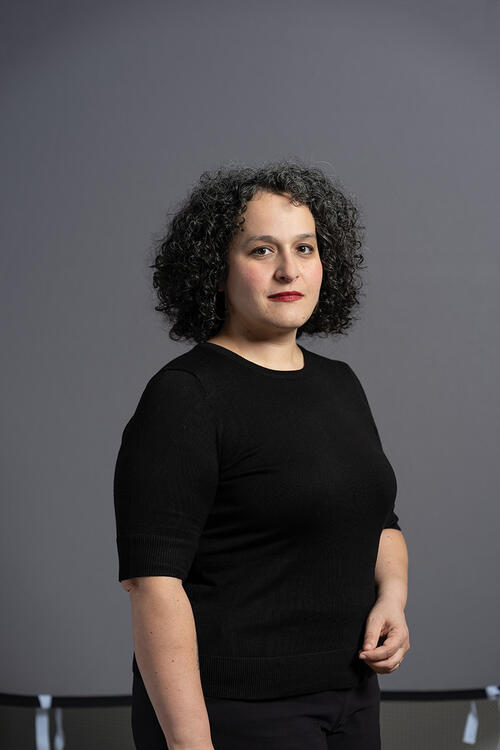
Starting in 2024 and working with professors from Barnard College and California State University, Long Beach, she has been training students to observe and document courts in New York City; Philadelphia; Newark, New Jersey; and Santa Ana, California. By pairing classroom preparation with on‑site observation, the project tries to decode the black box of the courts — where similar cases can have vastly different outcomes. As of May 2026, her students have observed more than 1,200 hours in 19 immigration courts, documenting how deportation decisions are made — rulings that often happen in minutes, without the respondent even present.
Their goal is to explain what happens from start to finish, and use the observations to understand outcomes. Students document how judges, attorneys, and interpreters interact off the official record. The researchers then analyze the student data to uncover patterns. Frank-Vitale says she’s not just studying the final decisions in the cases, but the process. “We are interested in all of the things that happen before an outcome is even made possible.”
Anthropology is uniquely poised to help understand the courts. “Students can be brought into research in a really direct and relatively simple way,” says Frank-Vitale, “because you don’t have to be an expert in immigration law to do ethnographic observations there.”
Immigration courts aren’t criminal — they are more administrative. Frank-Vitale and her colleagues say that they can best be understood not only as legal institutions, but as places where judges, agents, respondents, and interpreters are all part of an elaborate performance — often under the constraints of politics and bureaucracy. Because respondents aren’t guaranteed a lawyer, a judge often walks them through what they need to do. That can look very different in different places — and is often obscured from the public eye, she says. “Although proceedings are technically open to the public, it is a part of our legal system and our immigration bureaucracy that just hasn’t gotten that much attention for a long time.”
The project was planned before 2024, but with the start of the second Trump administration the researchers have documented vast changes. The administration weaponizes due process against the people it is supposed to protect, Frank-Vitale says — including looking for ways to detain or remove people before they get to their proverbial day in court. “They’re trying to clear an enormous backlog of cases by avoiding the possibility of people actually having their cases heard.”
Although the researchers are interested in the outcomes of cases, they aren’t doing a study of the immigrants who are adjudicated by the court themselves. Frank-Vitale teaches students that there’s a clear line between ethnographic observations — which she says are a long‑term contribution to a broader project of making the court as fair and just as possible — and the immediate interventions that legal aid organizations and community groups can do.
Students have told her that the research has changed their life trajectory. Some who planned to become lawyers decided not to, while others shifted their future plans to work with asylum-seekers. “Being in court is a very surprising, frustrating, fascinating experience that really changes what a lot of students think they want to do.”
The immigration court system only started in 1983, after all, and it is malleable — which means it can change in the future. One of the ways that Frank-Vitale could see it changing for the better is to have guaranteed representation for the asylum-seekers. “The differences are enormous,” she says, “when they have someone who’s on their side, who knows the legal system.”
No matter what the outcome, Frank-Vitale warns that all Americans should be watching immigration courts more closely, as she believes they are a bellwether for the rest of the judicial system. “We should all be paying attention to what is being done in immigration court because I do think it’s the canary in the coal mine for the kinds of changes that the Trump administration might imagine making elsewhere.”
The Latest
See all


Related News

McCarter Theatre’s First South Asian Musical Took Me Back to Forbes Basement
A Beat of Our Own is about a college dance team not unlike Princeton South Asian Theatrics



No responses yet