

Professor Lilia Schwarcz Brings Brazilian Culture and History to Princeton


In June 2024, Princeton professor Lilia Schwarcz was formally welcomed to the Brazilian Academy of Letters (ABL), succeeding the deceased Alberto da Costa e Silva as the fifth member of the Academy’s ninth chair. Schwarcz became the 11th woman accepted into the literary nonprofit society — a high honor.
“It is with pride and no less shyness that I occupy this podium,” Schwarcz said in Portuguese during her acceptance speech. “Since learning of my election to this illustrious house, I have been overwhelmed by thoughts, strong memories, and stubborn ghosts of those who preceded me in this life and in this institution.”
Schwarcz still holds her post in the prestigious institution, which is devoted to “the care of the national language of Brazil,” and will forever do so. Its 40 members, known as “immortals,” are selected by secret ballot for a lifetime appointment. And so Princeton, where Schwarcz is currently a global scholar and visiting professor, holds this tie as well, as she guides students through understanding the Brazilian cultural experience.
Schwarcz’s time at Princeton began nearly two decades ago when the Brazilian historian, anthropologist, curator, and professor was invited to give a talk. In 2012, then-president of Princeton Shirley Tilghman was hosted by Schwarcz in Brazil, where she is a professor in social anthropology at the University of São Paulo. From there a partnership began to exchange teaching and learning between the two universities — as well as other international schools — in an effort to globalize Princeton’s reach and connections. For Schwarcz, this marked the beginning of what has become close intellectual ties. Now, she spends six weeks on campus each year and typically co-teaches one class.
As a global scholar and visiting professor in Princeton’s departments of history, anthropology, and Spanish and Portuguese, Schwarcz has covered a range of topics in her classes, from Brazil’s history — including the transition from Portugal’s colony to an independent empire beginning in 1822 — to slavery, ethnicity, and the impact of several different waves of immigration.
During Schwarcz’s most recent spring visit to Princeton, she taught the class Topics in Brazilian Cultural and Social History, which explores the impact of Black Brazilian artists. Schwarcz also took her students on a walking tour of the Princeton University Art Museum, where they examined artworks that spoke to some of these themes of the Brazilian experience.
Schwarcz’s lectures are rich with history and full of interesting information and depth conveyed through her choice of words. Teaching in both English and Portuguese at times, her lectures are full of lots of over-emphasized gestures, which is typical of Portuguese culture. Her sentences demand focused attention, and it appears her students admire and respect her.
“Lili has become a part of what we are, intellectually and pedagogically,” says Pedro Meira Monteiro, former chair of the Department of Spanish and Portuguese. He adds, “Students and colleagues love her, and I lost count of the collaborative projects in which she has been involved.”
The author of more than 30 published books, Schwarcz is the recipient of numerous awards and major prizes in Brazil, the United States, and many of the countries where her translated works are known and admired. In addition to Princeton, her stays as a visiting professor include the universities of Oxford, Brown, Leiden, Columbia, the School of Advanced Studies in the Social Sciences in Paris, and The Free University of Berlin.
Peter Janos Kurz ’64 is a professional writer, translator, and photographer based in New Jersey. For more detailed information about Schwarcz, he suggests reading her full ABL speech, “Discurso de posse,” in Portuguese, and two of her books, As Barbas Do Imperado and Lima Barreto: Triste Visionario.
The Latest
See all


Related News

Overhaul Will Shorten Orientation by Four Days, Move Outdoor Action to Fall Break
Starting next year, freshman orientation will be eight days instead of 12 and no longer include Outdoor Action and other small-group experiences
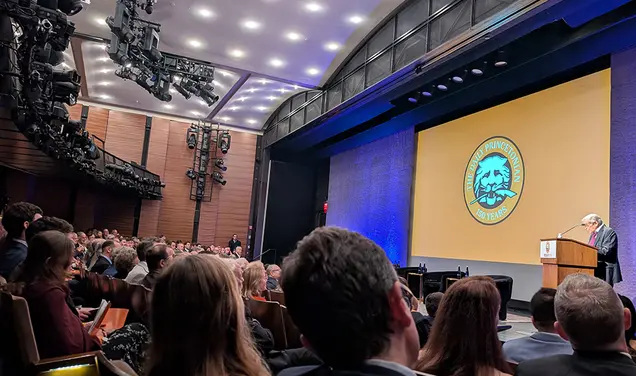
With Prominent Journalists and Hoagies, the ‘Prince’ Celebrates 150 Years
A gala at the New York Historical raised roughly $400,000 for the independent student newspaper


No responses yet