

Dating at Princeton? Part 1: It’s Complicated
‘I have a feeling that, always at Princeton, it will be the friendship-to-dating pipeline that will be the most successful’

Published May 28, 2026
Listen on Apple Podcasts • Spotify • Soundcloud
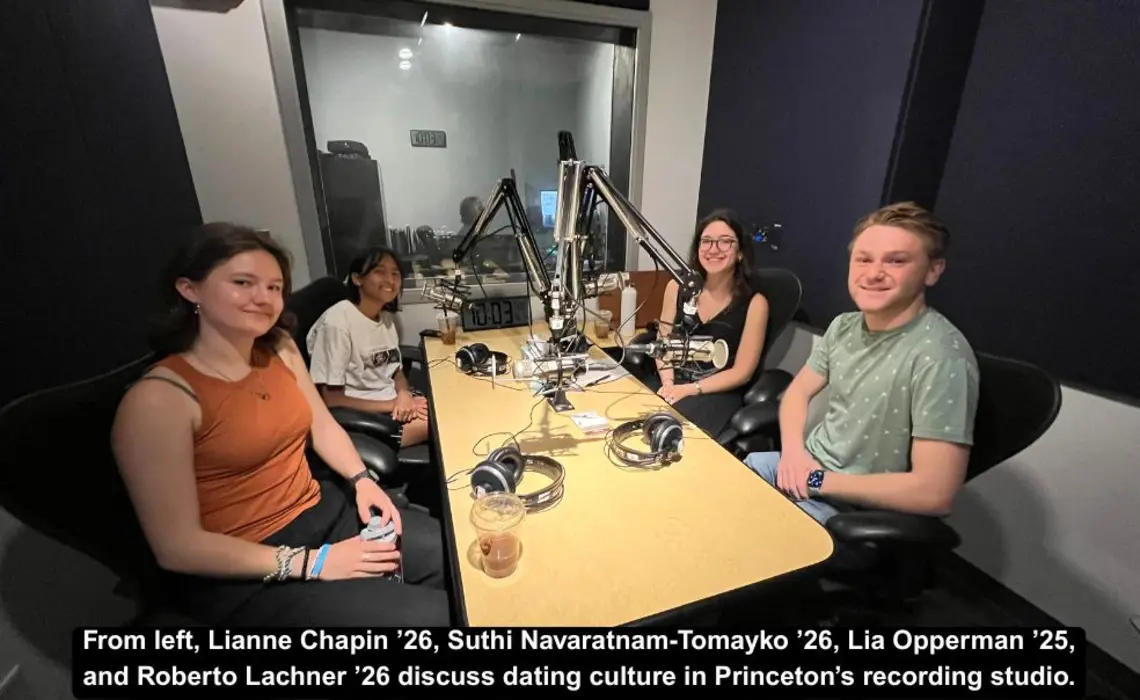
I’m Lia Opperman from the Class of 2025, and this is the Princeton Alumni Weekly’s PAWcast, where we talk with Princetonians about what’s happening on campus and beyond. Today, I’m excited to speak with three current seniors about the most perennial of topics in higher education: campus dating culture.
Romance has always been a big part of the college experience at Princeton and elsewhere. But in recent years, it’s faced digital disruptions. New apps like Date Drop, Datamatch, and Marriage Pact — yes, you heard that right — have appeared alongside the usual Hinges, Tinders, Bumbles, and Grindrs. Does anyone just ask each other out the old-fashioned way anymore? Join us as we dissect the ways that dating has changed for better or for worse, and all the ways that maybe, it really hasn’t.
To get us started, can our three seniors please each introduce yourselves?
Roberto Lachner ’26: My name is Roberto. I’m an economics major, Class of 2026, and I’m a member of the indestructible Charter Club. Thanks for having me.
Lianne Chapin ’26: My name is Lianne, and I’m a senior in the School of Public and International Affairs (SPIA), and a teacher prep minor, and I am a member of the famous renowned Terrace F. Club.
Suthi Navaratnam-Tomayko ’26: Hi, my name is Suthi. I’m an Operations Research and Financial Engineering (ORFE) major. I guess I’m also a senior, and I am also a member of the Terrace F. Club.
LO: Awesome. Well, thank you three for being here today. My first question is just, what’s dating culture like at Princeton, and just what is it like to be a student dating at Princeton after you’ve experienced this for the past four years?
LC: I think there’s a part of it that’s unique that comes from just the environment and the concentration that we all experience. Princeton is a unique campus in that we’re all sort of packed into the same area of land, and we all see each other all the time. So I think the concentration is very unique and unlike anything that I probably would experience anywhere else in my life. So I’m aware of that. I think I am more conscious of people that I run into every day. And the fact that it is the same people, I go about my day seeing only 20-somethings, professors, and dogs, babies on the weekend. So I think that the population, just in terms of geographic proximity, makes it very unique.
RL: And because of that, it’s very rare for people to ask out strangers, just because there aren’t so many strangers. Especially at this point, the people that you are friends with are the people you are friends with. And those are usually going to be the people that you ask out on dates if you are interested. Usually how it happens is you already have a nice friendship with the person, and then eventually one day you decide to take it a step further. But rarely do you just see a cute girl at the café, and then you go up and ask for her number. I feel like I don’t hear about that happening all too much.
LO: Yeah. Roberto, I’m curious about that. Are there certain spheres of campus that people are meeting each other in? Is it sports teams? Is it res colleges? Or what does that look like?
RL: Well, it’d be the same question for where are you making your friends on campus if your friends are going to become the people you’re dating? And so for myself, for example, I’m a very active member of the Aquinas Institute, which is our Catholic campus ministry. There’s about, let’s say, between 50 and 100 very active students. And so those are the people that I’m seeing basically every day. And eventually those are the people I’m going to become friends with and maybe ask out.
And I think this phenomenon kind of extrapolates to all sorts of other campus subgroups. I know certainly religious groups. I’ve heard within other religious communities, for example, that usually people are dating within the same dating pool. But I think this works also for clubs, for especially your eating clubs, and maybe especially even at the start, your residential colleges.
SN: Yeah, I would agree with Roberto. I mean, I’m not personally involved in any religious organizations on campus, so I’ll take your word for that. But I definitely feel like dating within your eating club is super, super common. I mean, it makes sense, right? Like you’re eating all three meals a day with the same like 200 people. After a certain point, you’re going to get to know them better, you’re going to become friends with them. And then, I don’t know, yeah, maybe something else happens after that as well.
LC: I think it’s possible also to chalk a bit of it up to just sort of the stereotype of “Gen Z are socially awkward and we’re less likely to approach a cute girl at a café” just on the whole. But I think also having a student group, having something in common maybe makes that distance a little bit shorter. So even if you are less likely to approach a cute girl at a cafe, you might be more likely to approach a cute girl at mass, where there is at least one thing that you have in common besides maybe that you both like the same café.
LO: So there are no meet cutes happening in classes or anything like that?
SN: I’m sure there are.
LC: But it would be in classes. I think there has to be another layer of commonality. So it wouldn’t be a meet cute happening on Nassau Street where the person could be just anyone. I think there has to be a little bit of data about them, a little bit of information, a little bit of closeness to justify it. Because I think that the level of boldness that people have is entirely reliant, or at least somewhat reliant on, an extra oomph that comes from being able to talk about something that you have in common, besides just being like, “I’m tired, I’m cold. Isn’t the weather great?” These are not things that are great conversation openers, but being able to start a conversation with like, “What did you think of the PSET?” Or something like, “Isn’t our tea selection so amazing?” Props to Terrace.
LO: Great conversation starters.
SN: I mean, I feel like asking someone out is kind of a vulnerable thing to do. I mean, I know of people who have had meet cutes in class, but it’s always like, “Oh, where are you going after this? Let’s walk together.” That kind of vibe. It’s not like, I’m going to walk up to you in public, and I don’t know who you are.
LO: Along those lines, I feel like there’s been a lot of campus algorithms in recent years. There’s been Datamatch and Marriage Pact. Datamatch basically matches you with your top romantic people and also friendships that you can have based on a survey you fill out. Marriage Pact is similar except for you’re just kind of getting one person, that’s your love of your life forever.
And then Date Drop, I’m a little unfamiliar with, maybe one of you can speak more to it. It seems like you’re getting a match a week to go on a date with. So, there’s been the rise of these things. And then there’s the traditional dating apps: there’s Hinge, there’s Bumble, there’s Grindr, there’s Tinder. Are there students really using these apps instead of meeting each other in person? I guess, how do you see that on campus and how have you seen people using that?
LC: I think it seems a little bit to me like a substitute for the effort that it would take to actually meet a person, and to actually try and find your people on campus. I know a lot of dating apps I think are like that, but also a lot of Princeton students are very busy. And our minds are often occupied with our coursework and our jobs and all sorts of things that we’re doing.
And I can see a world in which people would prefer the convenience of, or at least the false confidence of knowing that like this person is algorithmically the best person for me. And I can stop searching and I can stop worrying, and that can be like one thing off of my plate because I know that at least this person, through some measure, is compatible with me. And I think things like Datamatch and even Date Drop appeal to that sort of mentality where you can just fill out a form and some computer science majors who had some extra time on their hands will magically facilitate something for you.
And then you can talk to the person that you’ve matched with, and be like, “Well, so we’ve matched, I guess, on this kooky little thing. And maybe we can go get coffee together.” And again, that also takes away the need to have any sort of boldness or confidence because your hands are tied by this digital thing that you have no control over. You just filled it out, and all of a sudden, I guess you should talk to this person and you can meet this person just because I guess you matched and it’s out of your hands.
SN: Wait, I do think also part of it is really the, like, I’m too afraid to actually go approach someone in person because there is now a fourth one. I saw this in my email. They sent a campus-wide email about it and I opened it for the sake of research for this. And then I looked it up on Fizz, which is like an anonymous discussion. It’s like an anonymous confession app basically. And I’m not really on it, but I wanted to learn more about this app, so I looked it up.
And it’s called Crush. And basically what it is you put your crush’s email in, and you can put in multiple people. And then the idea is I guess everyone puts their crush’s email in, and then if the person you have a crush on has a crush on you, you get notified. But if you don’t, if there’s no match, no one ever has to know. So that’s sort of the big selling point here is you’re able to figure out if your crush likes you back without any kind of friction, without having to do anything scary, without any sort of fear. There’s no fear of rejection basically. I think this is wimping out.
LC: I agree.
SN: I’m against this. I sort of also don’t, I mean also like, I don’t know, Roberto and Lianne, you guys can weigh in, of course, but like I don’t really think people use these very much. At least in my experience, people will like fill out Marriage Pact and stuff, but you’re not actually going to go get married to that person. I know very few people have actually gone on dates off of these things. It’s mostly just look at it, and you’re like, “ooh, ha ha, LOL, I know that person” and that’s it.
LC: Yeah. Or just trying to guess who it is because I think on Datamatch, it’s like first you get their initials and then you get more information about them.
SN: I think that might be Marriage Pact. But yeah, one of them.
LC: Yeah.
SN: I don’t really know.
LC: Whichever one the kids are doing these days. The fun is in the fact that it is like not that serious. I don’t know of anyone being like really nervous to get their Date Drop or really sweating something like that. So it seems like because it’s so unserious, you don’t have to actually think about it as something that’s real.
LO: Have you guys seen any successes based on these campus-based algorithms?
RL: Well, I’ll say off the top, I rarely, if ever, hear of anyone using these conventional dating apps like Hinge or Tinder on campus, just because we all kind of know who’s here. Now for the Princeton-specific dating apps, many people do use them, but it’s typically a thing of, you get your match and then 95% of people ignore it. And then maybe you see your match around campus and then you pretend to not know each other even though you were set up for marriage for life according to an app.
I have heard of a few people recently, maybe one or two, who have had success, especially with the Date Drop. There might be something different about Date Drop than Datamatch and Marriage Pact. Date Drop again is kind of like some of these subscription services where once a month or once a week you get a box of art supplies or some hobby materials, or food at your doorstep to do something creative with, except it’s with a date.
So every week you get a new person in your inbox to go on a date with. I’ve heard of two people that have gone on dates with these. But I think it remains to be seen how successful it will be. And I have a feeling that, always at Princeton, it will be the friendship-to-dating pipeline that will be the most successful.
LC: And I think Date Drop feels like the least dystopian one to me because there’s no assumption that you and that person are the most compatible. There’s no imaginary pressure on it at all. It’s literally just something to get people to go on more dates, which I sort of appreciate. I think if you were not going to take that initiative, to have like a small external push factor to be like maybe you should go out a little bit and maybe you should do something fun with another person that you might not ask to do something fun with in a different situation. So I think if I were to choose the least dystopian out of all of them, it would definitely be Date Drop.
RL: And if we could back out a little bit and ask what is the purpose of a date, especially if we were in the real world, it’s typically to get to know the other person more, to see if you would want a relationship with them. But here, as we’ve discussed, you typically already know the other person. And so, when you go from friend to dating, it’s something different than what the date would be outside of the Orange Bubble.
But so then what is the equivalent of the real world date at Princeton? I think it’s those sometimes daily surprise interactions that you’ll have one-on-one with a person. Maybe you’re leaving class with someone and then you go study, or maybe you run into each other at the hall in your residential college or your dorm. And all of those things, there is not necessarily, and maybe there is no romantic interest between the two of you at all, but you are getting to know each other better from kind of a stranger or acquaintance level to becoming friends. And maybe for that reason then, these dating apps aren’t so, so successful because there’s already an organic process that fills that need on campus.
LO: Yeah. I’ve heard a lot of people who have made friends with their Marriage Pact people or Datamatch or Date Drop, but in terms of romantic relationships, it seems to not always be the case. I’m curious a little bit more about these traditional dating apps.
So, Roberto, you mentioned that you’re not really seeing people on campus using that because people already know each other. My first question is, Lianne, Suthi, do you guys feel the same? And then in addition to that, do you think people are changing their locations on these traditional dating apps to New York City, Philadelphia, places outside of Princeton to widen the bubble?
LC: I have definitely heard of people doing that, I think with dating apps. I’m not on any because I have my personal feelings about that, but I know a lot of my friends who are, will usually just like be swiping through and see people that they know from campus on Hinge, or something like that. And it’s like you laugh about it, and you’re like, “oh my gosh, what’s this person’s Hinge profile like? What’s this person’s dating profile like?” But typically people have those so that they can go to Philly or New York or somewhere else and go on dates with people who are not from Princeton, just to sort of make themselves available to that dating pool as well.
Which I think makes a lot of sense because we’re all here in this concentrated bubble and sometimes maybe you want to meet someone who does not close their eyes and see orange and black. And I totally understand that. But I think then when it is people who are on campus, it’s something that you’re like, oh, ha ha, when I set my location to Princeton, it’s so clogged with Princeton people. And then sometimes when I set my location to Philly or New York, I see Princeton people who have done the same thing.
SN: Yeah. I would agree with Lianne on pretty much all of that. I definitely see people using Grindr in Princeton. I see people using that a lot. And you can choose whether or not you want to include that in this podcast. But yeah, I would say I tried them my freshman year a little bit. I mean, there’s like 10 people on them, so it’s just like, oh, okay. I saw literally all of you. And I’m not joking, I mean that completely sincerely. So then I was just like, why did I do that?
LO: Yeah. And generally on campus, what do you think students are looking for? Is it love? Is it somebody to date for marriage? Is it a hookup? And then also, can people communicate what they want and what they’re looking for, or are there issues in that sphere?
LC: I mean, I think it depends on the type of person that you are. I know a lot of people who are in very wholesome and fulfilling relationships, and have been for a long time. But I also know a lot of people who are very sure that they do not want that, and that they are going to take college as a time to explore and to have sort of hookups, and to figure out who they are as a person, as a partner, just see the landscape.
And this seems like a bit of a strange thing to say, but to collect data on the people that they meet and what types of people draw different things out of them. So there’s an aspect of exploration that comes from people who are not wanting hookups, but then there are also, of course, situationships, there’s poor communication, there are people who have a mismatch where one of them is still in the exploration era, and then another one is maybe wanting to lock something down. But I think that is like a tale as old as time, and it is definitely something that happens on campus.
RL: I will say, I think as we’ve progressed through being freshmen to sophomores to juniors, and now seniors, I think you see less people wanting hookups and short-term things, and more people looking for longer term relationships. Maybe because we have had more experience and now we know what we’re looking for.
Another advantage I think of dating within communities you’re familiar with and your friends is that typically you do know what the other person wants, especially if you are within communities where there are shared values, shared understandings of what dating is, then it makes it a whole lot easier to enter into a relationship with someone because you have that shared understanding from the get go.
LO: Yeah. Would you guys say the same? Do you think the landscape has kind of changed from freshman year? Now you guys are seniors. Do you think what people want has changed over the years?
SN: Yeah, 100%. Just at least amongst the people I know and my friends. Freshman year, there was a lot more hooking up. And then I also think part of it changes when you join an eating club, and I know we talked about this a little bit earlier, but it’s like if you are put into this small community where you are hanging out with the same, like I said, 200 people all the time, I think that is an environment that is just more conducive to relationships than it is to hooking up. Because I don’t know, I feel like when I see people hooking up with each other, it can be kind of awkward afterwards. And it’s like, well, maybe you wouldn’t want to do that if you have to see that person literally all the time. You know what I mean?
LC: I think also in a place like an eating club where people have sort of sorted themselves, there is sort of that aspect of shared values that, Roberto, you mentioned, even though it is a larger population, and you get to see the person a lot more or you get to see people a lot more just living their life, and you get to know them even from a distance. And you sort of build this shared group identity that I think is very different from when we’re all first years and we are just 1,500 free agents floating around this campus, and we might not run into each other all the time. Whereas like in Terrace, I see the same people every day. And of course that is a huge disincentive to start anything that would be really awkward, but also it is a gift in that I get to know them better than other people on campus.
SN: Wait, yes. I think it’s an incentive to date.
LC: Rather than to hook up.
SN: Yeah. It’s like, Oh, great. I’m meeting all these people and they’re all young and eligible and cool and I like them. It’s like, well, why wouldn’t I want a relationship? I don’t know.
LC: And I think there’s also been, especially this semester, I’ve heard people call it the senior shuffle where lots of people ended relationships they had been in as juniors, as sophomores, because maybe they realized that the rest of their time at Princeton was brief. They saw the light at the end of the tunnel and they said I need to reshuffle my priorities. Because I know there have been a lot of breakups that happened junior spring and a lot of new things that sort of popped up during the winter. It really seems like Valentine’s Day 2026, there were a lot of fresh pairs.
SN: You were one of those fresh pairs.
LC: I was one of those fresh pairs. I’m speaking from personal experience. But I think I’m not the only one. Because I remember having this experience and thinking, wow, it is not singular. Everybody else is in this with me. And I was also reminded of that by my friends and also by Suthi.
LO: I’m curious, since you bring this up, and we’re talking about how small the Princeton community is, how we’re all kind of trapped in this bubble, what do breakups look like on campus? It does not have to be from personal experience.
RL: It does not have to, but I have the privilege and honor of having personal experience in this department.
SN: I think we all do.
LC: Yes, we do.
RL: Yes. It’s certainly harder than perhaps it would be outside of being a student here at Princeton than in the real world, or really at any other college. Because like we’ve mentioned, the community is so tight knit. And so that aspect that makes it so easy to start dating someone, or to make friends for that matter, also can make it more difficult to end the relationship, just because you probably have similar friend groups, right? Especially if you started dating because you have a shared community. You might even be in the same eating club, in which case you’ll see each other at almost every meal.
And this makes the Princeton breakup a little different than, when I talk to my parents, what they went through, or even my friends at other schools, where a breakup is really synonymous with you never see this person again. And that in some aspects is easier. I think in some aspects, it’s probably a good experience to still be around your ex on campus, just because it hopefully teaches you how to, I guess, remain both friendly and respectful with that other person that you did and probably do still care a whole lot about. I think that’s a very important skill that we get to learn here that in maybe other places it would be easier to run away from. But of course it is still hard to see them.
SN: Yeah. I would say in some ways, I think it’s really difficult because, I don’t know, so I had a relationship for about a year, and I’m going to also preface this by saying like no ill will. Great person, but you know. He was in Terrace. I live in Terrace. And we broke up. And it’s just like, I was talking to my mom, like you said, it’s so different from like something like my parents would experience because I was like, “Mom, have you ever broken up with someone and they already paid $10,000 to eat all of their meals in your literal house?” Like you can’t go outside without seeing them. I was like, “I can’t leave my room. This is awful.”
But yeah, I agree with you, Roberto. I think it was a really great learning experience to learn about how to have a good relationship with someone going forwards, even though, OK, so it wasn’t really working out. That doesn’t mean that we can’t be chill. It doesn’t mean that we can’t be girls together sometimes.
It sort of was like a good experience in like sort of separating the this relationship wasn’t working out from the other like, but I still care about this person a lot. I still have to see them all the time. And it was really hard to navigate that. But I think we did a really good job. I mean, we’re like very much chill, and it’s like, it’s all fine. So yeah.
LC: I think just adding to that also when you have the phenomenon of friends that then change their social contract and start a relationship, if you can be enough of an adult to have that first conversation that starts the relationship, to say, “Hey, we have this thing, I want to change it. Do you want to change it?” I think that then means that maybe you’ll do a better job of bringing it back down. Or not up or down, but like bringing it back into a different category, which I think is true about my junior spring breakup, which I think went about as well as I could have imagined.
I was a little bit nervous about it because obviously everybody is nervous about breaking up with a person. But I think being able to return to a time when we had been friends, and being able to point to that as something that was possible to do, but also I think the notion that we’re not in the same eating club, but being able to be like, we’re going to see each other on campus. This is an incentive for us to figure this out, and to make sure that we can return to campus. Because it was over the summer. I specifically timed it for the end of the academic year so we could have the summer apart. I thought about this.
And when we return to campus, we can be civil, we can be friends. We can sort of talk through all the different ways that our lives on campus will look different. Because we’d been together for a long time, since the spring of our first year. So I think it was a great conversation, and we talked a lot about like relationships on campus. I think also because there are so few couples, there’s almost like a there’s a phenomenon where friend groups will have couples in them and people will refer to those couples, and those will be like the couples of the student group, the couples of the eating club, the couples of this space on campus. And then you realize that other people are also invested in that. And they might be surprised, they might be kind of, feel betrayed, even though it has nothing to do with them. I think just because of the scarcity of relationships, people view them as a source of consistency, which was not something I was expecting.
SN: I think that’s a bad idea.
LC: I think it is a bad idea.
SN: We’re like 21, we’re not totally mature yet. I don’t think we should be counting on that.
LC: Exactly. But during that time, when I was thinking about breaking up, and there were other people doing so as well, I remember hearing someone be like, “All the couples are breaking up. This is terrible. All of the stability is gone.” Which obviously as you said, you can’t assume stability because we are so young and our lives are changing so rapidly. But I think it was surprising to see how many people viewed my relationship and other people’s relationships as a constant or as a part of their lives, even though they had not been in the relationship itself.
RL: Part of the reason for that, I think, is because what the actual dating looks like. We haven’t really talked about what the dates actually are yet. Because I think if you go back 70 years maybe, or around that time, if you talk to your grandparents, dating someone was like, if you were going steady back then, you would go to the roller skating rink or you’d have lunch, you’d see each other at the dance, right? But there would be discreet moments of the day in which you would see each other, probably not exceeding like three or four times a week.
Now, here we are all living in the same place. When people start dating, the vast majority of the time they spend together is not on these kind of discreet dates where you go out to Jammin’ Crepes or a USG movie or things like this. It’s mostly when you see couples together on campus, they’re just kind of doing life together. They’re studying together in the library. They’re eating most or all of their meals together at the eating club. You’re kind of doing a whole lot more together than a relationship would be when you are in the real world working, or outside of college where your daily life is not all the same thing.
And so for that reason, I think relationships here attain a sort of gravity that they wouldn’t elsewhere. And so of course when they end, people notice. Because you were together all the time and now you’re not. You were the center of the friend group, and now you’re not. And of course, the people in the relationship also notice a whole lot. Because it’s not just, oh, this person I would go out to lunch with a few times a week is now no longer. It’s like the person that I was, the bedrock of my daily life is now gone, and that’s a whole lot more difficult.
SN: That’s a really good way of thinking about it actually.
LC: Well, I think that is also sort of facilitated by just the lack of free time that we have. Because if you have time that you can reliably set aside, which I do try to do, but for things that are not school or work. That is great. And you can use that time to go to a USG movie. You can use that time to go on a really long walk. You can use that time to go to a roller rink. I think it would be cool if we had one, actually.
RL: It would.
LC: We should bring that back. But in the absence of that, when school ramps up, when work ramps up, it’s really hard to spend that quality time. And I remember a pair of my friends who are in a relationship were experiencing that last year, and they decided they were going to go on a laundry date, which was doing their laundry but together. And that they decided that would be meaningful time that they would spend together because they had like no other time to do anything. And all of their time that wasn’t class or doing schoolwork or doing work work was doing laundry. And they were like, “We’re going to do our laundry together and we’re going to go on a laundry date.”
Which I think is very emblematic of the, like, relationships exist not as an activity that we do, but as sort of like a haze, like a cloud that exists around us that influences our behavior. But it’s not like, here is my group of friends and here is the person that I’m dating and they’re separate. And when I hang out with my friends, that’s one thing. And when I hang out with this person, it’s a separate thing. And when I go on dates, that is like a discreet thing, even though I think it would behoove us to think about it in that way.
LO: Yeah. Is there traditional dates happening on campus or do you find that students are too busy to have these traditional dates such as going to Jammin’ Crepes, going to Grounds for Sculpture, or something near campus, going to New York City. You find that it’s mostly doing life together is the dates that you’re doing on campus.
SN: I mean, I think that traditional dates definitely happen. But I mean, I don’t know, a lot of those things, they take a lot of time. They take a lot of money. I do have a lot of unstructured time, but it’s not a lot of free time. So I would find that, like you guys both said, in my relationship, most of the time that I spent with my boyfriend would be like just in the library together or at meals together, walking around to and from class together, stuff like that. I would visit him at his work and stuff. But traditional dates definitely happen. I mean, dinner on Nassau, getting coffee, going on a walk.
RL: The walk is a classic date.
LC: The walk is a very classic date.
LC: Many places to walk.
SN: So many places to walk—
LC: —which is a gift in New Jersey.
SN: Yeah. Going to New York sometimes on very special occasions. Yeah, that’s definitely happened.
LC: And I think there are definitely places to do that. Like a USG movie. It can be hard sometimes to go on, using Roberto’s definition, like a traditional date where you really get to know the person, you get to see the person on campus, just because the buzz is so powerful and it’s so hard to escape. But I have found that leaving campus is very helpful for that. Going to New York, yes. But going to New York is always good because that is where I’m from and I love it so much.
But when I cannot do that, finding a place that is a little farther away from campus, a little off the campus beaten path. I went on a very good date at Conte’s, which when you think about it is not really like romantic candlelit date spot. Because you come in and they’re like, “We have pizza.” But because it is like a 20 minute walk to get there, because it is a place where not a lot of students go, it was so nice to just be like, wow, I’m living in the world. I am in a real place with real people. And they’re all here and I’m here and that’s so great. And I think it really facilitates the sort of exhale that needs to happen in order for you to really be able to like meet and experience another person and not be distracted by like there’s a career fair happening. I should edit my resume. Or like, oh my gosh, these people around me are talking about job interviews. Or like, wow, my thesis.
Related coverage
Dating at Princeton? Part 2: It’s Even More Complicated
‘Being here for four years changes you a lot. And so ideally you would maybe want someone who understands that part of you’
All of those types of things. I think it’s possible to leave those things on the other side of Nassau Street and then kind of go into town and be like, this is a real place. People here think about other things that are not their papers and that are not their internships and I can participate in that even just for a couple of hours and that will be very, very good for me.
SN: I’ve had great success using Enterprise CarShare to do stuff like this. You can go to the mall, you can go to one of the restaurants in the mall. I find this very fun. Okay. You can get soup dumplings at the restaurant in the mall. It’s awesome. Or I don’t know, just going to random places. And I’ve been gone mini golfing or getting ice cream somewhere that’s like not Princeton, and it’s like you pay like $20 to rent the car and then you just go drive around somewhere that’s off campus. It feels exciting and new, and it doesn’t take as much time as going to somewhere like New York.
That concludes part one of our two-part series on dating culture for PAWCAST, a monthly interview podcast produced by Princeton Alumni Weekly. We’ve only scratched the surface, so be sure to come back for Part Two to learn more about how students are navigating relationships today. If you enjoyed this episode, please subscribe. You can find us, and part two on Apple Podcasts, Spotify, and SoundCloud. You can read transcripts of every episode on our website, paw.princeton.edu. Music for this podcast is licensed from Universal Production Music.
Paw in print

October 2026
Holding on to Jewish life; Katy Anderson Keating ’08’s career in wine; Hollywood loves Princeton.
No responses yet