

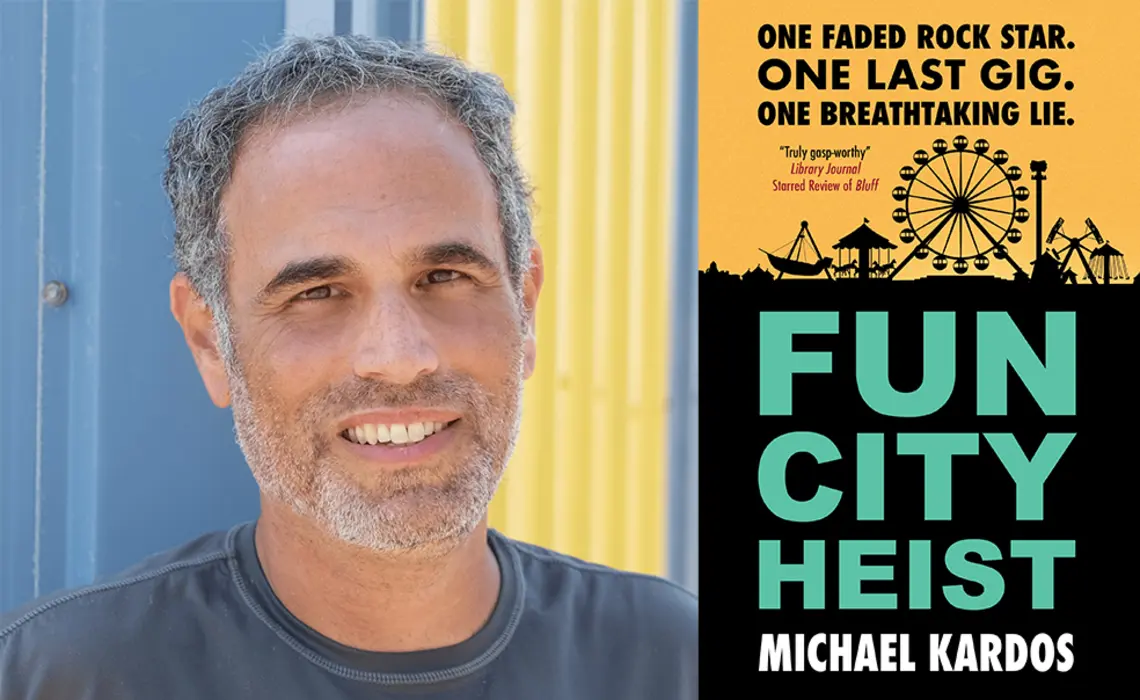
Michael Kardos ’92 Finds the Funny in ‘Fun City Heist’
‘There’s a lot of things that are maddening about writing, but one of the things that I love maybe the most is when ideas just pop out of nowhere and you know they’re right’

Published June 23, 2026
Can crime be funny? It’s a tricky combination to pull off, but in this episode of the PAW Book Club podcast, Michael Kardos ’92 explains how he made the balance work in his fourth novel, Fun City Heist. Answering questions from book club members, he discussed his published books and his parallel work teaching creative writing, as well as how his life experience as a drummer from the Jersey Shore informed the main character and the hilarity that ensues when an aging band gets back together — but with an ulterior motive.
Listen on Apple Podcasts • Spotify • Soundcloud
TRANSCRIPT:
I’m Liz Daugherty and this is the Princeton Alumni Weekly’s Book Club podcast where Princeton alumni and friends read a book together. Today I get to talk with author Michael Kardos from the Class of ’92 about his comedic crime novel, Fun City Heist. Michael was a music major at Princeton who went on to earn an MFA, a Ph.D., and his teaching chops, first as co-director of Mississippi State University’s creative writing program and more recently at Cape Henlopen High School in Delaware.
He set this novel, his fourth to date, in his old stomping grounds, the New Jersey shore, and he made the protagonist a drummer like himself. As the story unfolds, readers watch beach bum Mo Melnick connect for the first time with his teenage daughter, get back together with his band, Sunshine Apocalypse, and eventually get roped into a bandmate’s plan to rob a beachfront amusement park. I’ll ask him whether that plot point also has autobiographical roots, hopefully no. And whether he learns to be this funny of a writer at Princeton.
So Michael, thank you so much for being one of our PAW Book Club authors.
MK: Thank you very much for having me.
LD: OK. So our first question, this is from Sue Salberg, who’s the parent of an alum in the Class of ’97. She said, “I loved the book for its laugh out loud humor and thoughtful consideration of friendship, loyalty and life choices. Mo Melnick is hilarious. Is the narrator funnier than you are in real life?”
MK: I think one of the things about writing anything is that you get to keep tweaking it and working at it. So you get to do the best version of a line that’s supposed to seem like it’s off the cuff. So I think he’s probably funnier than me, but he doesn’t know he’s funny. I mean, I think that’s what makes him funny is that he thinks he’s being very serious about the things that he cares about. It’s just that we realize that the things he cares about and the way he is funny.
LD: Writing comedy strikes me as really difficult. Was that something that comes naturally to you or did you have to work at it?
MK: I think it does come a little naturally. My first couple of novels were not humor filled and then the previous novel Bluff had more humor in it and I really liked having humor in it. I really liked what it did to the book. I think the baked in challenge of writing like a crime novel with humor is that crime books are generally about the worst days of people’s lives and the most stressful days of people’s lives. And the tricky thing I think is I don’t ever want to make it seem like I’m making fun of them or making fun of what they care about.
And so the humor, it’s like this a little bit of a balancing act where it has to come naturally from the absurdity of the situation or something. And so I got to do a little bit of that in Bluff and I really liked doing that. And I think something about the material for Fun City Heist just made more sense. It was inherently a more comic absurd set of predicaments and so it seemed a little more natural. So I did it. This was the first book that intentionally was a comic novel as opposed to a novel that had some humor in it.
LD: OK. So you’re working in that direction.
MK: And the next one might be totally different. I’m not sure, but I think it’s a rock band robbing an amusement park. It has to be comic at heart because it’s absurd.
LD: Yeah. So Carol Tycko from the Class of ’79 asked, “Is the amusement park based on a particular town at the Jersey Shore?” We actually got a couple questions along the same lines. And she notes that she grew up near Philly and recalls going to Ventnor and Atlantic City. She says, “My husband also Princeton alumni now have a place in South Amboy on the Raritan Bay. We don’t get to shore towns all that much, but when we do, the boardwalks and Ferris wheels and the taffy stores take me back 50 years in the blink of an eye.” The book also brought back lots of fond memories.
MK: Thanks for that question and that statement. And I think one of the appeals for me, and this comes out, I think in the very first page of the book, is that there’s something very, timeless isn’t the right word. It’s more like out of time about this boardwalk amusement milieu. The setting. At Fun City, the amusement park, they mentioned right away, there’s still like a U-boat ride. I mean, it’s this very stuck in time kind of thing. I’ve really loved that people who have read the book say to me, I know exactly what town it is and they name one and they’re all different towns. I grew up closest to Long Branch and so my baked in boardwalk/pier is Long Branch Pier, which burned down in the late ’80s and now Long Branch is totally unrecognizable beachfront to me, but that’s what I always picture. And of course then Point Pleasant was a little south of me and there were some other ones, and now I live in Delaware at the beach, and so I think truthfully it’s a composite of a lot of things.
Part of what I remember, part of what needed to be useful for the book. The haunted house where I grew up and where I worked for a while in high school was a walkthrough. In the book, it’s a ride through. Originally I had set all my other novels in Jersey and I feel like every time I had a novel, I was determined to set it outside of Jersey. And for the previous one, I was like, “I’m going to set it in Philadelphia because to my mind it was a little bit of a rocky story and so it’s going to be Philadelphia.” And very quickly I was like, “No, but at one point they have to drive from point A to point B and that wouldn’t work in Philly.” So it moved over to Jersey.
And then with this novel, I’m living in Delaware. I was like, “Well, maybe I’ll set it at the beach in Delaware. That seems to make sense.” And two problems happened. One was that there’s a few moments in the book where they have to drive west and if you drive west in a lot of Delaware beaches, you end up in cornfields. So there is no town there, so that didn’t really work. And the other thing was when I finished the first draft of it needed to be about 20% seedier. It was too wholesome. It’s like, how do I make this 20% seedier? And the obvious answer was to move it to Jersey. And then it automatically happened. So the problem solved itself. So this too is in New Jersey.
LD: They say write what you know and you are writing what you know, because this is what you grew up with. Do you feel that pull like to use your own experience? Does it feel—
MK: Yeah, I think writing what you know on the one hand is true, on the other hand isn’t because part of the fun is writing what you don’t know or don’t understand. But I think writing a whole book with, I don’t know, 70 or 80,000 words, you’re making up so many things and having to invent so many things that there’s something nice about being able to at least picture a place without making everything up or picture, certainly in New Jersey I understand how people talk in the cadence of their speech. Whereas setting something in the South, and I’ve written short stories set in the South, but to maintain that for a novel, there’s an automatic understanding of the way that the language works that I don’t have to think about because I grew up in it. So I think that is, I feel myself returning to a bit. But yeah, I like the milieu and I like the way that, I don’t know, it feels like I don’t have to invent it because I grew up in it.
LD: Yeah. I could see that. So I’ve got a question here: While rock bands show up in fiction a fair amount, the drummer doesn’t usually get a big role. Was there something about the life of a drummer that you’re eager to put into a book? Or was making Mo the drummer just something that made sense because you understood it from your personal experience?
MK: I think it’s both. I think the drummer is the one who is in the back that usually you don’t see very well that is not doing; they’re holding things together and in real life the drummer is the one who’s carting in all the equipment at the beginning of the night and he’s the one at the end of the night who’s the last to leave because he’s got to pack up everything. And I think one of the fun things about a rock band book was putting in just some of the chitchat and some of the details that I know every band deals with. And so the lead singer who of course doesn’t have any gear, his excuse for not packing up is, “Well, someone’s got to schmooze after the show.” So the drummer has left packing up all the stuff. So I think there was something about Mo’s character that it made sense that he would be the one to just quietly have to do the work and literally set the beat and get the rhythm going but not be flashy and that’s everybody else’s job.
LD: Was that true to your own experience as a drummer? Because you were for what, 10 years after Princeton?
MK: Yeah, I played drum show and I still play, but yeah, I did it real seriously after college. And yeah, I was always packing up and cleaning up and setting up and having to worry more about where I park because of the load in and all that kind of stuff. So I think there is something true to that experience and I’m still cursing myself a little bit from my drum set being as heavy as it is. And I think now I’m like, “Oh, why didn’t I just get a lighter set?” Why didn’t I get the 18-inch bass drum instead of the 20-inch base drum?
LD: You got to go big or go home. You know what I mean? I could be wrong. I don’t really know about drumming. OK. Prem Subramanian from the Class of ’89 asked, “Are you a drummer with perfect pitch?” And is it, as they said, as Mo says in the book, really useless?
MK: I love that question and the answer is yes with an asterisk. So I am a drummer and if you were to play a random note on the piano, I could tell you right away what it is and it’s not something I trained to do. It’s just something that I could do. Strangely, I’m better at it on a slightly out of tune piano and I’m worse on it on like a violin or something without distinct notes where you have; it’s very confusing to me, but certainly piano, I’m real good at it. I play a chord, I can tell you what individual notes they are.
It’s better when I’m in that world and actively playing and actively around the music, I’m a little better at it and when I’m away from it, I’m a little worse at it, but it’s something that is, just I grew up just having. I didn’t have to work at it. And so I knew right away in the book I wanted Mo to have perfect pitch because it is, as a drummer, completely useless. And there’s a line in the book very early on. I think it’s like having a drummer with perfect pitch is like a whale who can count cards and it’s just like it’s a talent but not a very useful one for a drummer.
LD: Now he eventually plays steel drums. Do you play steel drums?
MK: OK. So this is really funny. I’ve always wanted to and my plan was I’d always wanted to play steel drums. I think they’re just great. And then during COVID in 2020 and suddenly we’re all home all the time, I was like, “OK, here’s my chance. I’m going to get steel drums. I’m home. I can work at it. This is going to be awesome.” And I started calling around music stores and they’re like, “Well, they all come from Trinidad. No one’s shipping anything anywhere. Call us back in about 18 months.”
LD: Oh, no!
MK: So my dream of playing the steel drums went away, but most recently I was able to borrow some. And so currently in my house is a lead pan that I am trying to learn to play and it’s so much fun. It’s awesome, but I’m terrible at it right now, but I just literally like the past few weeks started mucking around with it. So it’s pretty exciting.
LD: Oh, that’s awesome. That’s very cool. Next stop, Virgin Islands, right?
MK: That’s right.
LD: There you go. The characters, a little bit about the characters, the band members in this book, Mo and his bandmates, they seemed lost, like they never grew up or maybe they didn’t really know how to. And I was wondering, did you base these guys on anyone real or anything that you’ve seen from your band years or where did that element of the story come from?
MK: There’s no analog in real life to, like, character A is based on a certain individual. I think they’re based a little bit on my overall experience just knowing a lot of musicians and knowing a lot of musicians who were really talented, but at some point, what are you going to do? If it’s not enough money to live on, but you don’t want to; I guess what happened was I saw a lot of them when I was in my 20s, I saw a lot of older musicians who were in the situation where they had to take every gig that came along and they didn’t like playing anymore and that seemed really heartbreaking.
So these are guys in the book who on the one hand love playing so much they would do anything to do it. And on the other hand, that becomes a little bit of a curse because it stopped them from, it arrests them. And certainly Mo, when the story opens, he’s convinced himself he’s got it made. He’s found the loophole in life. He gets to work on the beach selling, renting out umbrellas and renting out beach chairs and he gets paid to have a bathing suit and sit on the beach and it’s awesome. Of course, he’s to some extent deluding himself, but I think that’s; there’s that; he’s stuck. So yeah, I think again, not based on specific people, but definitely based on people.
LD: Now his daughter, on the other hand, boy, in the end, she outsmarts everybody.
MK: Yeah. Janice is the brains.
LD: She is, oh my goodness, the band, the amusement park, the police. I love that. She’s 17. So you see Mo, he kind of grows up. He has an opportunity to really solidify that beach bum lifestyle. And when he walks right up to it, he goes, “You know what? I don’t actually want this anymore.” But at the same time, he doesn’t seem to know what else to do either. And she’s the one who finishes the robbery, gets all the money, makes the stuff happen, evades the police and then pulls him out of being stuck. So she’s like the hero. Where did this come from? This idea that the 17-year-old daughter is the one who, you know what I mean? Is going to save the day or pull off the crime, which, surprise.
MK: There’s a lot of things that are maddening about writing, but one of the things that I love maybe the most is when ideas just pop out of nowhere and you know they’re right. And one of the things that happened was I was writing first, I don’t know, a couple of chapters, I think it was really the first chapter. Now it’s split into three chapters, but at the time it was one. It was the end of the first chapter and Mo is, he’s playing the drums on this silly game on the boardwalk trying to beat the record and he gets really into it and then he sees these two girls, like teenage girls staring at him and he’s mortified and they’re mortified looking at him being mortified and it’s just this totally, he feels so stupid and old and pathetic and then just this line shot into me like, “the red-haired one was my daughter,” because that would make it even worse.
And I was like, I don’t know where that came from, but now apparently there’s a daughter in the story, so how’s that going to go? And so it just developed that she became a presence in the story and as I was working on it, she became more and more of a presence. And then the more she was on the page, I realized, oh no, she’s the brains here and she’s the one with the most verve and it made sense that she would pull it off.
Now I didn’t know how the novel was going to end. I usually do plan a little bit, not a ton. There’s the planners and the pantsers. Do you plan everything or do you fly by the seat of your pants? And I usually am somewhere in the middle where I know before I start writing chapters, where is it going to start? What are the three or four big pivot points maybe and how it’s going to end. And every single time I do that, I’m wrong about the end. So in this case, I thought it was going to end a couple chapters earlier, a much quieter ending and then, I forget, I was doing dishes, just some nothing task and I was like, “Oh wait a minute. No, no, no, that’s totally wrong. I exactly know how it’s going to go work.” With Janice, she’s the key, but I didn’t really know that until pretty far along in the drafting process.
LD: I was going to ask you about your writing process because you teach writing, you’ve taught it to college students, you ran a creative writing program and now you’re talking to high school students, I’m sure is a whole different experience. But I was curious about your process, but also what you tell people who want to become writers who are in these creative writing programs and are learning how to do it. I also love that you’re writing books that are readable and fun and funny because whenever I think about creative writing programs, I could be wrong about this, I tend to think of serious, real serious books and I love that you’re writing fun, interesting, you know what I mean, readable stuff. Do you have students to do the same thing and what do you tell them as you’re teaching?
MK: OK. So as far as the creative writing programs, I do think that people are writing all kinds of things and I think there is more of an appetite now than maybe 30 or 40 years ago for a wider range of things. My short stories I guess would be more conventional literary fiction, etc. I don’t really think about genre too much. It’s just like, what’s the story require? My first novel was called a thriller and was packaged as a thriller and shelved as a thriller because the editor who bought it was a thriller editor. But I didn’t write it to be a thriller, I just write it to be a novel that had some crime stuff in it.
But as far as what to tell students, I mean, first of all, there’s just a level of craft that to me is key. The reason I got my master’s of fine arts was because I had ideas and I could write OK because I’m a human who grew up writing, but there’s a lot of technique and a lot of craft that I just wanted to understand. And a lot of that came from music where it became really obvious to me over the years that there were two kinds of players. There’s the one player who would buy all the gear and have all the best equipment and have the place for everyone to rehearse. If he wasn’t good enough, those kinds of things aren’t going to help. Then there’s the guy who just locks himself in his bedroom for seven years in woodsheds and becomes amazing and even if he’s socially inept and doesn’t have a place to rehearse and is always locking himself out of his car, that’s the one you want in your band because he’s really talented.
And so I think when I started focusing more on writing, I really wanted to develop my writing chops and there’s just a lot of technique to learn and so certainly when I teach, I’m somebody who focuses a lot on craft. At the same time, I also learned that craft can’t take you the whole way. If you don’t have something to say or you don’t have a unique spin on it or you haven’t done the thinking that it requires or you haven’t developed an active practice for imagining things, craft will not get you to the finish line or you’ll end up with something that’s really stale. So it’s this weird blend of learn, learn, learn teachable things while also developing some kind of an artistic practice so that you can put those teachable things to some useful process.
LD: Do you think that having worked in music and having been a musician has an impact on your writing? They’re both very creative processes and also I have to think that as a professional musician you probably lived a little, you know what I mean? You’re out in the world, you’re seeing people, you’re getting ideas.
MK: Yeah, for sure. And I think in terms of life experience, this is the first bok that is really centered on music, but there’s usually musical stuff in a lot of the stuff, in a lot of things that I wrote. I think the connection is a little hard to pin down. I think I have a sense of prose rhythm. I don’t know if that’s from playing music or it’s just more just some innate thing that made me like both of them, that makes me hear things musically but also hear things on the prose level. Same thing, just certain creativity and being drawn to stuff like that.
I don’t know if one taught me to do the other or if it’s just some baseline thing that got me interested in doing both. I will say that one reason that I pivoted a bit from more music-focused life to a more writing-focused one was that when I found that when you write, you don’t need a bunch of guys and a soundman and a PA system and a stage and people showing up with their plus ones and it became much easier for me to just do regardless of where I am or where I’m living and it didn’t bind me to certain places and so that was freeing. You get to do very artistic things, but I didn’t need as much stuff.
LD: I could totally see that. They’re both tough careers though, you know what I mean? When I’m looking at, I’ve got two kids and when I think about what I want my kids to do, I’m like, engineer, you know what I mean? Musician? Oh God, you know what I mean? Novelist, oh God. These are tough careers to make it in, I think.
MK: Yeah. I think I was one of the only people who went and said, “Hey mom, dad, I’m going to go back to school for creative writing.” They’re like, “Oh good, something safe.”
LD: And lucrative.
MK: Yeah. That’s true. I don’t know, to me that’s just like, you only get to live once, you might as well just do the thing that you really like doing and have a little bit of faith that stuff will happen the way it’s supposed to, which is a little bit naive, but also, eh.
LD: That sounds like the answer to something I was about to ask you actually, which is Princeton kids and I’ve met amazing Princeton alumni from all walks and the kids are amazing, but I think you’re the first one I’ve met who left and became a professional musician. So I was wondering, is this a path that you would recommend to kids? Because I don’t see a lot of them doing that. What do you think, having lived it?
MK: I don’t know. I’m very bad at planning. OK. In other words, I’m going to do this from this year, this age. I thought when I came to Princeton, I thought I might be a lawyer. I don’t know. I started off as a, my first major was political science. And I was taking music classes all along. That was something I knew I was going to do, but at Princeton, a lot of people take music classes who are majoring in other things and I thought that’s what I would do. And I really loved my political science classes. They were awesome, but I did my JP, my junior paper, in political science and I was like, “You know what? For my senior thesis, I really wanted to do a music composition.” And so that was the main reason I switched. I was going to take—
LD: Good reason!
MK: No, I was going to take the classes regardless and so it really came down to where I thought the senior thesis was going to be and maybe; and then I was starting to think about post graduation what I might do and I just wanted to play the drums for a while and see where that went. But I’m not a good one for career advice because I feel like I’m still like working my way into a career. I don’t know. I feel like being, I’m not good at “I am an X”: “I am a lawyer. I am a doctor.” I guess I’m a writer, but I think it’s more like I’m a guy who writes books. You know what I mean?
Teacher, same thing. I never thought I would be a teacher or a professor, but then when I went to graduate school and met my professors and saw that they are both practitioners and also in a university environment that supports artistic work, it’s like, “Oh, this is a really good gig.” And so after a few years of being in grad school, I was looking at my professors and this is the life that I do want and so that’s what pushed me in that direction, but it was not very planned planning. It was just looking around and seeing what made sense and then pivoting.
LD: Makes sense to take one thing at a time and look around and finding your way through it. Yeah, I love that. Rachel Marek from the Class of ’17 asked, “Do you have any books that you’ve read recently that you’d recommend to fellow PAW Book Club members?”
MK: Sure. In the quasi crime genre, literally I think a few week ago maybe I finished a book, there’s a writer named Lou Berney, he has a novel called Crooks that came out last year that’s just terrific. I mean, if I were to sell it to you, I’d say, “Ooh, it’s linked to novellas.” You’d be like, “That doesn’t sound interesting.” But it’s really great. The writing’s terrific. It’s just a really good book. I’m usually bad with book recs, but that one comes immediately to mind and probably I’ll think of others as we’re talking.
LD: All right. Well, if you think of anything else, let me know and I will link them to the transcript online.
MK: I will definitely do that.
LD: First podcast, yeah.
MK: I have a few hour drive home tonight, so I’ll definitely be thinking of books. OK, for sure.
LD: Yeah, that’s great. OK. And you know what? We run through most of my questions. Is there anything else you want to talk about or anything else that, I don’t know, you think that people might be curious to know?
MK: I can tell you that the audio book just came out a couple of days ago. That was interesting.
LD: Did you do the voice?
MK: No, I did not do the voice. I mean, nobody asked if I wanted to, but I’ve not done the audio for any of my books. But one thing I learned, which was fascinating to me, is that people follow audiobook narrators the way they follow authors.
LD: I’ve heard this.
MK: And this is to my great luck because what happened was my second novel happened to have been narrated by a woman named Julia Whelan, who again, was not someone who I knew because I was not a big audiobook listener at the time. And this was back in 20, gosh, I forget, 2014 or so, but she had just narrated, she already was a well established narrator, but she had just finished a book that you may have heard of called Gone Girl.
LD: Yes.
MK: Which was a zillion selling book. And so consequently, my audiobook did very well because I mean, it’s not because of the book, it was because of her. No, fine. But I mean, she was responsible for a lot of those audiobook sales because people really follow her and then so what happened was that book in audio did really well and the audiobook publisher said, “Well, for the next book,” which was Bluff, which had a female protagonist who you can choose any narrator you want. I was like, “Well, obviously I’m going to ask her because she was great.” And then so she did Bluff as well, which she did an amazingly great job on and so that was really cool. And then so this book obviously had to be a guy and so I didn’t choose him, but I did get a sample of his voice and I just heard it for the first time. It just came out a couple of days ago and it’s great. He did a really, really good job. I was excited about that.
LD: Oh, that’s really cool. What kind of reaction have you had to the book? Have you heard from readers?
MK: Yeah, it’s been great. Well, I think I told you, everyone’s convinced they know what town it takes place in, which is really funny, but people have really liked the book. A lot of people, like you’re saying, they’re like, “Oh, I remember when I was a kid.” It draws them back to their own vacations on the beach and stuff, which again, that wasn’t intended. I like the setting because I can picture it, but apparently a lot of people can picture it. So people have been into that.
One thing I like, and this is something I learned as a writer was that people like the ending a lot. I get a lot of, “Oh, I didn’t see it going there.” What happened was my first novel, I think I mentioned I didn’t write to be a mystery or a thriller. I just wrote it to be a novel. There are some twists at the end, but some of the reviews were like, “Oh, I really like this book.” And I was, “Ha ha, I figured out the ending. I was so happy.”
And my reaction was, “Awesome. That’s so great.” And I realized I should have been like, “Oh wait, maybe that’s not good.” Because I wasn’t trying to fool anybody. I was just writing the story. But it was very funny. My reaction was like, “Oh, we’re so in this together. You figured it out too? Awesome.” And I was like, “Wait, hold on a second.” So then with the next book, I was like, “OK, I’m going to try to write this in a way that maybe you can’t predict the ending.” And so now that all of these novels are at least in some way crime mystery-ish kinds of things, I think I’ve gotten a little bit more deliberate in making the ending something that you’re not going to necessarily say.
LD: Oh, that’s interesting. So for that genre, people expect to be really surprised.
MK: People want to be.
LD: They want to be twisted at the end.
MK: They want to be twisted. They want to be wrong, which I get. So they want to be wrong. And again, with Fun City Heist, I thought I had the ending and when the proper ending came to me, one of the things that made it the proper ending was I was like, “I think I can make it so you’re really not going to predict that.”
LD: Yeah. I did not predict that. I had no idea that was coming. And it was fun. I thought it was a fun ending.
MK: And it needed to be an up ending, I think, given the nature of the book and everything. It couldn’t end on a sad totally down there. That would have felt a little wrong.
LD: Because you lost a character, one of the characters dies. Yeah, exactly. Although even though it was sad, it didn’t really bring down the book. You know what I mean? I don’t know. There was a sense that Johnny who dies, I got the sense that he had had his moment that he was looking for. He got what he needed to be able to say like, “OK, I’m out.” Yeah, that was what I got.
MK: One funny thing is that originally the book was called Fun City and then we realized there’s no mention of crime for the first 50 pages. So we better stick that in the title.
LD: Nobody’s like, wait a minute, there’s a crime in this book! This isn’t as family friendly as billed!
MK: So in case you didn’t know, now you can just read the title and you’ll know that there’s going to be a heist somewhere in this book.
LD: Yeah. That’s got to be important picking your title. Yeah. I think, PAW just had for Reunions, we did a panel during Reunions that was about how to get your book published because we thought the Princetonians would be really interested. I’m going to do a quick shout out because we’re actually hoping to get the audio from it and post it as a podcast. But it’s so interesting when we’ve had these conversations about publishing to hear that your book was billed as something that you hadn’t really intended and that once it’s out of your hands into the publisher’s hands, there’s a life, does that happen? The life of its own takes someone in that world?
MK: Absolutely. And my agent had sent it out to several editors that were, I would call literary fiction editors and several editors that were more crime imprint editors. And it just so happened that the editor who made the offer on it was one from the crime imprints at Grove Atlantic. It was Mysterious Press and the editor, we had the funniest phone call the first time we ever talked and he’s like, “Oh, I really like the novel.” And he said, “Read through this book once.” He had very light editorial suggestions, but he said, “Just so you know, you’re a crime writer now. So when you read through this novel, just keep that in the back of your mind as you’re reading through your final edit.” And I was like, “Oh, OK.” And so of course all the jacket copy and everything all really made it seem like a thriller and the cover definitely conveys thriller and I don’t know if it’s a thriller or not, but they definitely had a marketing idea for it.
LD: Did that bother you at all? Were you like, “No, this was literature.” Or you just like, “I am just happy to have it in front of people.”
MK: I think because the guts, everything inside the cover was mine and I was very happy with his editorial suggestions, honestly. They weren’t big, but they were helpful and they were good and they made the book better. I figured as long as I got the book I wanted, the cover’s marketing and they beautiful, I like them all, but I’m not going to push back on something that if people at the publisher are like, “No, this cover’s going to work best.” That’s fine.
LD: Well, and it probably taps into a certain audience of people and I think crime readers are one of those really engaged groups of readers so you tap into that and you have the benefit of being able to.
MK: It’s true. I think crime readers, and this is something that I learned, I think crime readers read a lot. They read a lot of books and they buy books, so that’s cool.
LD: Two great things. Yeah, exactly when you’re a writer. Awesome. Thank you so much for taking the time for this.
MK: Yeah, for sure. Thank you.
LD: Yeah. And for the book, we all really enjoyed reading it at PAW. This was so fun. I feel all set to start the summer.
After recording, Michael Kardos wrote to offer more book recommendations to readers:
- Saint of the Narrows Street, by William Boyle
- Dickens and Prince, by Nick Hornby
- Partisans, by Joe Oestreich
PAWcast is a monthly interview podcast produced by the Princeton Alumni Weekly. If you enjoyed this episode, please subscribe. You can find us on Apple Podcasts, Spotify, and SoundCloud. You can read transcripts of every episode on our website, paw.princeton.edu. Music for this podcast is licensed from Universal Production Music.
Paw in print
June 2026
Ivy Style finds new life; University ‘pauses’ Trenton program; Princeton’s dating culture.
No responses yet