

Professor Sean Wilentz Co-produced Bob Dylan’s New ‘Bootleg’ Albums
‘He works very, very hard. Genius does not become genius on its own. You have to work at it for it to flower’

Published March 25, 2026
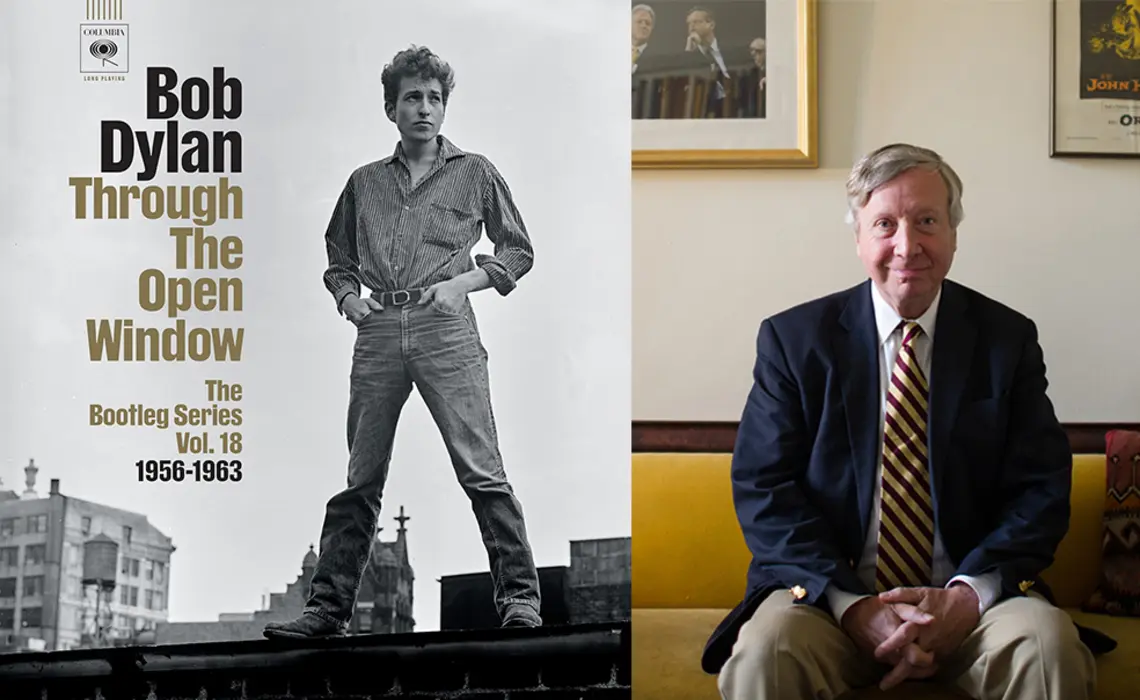
Princeton history professor Sean Wilentz has co-produced a new eight-CD box set of material by singer, songwriter, and Nobel laureate Bob Dylan. It’s called The Bootleg Series Number 18: Through the Open Window, 1956 to 1963, and it contains 165 tracks, many of them never heard before. It also contains 125 pages of liner notes written by Wilentz, who is a scholar of Bob Dylan and his music. Unusual for a history professor, Sean can also boast not one but two Grammy nominations, one of which was Dylan-related.
Listen on Apple Podcasts • Spotify • Soundcloud
TRANSCRIPT:
Bob Dylan singing:
It ain’t no use to sit and wonder why, babe
And it ain’t no use to sit and wonder why, babe
If you don’t know by now
When the rooster crows at the break of dawn
Look out your window and I’ll traveling on
You’re the reason I’ll be gone
But don’t think twice, ’cause it’s all right
MB: I’m Mark Bernstein [’83], and this is the Princeton Alumni Weekly’s PAWcast, where we talk with Princetonians about what’s happening on campus and beyond.
Right now, you’re listening to a track from the new eight CD box set of material by singer, songwriter and Nobel laureate, Bob Dylan. It’s called The Bootleg Series Number 18: Through the Open Window, 1956 to 1963, and it contains 165 tracks, many of them never heard before. It also contains 125 pages of liner notes written by Princeton professor Sean Wilentz, who was also co-produced the set. Professor Wilentz is our guest today.
Sean is the George Henry Davis 1886 Professor of American History, and the author of more than a dozen books. His 2005 book, The Rise of American Democracy: Jefferson to Lincoln, won the Bancroft Prize. But he’s also a scholar of Bob Dylan and his music. His 2010 book, Bob Dylan in America, was a New York Times bestseller and was praised by everyone from Philip Roth to Martin Scorsese.
Unusual for a history professor, Sean can also boast not one but two Grammy nominations, one of which was Dylan-related. In 2005, he was nominated for his liner notes on a recording of Dylan’s 1964 concert at New York’s Philharmonic Hall.
The new box set covers Dylan’s development as a singer and songwriter from his teenage years growing up in Minnesota to his concert at Carnegie Hall in October 1963. It includes 48 never before released performances from those years, as well as recordings from some of the Greenwich Village clubs Dylan played when he was getting his start, studio outtakes, and recordings made in friends’ homes and apartments — so in other words, a lot to talk about.
Sean, thank you for joining us.
SW: Wonderful to be here, Mark.
MB: You have a personal and family connection to Dylan that predates your academic work on him. Can you just tell us a little bit about that?
SW: Sure. My dad owned a bookshop with his brother in Greenwich Village on the corner of 8th Street and McDougal, and it was right in the middle of first, the beatnik world, the beat world rather, and then later, the folk revival. So I grew up in all of that. We lived in Brooklyn on Brooklyn Heights for a bunch of reasons, but I was spent a lot of time in the village at the bookshop. So the bookshop is a center, a Mecca for writers of all kinds and musicians and so forth, so I grew up in all of that.
And my dad’s bookshop was at one end of McDougal Street and everything else was happening at the other end of McDougal Street, and in particular, he was friends with a man named Israel Young, Izzy Young, who ran a place called the Folklore Center.
And then later on, in 1963, this is the kind of thing that would happen: Dylan met Allen Ginsberg in my uncle’s apartment above the bookshop, so this is what was going on, and the only problem, Mark, is that I thought all of this was quite normal. This is not a normal upbringing.
MB: This is the 18th in the Dylan Bootleg Series. First of all, how is there so much stuff out there and how did this stuff come to light?
SW: Yeah, there is a lot of stuff. Some of it, on this particular set, is stuff that people tape recorded as a matter of course, friends and so forth, going to clubs, being in people’s parties and so forth. It was just the kind of thing that was being done then, in part because tape recorders were much more available in the early ’60s than they had been before. But then there’s lots of soundboards, outtakes, things that people are interested in hearing to understand Dylan’s creative process. You’ll never get to the heart of everything, but you can see how it develops inside the studios.
So for example, there’s one of the box sets, the bootleg series box sets called The Cutting Edge, which releases basically everything that he recorded in the studio, including outtakes, flubs, you name it, from 1965 through 1966. And I actually wrote the liner notes for that one too, and there, you can really see him in the studio writing his work, making his work better, figuring out what he wanted to say, what he wanted to hear as much as what he wanted to say. So that’s the kind of thing that you find. There’s so much material out there.
Now for this one, this is the earliest period. So over the decades, things have come out of people’s attics, old tapes that get rediscovered. We just discovered a bunch of them at the end of last year which were not in time to put in the box set. They come out of all sorts of places. The Dylan office has been diligent about collecting all of that stuff, so that when they got me to co-produce the thing, we had hundreds of hours of things that they had collected over the years, just on the period before, including October 1963.
MB: Let’s listen to the very first clip on the first CD. It’s a recording that he did of “Let The Good Times Roll,” which was a song by Shirley & Lee in 1956. Let’s listen to it.
Recording of Bob Dylan singing:
Come on baby, let the good times roll
Come on baby, let me thrill your soul
Come on baby, let the good times roll
Roll all night long
Come on baby, let the good times roll
Come on baby, let me thrill your soul
Come on baby, let the good times roll
Roll all night long
That’s a very different Bob Dylan than most of us are used to hearing. Can you...
SW: Well, this was a recording made on Christmas Eve, 1956 in St. Paul at one of those do-it-yourself record stores. You could do it, you make your own acetate records there, there with a cousin and a friend from camp, and yeah, he’s 15 years old. And this is Bob Dylan very early on, like any 15-year-old in those days who was into R&B and doo-wop who really wanted to perform it. This is before he got into his rock and roll bands, but he’s getting there, and he’s singing the songs that he likes, that he and his friends like a lot, which is some rock ’n’ roll, but basically, it’s doo-wop and R&B.
This is stuff that he had been listening to in part late at night, listening to radio stations as far away as Shreveport, Louisiana. But yeah, this is the first recording we have of him, and it shows him, it’s crude, shall we say, but it shows great enthusiasm, and also, you can’t quite get it by one hearing, but you hear that Dylan is very much in charge. Dylan was the guy who took the most risks. Dylan was the guy who was out there on stage who would do things that nobody else would do. He was scared of nobody. He wasn’t scared of girls, he wasn’t scared of authority. He was out there to do his thing, and you can hear that in this tape, even at age 15.
MB: This sounds a little bit like the sort of thing that young John Lennon and Paul McCartney were doing over in England around the same time, the same kind of music.
SW: Exactly. It’s funny, some of the songs that The Quarrymen, that was John Lennon and George Harrison and Paul McCartney’s first group, they were singing some of the same songs as Dylan was listening to at the same period. He would have no way of knowing it. There’s a guy named Lonnie Donegan in Britain who was the inventor of something, or the first guy who made important waves in something called Skiffle, and he had a hit number called “Rock Island Line,” and that’s a song that the Quarrymen were taking off on. It’s a song that it turns out Bob Dylan was very familiar with, we get it on some of the tapes. So there’s this weird circuit between John Lennon, Paul McCartney, and George Harrison and Bob Dylan as early as 19, what, ’58, ’59 or so.
MB: How does Dylan feel about having this raw old material made public now?
SW: I think he’s happy to have it out there. All along, this whole bootleg series was begun because people purloining various tapes or had found their way to get stuff out there without his official permission. So now he has control over what is out there, and it comes out in much better condition. Thanks to my co-producer, Steve Berkowitz, the sound is extraordinary compared to what you’d be hearing otherwise. So I think he’s happy enough to have it out there. He’s always thought, “Look, I made the record. That’s the best version. Who cares about anything else?” But I think he respects the fact that there are things that people haven’t heard that people would like to hear, and that there’s a fascination with him as an artist, especially now that he’s grown to be of Nobel laureate stature. You want to see the early manuscripts of WB Yeats. Well, you want to hear the early recordings of Bob Dylan.
MB: Did you personally have any role in finding this stuff or assembling it?
SW: In assembling it, absolutely, in terms of taking what they sent me. But no, there is a coterie of people who are all acknowledged who have been doing this for years and years, helping the office itself. The office itself does a lot of this work, but there are a group of about five or 10 people who’ve been collecting this stuff over the years, they’re absolutely obsessed with all of this stuff, but for all of that, they keep their sense of humor about it too.
But I’m very good, close friends with them. So they would come up with a new thing and I would hear about it, so I had an idea of what was coming, but I wasn’t prepared for the hundreds of hours that was dumped on me.
MB: I think one of my favorite selections from the eight CDs that you have is there’s a recording of “Blowing in the Wind” at Gertie’s Folk City in Greenwich Village, April 16, 1962. And am I correct that this is, so far as we know, the first time that song was ever performed in public?
SW: It’s not the first time it was ever performed, but the first time that Bob Dylan ever performed it in public. He had written it, he brought it over to Folk City, which was the big folk club. One of many, but the biggest one. And a guy named Gil Turner had heard it first, and there’s some questions to who actually performed it first, when, but this was a very early production, but it was the first time that Dylan ever sang it in public.
MB: Well, let’s listen to a clip of that, and particularly his intro to this.
Recording of Bob Dylan: This is here, this is just, uh. It ain’t a protest song or anything like that, because I don’t write protest songs. I try to make them. I’m just writing it as something that’s something to be said for somebody, by somebody.
Recording of Bob Dylan singing:
How many roads must a man walk down before he is called a man?
And how many seas must the white dove sail before he sleeps in the sand?
And how many times must the cannonballs fly before they’re forever banned?
The answer, my friend, is blowing in the wind, the answer is blowing in the wind.
MB: Remarkable to hear that early on, but I am particularly interested by his intro because people think of that as the ultimate protest song, but Dylan didn’t.
SW: Yeah, it is and he didn’t. Look, Dylan was never a political songwriter in quite the way that people took him to be. He wasn’t coming out of this with the politics first and trying to find a song that would match his politics. For him, these political events of the ’60s, early ’60s, they were emotional as much as anything else, and he’s writing out of his heart and soul and not out of his intellect quite so much, unlike an earlier generation of folk singers like Pete Seeger and others who did, so people were confused about that.
“Blowing In the Wind” is interesting, but notice, unlike most protest songs as it were, it doesn’t really give you an answer. It doesn’t give you a solution. He’s not saying, “Here’s the answer to your problems.” He’s saying it’s blowing in the wind, it’s indeterminate. It’s not so clear. He’s coming at it from a different direction from the very start. And when he does do his most, I think, most effective, quote-unquote, “protest songs,” he’s as much telling a story about something as he is protesting. There are some anthems out there to be sure, and look, “Blowing in the Wind” became an anthem of the civil rights movement, second only maybe that “We Shall Overcome” in some circles, thanks to Peter, Paul and Mary more than anyone else.
So any creation goes beyond what you intend to create. That’s what happens. But this is kind of ... It’s not an irony, but it’s a tension in Dylan’s work, because he means what he’s saying. It’s not as if he’s being cynical or just trying to cash in or anything. He really truly means it. But his political purposes were not quite the same as some of the other people who were around him at the time.
MB: You write in your liner notes that apparently Pete Seeger and Dave Van Ronk hated it.
SW: Well, they thought it was kind of stupid and puerile. What is this blowing in the wind stuff? Who’s blowing where in the wind? And they were much more interested in getting more programmatic political songs, so they didn’t quite get it. They only got it later, not too much later in that same year, 1962, when he writes “A Hard Rain’s Going to Fall,” which again has an aspect of protest to it, but it was really about something, a judgment about to happen. It was almost more biblical than it was coming out of Karl Marx or something, or even Martin Luther King. It was a different kind of thing.
And then I think though, they began to understand what he was getting at and began to understand the poetry behind it and the imagery behind it, which no question that that song was a quantum leap beyond what “Blowing in the Wind” was about, but there was the same kind of, you know, he wasn’t telling you what to think. He was giving you ways to think anew.
MB: We didn’t play the entire version of this, but you note in the liner notes that there are only two verses, and that’s partly because Dylan hadn’t written the third verse yet.
SW: Absolutely, he hadn’t finished it. And later on in the box when we get to the Carnegie Hall concert in October ’63, you do hear him sing the whole song, so you do get the full version. But yeah, this is early on. This is him creating, this is him coming up with something new.
MB: The next piece I wanted to play is from the album as well, which is actually not a song, and it’s something that Dylan spoke about. This was recorded at a friend’s house, but it’s him telling a story. Let’s listen to that.
Recording of Bob Dylan:
The first time I ever worked in East Orange, New Jersey. Folks, never go to East Orange, New Jersey. It’s a horrible town. I went there to play in a coffee house in East Orange, New Jersey. It was a chess playing coffee house out there. It was so bad, people playing chess out there. That’s all I thought about was chess and chess and chess. People would come up to me. “Can you play a song?” I play a real quiet song. In the middle of the song, you hear, “Check,” and, “Hey, that was a good move,” and all kinds of stuff like that.
And folks, it was so bad, I had a little dream out there the first night I worked about this chess playing stuff. I dreamed I went to work out in East Orange, New Jersey, and about time I quit in two days and I went there to ask the guy for my money, I says, “Can I have some money? I worked two days for you.” He says, “Well, OK, we don’t pay money around here though.” I says, “Yeah?” He says, “Well, we pay a chess man.” I said, “Well, give me my chess man then. I worked two days.”
I didn’t really figure. I thought he was lying at first, but I took it anyway. He gave me a king and a queen for working two days. I said, “Fine, that’s OK.” So I took my king and queen went down to a bar, the nearest bar to find. I walked in the bar and ordered a pint. I got in the bar. “Bartender,” I says, “Can I have a pint?” I’ll be damned if he didn’t give me a pint. He asked me for money. I gave him my king and queen. I’ll be damned. He took that king and queen, threw it under the counter and brought me out four pawns, two bishops and a rook for change. It’s a story about East Orange, New Jersey.
MB: Where did this story get told?
SW: It was told at a friend’s house in Minneapolis. He would go back to Minneapolis where he started out as he’d get to New York, and so he had a lot of good friends there. There was a kind of outcropping of Greenwich Village friends of his, Dave Glover. I think it was at Bonnie Beecher’s apartment. It doesn’t matter, but yeah, he goes back and he tells these stories about his exploits. You see, he is going to New York, they’re staying behind, but he’s telling his exploits.
East Orange was a town where he actually already met Woody Guthrie for the first time, or not for the first time. Did he go to the hospital? I guess he went to the hospital first, but on weekends, a couple who lived in East Orange would get Woody Guthrie out of the hospital, out of the, not a hospital exactly, but never mind, where he was being kept, and he’d be able to hang out with his old friends and he would be able to hang out in East Orange, New Jersey.
So Dylan would spend some time in East Orange, New Jersey. I don’t know about his coffee playing. Who knows? He’s an extraordinary imagination. I suppose it’s halfway true. So that’s what that’s about. It shows his irrepressible side. He has to tell stories. You hear he’s talking very quickly. He’s getting it all out. He’s not quite the figure that you see in the film, Complete Unknown. He’s not just a sort of sullen genius. He’s very hepped up a lot of the time, and you can hear that in his voice as well, and it is a pretty funny story.
MB: Yeah, it’s not the Dylan that people are used to, being the guy who’s a man of very few words spoken.
SW: Oh, yeah. No, he’s full of words, and not just for his songs, so there is this kind of hepped up quality. He’s also funny. That’s the other thing is you don’t necessarily get it from the film. He is a wit and he’s making stuff up. Some of his songs are quite amusing, a very early song about a bare mountain picnic. It goes on a little long, but still, it’s a joke, it’s funny. And there are other songs of his, “I Shall Be Free No. 10” later on, he’s a very funny guy, in his art as well as when talking to his friends, so that comes across as well.
MB: You mentioned Woody Guthrie, and that’s one of the things that I think people might not make the connection with is that the Bob Dylan Center is in Tulsa, Oklahoma. Bob Dylan’s from Hibbing, Minnesota, Minneapolis. Why is the Dylan Center in Tulsa?
SW: Well, that’s a good question, I get asked it a lot. In part because the Woody Guthrie Center is there. The Woody Guthrie Center was established because Woody Guthrie is from Oklahoma. A man named George Kaiser has a large foundation. He’s a very wealthy man who was a sort of a, I think he was in Cambridge during the midst of all this and listened to Joan Baez and was a big Bob Dylan fan as well. So he made an offer to bring Bob Dylan’s archive to Tulsa, and it ended up being just down the street in fact from where the Guthrie Center is, the Guthrie Archive is.
I think that for Dylan, it was a matter of he could have put that archive anywhere. He could have had it in Princeton. After all, he has a Princeton degree. Why not? He could have had it at the New York Public Library, he could have had it in Minneapolis, he could have had it in LA where he’s been living for a very long time. But he chose to do it in Tulsa, which is out of the way, shall we say, in part out of the feeling that not only would he be close to Guthrie, to whom he still has a very, very strong affinity, but also there are other aspects to it. The Gilcrease Museum, the American Indian, is out there. It’s an extraordinarily rich museum. So I think there are a bunch of reasons why he thought that Tulsa would be the right place.
It’s also a kind of, it was, what should we say? It’s not what people would’ve assumed he would’ve done, and boy, does he like to do nothing more than to break with people’s assumptions and to undermine them.
MB: The next song I was hoping we could listen to is, I think out of a lot of contenders, maybe one of the prettiest songs on this, and it’s a song called “Boots of Spanish Leather.” Let me pull it up. There are a couple of different versions on this, but we’ll talk about this one.
Recording of Bob Dylan singing:
I’m sailing away, my own true love.
I’m sailing away in the morning.
Is there something I can send you from across the sea, from the place that I’ll be landing?
No, there’s nothing you can send me, my own true love.
There’s nothing I’m wishing to be owning.
Just carry yourself back to me unspoiled, from across that lonesome ocean.
Oh, but I just thought you might want something fine.
Made of silver or of golden, either from the mountains of Madrid, or from the coast of Barcelona.
MB: Beautiful song.
SW: An amazing song, yeah.
MB: What’s the significance of this in terms of Dylan’s development as an artist?
SW: Well, at one level it takes off from a period where his great love, Suze Rotolo, had gone to Italy, so it’s a song of missing his girlfriend and she comes back late, and it’s all about that. But this shows his maturation, not simply as a songwriter but as a performer. You can hear his guitar picking is much, much better than it had been before. He works very, very hard. Genius does not become genius on its own. You have to work at it for it to flower. So the songwriting has gotten much more mature, advanced, sophisticated.
This is coming in 1963. He writes this song I believe in Italy, or he starts to write in Italy after he’d been to London, a trip to London in early 1963, end of ’62, ’63. It was a big snowstorm actually, not unlike the one we just had here in Princeton. And he got to listen to English balladry of a kind he never really heard before. He would’ve heard the American version of it from 500 years later. Those are the things he thought were old. In fact, he heard stuff that was much older, and with a man named Martin Carthy, who’s a very important figure in his development.
Carthy taught him, among other things, his version of “Scarborough Fair,” which actually Simon & Garfunkel was going to pick up on later on, another story, but Dylan was just smitten by this stuff. And so “Boots of Spanish Leather,” the melody from it basically is a rearrangement of Martin Carthy’s version of “Scarborough Fair,” but this is him in transition. This is him absorbing everything around him.
With the humor stuff, for example, he’s listening to a lot of comics in the village. He’s listening to Lenny Bruce among others. His style is kind of that way, kind of jump cut, weird, funny. Here, it’s much more central. It’s the musical stuff, and so “Boots of Spanish Leather” not only shows his maturation, but his maturation in a very specific way coming off of his experience in London.
MB: To my ear, the beginning, it sounds like “Girl from the North Country.” There are some similarities to it.
SW: Not only are there similarities, it’s the same song.
MB: OK.
SW: It’s about two different women you don’t really know. Suze pretty clearly in the first, but the second, Girl from the North Country, could be a lot of different people or nobody at all, but it’s the same. It’s the melody, it’s the same, I play the guitar and you can move from one into the other, it’s real simple. And so basically, he loved that version coming off of Martin Carthy so much that he devoted two of his greatest songs to it.
MB: There was a story that I read that Joni Mitchell tells, that she asked Dylan where his songs come from, and he said, “I don’t write them anymore. The box writes them.” And he said he writes down scraps of lines that occur to him, pieces of poetry, pieces of songs. He puts them in a box, a physical box, and then he reaches into the box, and he’s always had that kind of magpie quality to him. Can you tell me a little bit about his creative process?
SW: Well, it’s very complicated, but at one level, yes, he absorbs everything around him. Everything that he reads, everything that he hears, everything that he sees, everything that he smells, everything about him becomes part of his creative process, becomes something that he’ll absorb and try to transform into art. So yes, she says that he writes these things down. He probably has some sort of commonplace book or box or whatever in which he takes lines. You can see lines even more clearly in the later work, more recent work where he has direct quotations from everybody from Mark Twain to Ovid or Ovid to Mark Twain. Thanks to the Google, people can track these things down now and find out exactly where he’s taken them from, but obviously, he will read something or hear something, and it will strike him as particularly powerful, beautiful, what have you, and he’ll use it for his art.
People accuse him of plagiarism, and I think Joni Mitchell may have actually tread into this. This is not plagiarism. This is taking something that is out there and making something new out of it. It bears no resemblance to what is in Metamorphosis or what is in Huckleberry Finn. It just doesn’t connect. It’s rather using those words, those images, to serve a different purpose, to serve his purpose. And is it T.S. Eliot who just says that good artists borrow, great artists steal, something like that? That’s what he is. He has a whole album, in fact, which is about minstrelsy in some way, taking a title of a book by a man named Eric Lott called Love and Theft, and he loves what he steals and he steals what he loves, and that’s Dylan’s process at one level. There’s much more to it than that, and it has to do with musical things.
English majors do a lot of writing about Bob Dylan and so it’s only about the words, but the music is really important. And he’s a songwriter, not a poet, although songwriting is a form of poetry, but it’s got the additional aspect of the music, so that’s part of it as well. You can hear bits and pieces of all kinds of things in the music.
MB: This isn’t from the box set, but you write in your book about Dylan’s song, “Blind Willie McTell,” and the tune is taken from “St. James Infirmary.”
SW: Basically. Yeah.
MB: It’s not his tune, but he’s completely redone it into something about something different.
SW: Absolutely. Although at the end, he talks about being at the St. James Hotel, so he’s tipping you off to where he got it from. But yeah, no, it’s an extraordinary song. Later, it’s from 1983, and it’s a kind of, I don’t know, a walk through, not unlike if “A Hard Rain’s A-Gonna Fall” is the story of a guy walking and seeing all these of horror, this is a similar kind of journey that he takes but it’s through the American South, going back to slavery days and then right up to where he is today. And it’s about the blues, but about the world that produced the blues and the world that produced Blind Willie McTell among other people, so yeah. But yes, it’s “St. James Infirmary.” If you’re going to steal a song, you might as well steal the best in my view, so there you go.
MB: This box set culminates with his concert in late October ’63 at Carnegie Hall, and a lot’s been done about the concert that he did a year later at Philharmonic Hall, which I think you attended. Is that right?
SW: Yes, I did. Yeah. Well, all of 13 years old, but there I was.
MB: The impression I’d gotten is that Philharmonic Hall was his emergence.
SW: Well, no. Philharmonic Hall is important for a different reason. Philharmonic Hall shows him on the cusp of what he had been, the development that we see coming to Carnegie Hall, into something else. So he’s singing different kinds of songs that are much more, in fact, influenced by the likes of Allen Ginsberg, songs like “Gates of Eden” and songs like “It’s Alright, Ma (I’m Only Bleeding)” and things like that. This is a different Dylan that’s coming into, so that’s Dylan on the cusp.
Carnegie Hall is important because it’s the culmination of everything that happened before. This is him becoming the Bob Dylan that we know. Now, he’s going to go through many more changes, but this is the culmination of everything, and it established him as a great star. It established him as the king of the folkies basically. He’d gotten a bit of that in Newport earlier that year, but to fill Carnegie Hall as a folk singer, most of whose songs were not even being listened, hadn’t even been released, let alone broadcast on radio, and to have people in the audience actually know those songs. There was a degree of identification with him which was singular, and Carnegie Hall being the citadel of American musical culture, no gig bigger than in Carnegie Hall, that marked a different level of arrival for him.
The recording, well, you can hear it on the recording, and the recording builds from, he starts over the song that nobody had heard before, “The Times They Are A-Changin’,” which is another anthem, and people like it, they like him. He’s very happy to be there, but they hadn’t heard it before, so it is good and beautiful. As you go through the concert and as he turns it — and it’s a very political concert, this one — more and more in a political vein, you can hear the crowd just becoming beyond ecstatic. They are in a state of what? They’re removed from their own bodies it seems. They are so entranced by what’s going on there, so energized by what’s going on there.
MB: I think this is the final song from his encore, “When the Ship Comes In.”
SW: This should be the encore, yeah.
MB: But let’s listen to the end of this.
Recording of Bob Dylan singing:
… that the ships come in and they’ll raise their hands saying we’ll meet all your demands.
But we’ll shout from the bow, your days are numbered.
And on Pharaoh’s tribe, they’ll be drowned and in the tide.
And like Goliath, they’ll be conquered.
MB: I wanted to let the applause roll on for a while. He clearly knocked it out of the park for that audience.
SW: Oh, absolutely. This is before the Beatles. The Beatles are going to come in February, this is October, but you hear some of the screaming and stuff, intimations of what’s going to become Beatlemania. Very different, but he had a rapport with his audience there on that night, but before too much longer, much more generally, that was unprecedented. I can’t think of anybody else — Joan Baez was much more popular, was better known than he was, and she was doing political work, though she wasn’t singing political songs. Dylan was a kind of convergence of political attitude, a kind of bohemianism and mass popularity that we’d never seen before, and Carnegie Hall is kind of the apotheosis of that.
MB: Bob Dylan is now 84. He’s still touring. It seems like he never stops touring. Is he still producing good work?
SW: Yeah. His last album, Rough and Rowdy Ways, is as good as anything he’s done over the last 20, 30 years, including a very long meditation, weird, strange, wonderful meditation on the Kennedy assassination of all things, which is an event in this period. Just after that concert, Kennedy of course, John F. Kennedy is assassinated, and that was part of the break that I was talking about earlier to something new that was going to be going on. Meeting Allen Ginsburg was part of it, but it was all at the same time as the trauma of the Kennedy assassination. But yeah, and then there’s other songs in there, just sheer rock ’n’ roll that are just fantastic. Highly literate of course, but you don’t have to be literate to dance, so it’s fine. He managed to do both, which is another part of his talent.
So yeah, he’s still going strong. I’m 10 years younger than Bob Dylan, and he’s a kind of exemplar to me to don’t give up, keep going, don’t stop. And if you rely on what has gotten you here thus far, there’s no telling what you can do.
MB: Terrific. Sean, thank you very much. Thank you to Columbia Records for the permission to use this material, and it was great to have you.
SW: Wonderful to be here, Mark.
PAWcast is an interview podcast produced by the Princeton Alumni Weekly. If you enjoyed this episode, please subscribe. You can find us on Apple Podcasts, Spotify, and SoundCloud. You can listen and read transcripts of every episode at paw.princeton.edu. The music in this podcast is used with permission from Columbia Records.
Recording of Bob Dylan singing:
Come gather ’round people wherever you roam
And admit that the waters around you have grown
And accept it that soon you’ll be drenched to the bone
If your time to you is worth savin’
And you better start swimmin’ or you’ll sink like a stone
For the times they are a-changin’
Paw in print
October 2026
Holding on to Jewish life; Katy Anderson Keating ’08’s career in wine; Hollywood loves Princeton.
1 Response
John Vine ’86
6 Months AgoTalent vs. Genius: A Matter of Taste?
This was a wonderful Q&A between a talented writer and a very knowledgeable individual (Professor Wilentz). While I recognize that Dylan had talent, I wonder why many folks consider him a genius. Dylan’s music never quite clicked with me, though there are a number of his songs that had a personal impact at one time or another (e.g. “Don’t Think Twice It’s All Right”). Is the term “musical genius” at least in part a matter of one’s taste as well as the aura that surrounds a particular musical artist? Something to ponder.