

Alumni Developed a Way to Remove Microplastics From Waterways
‘The goal is to become the barrier in major emission points before the big flow goes into the ocean,’ says Yidian Liu *21

Yidian Liu *21 and Nathaniel Banks *21 credit Princeton for inspiring them to launch a startup focused on an area of pollution management that has become increasingly critical across the world: capturing microplastics found in wastewater.
Even though they met years earlier at Syracuse University, their light-bulb moment came while both were securing a master’s in architecture at Princeton. As much as they enjoyed specializing in waste infrastructure, they wondered if they could tackle a major challenge that went beyond designing buildings.
Driven by an interest in applying their design skills to critical civic infrastructure, their graduate thesis focused on plastic waste, specifically the under-recognized issue of microplastics. Their research, titled “Plastic plastic,” proposed a radical new way of collecting and recycling all scales of plastic waste from rivers into architectural building components.
This interdisciplinary thesis won a prestigious award, motivating them to continue their research beyond school, which eventually led to the creation of their company.
“We realized how microplastics was about as big of a problem as we can think of, and we thought of how we could apply our skillsets to address a global issue,” says Banks. “This is no longer just being seen as something that affects aquatic wildlife, but it’s something that’s affecting us, and I think that’s really shifted people’s focus toward it. No one wants to have their body filled with plastic.”
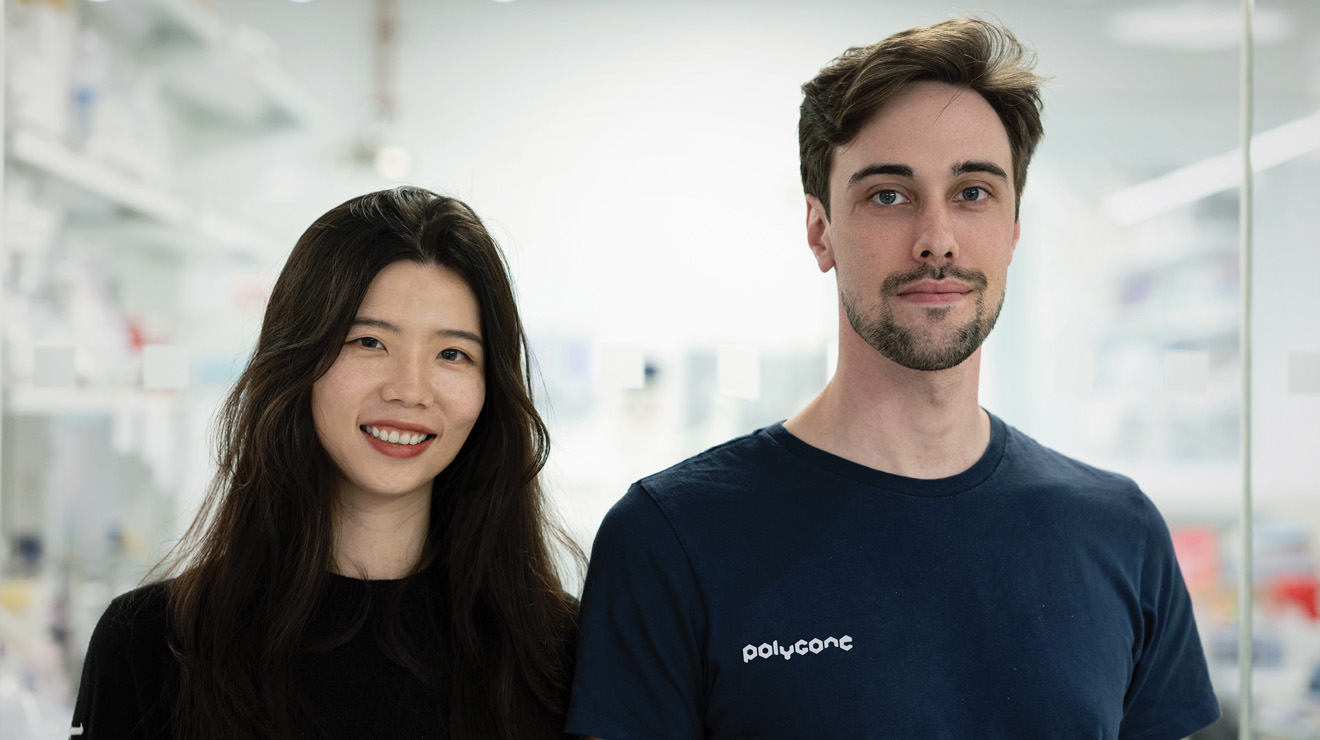
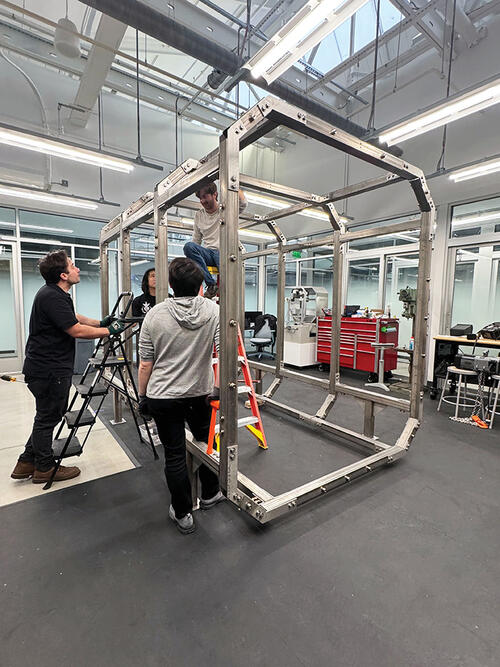
Based in Princeton since it launched in 2022, PolyGone Systems developed a floating filter that can capture most of the invisible tons of microplastics that stream into the world’s waterways every year. These miniscule particles, often invisible to the naked eye, can accumulate in huge amounts and have been found in both the stomachs of marine animals and the bloodstreams of human beings.
Concerns about microplastics have made a big splash in the news in recent years, but the full extent of its impact on human health is still being researched. That said, experts generally agree that solutions to remove and lessen exposure to microplastics are a positive step.
Liu outlines how PolyGone’s filter works: Made of thousands of silicone fibers, it traps small particles due to their hydrophobic properties, meaning the microplastics stick to the bristly brush-like filter.
Banks goes on to say that the filter allows wastewater systems to recover the collected plastics, separating them from the bristles. Since most plastic is either buoyant or lighter than water, they are usually found on the surface or in the first 30 centimeters of the water column, where PolyGone’s filter operates.
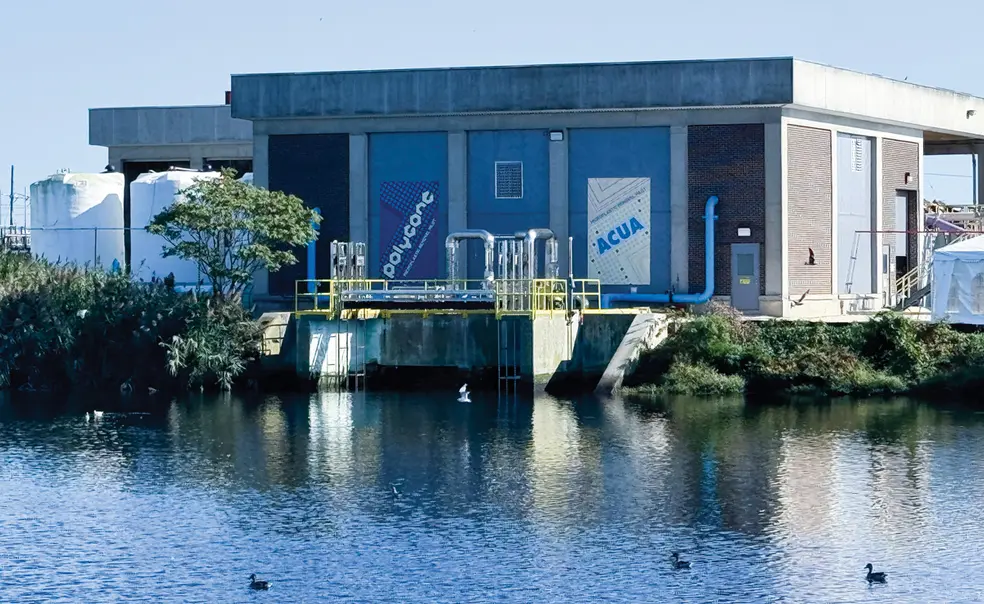
The company recently wrapped up a pilot with the Atlantic County Utilities Authority in New Jersey and will soon be working with utilities in California, as well as with major textile companies.
Liu says their filter is critical for both marine health and aquatic pollution prevention. “Since we collect 98% of the microplastics found in wastewater, we are reducing exposure to coastlines. The goal is to become the barrier in major emission points before the big flow goes into the ocean.”
Recognized for their social impact by Forbes in 2024, Liu and Banks bring a range of entrepreneurial skills to their startup. Banks says he’s more of the engineering specialist, while Liu leads the project management side of PolyGone.
Their individual paths run parallel to each other, in a symbiotic way. Liu grew up in Tianjin, China, and was consistently fascinated by architecture and environmental protection. Banks left London for Syracuse after also being enthralled by building design, so much so he delved deep into crafting a “bunch of larger-scale infrastructure projects that also started to integrate things like water and natural systems” during his undergrad years.
When they both went to Princeton, Liu and Banks first launched an idea called Project Plastic that served as the inspiration for PolyGone. After winning the People’s Choice Award at a Princeton Reunions pitch competition, PolyGone trained its vision on how to turn plastic waste found in rivers and oceans into building materials by melting them into panels.
Liu says as much as the company is focused on growth, they also want to educate the public about the scourge of microplastics. “We believe that talking about the problem is just as important as solving it, which is why we had a pavilion about PolyGone during our Atlantic City pilot project. There are so many great inventors in the world, but they are not all strong narrators.”
Banks echoes his colleague, saying, “The problem of microplastics pollution is going to require more than just technological solutions. It’s also going to require a huge amount of public and government and corporate engagement. It’s an issue you have to address from all angles. And once there’s a broad enough understanding of the problem, people will be more engaged to hopefully change their consumer habits.”
The Latest
See all


Related News

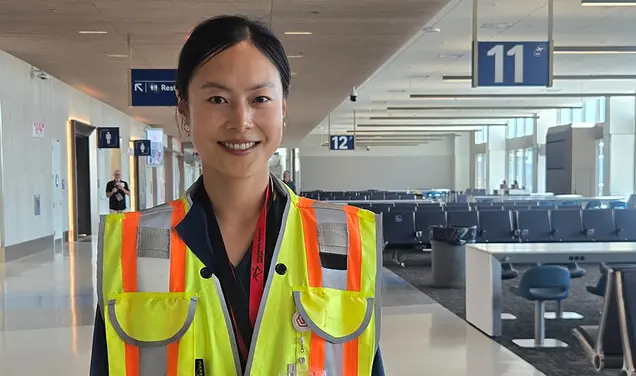
Janice Lee ’09 Worked to Renovate One of Hollywood’s Best-Kept Secrets
An engineer by training, Lee has been deputy project manager on the renovation of Hollywood Burbank Airport

1 Response
Rick Mott ’73
6 Months AgoScrutinizing Microplastics Concerns
PAW readers may not know that the Nihart et al. Nature Medicine paper about a year ago which made all the headlines about microplastics in the brain was followed up by a November 2025 “matters arising” response by an international group led by Fazel Monikh which very politely called BS on the methodology. In a nutshell the authors used pyrolysis gas chromatography and mass spectrometry (Py-GC-MS), which is notoriously finicky when applied to complex organic materials with significant amounts of long-chain fatty acids (like the brain) whose pyrolysis products can mimic polyethylene. I have no expertise in Py-GC-MS, but I spent a career in scientific instruments and watched as marketing pressure steered product development toward greater ease of use, which meant users did not need a deep specialized understanding of the technique to get results. I could tell some very funny horror stories about some of the questions we got from our users with odd results, but will refrain out respect for the guilty. Let’s just say extraordinary claims demand extraordinarily accurate evidence, and you can probably stop worrying now about having a head full of microplastic.