

Carey Jones ’08 Is Raising Money to Prevent Morning Sickness in Pregnancy
Jones kicked off her crowdfunding campaign with an article titled, ‘Let’s Fund the Damn Research Ourselves’
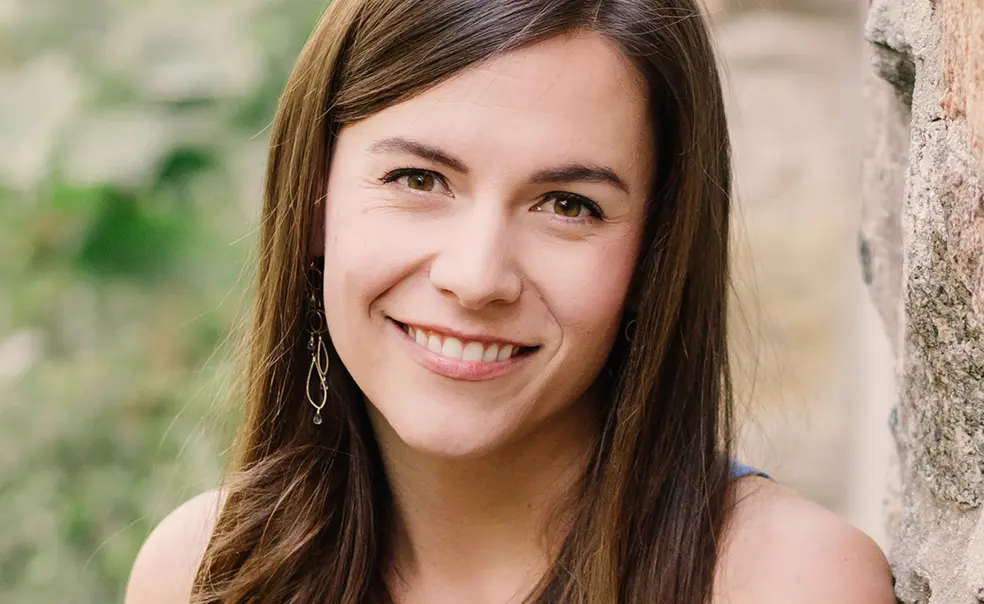

About a year ago, Carey Jones ’08 stumbled on a news nugget: A research project planned by Marlena Fejzo at the University of Southern California into a possible way to prevent severe vomiting during pregnancy couldn’t get funding.
Jones’ ears had pricked up the first time she heard of Fejzo’s work. She herself had suffered intense morning sickness during her two pregnancies, and while she didn’t have hyperemesis gravidarum — the most severe, diagnosable variety — she knew how dangerous it is, and how understudied.
Now, after 25 years of research including some major breakthroughs, Fejzo couldn’t get funding for a clinical trial — a casualty of the research world’s labyrinthine systems. And Jones, who is not a doctor or a researcher but a food and travel writer, decided to jump in.
The article she wrote launching a crowdfunding campaign was titled, “Let’s Fund the Damn Research Ourselves.” To date she’s raised $792,706 of the needed $1.3 million, enough for Fejzo to start the trial on faith that the rest will come.
“This is the only roadblock right now for this particular thing that has the potential to really improve the lives of women,” Jones says. “I’ve seen a lot of excitement from people wanting to be part of that.”
HG, as it’s known, can put pregnant women in the hospital; Kate Middleton, Britain’s Duchess of Cambridge, might be the best known example. It can also cause miscarriage, which is what happened to Fejzo 25 years ago, when she lost her baby at 15 weeks.
Yet like so many women’s health problems historically, severe vomiting during pregnancy often isn’t taken seriously. Jones, who described hers as “debilitating,” said she was shocked by how little help she got — mostly medications that put her to sleep when she was trying to care for a toddler, and lightweight suggestions like ginger tea.
“There’s a lot of condescension,” she says. “There’s a lot of like, ‘Oh, don’t worry your head, sweetie. It’s just one of those mysteries of life.’”
Fejzo previously found a genetic link for HG, and now she’s testing whether Metformin, a drug approved to treat Type 2 diabetes, could prevent predisposed women from experiencing it. The difficulty with funding stems largely from the nature of her research, Jones says: Because so few people study the same thing, she hits structural hurdles like a lack of subject-matter experts on funding panels.
Jones majored in English at Princeton. Initially she wanted to be a journalist, but when she graduated the internet was wreaking havoc on the field. “Everyone was getting fired,” she recalls. Eventually she landed at a website called Serious Eats, which got her into writing about food, travel, wine, and spirits — “a lot of the fluffier things in life,” she laughs. She’s written a few books, most recently Every Cocktail Has a Twist with her husband, who’s a mixologist himself. Their children are now 4 and 1.
Jones notes she’d love to connect with anyone in the Princeton community who has experience in women’s health research. “There’s no ego behind this,” she says. “I feel like I’m completely making it up as I go along, and would just so welcome any kind of collaboration, feedback, input from the brain trust of Princetonians.”
Carey Jones ’08 invites anyone interested to attend a webinar she’s hosting with Marlena Fejzo on Dec. 11. Sign up at this link.
The Latest
See all


Related News

With Prominent Journalists and Hoagies, the ‘Prince’ Celebrates 150 Years
A gala at the New York Historical raised roughly $400,000 for the independent student newspaper


2 Responses
Dorina Amendola ’02
9 Months AgoWomen’s Health Is Worth the Investment
Locomotives and brava for attention to women’s health that is actually about women’s health! In 2026 it is inexcusable that so many common conditions, afflictions, and deadly complications women and girls experience every day are still shrouded in mystery. “Women’s health” has been emptied of all meaning except to become a euphemism for abortion and other sexual-license issues, and a tool or even weapon to spread Western sexual ideologies across the world. Yet here we are still suffering from PCOS, endometriosis, debilitating menstrual and pre-menstrual issues, the host of pregnancy complications, “unexplainable” infertility … and no answers, nothing but the pill to mask symptoms and silence an aching body, and IVF to painfully impose fertility on a woman’s ailing system, rather than gaining any understanding of root causes and treating them.
The pill itself is fraught with miserable side effects and challenges that women are only now speaking up about, as they get “sick” of feeling like contraceptive guinea pigs to be sexually available at all times. Something called “restorative reproductive medicine” is gaining ground, but is continually bashed by mainstream medicine. Plus, fertility cycle tracking has made enormous advances past the old “rhythm method,” with some amazing apps available, yet is still treated as stone-age. Why can’t we learn to work with our bodies and their natural cycles respectfully, instead of treating our operating fertility as a disease and our very womanhood a liability?
Medical research on women is more complex than men. But aren’t we worth it? Again, kudos to Ms. Carey Jones ’08. May we see more funded research in women’s health!
Christel Chehoud ’11
9 Months AgoSupporting Research of Morning Sickness
Thank you for your support to research such an important, yet sadly overlooked, disease.