

Class Scribe Walter Lowrie 1890 and the ‘Highspot’ of Class Notes
Princetonians cherished an author’s shorter works — the witty dispatches of an octogenarian
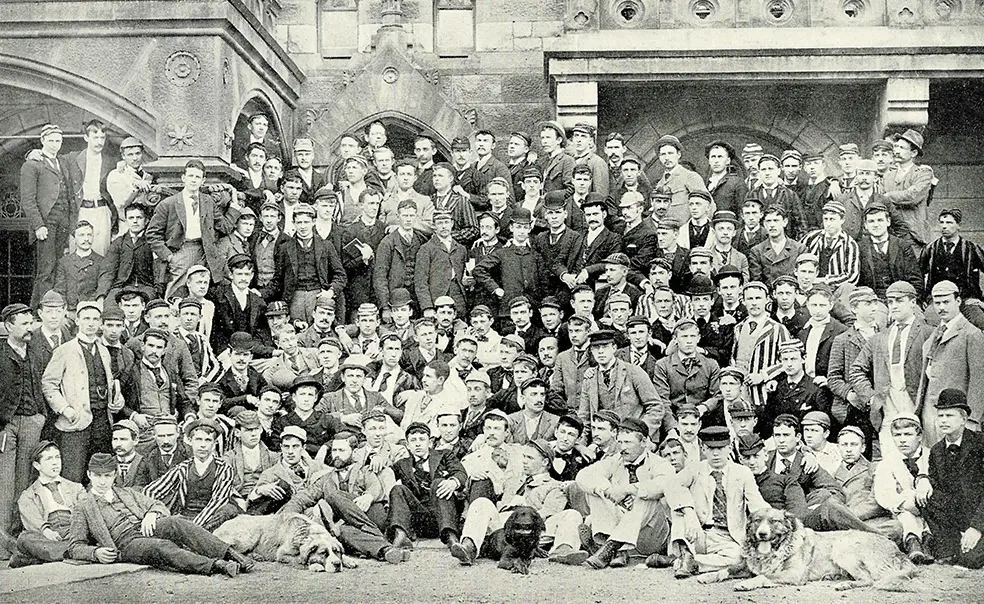

Walter Lowrie 1890 published 38 books and countless articles, but said when he was 89, “nothing I have ever written has brought me so much fan-mail as my Class Notes.” From 1954 to 1957, Lowrie turned the Class of 1890’s notes in Princeton Alumni Weekly into must-read updates about elderly alumni — a challenge, to be sure. “At our age, we are most profitably employed in doing nothing,” he quipped.
Lowrie brought unexpected whimsy even to the most mundane content, like factual corrections. When an extra zero appeared in a report about classmate William Conant’s donation, Lowrie wrote, “This blunder must be corrected; for, if Billy had been so rich as that … I am sure he would have been generous enough to share this great fortune with his friends … perhaps with me!” Mistaken news of a peer’s death was corrected with similar playfulness: “The victim himself was so glad to find himself alive that he wrote me a most amicable letter.”
In 1954, Lowrie listed each surviving class member. “In calling this roll of octogenarians approaching four score years and ten I conjure you all to tell me (if you are not too dilapidated to make any response) what tender memories of things past you still cherish, what bright hopes of things to come ... .” After hearing from only one, he complained: “But the rest of you who know my name and address write nothing. The absurd stories I invented about some of our dear classmates prompted no replies ... .”
Lowrie wrote about himself to fill the silence. “How can I help seeming egotistical, if nobody in the Class is willing to tell me what he is doing?” PAW readers learned about Lowrie’s 89th birthday celebration plans (“I take pride too in this editorial scoop”), why he still wore a coat older than he was (it was his grandfather’s), his thoughts on the campus (he suggested using Pyne Hall, then an administrative building, as a student refectory since it was too “beautiful” to devote to “all these bureaucracies”), and frustrations about the impossibility of his class achieving 100% participation in Annual Giving when he couldn’t bribe someone to donate because of a grudge still held over the demolition of East College in 1897.
Lowrie retired from writing Class Notes in 1957. Beyond Princeton, he remains best known for translating Søren Kierkegaard’s work. Alumni might most remember him instead for writing what President Harold Dodds *1914 described as “the highspot of all the class notes that ever were.”






No responses yet