

Mitch Daniels ’71 Recounts Career in Government, Business, and Higher Ed


The book: Impatience Is A Virtue (Lyons Press) documents the life and career of Mitch Daniels ’71, tracing his extraordinary path from the White House as the director of the U.S. Office of Management and Budget under President George W. Bush and the corporate world at Eli Lilly and Company to the Governor of Indiana and, most recently, the president of Purdue University. In this memoir, Daniels reflects on the leadership principles and lessons that shaped his work and approach to driving change. Drawing on experiences across the public, private, and nonprofit sectors and blending personal anecdotes with reflections on major moments in American history, from the Reagan era and September 11 to the COVID-19 pandemic and contemporary debates over free expression on college campuses, Impatience Is A Virtue offers a firsthand perspective on five decades of American life. Told with humility and humor, Daniels’ memoir recounts his unlikely journey from the grandson of a Syrian immigrant to a prominent American leader, while also considering the role of effective leadership and institutional trust in an increasingly polarized society.
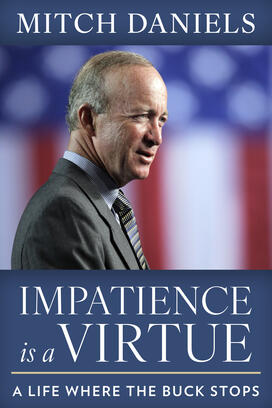
The author: Mitch Daniels ’71 graduated from Princeton in the SPIA Department and later received his J.D. from Georgetown University. He has had leadership positions in government, business, and higher education. He served as Indiana’s 49th governor from 2005 to 2013, director of the U.S. Office of Management and Budget under President George W. Bush, and president of Purdue University from 2013 to 2022. He is currently the interim president of Purdue University. He has also held senior positions at Eli Lilly and Company and served in the Reagan administration. Impatience Is A Virtue is his debut memoir.
Excerpt:
Preface
The Big Brush
Possessed as I am of absolutely no artistic talent, I believe I may have enjoyed Winston Churchill’s little book Painting as a Pastime even more than would an accomplished artist. Along with his instruction about the value of an absorbing, restorative diversion for a person with an all-consuming professional responsibility, Churchill urges the reader to overcome the natural reluctance to embark on a new hobby.
Churchill confesses his own original trepidation: “The empty brush hung poised, heavy with destiny, irresolute in the air. My hand seemed arrested by a silent veto.” That fairly describes the hesitation with which I have approached the notion of this literary venture. Months of dithering were complicated by the varying encouragement and conflicting advice of friends about the nature and purpose of any such book.
The threshold question was, did the world really need a book of mine? Or, I should say, another one? At this writing, Purdue University Press has just released a volume of speeches, columns, and interviews from my 10 years working for the university. Technically, this is the fourth book I have produced, which is arguably already more than anyone needs to hear from me.
But in fairness, three of those works were anthologies, collections of writings over a period of time, wrapped in my annotations but not written from scratch in one project. Over the years, I have turned out millions of words in print, but only once have I bitten off the daunting task of writing anything book-length from end to end. Thus I found myself, like Churchill paralyzed in front of his easel, dithering about whether and if so how to start.
Winston’s dilemma was solved by the wife of a friend, who lectured him “What are you hesitating about? Let me have a brush — the big one!” Under her intimidating gaze, he launched into what he quickly discovered was “the absolutely cowering canvas. Anyone could see that it could not hit back. No evil fate avenged the jaunty violence.”
It worked. “The canvas grinned in helplessness before me. The spell was
broken. The sickly inhibitions rolled away.” And so, shamed and bolstered by Churchill as he had been by Mrs. Lavery, I resolved to “fall upon my victim with Berserk fury.”
Of course, a crucial difference is that in this case the victim is not an inanimate canvas but the innocent acquirer of the account that follows, or as much of it as the reader decides is worth the effort. Still, I’ve persuaded myself that it is worth the attempt. The discipline, mental exertion, and hours of work ahead will be useful even if the eventual product proves not to be. The absence, for the first time in decades, of a 70- to 80-hour-per-week job brings an invitation to indolence which by one means or another I need to resist.
Deciding to undertake the endeavor left an equally vexing question: What kind of book ought I attempt? Two theories competed, in mind and in the counsel of those urging that I write one. My original thought had been to write a fairly light and lighthearted collection of the aphorisms, some original and some plagiarized, which I had come to employ and apply over the years of work in positions of large responsibility. I imagined illustrating mottoes like “Don’t let the ball play you” or “Speed of business, not the speed of government (or higher ed)” with examples from my various vocational lives. I could turn out such a product, under some whimsical title like Daniels’s Dicta, with relative ease.
But good friends and colleagues, hearing that concept, pressed me to go further. They noted that fortune had permitted me to work extensively in all three sectors of our society — the business, government, and nonprofit realms — and to know and work with an unusual assortment of noteworthy leaders in each. They asserted that there were stories to tell and lessons to share that could include but should go beyond a mere book of maxims.
So, Dear Victim, I must report that the memoir advocates won the day. After months of procrastination, I am launching myself on the task of recounting much of what, and whom, I have encountered on an unplanned path that lurched, abruptly and unexpectedly, from sector to sector, new life to new life.
As I find myself a distinctly uninteresting figure — conventional lifestyle, no intriguing hobbies, not well-traveled outside of business requirements — the reader will not be burdened with many personal revelations or excessive autobiographical detail. Besides, I have always looked askance at the contemporary tendency to wallow in introspection, constantly parsing one’s “feelings” and checking for treatable neuroses. I hope not to be callous, but such an outlook strikes me as self-absorbed and often self-limiting; I don’t anticipate spending many words here on personal matters or emotional self-analysis.
Rather, I’ll attempt to share some recollections, lessons, and observations about people and events I was lucky enough to see and know at close range. To offer some thoughts about the ways and means for translating good ideas, which are abundant, into tangible action, which is all too rare. And to submit, for what they are worth, my views on the ways a society conceived out of a reverence for individual dignity and autonomy can maintain those ideals against all the modern forces hostile to them.
With those goals in mind, I reach for the big brush.
Excerpted from Impatience Is a Virtue by Mitch Daniels. Copyright (c) 2026 by Mitchell E. Daniels, Jr. Used with permission of the publisher, Lyons Press (an Imprint of The Globe Pequot Publishing Group).
Reviews:
"[A] detailed account of an accomplished career that brought [author and former Indiana governor Mitch] Daniels to the brink of running for president . . . [includes] amusing anecdotes and lessons . . . a solid record of achievement." — The Wall Street Journal
“I know leadership when I see it, and I got to watch it closeup for more than a decade in Indiana. He’s still ‘My Gov Mitch’ in my book.” — Peyton Manning, former NFL quarterback for the Indianapolis Colts and the Denver Broncos
“Mitch Daniels has brought uncommon range and practical wisdom to every chapter of his career, with a track record of results. His insights on leadership and institutional change — shaped in part during his time at Lilly and across his work in public service and higher education — are timely and actionable.” — Dave Ricks, Chair and CEO of Eli Lilly and Company
The Latest
See all


Related News


Steve Shueh ’97 Brought Pro Hockey Back to Trenton
The minor league Ironhawks mark the latest chapter in Shueh’s community involvement

Princeton Pauses Orientation Overhaul but Promises Changes
Vice President for Campus Life W. Rochelle Calhoun promised further discussion

No responses yet