

Conservator Marco Grassi ’56 Gave New Life to Great Works of Art
July 7, 1934 — March 30, 2025

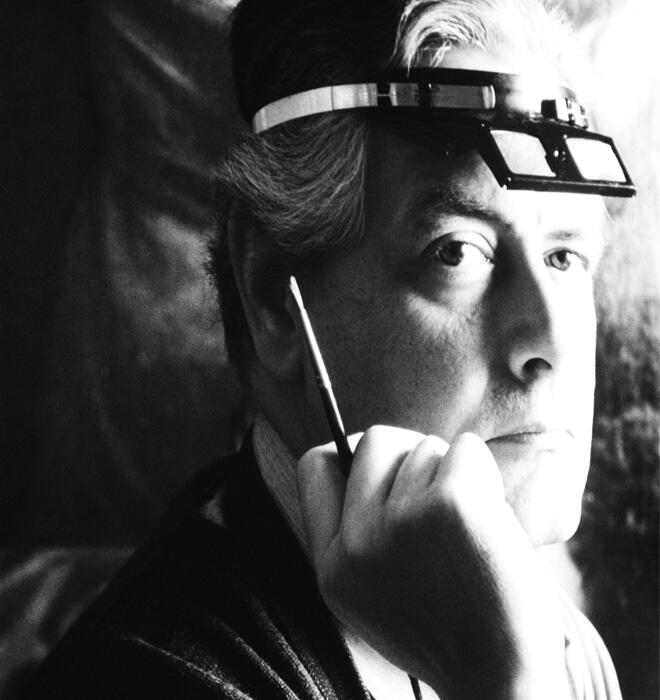
Marco Grassi ’56 spent his life in intimate contact with great art, as an admired restorer specializing in Old Masters, especially Italian painters of the 14th and 15th centuries. But he never aspired to make art of his own.
Artists “have to have a talent of creating. You paint a tree, but you have to find your tree,” says Cristina Sanpaolesi Grassi, Grassi’s wife of nearly 56 years, herself an artist who works in pastels. “Marco didn’t want to do this. Marco simply wanted to understand what the artist wanted.”
Grassi’s 60-year career took him from an ornate villa in Switzerland to a waterlogged church in Florence, Italy, to a sunny studio in Manhattan. His work required a scholar’s understanding of art history, a scientist’s familiarity with the properties of varnish and paint, and a monk’s calm patience.
The work “transported him back in time,” says his daughter, Irene Grassi Osborne. “He could sit at his easel for the whole day and be perfectly happy. And he just loved being surrounded by beautiful things.”
Grassi was born in Florence to an American mother and an Italian father who was a second-generation art dealer. After World War II, when Grassi was 11, the family moved to the United States. Grassi attended a Catholic boys’ boarding school in New Jersey and went on to Princeton, where he majored in art history and, despite speaking unaccented English, cut a memorably European figure.
“He was much more elegant than me and all my other roommates,” says John Doyle ’56, who roomed with Grassi in Holder Hall. “The rest of us wore khakis and blue button-down shirts, virtually a uniform, but he was much more formal.”
That sartorial taste persisted into adulthood: Grassi had many of his suits made by a Florentine tailor his family had long patronized. “He always loved black-tie, or even white-tie, parties, because it was his chance to dress up,” his daughter says.
After training in Italy and Switzerland, Grassi established a restoration studio in Florence where, through a mutual friend, he met Baron Hans Heinrich Thyssen-Bornemisza, a famed collector whose villa in Lugano, Switzerland, was filled with important works of European art. The baron asked Grassi to evaluate a Renaissance sculpture, which Grassi recognized instantly as a 19th-century copy.
Whether the request was genuine or a test of skill, it soon landed Grassi a plum appointment as Thyssen’s visiting conservator. Until the 1990s, when the collection moved into its own museum in Madrid, Grassi had “the pleasure of strolling at will, often entirely alone and undisturbed, through Thyssen’s incomparable anthology of European art,” he wrote in a 2018 essay for The New Criterion magazine. “After a year or two, I was on intimate terms with virtually every centimeter of those painted surfaces.”
Grassi was in Lugano in November 1966 when a devastating river flood threatened Florence’s priceless cultural heritage. The usual five-hour drive home took 12, but he arrived in time to help administer first aid to Vasari’s monumental Last Supper, which hung in the Santa Croce complex, in a room where water had risen to the ceiling.
Grassi met his Florentine wife when he bought a painting from her booth during a city antiques fair, and his deep affection for Florence never waned. But by the 1970s, Italian political instability persuaded him to move his freelance restoration business to New York, and for the next 50 years he divided his time between the two cities.
Near the end of his life, Grassi stopped working on important restoration projects — “his hands were not the same,” his wife says — but he continued to do small jobs for friends.
“In conservation, there is a kind of aesthetic democracy, kind of like a hospital,” Grassi once told an interviewer. “Everything gets the same basic treatment. Grandma’s portrait ... needs to be looked after just like a great painting.”
Deborah Yaffe is a freelance writer based in Princeton Junction, New Jersey.




No responses yet