

Andrew Jarecki ’85’s Prison Documentary Is Up for an Oscar
The Alabama Solution exposed abuses within the state’s prison system


About seven years ago, documentary filmmaker Andrew Jarecki ’85 went on an Alabama road trip with his teenage daughter Jeremy. They had both read Anthony Ray Hinton’s memoir about spending 28 years wrongfully imprisoned, The Sun Does Shine, and were inspired to meet Curtis Browder, the first Black prison chaplain in the state. That early curiosity evolved into his Oscar-nominated HBO documentary The Alabama Solution, co-directed with Charlotte Kaufmann. It’s a bruising exploration of abuses within the Alabama prison system told partly through contraband cell phone footage taken by the prisoners themselves.
“Compared to a lot of filmmakers, I’ve worked on a lot of things that have started as one thing and become another thing,” Jarecki says. His 2003 documentary, Capturing the Friedmans, formed an example of this unfolding process: His initial interviews with professional birthday party clown David Friedman evolved into an investigation of the entertainer’s disturbing family history. Then there was the wide arc of Jarecki’s investigations into Robert Durst, an enigmatic real estate scion accused of three murders. Jarecki’s drama 2010 film All Good Things, inspired by the Durst story, persuaded the real Durst to approach Jarecki for a documentary project that became HBO’s two-season true crime series The Jinx(2015–2024), in the course of which Durst confessed to the three murders on a hot mic.
Jarecki says that his approach of narrative flexibility, “the willingness to change the nature of a project by listening to the project,” started with his Princeton thesis, an adaptation of French playwright Alfred Jarry’s three surrealist Ubu plays. In one of his discussions with longtime English professor Alan Mokler MacVey about the production’s set design, his adviser encouraged him to cast aside logical considerations and go with his gut. “I found that extremely liberating, and it gave me a lot of confidence that I could follow my nose,” Jarecki says.
He followed the same intuitive process with The Alabama Solution. After Jarecki met with Browder in Alabama, the chaplain invited the filmmaker to volunteer at one of his revival meetings at a local prison, Easterling Correctional Facility, to which Jarecki brought a camera crew. When Jarecki’s team started asking too many questions, and several prisoners urged them to investigate the prison’s conditions, the prison officials threw them out. “Right after we leave is when we realize how urgent the story is,” Jarecki says. “Now we understand that this is a terrible human rights disaster going on in secret, that we feel like we need to tell that story, that the men inside strongly wanted us to tell the story.”
Denied permission to film within the prisons, Jarecki’s team relied on the initiative of activist prisoners who recorded videos of prison abuses with illicit cell phones. “The men are always in jeopardy, and for a long time before they ever met us,” Jarecki says. “It’s an example of incredible bravery that these guys are willing to take the risk of organizing a work strike, or a hunger strike, or talking to the media.”
In 2019, the Department of Justice concluded that the Alabama Department of Corrections had the highest prison murder rate in the U.S. Based on the documentarians’ investigation, the problems persist: More than 1,300 prisoners have died in the Alabama prison system since 2019, all while the system extracted $450 million in unpaid prison labor per year.
After the film’s Oscar nomination, Alabama Gov. Kay Ivey’s press secretary issued a statement asserting “there has never been an Alabama governor more dedicated to solving the longstanding challenges facing the system than Governor Ivey” and citing sentencing reforms, new corrections facilities, and recruitment of officers. Jarecki calls this “absolutely absurd” given the sobering statistics that have piled up during her tenure. “The people that have seen the film are now in a position to hold [Alabama leaders] accountable,” Jarecki says. “There are millions of people who’ve seen what’s really happening in this deadly prison system, the deadliest in the country and beyond.”
Watch the trailer for The Alabama Solution:
The Latest
See all


Related News
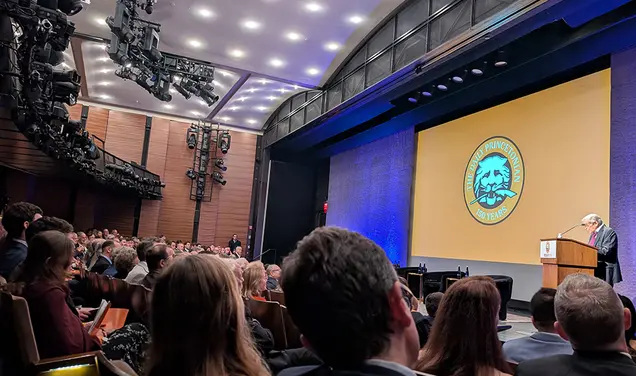
With Prominent Journalists and Hoagies, the ‘Prince’ Celebrates 150 Years
A gala at the New York Historical raised roughly $400,000 for the independent student newspaper

No responses yet