
One Exhibition, Decades of Donations, Centuries of History

An extra ration of liquor to be issued to every man tomorrow, to drink Perpetual Peace, Independence & Happiness to the United States of America. — Gen. George Washington, April 18, 1783
Given Reunions, princeton.edu, and Your Favorite Periodical, I find it difficult to believe you’ve not heard about the wonderful exhibition in Firestone’s Milberg Gallery until July 12: “Nursery of Rebellion”: Princeton and the American Revolution. (Why only until July 12? Don’t look at me — the important topic plus the effort involved by researchers, a significant number of students for credit, curators and brilliant designers seems to argue for a yearlong display rather than 14 weeks …) Fortunately, there is a well-presented online version for us in the boonies, but while it presents the various highlighted documents well, the atmospheric/tactile feel for the 250-year-old originals so beautifully displayed onsite cannot possibly carry through. It may very well be that this is the peculiar type of presentation that will demand a gallery encore in 10 years or so, then 10 or 20 years after that, and so on. Certainly a reminder of the ideas put forward in these iconic documents — and the chance to reflect on how we are or aren’t fulfilling them — is relevant in every decade, not just the current one.
End of sermon, commencement of credit roll. The library, much like the art museum, has seen over its lives a remarkable, and sometimes quirky, set of loyal groupies, some faculty, some alums, some merely “friends” in the parlance of philanthropy, whose zeal in creating better ways for the student body to study and create through the use of primary holdings (relics and documents) rivals any other institution on Earth. Over the years I’ve been a profligate beneficiary in writing columns deconstructing Princeton history and relating it to the world at large, and I’ve lost count of the times I’ve wanted to thank those whose toil and taste — through their donations of historical objects — have deepened our understanding of the world and allowed others to push the conceptual ball further down the field. So today we make up for that by thanking the legions of library donors, on the occasion of the Nursery exhibit which so dramatically shows the value of such effort. We don’t have space to thank every donor represented, but a selection of the more prominent will give you an idea of the work and hours given over many decades to get such an exhibit to the starting line.
Related coverage
250 Years Later and Counting
From a rare Dunlap Broadside to an original Constitution, Revolutionary history comes alive at the Princeton University Library
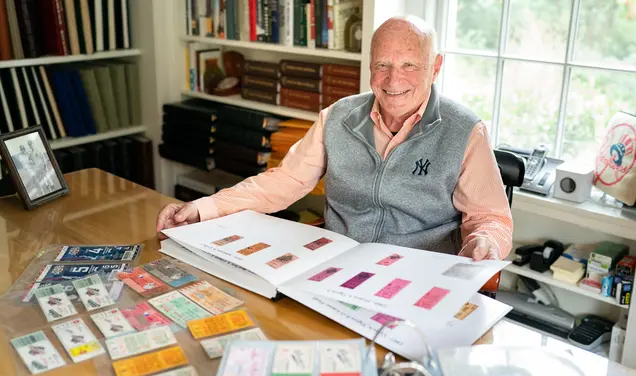
There are three principal collections at the heart of the exhibition. We should start with Sid Lapidus ’59, whose Collection on Liberty and the American Revolution at the Library now consists of hundreds of items focused on rights and liberties in the 18th century, precisely Nursery’s center. His entire collection is digitized and indexed and so provides the kind of landmark research opportunities that were literally impossible 20 years ago, on a crucial 18th century topic as current as yesterday’s headlines. Lapidus did not stop there; David Bell is now the Sidney and Ruth Lapidus Professor in the Era of North Atlantic Revolutions in the history department — endowing chairs is no minor matter. A partner for 40 years at Warburg Pincus, Lapidus has donated time and gifts widely beyond Princeton too, beginning with NYU and running off the page, and the chance to thank him publicly should never be missed.
The second collector whose holdings focused hugely on this era, Andre de Coppet 1915 — you’ll notice his name throughout the exhibit — was also a New York broker for 40 years and one of the premiere Americana collectors of his day, enabling a range of hundreds of original items at Princeton focused on the American Revolution, the Federal period and the Civil War.
The sheer number — and historical extent — of the other alumni represented in the exhibition is impossible to absorb as you walk through, so let’s assemble them by class year and just consider the breadth of intellect and generosity assembled to make this happen. The first group represents the McCosh administration and the arrival of Allan Marquand 1884, who created the art department from absolutely nothing, and it includes his classmate Patton Woods 1884. Rodman Wanamaker 1886 is a name for the Philadelphia crowd, the heir to the Wanamaker department store and a noted local and national philanthropist who even carved out the time to found the Professional Golfers’ Association. Junius Spencer Morgan II 1888 — yes, as in the nephew of J.P. Morgan — made his own fortune at Cuyler, Morgan & Co. and donated dozens of artworks both to Princeton and the Met in New York. Edward Duff Balkan 1897, coming from a wealthy Pittsburgh family, was basically a professional collector and, to furnish his second home in the Berkshires, essentially began the collection of American folk art as an organized field of study — his collection formed the core of a groundbreaking show at the Princeton University Art Museum in 1999.
The collecting of Revolutionary War artifacts represented in the exhibition continued through the twentieth century. One of Princeton’s most generous donors, tobacco baron Carl Otto Kretzschmar von Kienbusch 1906 is very appropriately present here; his donations covered a large expanse from angling and paintings to the very first endowment for women’s athletics at Princeton. Harry Crawford Black 1909, from a wealthy Baltimore family, was the chair of The Baltimore Sun, which he built into one of the preeminent newspapers in the country.
We arrive now at an alum whose presence here may be a bit surprising in one way, but never really unexpected anywhere. Dean Mathey 1912 is one of those few people whose direct influence on Princeton can be seen every day as you walk around. The director of the University’s investments for 34 years — and at one time or another a member of every standing committee on the Board of Trustees — he laid the financial groundwork to prevent collapse in the Depression and to create robust earnings after World War II. His artistic, creative side (e.g. the restoration of the entire town of Grafton, Vermont) was never far away, however, and in this instance from Mathey we see a magnificent donated painting of The Battle of Princeton by James Peale, a participant. J. Dennis Delafield ’57, a financier whose collecting and donation of a trove of rare documents which extend over the 18th and 19th centuries, is here as well.
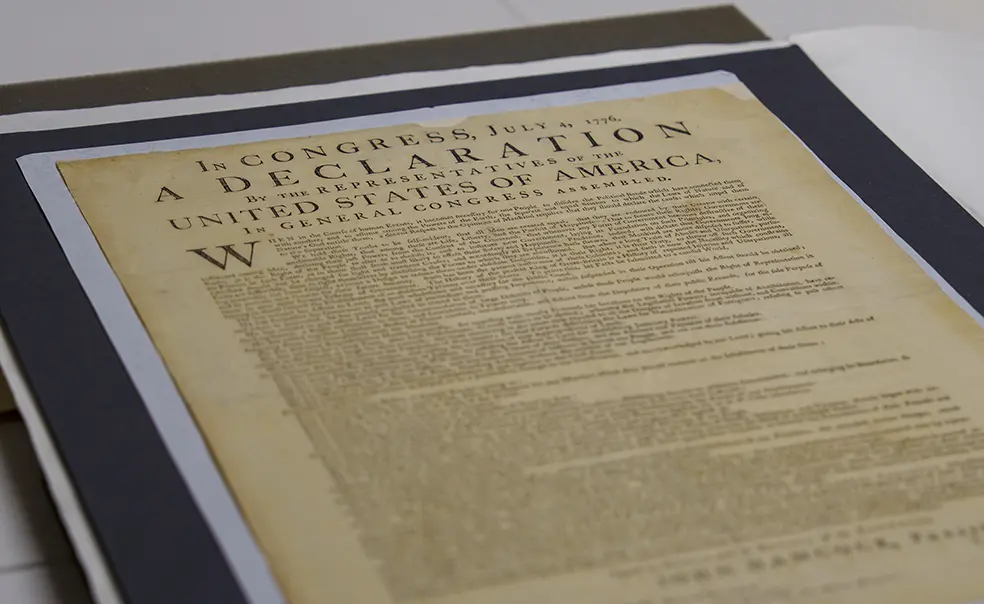
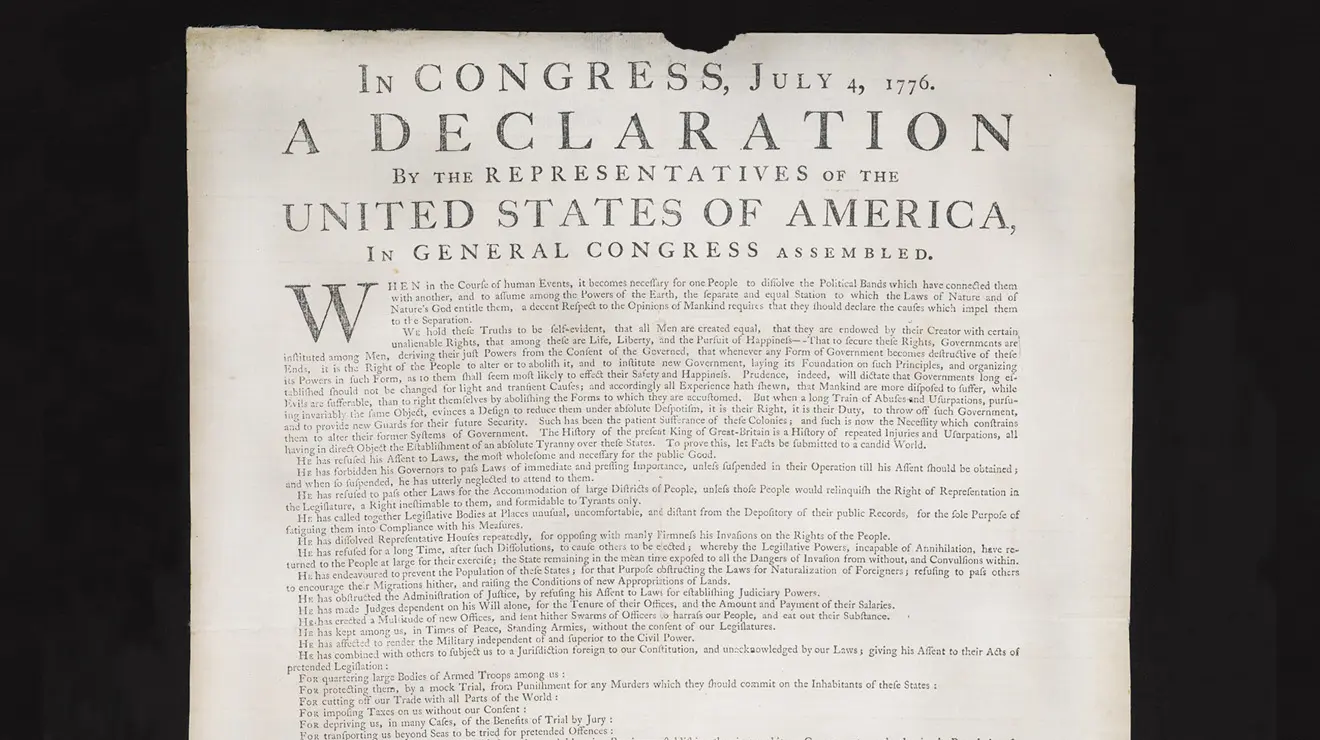
And finally, what of the third major collection represented? It’s a family story, beginning with William T. Scheide in the late 19th century. He was a key executive for John D. Rockefeller’s Standard Oil, who after reorganizing the company quit at 42 to “buy books and read them.” His path was followed by his son John H. Scheide 1896, and both made library donations to Princeton. John died six years following the Princeton graduation of William H. Scheide ’36, his son who thus became the shepherd of the Scheide Library that the family had already been assembling for a half century. In 1959, the Scheide Library, by now replete with Gutenberg bibles, sheafs of original Bach manuscripts, and the Dunlap printing of the Declaration of Independence you see in this exhibit, among much else, was duplicated inside of and moved to Firestone Library. It technically operated independently, but dozens of Princeton students and scholars were able to conduct groundbreaking research there as Bill Scheide continued to enhance the collection. Upon his death in 2015 at 100 years old, the Scheide Library became the largest donation in the history of Princeton; valued for estate purposes at something around $300 million; knowledgeable collectors all but giggled at the “low” number, regarding the true value of the collection as practically incalculable. And in conjunction with the Lapidus and de Coppet collections, the Scheide Library provides a base for this story of revolution and breathtaking intellectual advances in one of the very spots where that pivotal adventure took place.
By my count, there are 31 individual donors represented in the Nursery exhibition, all of whose concern for history, for wisdom, and for Princeton have been marshaled to bring this stunning display to all of us. We should also explicitly praise their spirit guides, the Friends of the Library, who for 95 years have acted as a goad and catalyst to a huge range of activities within and adjacent to the library. To describe the resulting exhibition as a teaching tool is something like describing Bill Scheide’s Gutenberg bibles as illustrated religious texts. In both cases, the accuracy of the description is undeniable, but the dramatic flowering of human imagination and potential they represent still spills out into our everyday lives and our highest aspirations after these many hundreds of years.
Dei sub numine viget.
The Latest
See all


Related News
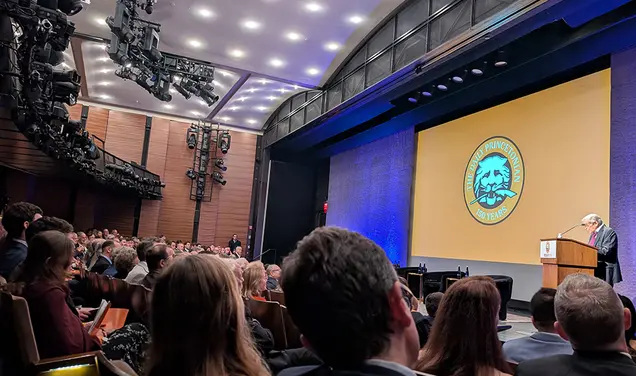
With Prominent Journalists and Hoagies, the ‘Prince’ Celebrates 150 Years
A gala at the New York Historical raised roughly $400,000 for the independent student newspaper


1 Response
Allen Scheuch ’76
4 Months AgoPrinceton’s Grand Tradition of Collecting and Preserving
Thank you, Gregg Lange ’70, for succinctly and fluidly encapsulating the much honored Princeton tradition of donating to the Princeton University Library and passing on through University-fashioned exhibits, publications, research and teaching, the awareness and appreciation of the riches the library holds and preserves. Truly, it is has been an Ivy League passion, shared across the country by other colleges, universities, libraries and museums; and it establishes our nation as a protector of history from around the globe. It’s thrilling to be able to feel the aura, know the impact of and see such documents first hand. For every von Kienbusch, Black, Crawford, Mathey, Taylor, Lapidus, Milberg and Scheide, there are thousands of Princetonians who have gone and are going to book shows and bookshops of all sizes and specialties, regularly scouring the listings in eBay and contents of catalogs, checking attics and basements for hidden, unnoticed gems. Princeton is fortunate to have an active cadre of Undergraduate Library Friends to continue the tradition as it evolves and every year the Elmer Adler cash prizes are awarded to three Princeton undergraduates and one Princeton graduate student for essays on the collecting of books and other objets. Those essays are some of the most riveting works by Princeton students that I have read. Perhaps one day a compilation will be published of selected essays from the long line of annual Adler competitions.