

Hana Miyamoto Mundiya ’20 Picked Up the Violin at 3, and Has Kept Playing
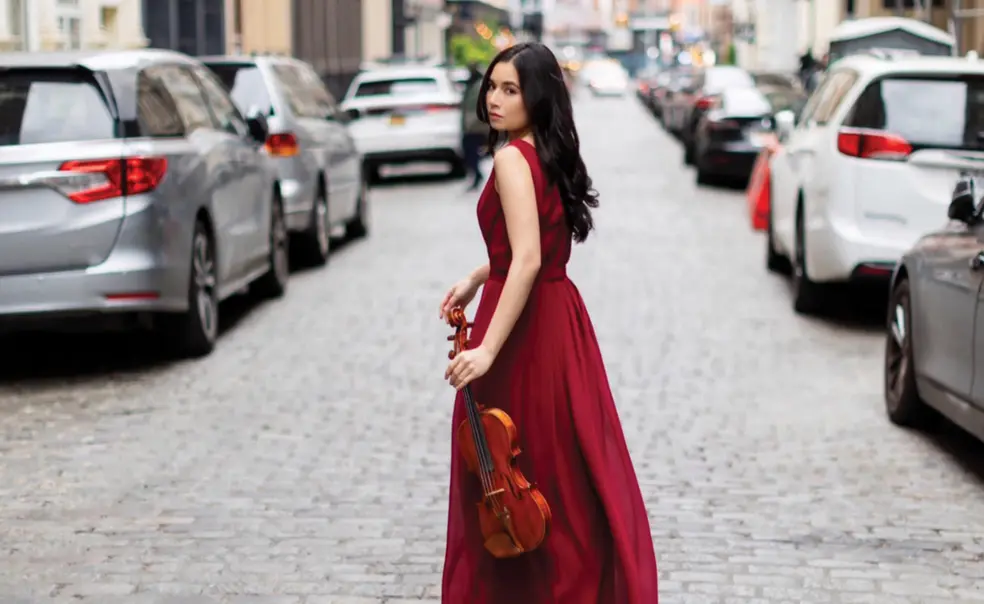

In the Mudd Manuscript Library at Princeton, there’s a news article about Hana Miyamoto Mundiya ’20 at age 11 and her brother Rohan, who was 9, playing their violins on stage during a benefit concert in New York City. The duo performed Bach’s “Concerto for Two Violins in D Minor” for that 2009 performance.
Though she began playing violin at 3, that was likely the starting point of Mundiya’s professional music career. Two years later, she made her solo debut with the New York Philharmonic at David Geffen Hall at Lincoln Center, at age 13. By 2018, she began performing alongside the prize-winning Swedish classical pianist Per Tengstrand at concerts in Princeton.
Born and raised in the SoHo neighborhood of New York, Mundiya’s impressive musical training accelerated during her four years at Princeton. She studied comparative literature, specializing in Japanese and French literature, and earned a certificate in musical performance. She was also active in Opus 21 (now Opus), Princeton’s student-led chamber music group, and served as the organization’s president.
“I believe that studying at Princeton broadened my view of the world and gave me perspective on time, and time management,” Mundiya said in a previous interview with Tengstrand about her choice to attend Princeton despite already being on track as a professional musician.
By graduation she’d achieved numerous honors including winning the Princeton University Concerto Competition, and prizes in the International Brahms Competition and the Aspen Music Festival Concerto Competition; played various benefit concerts including in schools and nursing homes; and had performed on many stages from New York to Sweden. She went on to receive a master’s in music from Juilliard and spent one term at the Royal College of Music.
In 2024, Tengstrand created the Princeton Chamber Music Series, now in its third year, and invited Mundiya to perform at the first concert in January of that year. The pair have played together many times through the years, and Mundiya is featured in Tengstrand’s two films, Beethoven — Freedom of the Will and Piano Rivals. Her memorable performance of Paganini’s “Caprice No. 24” in Piano Rivals received high praise. “She attacks the famously difficult piece without trepidation and plays it like it was Paganini himself … the octaves, thirds, and trills fly by in a breathtaking rendition, beautifully filmed in a red, fiery tone,” Tengstrand says.
Mundiya says she finds being able to meet local musicians and students is one of the great benefits of her frequent travels.
While in Sweden for a number of concert performances, Mundiya met Erik Rydvall, a composer of music specifically for the nyckelharpa, a keyed harp that resembles a violin, but larger. The two ended up having an impromptu jam-rendition of “Sonata for Two Violins in E Minor,” by Jean Marie Leclair.
“This kind of experience reminds me of why I play music,” Mundiya says.
In December, Mundiya performed at Carnegie Hall for a concert in celebration of World Arabic Language Day with the United Nations Chamber Music Society, of which she is a member. In July, she plans to return to Japan for several performances.
The Latest
See all


Related News

With Prominent Journalists and Hoagies, the ‘Prince’ Celebrates 150 Years
A gala at the New York Historical raised roughly $400,000 for the independent student newspaper


No responses yet