

David Feinman *62 Lived for Service, Travel, and Adventure
May 25, 1924 — June 27, 2025

In David Feinman *62’s telling of the story, the admiral leaned over the boat edge and asked Feinman if he’d like to serve in Antarctica. Feinman invoked his motto: “Service, travel, adventure.” The choice was easy.
A Navy commander, civil engineer, expert pistol shot, and lover of penguins, puzzles, and chocolate ice cream, Feinman lived many lives in his 101 years and touched many more. “He wouldn’t talk that much,” says Elizabeth (Feinman) London, the younger of his two daughters. “If he said something, it was like a pearl of wisdom.”
Growing up an only child in Philadelphia, Feinman enjoyed seeing musicals in New York with his mother. He joined the Navy at 18 — despite not knowing how to swim — and began a lifelong commitment to service around the world.
After attending Yale on the GI Bill, Feinman supervised public works in the Canal Zone and guarded the Panama Canal, where he learned to clear a pool table from his only company, a priest. After studying civil engineering at Rensselaer Polytechnic Institute, he helped with the construction of new air bases in the Pacific Northwest. In Newfoundland and Bermuda, he oversaw detachments of Seabees, the Navy’s Construction Battalions. In Morocco, he managed 40 construction projects and directed about 300 men. In 1959, his service — and engineering expertise — took him to the bottom of the Earth.
Over three summers, Feinman oversaw construction at McMurdo Station, the logistics hub for the U.S. Antarctic Program. The station opened in 1956 in anticipation of the International Geophysical Year, a global scientific cooperation that kicked off the Space Age. Penguins, seals, and skuas populate the area surrounding McMurdo, where temperatures drop as low as minus-58 degrees and snow piles meters high.
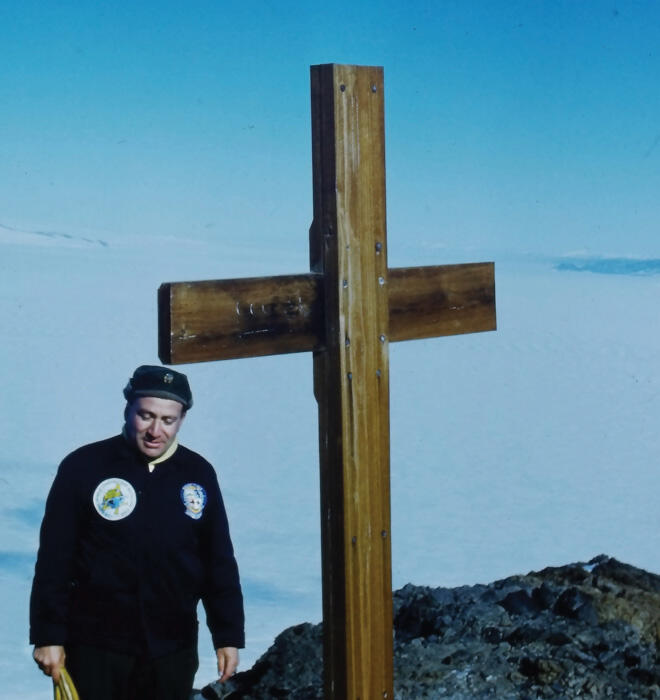
The weather made construction a challenge. The only civil engineer on staff at McMurdo, Feinman got creative, adapting traditional engineering techniques to the cold. He designed runways over icy surfaces and oversaw construction projects below the snow. In free moments, Feinman enjoyed taking color photographs of his surroundings. In an old picture, he wears a simple Navy peacoat, hammer in hand, his camera slung around his neck.
The Seabees in Antarctica had a motto: “Construction for peace.” Feinman advanced this mission, witnessing and informing key developments in international scientific collaboration. He planned construction at research facilities not only in the South Pole, but also in New Zealand. He collaborated with Russian exchange scientists and chose the site for the only nuclear power plant that ever operated in Antarctica. Penguins came to symbolize these laurels, and over time, Feinman amassed a trove of penguin-themed gifts and cards.
In 1962, Feinman pursued a master’s in civil engineering at Princeton, leaving the South Pole for good. “Once you smell the guano,” London recalls him saying, “you don’t need to go back.”
After graduating from Princeton, Feinman moved to London with his wife, Laura London Feinman, a mathematician. Abigail Stocks, who took after her father and became an engineer, was born soon after. Family was Feinman’s next adventure.
Feinman was as committed to family as he was to service. When his youngest, Elizabeth, was at summer camp, he sent her a piece of mail every day, whether it was a note or the comics she’d missed. He’d also fill out his favorite puzzles — quote acrostics — in pencil so he could erase the answers and leave hints for her.
These quiet acts of care defined Feinman’s character. He did the family’s taxes, and when two cousins became widows, Feinman managed their trusts. In 1967, he left the Navy to care for Laura, who died three years later of cancer. When his second wife, the prominent microbiologist Susan Ellmann Feinman, became sick with cancer, he assumed the same role.
Feinman’s joy, like his kindness, was unshakable. When London and her partner were caring for him during the COVID-19 shutdown, the trio developed the routine of singing show tunes, sometimes for hours, after dinner. Late in life, Feinman enjoyed watching the world go by from a chair outside, clad in a U.S. Navy hat, a penguin blanket on his lap.
Cecile McWilliams ’26 is a Spanish major from Austin, Texas.


No responses yet