
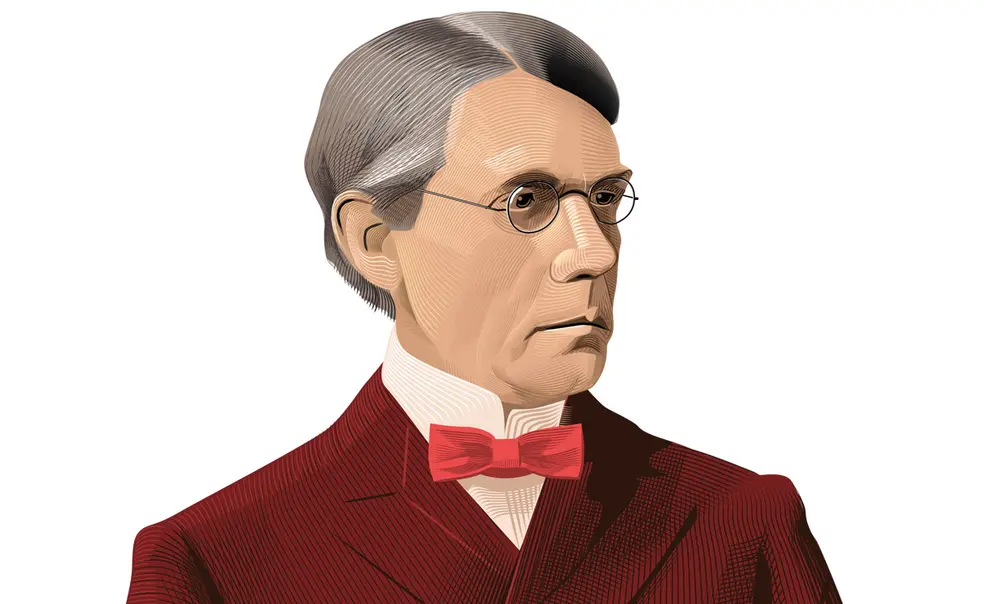
Francis Landey Patton Rode Off Into the Sunset Shortly After Wild West Riot

On May 15, 1899, the Wild West came to Princeton — at least, in the form of “Pawnee Bill’s Historic Wild West Show.” The show’s ringmaster, Major Gordon William Lillie, earned his “Pawnee Bill” nickname as a translator to Pawnee Native Americans while serving in the more famous wild west show organized by Buffalo Bill Cody. Lillie’s spinoff was a traveling circus of more than 1,000 performers; according to historian Jacob S. Dorman in his book The Princess and the Prophet, it included Mexican and Argentinian cowboys and members of the Cheyenne and Sioux peoples.
The circus planned to parade down Nassau Street in advance of its main show that evening. However, 700 Princeton students were ready to ambush them. At the time, Dorman explained, Princeton Township had an “unwritten law” forbidding touring parades, and the students intended to enforce this tradition. The disruption began with a bang, when a Princetonian tossed a firecracker beneath a wagon, causing the horses leading the wagon to take off in fear.
The disorder only escalated, with the students slinging eggs at the procession and the cowboys and Native Americans firing blanks into the crowd. “Some of the Mexican or South American cowboys unslung their bolas and used these with great effect,” The New York Times reported. Several students were injured in the mayhem; the cowboys, rushing the crowd on horseback, also trampled a Black laborer named Elwood Dillon, cracking his skull, though reports failed to elaborate on his fate.
As the dust settled, University President Francis Landey Patton was left with the unenviable task of restoring order. The Bermuda-born Presbyterian theologian gathered the student body for an emergency meeting at 5 p.m. “After gazing at them through his glasses,” Thomas Jefferson Wertenbaker wrote in his history of the University, “he rebuked them for their unprovoked attack on the circus and forbade them to attend the performance in the evening.”
However, the following day The Daily Princetonian played down the violence in an editorial, attributing the events to “horseplay” on the part of a few “practical jokers,” reflecting a student culture that was dangerously “virile” and unserious under the lax and permissive leadership of Patton, per Wertenbaker’s assessment.
An old-school religious scholar with a snarky attitude, Patton had always been an odd choice for president during a period when Princeton was transitioning from the classics-and-religion-based curriculum of the College of New Jersey to its 1896 rechristening as Princeton University, an institution where in addition to the humanities, students could pursue the sciences and soon, the trustees hoped, graduate study.
During Patton’s term, football had become a mania among the all-male student body, and the eating clubs had grown from a minor alternative to the campus refectory into a true social cartel, with new opulent mansions mushrooming on Prospect Avenue every year.
To his credit, Patton’s administration adopted Princeton’s famously rigorous Honor Code in 1893. Other attempts at reform were less successful. Though Patton tried to ban hazing on campus, students rebranded their practices as “mild hazing,” whatever that distinction meant.
Not helping was Patton’s lack of drive in having Princeton live up to its new “University” status, obstructing significant curriculum reform while being uninterested in maintaining academic standards. His nonchalant attitude toward his poor administrative abilities was summed up by his saying, “It is better to have come and loafed, than never to have come at all.”
For the group of faculty reformers, the 1899 Pawnee Bill incident was just another indicator of Princeton heading in the wrong direction, and by 1902 a contingent led by Woodrow Wilson 1879 and Graduate School Dean Andrew West 1874 conspired to remove Patton from office by taking over some of the president’s administrative responsibilities. Patton agreed to step down in exchange for a buyout of $31,500; the sum, adjusted for inflation, would be worth approximately $1 million today. Though Wilson was promptly elected to replace him, that same year Patton deftly pivoted into the presidency of the nearby Princeton Theological Seminary.
Upon Patton’s 1913 retirement from the seminary, ironically West, one of the architects of Patton’s downfall, presented the deposed president with an honorary doctorate. Patton lived out the rest of his days in Bermuda, his humor as sharp as ever. When asked if he had any connection with Princeton, Patton joked that yes, he was “president of Princeton University — once removed.”






1 Response
Jeffrey Marshall ’71
1 Week Ago‘Horseplay’ at a Wild West Show
Intriguing piece about the near-riot on campus with the arrival of Pawnee Bill’s Wild West Show in 1899, when students actively tried to sabotage the show. Pawnee Bill’s traveling circus was a pale shadow of Buffalo Bill’s Wild West Show, which I wrote about extensively in my novel, Little Miss Sure Shot, chronicling the life of Annie Oakley — the undisputed star of that show.
Buffalo Bill never played any college campuses that I know of — most of those shows, which were earlier, played in large arenas or playing fields, and in front of adoring crowds, not an army of collegians eager to wreak havoc. It wasn’t surprising to read that President Francis Patton, a stern Presbyterian, chewed the students out for their hijinks — or that The Daily Princetonian downplayed the violence, calling it “horseplay.” Well, according to contemporary accounts, there were a lot of horses.